Magahi Language: The Living Voice of Ancient Magadha
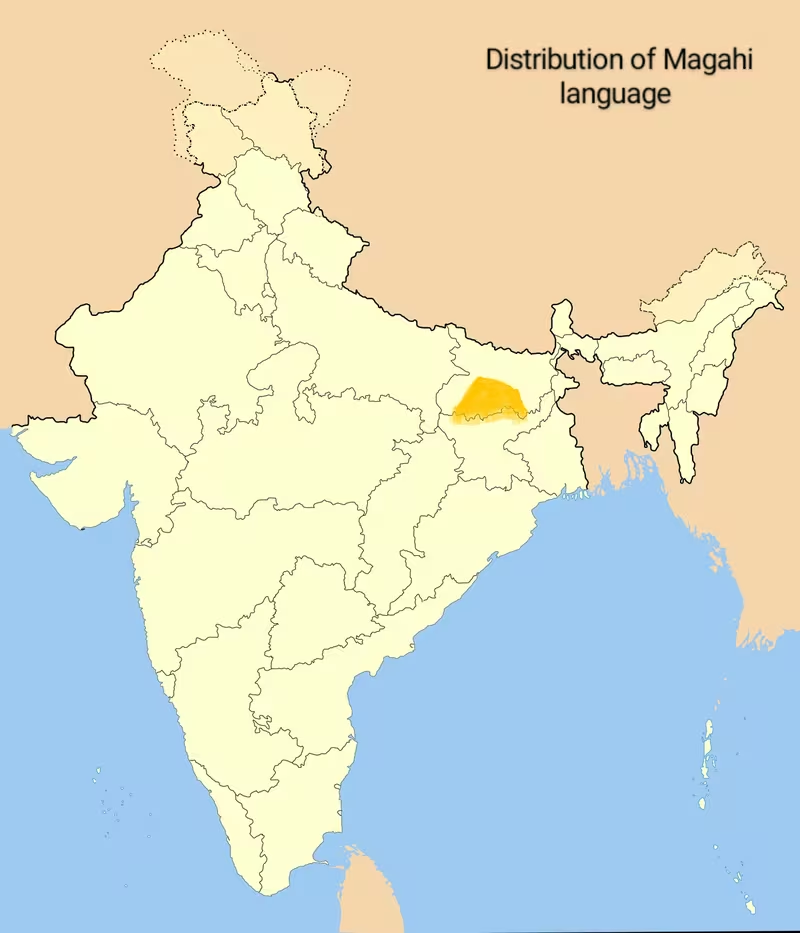
Magahi, also known as Magadhi, carries the name of the ancient kingdom of Magadha into the present. Its ancestor, Magadhi Prakrit, formed in the region south of the Ganges and east of the Son River, an area that became the historical core of Magadha. Today, Magahi is spoken across parts of Bihar and Jharkhand, as well as in West Bengal, Odisha, and Nepal’s Terai region. Approximately 12.7 million people speak the language.
The history of Magahi is closely connected with oral culture. Although it has no famous written literary tradition in the historical record described here, it possesses a rich body of folk songs, stories, ballads, and long epic poems. Strolling bards traditionally recite these poems, and folk singers perform ballads throughout the Magahi-speaking area. The language also preserves evidence of a long process of linguistic change, from Magadhi Prakrit through Apabhramsa and into modern regional speech.
Origins and Classification
Linguistic Family
Magahi belongs to the Indo-Aryan branch of the Indo-European language family. Linguists associate its development with Assamese, Bengali, Bhojpuri, Maithili, and Odia, which are described as sister dialects that originated from Magadhi Prakrit between the eighth and eleventh centuries.
Origins
Magadhi Prakrit developed in the ancient kingdom of Magadha. Its central area lay in what is now southern Bihar, south of the Ganges. Magahi later emerged from this older language, although the exact stages through which it took its current form remain unknown.
Name Etymology
The name Magahi derives directly from Magadhi. The older word also acquired a cultural meaning: because strolling bards traditionally performed long poems in the dialect, “Magadhi” came to mean “a bard.”
Historical Development
Magadhi Prakrit (8th–11th Centuries)
Magadhi Prakrit was the ancestor of Magahi. During this period, several related regional forms developed from it. Assamese, Bengali, Bhojpuri, Maithili, and Odia followed their own paths of growth and differentiation alongside Magahi.
Apabhramsa and Early Magadhi (12th Century)
By the end of the twelfth century, the development of Apabhramsa had reached its climax. A distinct form of Magadhi can be seen in the Dohakosha, associated with Sarahapa and Kauhapa. The precise moment when modern Magahi took shape is not certain.
Modern Period
Magahi experienced a setback during a transition in the administration of Magadha. In Bihar, Hindi displaced Urdu as the official language in 1881. After independence, the Bihar Official Language Act of 1950 gave Hindi sole official status, overlooking the state’s own languages. Magahi was legally absorbed under Hindi in the 1961 Census.
Scripts and Writing Systems
Devanagari
Devanagari is the most widely used script for Magahi in the present. It is the principal writing system associated with the language today.
Bengali, Odia, and Kaithi
Bengali and Odia scripts are also used in some regions where Magahi is spoken. Historically, Magahi used the Kaithi script. These script traditions reflect the language’s distribution across eastern India and its contact with neighboring regional cultures.
Geographic Distribution
Historical Core
Magahi is spoken in the area that formed the core of ancient Magadha. Its principal Bihar districts include Patna, Nalanda, Gaya, Jehanabad, Arwal, Aurangabad, Lakhisarai, Sheikhpura, and Nawada. It is bounded to the north by Maithili across the Ganges, to the west by Bhojpuri, and to the northeast by Angika.
Modern Distribution
Magahi is spoken in approximately twelve districts of Bihar and twelve districts of Jharkhand. In Jharkhand, its distribution includes Hazaribag, Palamu, Chatra, Koderma, Jamtara, Bokaro, Dhanbad, Giridih, Deoghar, Garhwa, and Latehar. It is also spoken in Malda district of West Bengal, parts of Odisha, and various districts of southeastern Nepal.
A blend of Magahi called Khortha is spoken by non-tribal populations in the North Chotanagpur division of Jharkhand.
Literary Heritage
Oral Literature
Magahi’s strongest literary tradition is oral. Folk singers perform numerous ballads, while strolling bards recite long epic poems known across much of northern India. Folk songs and stories remain central to the cultural identity of the Magahi-speaking region.
Written Literature
Historically, Magahi had no famous written literature. The Dohakosha, associated with Sarahapa and Kauhapa, is important as an early work in which a distinct shape of Magadhi can be observed.
Grammar and Phonology
Key Features
Magahi has several dialects and a number of verbal forms for each person. Its pronunciation is described as less broad than that of Maithili.
Sound System
The vowels /i/ and /u/ may be heard as lower [ɪ] and [ʊ] in shortened positions. The vowels /e/ and /o/ may be realised as lower [ɛ] and [ɔ] in more initial positions. The vowel /ə/ can also be heard as [ʌ] in more stressed positions.
Influence and Legacy
Related Languages
Magahi developed alongside Assamese, Bengali, Bhojpuri, Maithili, and Odia from Magadhi Prakrit. These languages are described as sister dialects whose forms differentiated and followed separate courses of development.
Cultural Impact
Magahi’s cultural legacy is especially visible in performance. Its folk singers and strolling bards preserve songs, stories, ballads, and epic poetry across the language’s broad regional area.
Modern Status
Current Speakers
Approximately 12.7 million people speak Magahi. In Bihar, however, Hindi is used for educational and official matters.
Official Recognition
Magahi has not been constitutionally recognised in India. Its legal absorption under Hindi in the 1961 Census and the official position of Hindi in Bihar have shaped its modern administrative status.
Conclusion
Magahi connects a living eastern Indian language with the historical world of Magadha and Magadhi Prakrit. Its precise development into its modern form cannot be fixed with certainty, but its broad linguistic history is clear: it emerged from Magadhi Prakrit, developed through the medieval period, and became one of the regional languages of Bihar, Jharkhand, neighboring eastern India, and southeastern Nepal. Its written traditions include Devanagari, Bengali, Odia, and the historically used Kaithi script. More importantly, Magahi’s heritage survives through performance—folk songs, ballads, stories, and epic poems recited by singers and bards. Despite its large speaking population, the language remains without constitutional recognition in India, making its oral culture especially significant to its continuing identity.