Mundari Language: A Munda Language of Eastern India
Mundari is spoken by Munda communities native to the Chota Nagpur Plateau and adjoining parts of eastern India. With over 1.5 million native speakers, it is one of the four major Munda languages, alongside Ho, Santali, and Bhumij. Its principal areas of use include districts of Jharkhand and Odisha, with significant speakers also found in West Bengal, Assam, and the northern Rangpur Division of Bangladesh. In Jharkhand, Mundari has been recognised as an additional official language since 2011.
The language belongs to the Munda branch of the Austroasiatic family. It is closely related to Ho and Santali, yet its sound system differs considerably from Indo-Aryan and Dravidian languages in the surrounding region. Mundari is agglutinative: grammatical relationships are expressed by adding multiple affixes to roots. Its lexical and grammatical structure has also attracted sustained debate. Earlier descriptions emphasised the flexibility of Mundari words, while later research argued that the language has distinct but exceptionally fluid categories such as nouns, verbs, and adjectives.
For much of its history, Mundari was transmitted orally. It is now written in Mundari Bani, an alphabet invented by Rohidas Singh Nag in the 1980s, as well as in Devanagari, Odia, Bengali, and Latin scripts. Its continuing use, official recognition, and vulnerability make Mundari important both as a living community language and as evidence for the study of Austroasiatic languages in South Asia.
Origins and Classification
Linguistic Family
Mundari is a Munda language within the Austroasiatic language family. It is closely related to Ho and Santali and, together with Bhumij, forms part of the group described as the four major Munda languages. The Munda languages are spoken in parts of eastern India, and their relationships are significant for research into the migration patterns of Austroasiatic speakers in South Asia.
Mundari is classified as an agglutinative language. In an agglutinative structure, multiple affixes can be attached to a root, with the resulting forms conveying grammatical relationships. Mundari's morphology is therefore one of the principal features that distinguishes it as a subject of linguistic study.
Origins
Mundari is associated with the Munda tribes native to the Chota Nagpur Plateau region. The available historical account does not assign the language a single founding date or identify a written ancestor. Instead, it describes a language historically transmitted through oral tradition and later documented by linguists and missionaries.
The language is spoken primarily in Jharkhand and Odisha, with additional communities in West Bengal, Assam, and Bangladesh. Mundari speakers are often bilingual in Hindi or in the local language of the state where they live. This multilingual setting forms part of the modern history of Mundari.
Name Etymology
The term Muɳɖa means “village headman” in Mundari. Neighbouring communities referred to the language as Muɳɖārī. Mundari speakers themselves use hoɽo dʒagar, meaning “human language,” and muɳɖa dʒagar, meaning “Munda language.”
The expression hoɽo dʒagar combines hoɽo, “man,” with dʒagar, “to speak” or “speech.” These terms show how the language is named both through its association with the Munda people and through the idea of human speech.
Historical Development
Oral Tradition
Before extensive written documentation, Mundari was maintained through oral transmission. The historical account does not identify an early manuscript tradition or a dated inscriptional record for the language. Its later written history therefore begins with linguistic documentation and printed materials rather than with a named ancient literary corpus.
Early Documentation (1871–1902)
Studies of Mundari began in the nineteenth century. Haldar's work dates from 1871, followed by J. C. Whitley's work in 1873 and Nottrott's in 1882. These early studies were mainly brief sketches and forms of documentation.
Whitley's A Mundári Primer, published in 1873, represents an early effort to provide structured written material for the language. Nottrott's Grammatik der Kolh-Sprache, published in 1882, belongs to the same period of early grammatical description.
Hoffmann's Projects (1903–1978)
In 1903, the German missionary and linguist John Hoffmann began two major projects: Mundari Grammar, produced between 1903 and 1905, and Encyclopaedia Mundarica, begun in 1903 and completed in 1978. The encyclopaedia was finished long after Hoffmann's death and published posthumously.
Hoffmann's work was influential not only because of its scale but also because of the questions it raised about Mundari grammar. He observed that Mundari lexemes did not appear to possess fixed lexical categories in the same way as words in many familiar grammatical descriptions. His analysis became an important point of reference for later research.
Modern Written Development
Mundari continued to be written in Devanagari, Odia, Bengali, and Latin systems. In the 1980s, Rohidas Singh Nag invented Mundari Bani specifically for writing Mundari. The script has since seen limited but increasing use in literature, education, and computing.
In 2011, the language gained additional official status in Jharkhand under the Jharkhand Official Language (Amendment) Act, 2011. This allowed Mundari to be used in administrative and cultural contexts alongside Hindi, the state's primary official language.
Scripts and Writing Systems
Mundari Bani
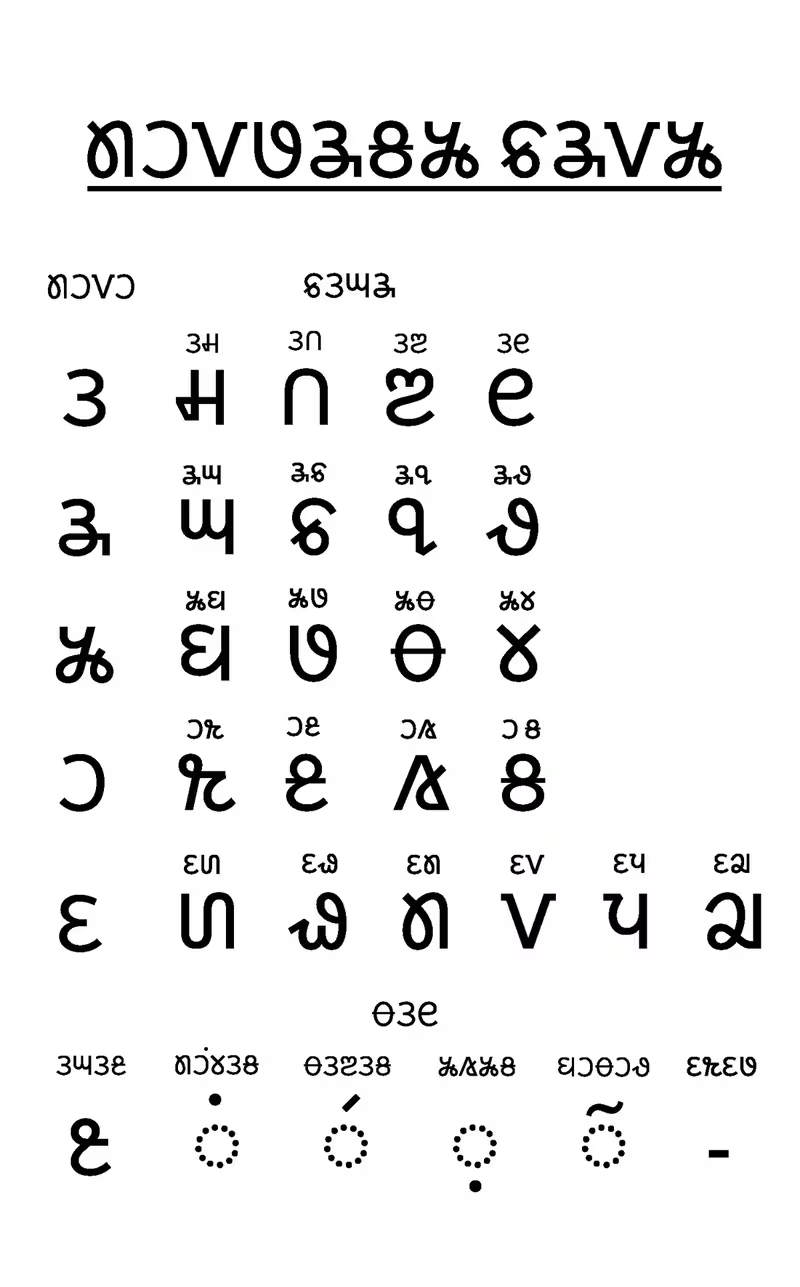
Mundari Bani is the native script most closely associated with modern written Mundari. Rohidas Singh Nag invented it in the 1980s specifically for the language. It is described as a true alphabet with 27 distinct letters and five diacritical marks.
The forms of the letters are intended to evoke natural shapes. The script is unicameral, meaning that it does not distinguish separate uppercase and lowercase forms. It is written from left to right, and its consonants do not carry an inherent vowel.
The letters are organised into five clusters, each led by a primary vowel. The first letter of a consonant's name matches the primary vowel of its cluster. The letter names follow traditional naming schemes. Mundari Bani has experienced limited but increasing use in literature, education, and computing.
Other Scripts
Mundari is also written in Devanagari, Odia, Bengali, and Latin writing systems. These scripts provide additional written channels for speakers in different linguistic and regional environments. The use of several scripts reflects the geographical distribution of Mundari across Jharkhand, Odisha, West Bengal, Assam, and neighbouring areas.
Script Evolution
The written history of Mundari moved from a predominantly oral tradition to documentation in the nineteenth century, major grammatical and encyclopedic projects in the early twentieth century, and the development of a dedicated script in the 1980s. Mundari Bani did not replace the other scripts used for the language; instead, it joined an existing multilingual writing environment.
Geographic Distribution
Historical Spread
Mundari is associated with the Munda communities of the Chota Nagpur Plateau. Its principal Indian distribution includes Jharkhand and Odisha. The language also has significant speakers in West Bengal and northern Rangpur Division of Bangladesh.
The language is spoken in the Jharkhand districts of Khunti, Ranchi, Seraikela Kharsawan, West Singhbhum, and East Singhbhum. In Odisha, it is spoken in Mayurbhanj, Kendujhar, and Sundargarh.
Dialect Areas
Mundari has several dialects spoken mostly in Jharkhand:
- Hasada is spoken east of the Ranchi–Chaibasa Road.
- Naguri is spoken west of the Ranchi–Chaibasa Road.
- Tamaria, also called Latar, is associated with the Panchpargana area, including Tamar, Bundu, Rahe, Sonahatu, and Silli.
- Kera is spoken by ethnic Oraon communities living in the Ranchi city area.
These dialects are especially important in grammatical research, because Hasada and Kera show different approaches to lexical flexibility.
Modern Distribution
At least 1.1 million people speak Mundari in the listed districts of Jharkhand and Odisha. A further 500,000 people, mainly in Odisha and Assam, are recorded in the census as speaking “Munda,” which may be another name for Mundari. Overall, the language has more than 1.5 million native speakers.
Literary and Documentary Heritage
Grammar and Reference Works
Mundari's documented heritage is particularly strong in grammar, vocabulary, and linguistic description. Hoffmann's Mundari Grammar and Encyclopaedia Mundarica are the central large-scale works associated with the early twentieth century. Earlier materials include Whitley's A Mundári Primer and Nottrott's grammatical work.
Other recorded materials include Four gospels in Mundari, published in 1881, and P. K. Mitra's Mundari Folk Tales, published in 1956. These works show that written Mundari has been used for religious translation, educational material, and the preservation of traditional narratives.
Oral and Written Tradition
Mundari was historically transmitted through oral tradition, and its written development did not eliminate this oral foundation. The language's folk tales, everyday speech, and community usage remain part of its cultural setting. Its later use in education, literature, and computing has expanded the contexts in which Mundari can appear in written form.
Grammar and Phonology
Lexical Categories
Mundari grammar has been the subject of an extended debate over lexical categories. Hoffmann described Mundari words as having considerable “vagueness” or “functional elasticity.” In his analysis, the same unchanged form could function as a conjunction, adjective, pronoun, adverb, verb, or noun depending on context.
Later scholars revisited this interpretation. Evans and Osada argued that Mundari has distinct but exceptionally fluid grammatical categories, including nouns, verbs, and adjectives. Their analysis considered semantic compositionality, bidirectionality, and exhaustiveness. The debate generated peer reviews and criticism in the same volume of Linguistic Typology.
Research has also identified expressives as a further open lexical class, with at least 1,500 lemmas. The status of this large lexical stratum has not featured fully in all word-class debates.
Dialectal Morphology
Hasada Mundari allows entity-denoting lexemes and noun-like, noun-phrase-like, and adjective-like structures to function as semantic bases of predicates without derivation. The resulting verbal meanings are often compositional, though some are idiosyncratic.
Kera Mundari does not permit the same degree of zero derivation. Nouns can be used as verbs with the sense of performing a semantic action when the verbalising suffix -o/-u is present. Mundari also has an infix -n- that can transform a verb root into an abstract inanimate noun stem that can no longer take verb inflection:
- dal “strike” → da-n-al “a blow”
- dub “sit” → du-n-ub “a meeting”
- ol “to write” → o-n-ol “the writing”
Sound System
Mundari has five vowel phonemes. All vowels have long and short as well as nasalised allophones, but vowel length and nasality are not contrastive. Vowels in open monosyllables are quantitatively longer than vowels in closed syllables. Vowels following nasal consonants or /ɟ/ are nasalised, and vowels preceding or following /ɳ/ are also nasalised.
The language has 23 basic consonant phonemes. The Naguri and Kera dialects include aspirated stops as additional phonemes. Mundari's consonant inventory resembles those of other Austroasiatic languages, although retroflex consonants appear to occur only in loanwords. Its phonology is consequently different from that of surrounding Indo-Aryan and Dravidian languages.
Influence and Legacy
Linguistic Relationships
Mundari is closely related to Ho and Santali and belongs to the wider Munda branch of Austroasiatic. Its structure offers evidence for comparison among Munda languages and contributes to wider research on Austroasiatic migration patterns in South Asia.
The language has significant contact with Hindi and with the local state languages of its speaking regions, since Mundari speakers are often bilingual. Its phonology is described as being considerably different from Indo-Aryan and Dravidian languages despite this regional multilingualism.
Cultural Impact
Mundari remains closely connected with Munda identity and community life. Its names for itself—hoɽo dʒagar and muɳɖa dʒagar—express the relationship between language, people, and speech. Its recognition as an additional official language in Jharkhand has extended its role into administrative and cultural contexts.
The creation of Mundari Bani also represents a significant cultural development. A script designed specifically for Mundari provides a distinct written identity while the language continues to use Devanagari, Odia, Bengali, and Latin systems.
Modern Status
Current Speakers
Mundari has over 1.5 million native speakers. At least 1.1 million are recorded in districts of Jharkhand and Odisha, while another 500,000 people, mainly in Odisha and Assam, are recorded under “Munda,” potentially another name for Mundari.
Mundari is classified as a vulnerable language in the UNESCO Atlas of the World's Languages in Danger. Although it remains widely spoken in its core regions, bilingualism in Hindi or local state languages is common.
Official Recognition
Jharkhand recognised Mundari as an additional official language in 2011. This status permits its use in administrative and cultural contexts alongside Hindi.
India also recognises Mundari as a significant minority language. Its official and minority-language status provides institutional recognition, while its continued use depends on speakers, families, communities, education, and written resources.
Preservation and Study
Mundari Bani has seen limited but increasing use in literature, education, and computing. Written materials, grammatical descriptions, folk narratives, and digital projects contribute to the language's modern visibility.
Mundari is also the subject of extensive linguistic study. Researchers have examined its phonology, dialects, morphology, expressive vocabulary, and lexical categories. Recent work has addressed syllable prominence, vowel structure, phonetic correlates, and methodological issues in studying Mundari expressives.
Learning and Study
Academic Study
Mundari studies began with nineteenth-century documentation by Haldar, Whitley, and Nottrott. John Hoffmann's work from 1903 onward established an especially influential foundation for grammatical and encyclopedic research.
Modern scholarship has focused on questions that extend beyond basic description. The flexibility of Mundari word classes has been discussed by Evans and Osada, Hengeveld and Rijkhoff, Peterson, Croft, and others. Research has also compared the Hasada and Kera dialects and examined the language's expressives as a possible open lexical class.
Resources
Available resources include Mundari Grammar, Encyclopaedia Mundarica, A Mundári Primer, Mundari Folk Tales, and the 1881 translation of the four gospels. Mundari Bani materials and digital archives further support the language's written and computational presence.
Conclusion
Mundari combines a strong community identity with a complex and actively studied linguistic structure. Spoken across Jharkhand, Odisha, West Bengal, Assam, and Bangladesh, it belongs to the Munda branch of the Austroasiatic family and remains closely related to Ho and Santali. Its agglutinative morphology, five-vowel system, dialect differences, and unusual flexibility in lexical categories have made it significant in linguistic research.
Its written history includes nineteenth-century documentation, Hoffmann's monumental grammatical and encyclopedic projects, and the later creation of Mundari Bani by Rohidas Singh Nag. At the same time, Mundari continues to be written in several regional scripts and used in literature, education, administration, and computing. Official recognition in Jharkhand supports its public role, while its UNESCO classification as vulnerable highlights the need for continued community use, documentation, and preservation.