Overview
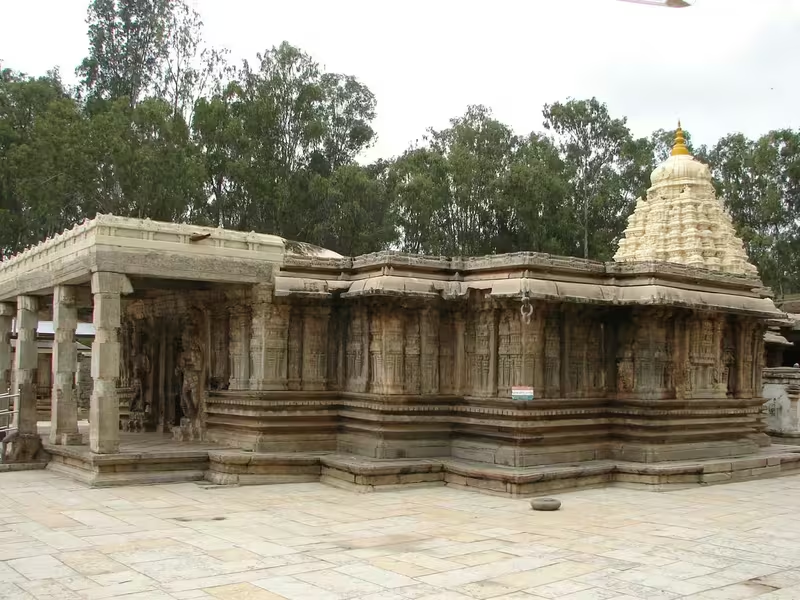
At Talakadu, the Kaveri turns eastward beside a broad spread of sand, covering the remains of a historic temple town. Located on the river’s left bank in Karnataka, about 45 kilometres from Mysore and 133 kilometres from Bangalore, the settlement is now known for pilgrimage, buried shrines and the surviving Vaidyanatheshwara temple.
Talakadu was once a political centre of the Western Ganga rulers. It later passed through Chola, Hoysala, Vijayanagar and Mysore spheres of power. Its history combines documented dynastic changes with enduring traditions, including the story of two forest-dwelling brothers and the celebrated curse associated with Rani Alamelamma.
Etymology and Names
The earliest authentic historical reference identifies the town as Talekad or Talakadu, with the Sanskrit form Dalavana-pura. A traditional account derives the name from two Kirāta twin brothers, Tala and Kādu. According to the story, they saw wild elephants worshipping a tree and cut it down. Inside, they discovered an image of Shiva; the elephants were believed to be rishis transformed into that form. When the tree was miraculously restored, all present attained moksha, and the place became Tala-kādu, later translated into Sanskrit as Dala-vana.
Two stone images said to represent Tala and Kādu are displayed before the Veerabhadra Swamy temple. Another tradition holds that Rama halted at the site during his expedition to Lanka. These accounts belong to the sacred traditions of Talakadu, while the town’s association with the Ganga dynasty provides its earliest historical setting.
Under Chola rule, Talakadu was renamed Rajarajapura. Across different periods, its name appears in several forms, including Talkad, Talakkadu and Thalakadu.
Geography and Location
Talakadu stands beside the Kaveri where the eastward-flowing river changes course and its banks widen into extensive sandy ground. This landscape shaped both the town’s religious identity and its physical history. Sand hills advanced over the old settlement, especially during the south-west monsoon, and residents repeatedly abandoned houses as the dunes pressed in from three sides.
The historic town is said to have been buried across a stretch nearly a mile long. In places, only the tops of two gopuras were visible. Yet the surrounding countryside remained productive. Wet cultivation supported the growing population through water supplied by the Madhavamantri anicut and channel.
Ancient History
Talakadu’s origin disappears into antiquity, but the earliest reliable historical reference connects it with the Western Ganga line of kings. An old chronicle associates Harivarma, assigned by historians to approximately 247–266 CE, with Skandapura, while describing him as residing in the great city of Dalavanapura in Karnata-desa.
Once Talakadu became the Ganga capital, the dynasty’s rulers and their successors were crowned there. This made the settlement more than a religious centre: it was also a seat of royal authority and ceremony. The evidence available for this early period does not establish a precise date for the town’s foundation, but it does place Talakadu within the political history of the early Ganga kingdom.
Historical Timeline
Ganga and Chola Rule
The Western Gangas made Talakadu their capital and coronation centre. At the beginning of the eleventh century CE, the dynasty succumbed to the Cholas, who captured the town and renamed it Rajarajapura. The change of name reflects Talakadu’s incorporation into a new political order.
Hoysala Period
About a century later, the Hoysala ruler Vishnuvardhana drove the Cholas from Mysore and took Talakadu. During the Hoysala period, Talakadu consisted of seven towns and five mathas, suggesting a substantial settlement with several religious and urban units.
Vishnuvardhana is also associated with major Hoysala architectural activity elsewhere. He built the impressive Vijayanarayana Chennakesava temple at Belur. Talakadu’s Hoysala-era importance forms part of this wider period of dynastic expansion and temple building.
Vijayanagar and Mysore Rule
Until the middle of the fourteenth century, Talakadu remained in Hoysala possession. It then passed to a feudatory of the Vijayanagar sovereigns. This ruling line appears to have been known as that of Soma-Raja.
In 1610, Raja Wodeyar of Mysore conquered Talakadu amid a transfer of authority at Srirangapatna. The event became inseparable from the legend of Rani Alamelamma and the curse of Talakadu.
The Curse of Talakadu
Tirumala-Raja, also called Sri Ranga Raya in the tradition, came to Talakadu to offer sacrifices at the Vaidyanatheshwara temple while suffering from an incurable illness. His second wife, Rani Alamelamma, remained in charge of the government at Srirangapatna. Hearing that her husband was near death, she travelled to Talakadu to see him and handed Srirangapatna and its dependencies to Raja Wodeyar.
The account states that Raja Wodeyar wanted the jewels belonging to the queen. Unable to obtain them, and seeking a pretext for action, he advanced against her with an army. Alamelamma went to the Kaveri and threw the jewels into the river before drowning herself opposite Malingi. She is said to have pronounced a threefold curse:
“Let Talakadu become sand; let Malingi become a whirlpool; let the Mysore Rajas fail to beget heirs.”
In Kannada, the saying is remembered as:
Talakādu maralāgi, Mālingi maduvāgi, Mysūru dhorege makkalāgade hōgali!
The curse remains a powerful part of Talakadu’s cultural memory. The advance of sand and the succession concerns of the Mysore royal family have often been interpreted through this story, although the legend and the physical processes affecting the riverbank belong to different kinds of historical evidence.
Religious and Cultural Importance
Talakadu is a popular Hindu pilgrimage site. Its temples stand in a distinctive setting where river, sand and sacred architecture overlap. More than thirty temples are believed to lie beneath the dunes. The Vaidyanatheshwara temple is the most imposing shrine still uncovered, while the Kirtinarayana temple has been successfully excavated.
The town also preserves epigraphic evidence. Four fragmentary records were found on the outer walls of the Pataleshvara temple. One is an old Kannada inscription from the Ganga period, while the others are in Tamil, reflecting the different political influences that reached Talakadu.
Monuments and Architecture
Two temples, Anandeshvara and Gaurisankara, were unearthed in the early nineteenth century. Anandeshvara is attributed to Chidanandaswami, described as a contemporary of Haidar. A local story says that the swami once crossed the Kaveri in full flood while seated on a plantain leaf. Haidar witnessed the feat, honoured him and granted land for the temple.
A Kannada inscription at the Gaurisankara temple attributes its construction to the reign of Chikka-Deva-Raja-Wodeyar, who ruled Mysore from 1672 to 1704. Together, these temples show that Talakadu’s sacred landscape continued to develop after its major medieval dynastic transitions.
Decline and Revival
Talakadu’s partial burial did not erase its importance. Sand repeatedly forced inhabitants to move inland, but fertile cultivation helped the town’s population increase. Excavation has recovered some shrines, while others remain beneath the sand. This combination of loss, survival and archaeological recovery defines the town’s modern heritage.
Talakadu Today
Talakadu remains a small pilgrimage and heritage town on the Kaveri. Visitors come for its temples, river setting and unusual buried landscape. In recent years, the wider Kaveri Valley has also been associated with horticulture, wine making, pesticide-free produce, artisan cheese and culinary activity. These newer economic interests exist alongside the older religious and agricultural life of the settlement.
Timeline
Early Ganga Association
An old chronicle connects Harivarma with Dalavanapura, the Sanskrit name associated with Talakadu.
Chola Conquest
The Cholas capture Talakadu and rename it Rajarajapura.
Hoysala Expansion
Vishnuvardhana takes Talakadu after driving the Cholas from Mysore.
Vijayanagar Feudatory Rule
Talakadu passes to a feudatory line linked with the Vijayanagar sovereigns.
Mysore Conquest
Raja Wodeyar conquers Talakadu amid the events associated with Alamelamma’s curse.
Gaurisankara Temple
An inscription attributes the temple’s construction to the reign of Chikka-Deva-Raja-Wodeyar.