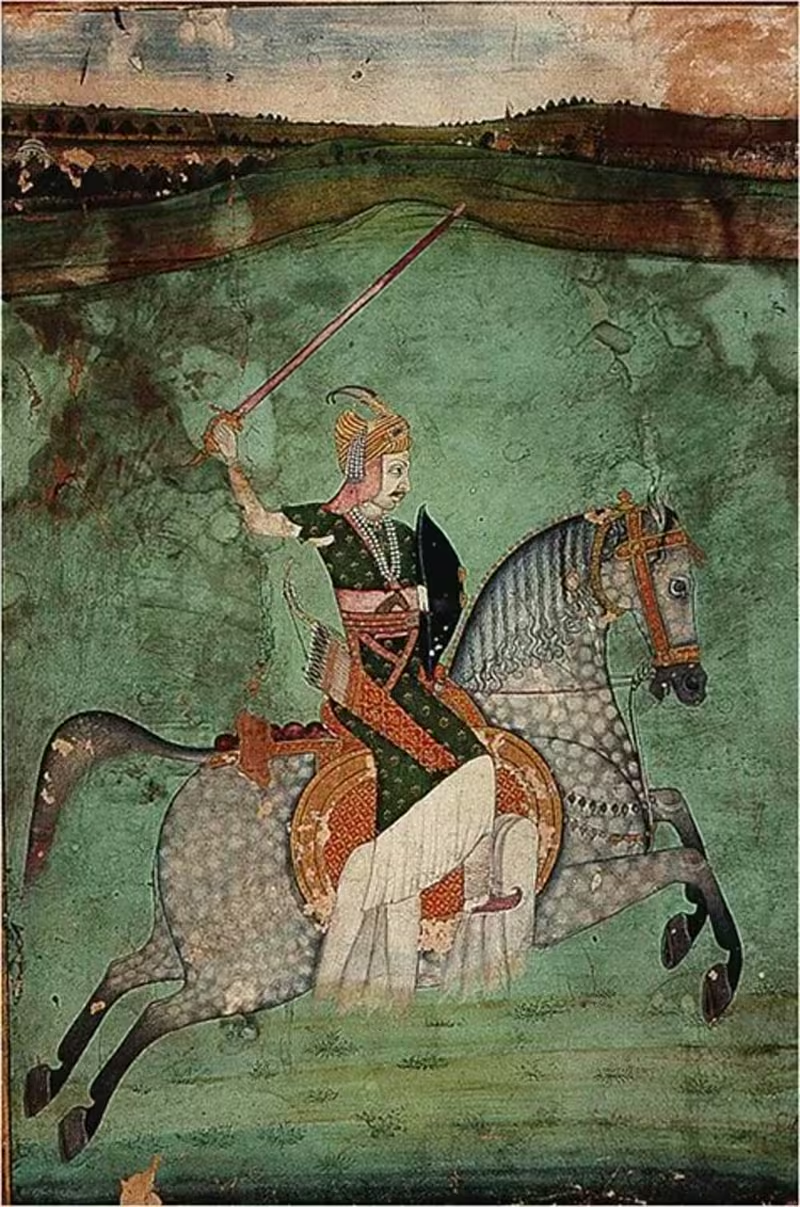

The Thunder from the Deccan: Bajirao's 600-Mile Lightning Strike on Delhi
The year 1737 marked the zenith of one man's extraordinary military career—a campaign so audacious that it would echo through the corridors of Indian history for centuries. Bajirao I, the 7th Peshwa of the Maratha Empire, was about to undertake a march that would redefine the very concept of cavalry warfare in the subcontinent.
The Bold Decision
In the grand durbar hall of his residence in Pune, Bajirao stood before his assembled commanders. At thirty-seven, he had never tasted defeat in battle. His reputation preceded him like thunder before a monsoon storm. But what he proposed now made even his most seasoned warriors draw sharp breaths.
"The Mughal Empire is a withering tree," Bajirao declared, his voice carrying the weight of absolute conviction. "We have been nibbling at its branches—Gujarat, Malwa, the Deccan. But a dying tree must be struck at its roots."
He had witnessed the empire's decay firsthand. In 1719, as a young man of nineteen, Bajirao had accompanied his father Balaji Vishwanath on an expedition to Delhi. He had seen the weakness behind the Mughal facade, the crumbling infrastructure of an empire that had once seemed invincible. Now, eighteen years later, that decay had only deepened.
According to Wikipedia, Bajirao "was convinced the Mughal Empire was disintegrating and would be unable to resist northward Maratha expansion." The Battle of Delhi in 1737 would mark "the pinnacle of his military career."
Young commanders like Malhar Rao Holkar and Ranoji Shinde leaned forward, studying the maps spread before them. Six hundred miles separated Pune from Delhi—a distance that conventional armies might cover in three months, if they were fortunate. Bajirao's finger traced a direct route northward.
"We will be there in thirty days," he announced.
The silence that followed was profound.
The Cavalry Assembles
As dawn broke over Shaniwar Wada—the magnificent palace Bajirao had begun constructing in 1730—the courtyard filled with the sound of thousands of hooves striking stone. This would be no ordinary campaign.
Bajirao had spent his entire life preparing for moments like this. Born into the Bhat family in Sinnar, he had been raised not just in Sanskrit scriptures but in the saddle. While other Brahmin boys remained confined to their books, young Visaji (as he was born) had accompanied his father on military campaigns, learning the art of war through direct experience.
Now, that lifetime of preparation manifested in every detail of his planning. He selected only the finest cavalry—men who could ride hard and fight harder, warriors who trusted their Peshwa with their lives. Each soldier was instructed to bring minimal baggage. Speed would be their greatest weapon.
"We will move faster than any messenger," Bajirao told his assembled force. "Faster than rumor itself. Delhi will not know we are coming until we appear at their gates like a thunderbolt from a clear sky."
The horses were the best the Maratha Empire could provide—sturdy animals bred for endurance, capable of maintaining punishing paces across varied terrain. Arrangements had been made with villages along the route for fresh mounts, allowing the cavalry to maintain their unprecedented speed.
Bajirao's first wife, Kashibai, watched from the palace windows as her husband prepared to depart. Their relationship was one of mutual respect and affection—she understood the weight of duty that drove him. Their eldest son, Balaji, would one day inherit his father's position, but first, the father had to secure the future.
The Relentless March
The Maratha cavalry moved like a force of nature across the Indian landscape. Twenty miles per day—an extraordinary pace for such a large force. Bajirao drove his men with relentless determination, but he drove himself harder still.
They crossed rivers and plains, navigating through territories that Bajirao had secured through previous campaigns. His victories at Palkheda against the Nizam, at Dabhoi against the rebel Trimbak Rao Dabhade, and most recently at Bhopal against the combined forces of the Mughal-Nizam-Nawab of Awadh alliance—all these triumphs had paved the way for this audacious thrust northward.
The young Peshwa who had been appointed at age twenty, despite opposition from other chieftains, had proven his doubters catastrophically wrong. Now thirty-seven, he commanded not just through hereditary right but through demonstrated genius.
Villagers who witnessed the cavalry's passage spoke of it in hushed, amazed tones. The column stretched for miles, a river of horses and men flowing northward with inexorable purpose. Dust clouds marked their progress, visible from great distances, yet by the time word could spread, they had already moved beyond reach.
Bajirao himself seemed tireless. He slept in the saddle when necessary, changed horses multiple times daily, and maintained absolute secrecy about their ultimate destination. Some thought they marched to Malwa, others to Rajputana. None guessed the truth until it was far too late.
The discipline was extraordinary. No looting, no delays, no distractions. Every village that provided fresh horses and provisions was paid fairly. This was not a raid—it was a calculated demonstration of power, and Bajirao intended it to be executed with precision.
Arrival at Delhi's Gates
On the thirtieth day, as morning mist still clung to the ground, the impossible became real.
Maratha cavalry emerged from the haze before the gates of Delhi itself. The Red Fort, symbol of Mughal power, loomed against the dawn sky. Guards on the walls rubbed their eyes in disbelief. This could not be happening. The Marathas were in the Deccan, in Malwa—anywhere but here.
Yet here they were.
Bajirao sat astride his horse, surveying the capital of the empire that had once ruled from Kabul to Bengal. He had covered six hundred miles in thirty days—a feat that would be discussed in military academies for centuries to come. No messenger had outpaced them. No warning had preceded them. They had moved with the speed of legend.
The Maratha flags unfurled in the morning breeze, their saffron colors a stark declaration that the old order had changed irrevocably.
The Emperor's Shock
Inside the Mughal court, Emperor Muhammad Shah received the news with a mixture of disbelief and alarm. The Marathas? At Delhi? How?
Courtiers who had spent decades dismissing the Marathas as upstart rebels from the Deccan suddenly understood the magnitude of their miscalculation. The empire that Aurangzeb had stretched to its breaking point was now revealed as hollow, incapable of defending even its own capital.
Messengers had been dispatched, of course, when Bajirao's force had been spotted days earlier in Rajputana. But they had arrived only hours before the Marathas themselves. There had been no time to assemble defenses, no opportunity to call in reinforcements from distant provinces.
The Peshwa had demonstrated, with brutal clarity, that the Mughal Empire could no longer protect its heart. The psychological impact was devastating. If Delhi itself was vulnerable, what territory remained secure?
The Strategic Victory
Bajirao had no intention of besieging Delhi or attempting to hold it. That was never the point. From his vantage point on the hills overlooking the sprawling capital, he had already achieved his objective.
He had proven that Maratha cavalry could strike anywhere, anytime, with a speed that made conventional defense impossible. He had shattered the illusion of Mughal invincibility. Most importantly, he had demonstrated to every prince, nawab, and raja in northern India that the balance of power had fundamentally shifted.
The territories he had secured earlier in 1737—particularly Malwa, won at the Battle of Bhopal against combined Mughal-Nizam-Nawab forces—now took on new significance. They were not isolated conquests but stepping stones in a larger strategy to establish Maratha dominance across the subcontinent.
As Wikipedia notes, "Further efforts to establish Maratha dominance saw him responsible for the Battle of Delhi (1737) which may be said to mark the pinnacle of his military career."
His commanders understood. Malhar Rao Holkar and Ranoji Shinde, who would go on to found their own dynasties, absorbed the lessons of this campaign. Speed, surprise, and strategic audacity could accomplish what brute force alone never could.
The Withdrawal and Legacy
After extracting promises of tribute and demonstrating Maratha power, Bajirao withdrew as swiftly as he had come. The return journey was equally disciplined, equally impressive. He had made his point.
The thirty-day march to Delhi would become legendary. Military historians would study it as a masterpiece of cavalry warfare. The psychological impact on the Mughal court would never fully heal. Within a decade of Bajirao's death in 1740, the Marathas would effectively control much of northern India.
Bajirao himself would not live to see the full fruition of his vision. He died in 1740, just three years after his Delhi campaign, at the age of forty. But in those forty years, he had never lost a battle. His son Balaji Bajirao, known as Nanasaheb, would succeed him as Peshwa, continuing the expansion of Maratha power.
The legend of the 600-mile march endured. It represented not just military prowess but the transformation of the Maratha Empire from a regional power into a force that could challenge for supremacy over the entire subcontinent. The withering tree of Mughal power had been struck at its roots, just as Bajirao had promised.
In the annals of Indian military history, few campaigns match the audacity and execution of Bajirao's lightning strike on Delhi. It was a moment when speed, strategy, and sheer willpower combined to change the course of history—when thunder from the Deccan shook the very foundations of an empire.
The message was clear: a new power had arrived, and it moved faster than the old world could comprehend.