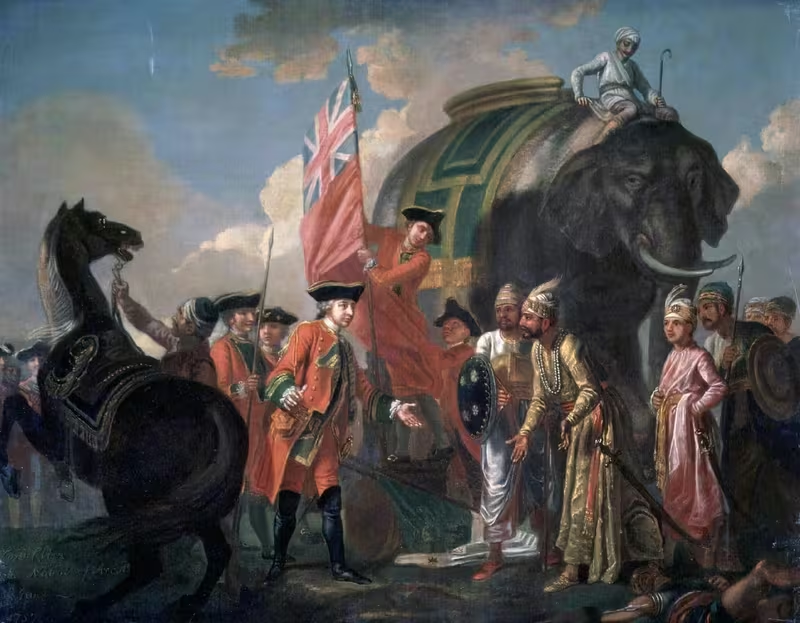
Overview
Between 1740 and 1763, the Carnatic region became the meeting ground of Indian succession struggles and the global rivalry between Britain and France. The conflicts were fought in the territories of Mughal India, where nominally independent rulers and their vassals competed for power while the British and French East India Companies supported rival claimants.
The wars unfolded in three connected stages. The First Carnatic War, fought from 1746 to 1748, grew directly out of the War of the Austrian Succession in Europe. The Second Carnatic War, from 1749 to 1754, continued largely as a proxy struggle over succession in Hyderabad and the Carnatic. The Third Carnatic War, from 1757 to 1763, formed part of the global Seven Years’ War and ended with a decisive British victory in southern India.
The result was larger than the settlement of individual thrones. French ambitions were curtailed, while the British East India Company became the dominant European trading power in India. This advantage eventually supported British control over much of the subcontinent and the later establishment of the British Raj.
Background
The death of Mughal emperor Aurangzeb in March 1707 was followed by a broad decline in central imperial control. During the reigns of Bahadur Shah I, Jahandar Shah, and later emperors, provincial authorities gained greater independence. Nizam-ul-Mulk established Hyderabad as an independent kingdom, although many territories continued to retain a formal connection to the Mughal political order.
After Nizam-ul-Mulk’s death, Hyderabad was drawn into a succession struggle between his son, Nasir Jung, and his grandson, Muzaffar Jung. France supported Muzaffar Jung, while Britain supported Nasir Jung. The contest became more dangerous because the European companies were no longer merely protecting trading interests. They were intervening in local politics and using military forces to strengthen preferred rulers.
The Carnatic presented a parallel crisis. Although legally under the authority of the Nizam of Hyderabad, it was governed by the Nawab Dost Ali Khan. His death opened a struggle between his son-in-law, Chanda Sahib, who received French support, and Muhammad Ali, who was supported by the British.
Joseph François Dupleix, who had arrived in India in 1715 and became governor of the French East India Company in 1742, was a central figure in this transformation. French influence had been concentrated in a few trading settlements, especially Pondicherry on the Coromandel Coast. Dupleix organised Indian recruits under French officers and pursued alliances with local rulers. His principal British opponent was the young officer Robert Clive.
Prelude
The War of the Austrian Succession began in Europe in 1740. Britain entered the conflict in 1744 against France and its allies. At first, the British and French companies in India maintained cordial commercial relations despite the hostility of their parent states. French officials even sent goods from Pondicherry to Madras for safekeeping.
The situation changed when British officials received notice that a Royal Navy fleet was approaching and began seizing French merchant ships. France requested naval assistance from Isle de France, now Mauritius. In July 1746, French commander La Bourdonnais and British Admiral Edward Peyton fought an indecisive naval action near Negapatam. The British fleet then withdrew towards Bengal, leaving the coast exposed.
The Event
First Carnatic War, 1746–1748
On 21 September 1746, French forces captured the British outpost at Madras. La Bourdonnais had promised to return the settlement to the British, but Dupleix rejected that arrangement and intended to transfer Madras to Anwar-ud-din, the Nawab of the Carnatic.
Anwar-ud-din responded by sending an army of 10,000 men against Madras. A much smaller French force defeated this army at the Battle of Adyar. The engagement demonstrated the importance of disciplined troops trained and commanded in European fashion within the political struggles of the region.
The French then made repeated attempts to capture Fort St. David at Cuddalore. British reinforcements arrived in time to prevent its fall and eventually turned the situation against the French. In the later months of 1748, British Admiral Edward Boscawen besieged Pondicherry. The siege was lifted in October when the monsoon rains arrived.
The end of the War of the Austrian Succession brought the First Carnatic War to a close. Under the Treaty of Aix-la-Chapelle, Madras was returned to Britain in exchange for Louisbourg in North America, which Britain had captured. The conflict also gave Robert Clive his first military experience in India. He had been taken prisoner at Madras, escaped, and later participated in the defence of Cuddalore and the siege of Pondicherry.
Second Carnatic War, 1749–1754
The peace in Europe did not end the political and military contest in India. Nasir Jung and his ally Muhammad Ali were supported by Britain, while Chanda Sahib and Muzaffar Jung received French backing. Muzaffar Jung and Chanda Sahib captured Arcot, and Nasir Jung’s subsequent death enabled Muzaffar Jung to take control of Hyderabad.
Muzaffar Jung’s rule was brief. He was killed soon afterwards, and Salabat Jung became Nizam. In 1751, Robert Clive led British troops in the capture of Arcot and successfully defended the town. The campaign strengthened the position of Muhammad Ali and weakened the French-backed claimants. The Pari royal house, which had sided with the French, fled from its fort at Durgam to Pondicherry.
The conflict ended with the Treaty of Pondicherry in 1754. The agreement recognised Muhammad Ali Khan Walajah as Nawab of the Carnatic. Charles Godeheu replaced Dupleix, who returned to France and later died in poverty. The French retained their position as protectors of the nizams of Hyderabad, but their wider political ambitions had suffered a major setback.
Third Carnatic War, 1757–1763
The Seven Years’ War, which began in Europe in 1756, renewed hostilities between France and Britain in India. The Third Carnatic War extended beyond southern India. In Bengal, British forces captured the French settlement of Chandernagore in 1757.
The decisive phase occurred in the south. British forces successfully defended Madras, and Sir Eyre Coote defeated French forces commanded by the Comte de Lally at the Battle of Wandiwash in 1760. Pondicherry fell to the British in 1761.
The war concluded with the Treaty of Paris in 1763. Chandernagore and Pondicherry were returned to France, but French traders were forbidden from administering the settlements. France also agreed to support British client governments, effectively ending its ambition to establish an Indian empire.
Participants
British East India Company and Its Allies
The British East India Company supported Nasir Jung in Hyderabad and Muhammad Ali in the Carnatic. Robert Clive became particularly important during the Second Carnatic War through the capture and defence of Arcot. During the Third Carnatic War, British forces defended Madras and, under Sir Eyre Coote, defeated the French at Wandiwash.
French East India Company and Its Allies
The French East India Company backed Muzaffar Jung in Hyderabad and Chanda Sahib in the Carnatic. Dupleix sought to turn French military assistance and political alliances into lasting influence. French forces captured Madras in 1746 and remained powerful in southern India for much of the early conflict. Their defeat at Wandiwash and the fall of Pondicherry, however, ended the possibility of a French-controlled Indian empire.
Aftermath
The treaties that ended the three wars produced different immediate settlements, but the long-term direction was consistent. Indian rulers and claimants continued to matter, yet the British Company increasingly possessed the military and diplomatic advantage. France retained trading posts, but its political role was restricted.
The Carnatic Wars also demonstrated that European companies could intervene in Indian succession disputes with organised troops, naval forces, and local alliances. Commercial settlements could become military bases, and regional rivalries could be connected to wars fought across the world.
Historical Significance
The wars marked the shift from European commercial competition to European political dominance. Britain’s victory did not immediately create the British Raj, but it established the East India Company as the leading foreign power in India. The Company’s success in the Carnatic, combined with its gains elsewhere, eventually enabled it to control large parts of the subcontinent.
The conflicts also reveal the fragmented political landscape of eighteenth-century Mughal India. The British and French did not operate in isolation: each depended on Indian claimants, rulers, soldiers, and political networks. The outcome was shaped by both European rivalry and struggles within Hyderabad and the Carnatic.
Legacy
The Carnatic Wars are remembered chiefly as the conflicts that pushed French power into a primarily commercial role and opened the way for British expansion. Pondicherry remained associated with France, but the settlement no longer represented a credible base for an Indian empire. The rise of British power after 1763 connected the military contests of the Carnatic to the much broader history of Company rule and the later British Raj.
Historiography
The wars can be interpreted in two connected ways. They were part of the global conflicts between Britain and France, including the War of the Austrian Succession and the Seven Years’ War. At the same time, they were local struggles over succession and authority in Hyderabad and the Carnatic.
The account of the First Carnatic War also highlights the contrast between formal European diplomacy and events in India: the Treaty of Aix-la-Chapelle exchanged territories in India and North America, while Indian rulers and armies remained central to the fighting. This dual character explains why the Carnatic Wars were both regional succession contests and an important stage in the Anglo-French struggle for influence.