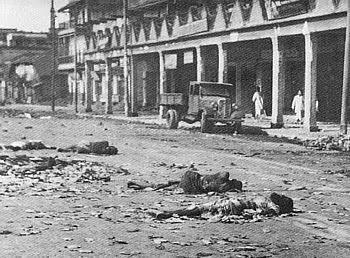
Overview
On 16 August 1946, Calcutta became the centre of a political crisis that had been building across British India. The All-India Muslim League had called a general strike, or hartal, to demonstrate Muslim support for Pakistan after negotiations over the transfer of power collapsed. The day was intended to combine a shutdown of commercial and civic life with mass meetings and processions. In Calcutta, however, it quickly became a cycle of communal attacks, killings, looting and retaliatory violence involving Hindus and Muslims.
The violence lasted several days. More than 4,000 people died and approximately 100,000 residents were left homeless in Calcutta within 72 hours, although no precise casualty figure has been established. The worst killing occurred on 17 August, and violence continued in parts of the city until military intervention and the imposition of wider authority reduced it on 21 and 22 August.
Direct Action Day is also known as the Great Calcutta Killings or the 1946 Calcutta Riots. It marked the beginning of what became known as the Week of the Long Knives. Its importance lay not only in the immediate suffering of Calcutta's residents but also in the political consequences that followed. Violence spread to Noakhali, Bihar, the United Provinces, Punjab and the North-Western Frontier Province. The killings deepened the conviction among many political leaders and ordinary people that Hindus and Muslims could no longer safely share a single postcolonial political system.
The event remains contested. Historians and political traditions disagree about the sequence of events, the conduct of individual leaders and the relative responsibility of the Muslim League, the Congress, the Bengal government, local activists, criminal groups and the colonial administration. There is greater agreement about the scale of the disaster and its short-term consequences than about who initiated or could have prevented it.
Background
By 1946, the British Raj was preparing for the transfer of power. The Indian independence movement had reached a decisive stage, and the Indian National Congress and the All-India Muslim League were the two largest political forces represented in the negotiations over India's future. They agreed that British rule should end, but they differed fundamentally over the political structure that would replace it.
The Muslim League had demanded since its Lahore Resolution of 1940 that Muslim-majority areas in the northwest and east of India should form independent states. The demand was often referred to as the demand for Pakistan. The League feared that a strong central government dominated by Congress would leave Muslims permanently vulnerable to the political will of a Hindu majority.
The British Cabinet Mission arrived in India in 1946 to propose a framework for the transfer of power. Its plan of 16 May attempted to reconcile Indian unity with the League's demand for regional autonomy. It proposed three levels of government: a central authority, groups of provinces and individual provinces. The central government would control defence, external affairs and communications. Other powers would largely remain with the provinces or with groups of provinces.
The grouping arrangement was crucial. It offered a way for Muslim-majority provinces in the northwest and east to coordinate without immediately creating a separate sovereign state. Muhammad Ali Jinnah, the Muslim League's leader, accepted the plan, as did the central Congress leadership in principle. The arrangement was fragile, however, because Congress and the League understood the future powers of the groups differently.
On 10 July, Jawaharlal Nehru, then Congress president, held a press conference in Bombay. He stated that Congress would participate in the Constituent Assembly but retained the right to modify the Cabinet Mission Plan. He also rejected the idea that provinces would be compelled to join a group. To the League, this suggested that the grouping scheme could be dismantled once Congress gained control of the central political process.
Jinnah interpreted Nehru's statement as a betrayal of the understanding reached around the Cabinet Mission Plan. On 29 July, the Muslim League withdrew its earlier approval of the plan. It also decided to boycott the Constituent Assembly and to pursue what it called Direct Action. The League's decision was not a declaration of conventional war. It was a call for political mobilisation, general strikes and economic shutdowns designed to demonstrate that the demand for Pakistan could not be ignored.
In July, Jinnah announced that 16 August would be observed as Direct Action Day. He warned that the alternatives were “either a divided India or a destroyed India.” In another statement, he declared that the League had said goodbye to constitutional methods and was prepared to “create trouble.” These statements were heard against a background of intense political suspicion. Their meanings were interpreted differently by leaders, officials and the crowds who later gathered in Calcutta.
The political system was also undergoing a wider breakdown. The British administration was attempting to withdraw at the lowest possible political cost, while Congress and the Muslim League competed for influence over the institutions that would govern the successor state or states. Bengal had a particularly broad political base for both organisations. Its leaders had experience of mass politics, flexible alliances and public mobilisation. Yet that political culture could not contain the emotions released by the confrontation over nationhood.
The idea of the nation was changing rapidly. For many political leaders, it was still a constitutional question involving provincial powers, central authority and the transfer of sovereignty. For many ordinary people, it was becoming a question of community, security and territorial belonging. A political demonstration intended to influence negotiations could therefore be understood as a struggle for survival. This helped make the consequences of Direct Action Day far more destructive than its organisers had anticipated.
Prelude
Communal tension in Calcutta had been high for months. Riots in February 1946 had already damaged relations between Hindus and Muslims. Newspapers associated with the two communities often used inflammatory and partisan language, heightening fear and anger. In one example of the atmosphere, a pamphlet attributed to Calcutta's mayor, Syed Mohammed Usman, used martial and religious language to urge Muslims not to lose heart and to prepare for conflict.
Hindu political opinion was mobilised around the slogan of Akhand Hindusthan, or United India. Some Congress leaders in Bengal developed a stronger Hindu political identity as they considered the possibility that Hindus in a partitioned Bengal might become a minority or lose influence. The Pakistan movement, meanwhile, encouraged Muslim political solidarity. Propaganda from both sides helped legitimise communal identities as political identities.
The League's programme for 16 August was ambitious. Its newspaper, The Star of India, published a detailed schedule. The plan called for a complete hartal and general strike across civic, commercial and industrial life, apart from essential services. Processions were to begin in several parts of Calcutta, Howrah, Hooghly, Metiabruz and the 24 Parganas, then converge at the Ochterlony Monument, now known as the Shaheed Minar.
A mass rally at the monument was to be presided over by Huseyn Shaheed Suhrawardy, the Chief Minister of Bengal. The League also instructed its branches to send workers to mosques in each ward to explain the programme before Friday prayers. Special prayers were arranged after the Juma prayers. League notices connected the day with the month of Ramadan and used religious imagery to describe the struggle for Muslim India.
The Bengal government became involved in a decision that later attracted intense criticism. On the advice of Ronald Leslie Walker, the Chief Secretary of Bengal, Suhrawardy asked Governor Sir Frederick Burrows to declare 16 August a public holiday. Walker believed that closing government offices, shops and commercial houses might reduce conflict connected with picketing. If businesses were already closed, there might be fewer confrontations between strikers and those who refused to join the hartal.
The Bengal Congress opposed the holiday. It argued that the closure would help the Muslim League enforce the hartal even in areas where its organisation was weak. Congress leaders also feared that Hindu shopkeepers and office workers would be compelled to participate in the League's political demonstration. On 14 August, Kiran Shankar Roy, the Congress leader in the Bengal Legislative Assembly, urged Hindu shopkeepers to keep their businesses open in defiance of the hartal.
The decision produced a dangerous contradiction. The League interpreted the holiday as an opportunity for mass mobilisation, while Congress supporters could interpret opposition to the closure as a defence of their political and economic independence. The streets were therefore prepared for both processions and resistance. Neither side could be certain that the other would act peacefully, and the administration had not developed an effective plan for controlling a mass confrontation.
The colonial government also prioritised other threats. During protests connected to the Indian National Army trials, the administration had created an Emergency Action Scheme that emphasised monitoring and suppressing anti-British demonstrations. Communal violence among Indians received less attention than officials' fears of anti-colonial agitation. Burrows later defended the public holiday, arguing that it allowed peaceful citizens to remain at home. He also suggested that open shops and markets might have produced even more looting and killing. Other critics believed the holiday helped create the conditions for the violence.
The Event
The morning of 16 August
The first signs of disorder appeared before the main rally. By 10 a.m., police headquarters at Lalbazar had received reports of excitement throughout the city, forced shop closures, brawls, stabbings and the throwing of stones and brickbats. The incidents were concentrated in north-central areas including Rajabazar, Kelabagan, College Street, Harrison Road, Colootola and Burrabazar.
These districts had experienced communal disturbances in the past. In them, Hindus were generally the majority and held a stronger economic position. The pattern of early confrontations therefore combined political mobilisation with existing social and economic antagonisms. What may have begun as attempts to enforce or resist a strike soon acquired a communal character.
The situation developed in a city already shaped by economic inequality and dense settlement. Once shops were closed and normal movement disrupted, rumours could travel rapidly. Reports of injuries or attacks in one locality could provoke retaliation in another. The closure of transport and commercial life made it difficult for people to escape or obtain reliable information.
The mass meeting
Muslim processions began assembling from around midday, after the prayers, although the principal meeting began at about 2 p.m. Estimates of the crowd differed sharply. A Central Intelligence Officer's reporter estimated about 30,000 people; a Special Branch inspector estimated 500,000; and a Star of India reporter gave a figure of approximately 100,000. The differences show how difficult it was to measure a large and rapidly moving crowd during the crisis.
Many participants were reported to carry iron bars and lathis, or bamboo sticks. The presence of weapons did not mean that every participant intended violence, but it made the gathering more dangerous and increased the likelihood that local confrontations would become deadly.
Khawaja Nazimuddin and Suhrawardy were among the principal speakers. Nazimuddin appealed for peacefulness and restraint, but he also heightened the crowd's anger by stating that all the injured people reported by 11 a.m. had been Muslims and that Muslims had merely retaliated in self-defence. Suhrawardy appeared to promise indirectly that armed Muslims would not face action.
The exact wording and meaning of Suhrawardy's speech remain disputed. The Calcutta Police Special Branch sent only one shorthand reporter to the gathering, so no complete transcript survives. Two accounts available to the administration agreed that Suhrawardy referred to the police and military arrangements and suggested that they would not interfere, but they differed on whether he said he had “seen to” those arrangements or had been able to restrain the forces.
There is no evidence in the account of a specific police order instructing officers to hold back. Nevertheless, the impression created among a large and largely uneducated crowd could be interpreted as permission to act without fear of immediate punishment. Some accounts report that attacks on Hindus and the looting of Hindu-owned shops began as participants left the meeting. Other reports described trucks moving along Harrison Road carrying armed Muslim gangsters who attacked Hindu shops with brickbats and bottles.
The uncertainty over the speech illustrates a larger problem in reconstructing the event. A political statement made to reassure or control a crowd could be understood as a threat or an invitation. The failure to record the entire speech left later observers with competing interpretations, each of which became part of the political argument over responsibility.
The spread of violence
The violence did not remain confined to the meeting or to a single neighbourhood. Attacks, looting and killings spread through parts of Calcutta. Hindus and Muslims became both victims and perpetrators in different localities. The event was not a single clash between two organised armies; it was a breakdown of civil order involving processions, neighbourhood groups, armed gangs, workers, residents and political supporters.
At 6 p.m., a curfew was imposed in parts of the city where rioting had occurred. At 8 p.m., forces were deployed to protect the main routes and conduct patrols along those arteries. This allowed the police to focus on slums and other underdeveloped areas away from the main roads. The deployment reduced disorder in some places but did not immediately restore citywide control.
One especially severe episode occurred at the Kesoram Cotton Mills compound in Lichubagan, in Metiabruz. Syed Abdullah Farooqui, president of the Garden Reach Textile Workers' Union, was reported to have led a radical mob in attacks on Hindu mill workers. The victims included many Odia labourers. Estimates of those killed ranged between 7,000 and 10,000, but the identity and religious composition of the victims are disputed. Some accounts state that most victims were Muslims, while others argue that Hindus formed the majority.
The disagreement over Lichubagan is an example of the wider difficulty in establishing casualty figures. The area was affected by the breakdown of administration, the victims were not always immediately identified and later political accounts often used the dead to support competing explanations of the riots. Four survivors later filed a complaint against Farooqui at the Metiabruz police station on 25 August. Bishwanath Das, a minister in the Government of Orissa, visited Lichubagan to investigate the killings.
The worst killing
The worst of the killing took place during 17 August. By late afternoon, soldiers had brought the most severely affected areas under control, and the military expanded its hold during the night. Yet areas outside military control remained dangerous. In the slums, disorder and violence continued to escalate.
On the morning of 18 August, buses and taxis were reportedly moving through the city carrying Sikhs and Hindus armed with swords, iron bars and firearms. This marked a shift from the initial mobilisation surrounding the League's hartal to wider retaliation. Groups that had not been the original organisers of the protest became involved, while news of attacks was used to justify further attacks.
For several days, the city was divided between zones where troops controlled the streets and areas where police and local residents faced disorder with limited protection. The movement of people became hazardous. Thousands attempted to leave Calcutta, and the Howrah Bridge over the Hooghly River became crowded with evacuees travelling towards Howrah station. Many, however, encountered violence beyond the city as the conflict spread through the surrounding region.
Restoration of order
Suhrawardy repeatedly pressed British officials to deploy troops stationed at Sealdah. The first units reached the scenes of violence at 1:45 a.m. on 17 August. Later, as the scale of the crisis became clearer, more troops were used.
On 21 August, Bengal was placed under the rule of the Viceroy. Five battalions of British troops, supported by four battalions of Indian and Gurkha troops, were deployed in Calcutta. Lord Wavell later stated that troops should have been called in earlier, although the available account gives no indication that British forces were unavailable. The rioting declined on 22 August.
The end of the immediate crisis did not resolve its political meaning. The streets were quieter, but thousands had been killed, homes had been destroyed and trust between communities had been severely damaged. The question of who had failed—political leaders, the provincial government, the police, the colonial administration or local actors—became part of the continuing struggle over the history of Bengal and Partition.
Participants
The All-India Muslim League
The Muslim League called Direct Action Day after withdrawing from the Cabinet Mission Plan. Its objective was to show that Muslims would not accept a constitutional arrangement that could place them under permanent Congress dominance. Jinnah's call was for a general strike and mass political action, not an announced plan for citywide massacre. However, the political language of confrontation, combined with the organisation of armed processions and the intensity of communal mobilisation, created conditions in which violence could rapidly escape political control.
Suhrawardy occupied a particularly complex position. As Chief Minister of Bengal, he was responsible for the provincial government; as a leading Muslim League politician, he was also associated with the political mobilisation behind the hartal. He spent significant time in the police control room at Lalbazar, often in the company of supporters. Critics alleged that he interfered with police duties, obstructed effective action and was partisan. It was also reported that Hindu policemen were dismissed on 16 August.
The historical record is contested. Some accounts portray Suhrawardy as deliberately enabling Muslim violence; others emphasise his attempts to manage a rapidly collapsing situation and his pressure for military assistance. His alleged remarks at the mass meeting remain central to the debate because they could be interpreted as either a promise of restraint or an assurance that the police would not intervene.
Khawaja Nazimuddin, another major speaker, called for peacefulness but also described Muslims as acting in self-defence. The League's local branches, mosque workers and Volunteer Corps helped organise the day's processions and meetings. Their organisational capacity made the demonstration possible, but it also meant that political networks were present when the situation turned violent.
Congress and Hindu political mobilisation
Congress leaders in Bengal opposed the public holiday and urged Hindu shopkeepers to defy the hartal. Their opposition reflected both constitutional disagreement and fear that the Muslim League would use the shutdown to demonstrate control over the city. Congress supporters viewed the League's political programme as a step towards the division of India and mobilisation around Akhand Hindusthan became a response.
The Congress version of events placed primary responsibility on the Muslim League and especially on Suhrawardy's government. Congress leaders argued that the League had created the confrontation, used its administrative influence to weaken the police response and permitted armed supporters to attack Hindus. At the same time, Congress leaders and supporters were not merely observers. Hindu groups took part in retaliatory violence, and the wider pattern of killing cannot be explained solely through the actions of one party.
Nehru and Gandhi responded negatively to the riots. Nehru described the violence as far more than an ordinary riot, observing that murder and sadistic cruelty had taken over the streets. Their reaction reflected both humanitarian shock and the political realisation that communal violence was destroying the possibility of a negotiated united India.
The Bengal government and colonial officials
The Bengal government's decision to accept the public holiday became one of the immediate points of criticism. Governor Burrows approved the request despite Congress objections. He later defended the decision by arguing that the holiday allowed peaceful citizens to stay indoors and might have prevented even greater looting and murder.
The colonial administration's response was weakened by the broader crisis of decolonisation. Officials were attempting to transfer power while preserving order, but they did not fully anticipate the scale of the mass mobilisation. The Emergency Action Scheme prioritised anti-British protests connected with the Indian National Army trials rather than communal violence.
The police struggled to respond to simultaneous incidents across a dense city. The absence of a reliable transcript of the main speech, incomplete intelligence and delayed military deployment further complicated the response. When troops were finally deployed in sufficient numbers, they were able to secure the main routes and affected areas, but only after the killing had already reached a devastating scale.
Local groups and ordinary residents
The violence involved more than the principal political parties. Processions, neighbourhood groups, workers, shopkeepers, transport operators, criminal elements and residents all affected the course of events. Some people participated in attacks or looting; others protected neighbours, sheltered families or attempted to flee. The available accounts do not provide a complete social history of these actions, but they show that mass politics quickly became local violence.
The scale of participation also explains why the violence was difficult to stop. The League and Congress could mobilise large crowds, but neither could reliably control every participant once fear and revenge became the dominant forces. Leaders had assumed that Calcutta's established traditions of hartals and mass meetings would contain the confrontation. Instead, political mobilisation released emotions that overwhelmed those traditions.
Aftermath
The immediate aftermath was marked by displacement. Thousands fled Calcutta, many crossing the Howrah Bridge towards Howrah station. Some were escaping direct attacks; others feared that violence would return to their neighbourhoods. The city had lost homes, shops, workplaces and ordinary routes of communication.
The human cost is difficult to calculate precisely. More than 4,000 deaths and approximately 100,000 homeless people are widely associated with the 72-hour crisis, but the exact number remains unavailable. Some local episodes have much higher disputed estimates, while official and political accounts often differ sharply. The absence of a single agreed figure does not reduce the scale of the catastrophe; it demonstrates the administrative collapse and the later politicisation of the dead.
The violence soon spread beyond Calcutta. News of the killings contributed to the Noakhali-Tipperah violence in October 1946. It also contributed to retaliatory violence in Bihar and to later massacres in the United Provinces and Punjab. Communal violence affected Hindus, Muslims and Sikhs in different regions. These episodes were not identical in their causes or forms, but they were connected by rumours, fear and the belief that one community had to avenge crimes attributed to another.
The political consequences were immediate. The killings intensified calls for a separate Muslim homeland among Muslims who feared Hindu domination, while many Hindus concluded that Pakistan would endanger their security in Muslim-majority provinces. The possibility of maintaining a united India became increasingly difficult to defend in the face of repeated massacres.
In a meeting with Wavell on 27 August, Gandhi reportedly said that if India wanted a bloodbath, it would have one, even if non-violence was the declared principle. The statement reflected the grim recognition that political ideals were not controlling events on the ground.
The demographic consequences unfolded over several years. Before Partition, Calcutta had approximately 2,952,142 Hindus, 1,099,562 Muslims and 12,852 Sikhs. After independence, the Muslim population fell to about 601,817, partly because approximately 500,000 Muslims migrated from Calcutta to East Pakistan after the riot. The 1951 census recorded that 27 percent of Calcutta's population consisted of East Bengali refugees, most of them Hindu Bengalis.
Estimates indicate that around 320,000 Hindus from East Pakistan migrated to Calcutta between 1946 and 1950. In the censuses, the Hindu share of Calcutta's population rose from 73 percent in 1941 to 84 percent in 1951, while the Muslim share fell from 23 percent to 12 percent. These changes were not caused by Direct Action Day alone, but the killings formed part of the violence and insecurity that drove migration and helped produce the eventual religious reorganisation of Bengal.
Historical Significance
Direct Action Day transformed a constitutional dispute into a mass crisis of public order. The Cabinet Mission Plan had attempted to preserve an Indian union by combining a limited centre with powerful provinces and provincial groups. Its collapse removed an important political compromise. The Calcutta killings then made the consequences of constitutional disagreement visible in the form of neighbourhood violence, displacement and communal fear.
The event also demonstrated the limits of political control during decolonisation. The Muslim League and Congress were experienced in organising meetings, strikes and public campaigns. Yet both miscalculated the force of popular emotion. Political leaders treated mass action as a tool that could be directed towards constitutional objectives. In Calcutta, the crowd's interpretation of nationhood and community overwhelmed the assumptions of the organisers.
The riots affected the future of Bengal particularly strongly. Bengal had a large Muslim population, a powerful Hindu commercial presence and a provincial political system in which both communities possessed substantial organisational strength. The violence made a partition of the province appear increasingly plausible. The later division produced a Hindu-majority West Bengal, including Calcutta, and a Muslim-majority East Bengal, which became East Pakistan and later Bangladesh.
The killings also helped create a chain of retaliatory violence. Noakhali, Bihar, the United Provinces and Punjab each experienced severe communal conflict in 1946. Although each episode had its own local conditions, they were linked in public imagination. Reports of atrocities elsewhere were used to justify violence at home. The result was a widening cycle in which each community saw itself as responding to earlier aggression.
For the British administration, Direct Action Day exposed the danger of a rapid withdrawal without a stable political settlement or effective security arrangements. The administration had to balance negotiations with Congress and the League, the suppression of anti-colonial protest and the maintenance of public order. Its failure to anticipate the scale of violence damaged confidence in its ability to manage the transition.
For Congress, the events strengthened the argument that League participation in a united central government would be difficult or impossible. For the Muslim League, the violence confirmed the urgency of creating a political arrangement that would protect Muslims from Hindu majoritarian rule. These conclusions moved in opposite directions but produced the same result: the space for compromise narrowed.
Legacy
Direct Action Day is remembered both as a catastrophe in Calcutta and as a turning point on the road to Partition. The name “Great Calcutta Killings” emphasises the scale of death, while “Direct Action Day” points to the political decision that initiated the day's mobilisation. Neither name alone captures the full history. The event was simultaneously a constitutional confrontation, a mass strike, a series of local clashes and a prolonged communal breakdown.
Its memory has remained politically charged. Muslim League supporters and later Muslim political interpretations have emphasised the role of Congress mobilisation, economic conflict and the vulnerability of Muslims in a political system dominated by Congress. Congress and many Hindu accounts have placed responsibility on Jinnah, the League's Volunteer Corps and Suhrawardy's Bengal government. British interpretations often blamed both communities and highlighted the calculations of political leaders alongside the violence of ordinary participants.
The event is also linked to Gandhi's efforts in Noakhali. When violence spread there in October, Gandhi spent four months travelling and camping in the district in an attempt to restore peace and communal harmony. His mission represented one of the last major efforts to oppose Partition through personal appeals for intercommunal trust. In the meantime, however, Congress leaders increasingly accepted the proposed division of India, and relief and peace efforts were reduced.
The demographic legacy remained visible in Calcutta and eastern India. Refugee arrivals, Muslim migration to East Pakistan and the changing religious composition of cities reshaped neighbourhoods and political identities. The movement of people continued to connect Calcutta with East Bengal, Tripura and Assam long after the immediate violence had ended.
In popular culture, the events have continued to be represented through writing, political memory and cinema. Director Vivek Agnihotri's film The Bengal Files, released on 5 September 2025, depicts Direct Action Day, the Great Calcutta Killings and subsequent violence in Bengal, including the Noakhali riots. Such representations keep the events in public discussion, but they also inherit the contest over blame and interpretation.
Historiography
The central historiographical problem is responsibility. There is broad agreement that the riots caused mass death, homelessness and communal displacement. There is much less agreement about the precise sequence of attacks and the degree of responsibility borne by different actors.
One interpretation places primary responsibility on the Muslim League and the Bengal government. It points to the League's call for Direct Action, the organisation of processions and the reported presence of armed participants. It also emphasises Suhrawardy's role as Chief Minister and Home Minister, his presence in the police control room and the alleged failure of the government to act decisively. In this view, the public holiday gave the League an administrative advantage and made it easier to enforce the hartal.
A second interpretation argues that Congress and Hindu political organisations also contributed substantially. It points to Congress opposition to the holiday, the call to keep shops open and the mobilisation of Hindu political identity around United India. Supporters of this interpretation argue that Hindu retaliation was not simply a later response but part of the wider conflict over political power and economic dominance in Calcutta.
A third interpretation, common in some British accounts, distributes responsibility more evenly. It stresses that both communities were mobilised, that leaders miscalculated the crowd's response and that local criminal elements and armed groups turned confrontation into massacre. This interpretation also highlights the failure of the colonial state, which did not call in troops soon enough and had prioritised anti-British protest over communal violence.
A further historical approach treats the riots as a crisis of institutions during decolonisation. From this perspective, the central issue was not simply which community struck first. The existing political system was losing authority, the British were preparing to leave and Congress and the League were competing to define the new state. Bengal's political organisations assumed that their established methods of negotiation and mass mobilisation would continue to work. Instead, the meaning of nationhood had changed so rapidly that their methods could no longer contain the response.
Casualty figures are also contested. The overall scale—more than 4,000 dead and around 100,000 homeless in the immediate period—is widely cited, but exact numbers are unavailable. Estimates for individual episodes, particularly the killings at Lichubagan, differ sharply. The competing figures reflect incomplete records, administrative disorder and later political efforts to establish one community as the principal victim.
The history of Direct Action Day therefore requires attention to both structure and agency. The collapse of negotiations, communal propaganda, economic inequalities, administrative decisions and the actions of political leaders created the conditions for disaster. At the same time, individuals and local groups made choices that produced attacks, rescues, retaliation and flight. No single explanation resolves the event's complexity, but the evidence shows how rapidly constitutional conflict can become communal violence when political authority is weakened and fear defines the meaning of citizenship.