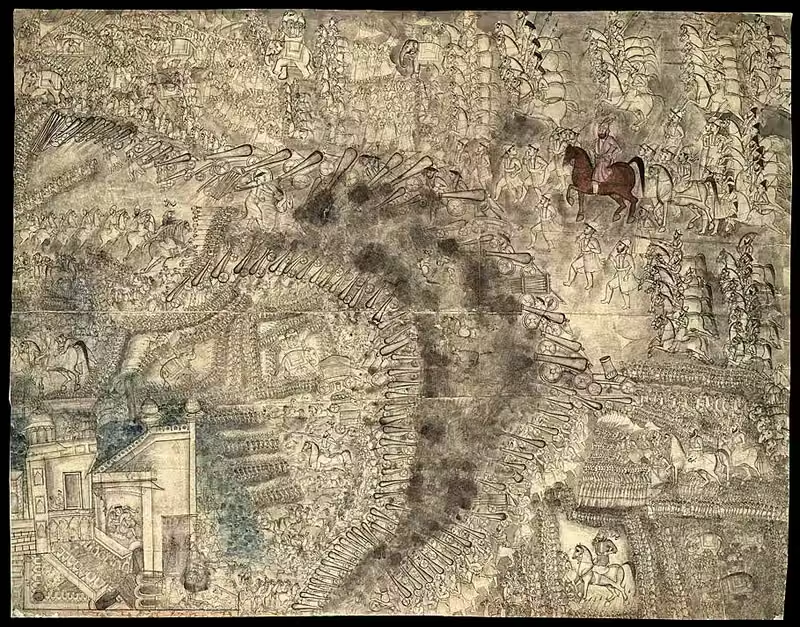
Overview
The Third Battle of Panipat, fought on 14 January 1761, stands as one of the most consequential military engagements in Indian history. This massive confrontation between the Maratha Empire and the invading forces of Ahmad Shah Durrani (also known as Ahmad Shah Abdali) of the Durrani Empire took place on the historic plains of Panipat, approximately 97 kilometers north of Delhi. The battle resulted in a catastrophic defeat for the Marathas, fundamentally altering the political landscape of 18th-century India.
The clash represented more than a simple territorial dispute—it was a struggle for supremacy over northern India between two rising powers. The Maratha Confederacy, having expanded rapidly across the subcontinent from their Deccan heartland, sought to establish themselves as the dominant force in the vacuum left by the declining Mughal Empire. Against them stood Ahmad Shah Durrani, the Afghan ruler who had made multiple incursions into India, determined to check Maratha expansion and maintain Afghan influence in the region.
The battle's outcome proved devastating for the Marathas, with casualties estimated between 40,000 to 70,000, making it one of the bloodiest single-day battles of the 18th century. The defeat halted Maratha expansion northward for nearly a decade and created a power vacuum that would eventually facilitate British colonial expansion in India. The Third Battle of Panipat thus marks a crucial turning point—the moment when indigenous resistance to European colonialism was fatally weakened through internal conflict.
Background
The Rise of Maratha Power
By the mid-18th century, the Maratha Confederacy had emerged as the most powerful indigenous force in India. Following the death of the Mughal emperor Aurangzeb in 1707, the Mughal Empire entered a period of rapid decline, with provincial governors asserting independence and the empire's territorial control shrinking dramatically. The Marathas, under the leadership of the Peshwas (hereditary prime ministers), exploited this weakness to expand from their base in the Deccan Plateau across much of central and northern India.
Under Peshwa Baji Rao I and his successors, Maratha armies conducted successful campaigns that brought large parts of India under their control or influence through a system of tributary relationships. By 1758, Maratha forces had even occupied Delhi briefly, exercising effective control over the Mughal emperor. This rapid expansion, however, created enemies and anxieties among various regional powers who feared Maratha dominance.
Ahmad Shah Durrani and Afghan Interests
Ahmad Shah Durrani, the founder of the Durrani Empire (often considered the founder of modern Afghanistan), had his own interests in India. Having made several previous invasions, Durrani sought to maintain Afghan influence in northern India, collect tribute, and prevent any single Indian power from becoming too dominant. The rapid Maratha expansion directly threatened these interests.
The catalyst for the conflict came when the Marathas began interfering in the politics of the Punjab region and challenging Afghan authority. This, combined with appeals from Indian nobles threatened by Maratha power, prompted Ahmad Shah Durrani to launch his seventh invasion of India in 1759.
The Coalition Against the Marathas
Ahmad Shah Durrani's invasion gained support from several important allies who feared or resented Maratha power. Najib ud-Daula, the Rohilla chief, played a crucial role in persuading various Rohilla leaders to support the Afghan cause. Shuja-ud-Daula, the Nawab of Oudh (Awadh), brought his substantial forces and resources to the anti-Maratha coalition. Elements of the declining Mughal nobility also threw their support behind Durrani, seeing the Afghans as the lesser threat compared to the Marathas.
Even Maharaja Deep Chand of the Kingdom of Kumaon, a traditional Himalayan ally of the Mughal Empire, was persuaded to support the Afghan side, demonstrating the breadth of opposition the Marathas faced.
Prelude
Maratha March North
In response to the Afghan invasion, the Maratha Confederacy assembled a large army under the command of Sadashivrao Bhau, the third-highest authority in the Maratha hierarchy after the Chhatrapati (the ceremonial Maratha king) and the Peshwa (the prime minister). Bhau, serving as the commander-in-chief, was an experienced military leader and cousin of Peshwa Balaji Bajirao.
The Maratha army that marched north was substantial, though exact numbers remain debated by historians. The force included not just fighting men but also a large number of camp followers and pilgrims who joined the army's northward march, swelling the total number of people with the Maratha camp to possibly over 300,000.
However, a critical strategic error was made: the bulk of the Maratha army remained stationed in the Deccan Plateau with the Peshwa. This meant that the force that would face the Afghans at Panipat, while still formidable, was not the full military might of the Maratha Confederacy. Furthermore, key Maratha leaders and their forces, including important allies, either did not join the campaign or arrived with insufficient forces.
Strategic Maneuvering
As the Maratha army advanced into northern India in 1760, they initially achieved some successes, occupying Delhi and other strategic locations. However, they found themselves increasingly isolated in hostile territory. The Afghan and allied forces, under Ahmad Shah Durrani's command, employed strategic maneuvering to cut off Maratha supply lines and isolate them from reinforcements from the Deccan.
By late 1760, the Maratha army found itself in an increasingly difficult position near Panipat. Supply shortages began to affect the army's effectiveness, and the approaching winter made conditions even more challenging. The stage was set for a decisive confrontation.
The Battle
The Morning of 14 January 1761
As dawn broke on 14 January 1761, two massive armies faced each other on the plains of Panipat. The Maratha forces, though weakened by months of supply shortages and the harsh winter, still represented a formidable fighting force. Sadashivrao Bhau organized his troops in traditional formations, hoping to use the discipline and training of his forces to counter the numerical and tactical advantages of the enemy.
The Durrani-led coalition army, bolstered by its allies including the Rohillas and the forces of Oudh, held advantages in cavalry mobility, artillery, and knowledge of the local terrain. Ahmad Shah Durrani, an experienced military commander, had carefully prepared his forces and coordinated his allies for the decisive engagement.
The Clash
The battle began with artillery exchanges and cavalry skirmishes. The Afghans and their allies, employing mobile cavalry tactics that had proven effective in Central Asian warfare, sought to outflank and surround the Maratha positions. The Marathas, fighting with characteristic bravery, mounted determined resistance.
Vishwasrao, the Peshwa's son and heir apparent who accompanied the army, was killed early in the battle, dealing a severe blow to Maratha morale. The loss of this young prince, who represented the future of the Peshwa's lineage, had psychological effects that rippled through the Maratha ranks.
As the battle progressed, the superior coordination of the Afghan and allied forces, combined with their effective use of cavalry and artillery, began to tell against the Marathas. The months of supply shortages had weakened the Maratha forces, affecting their stamina and combat effectiveness. Despite desperate resistance and numerous acts of individual heroism, the Maratha lines began to buckle under sustained assault.
The Collapse
By afternoon, the Maratha army's position had become untenable. Sadashivrao Bhau himself was killed in the fighting, leaving the Maratha forces without their commander. The death of their leader, combined with mounting casualties and the overwhelming pressure from enemy forces, led to the collapse of Maratha resistance.
What followed was a catastrophe. As the Maratha army broke and fled, they were pursued by Afghan cavalry. The camp followers and non-combatants with the Maratha army became victims of the rout. The massacre continued through the day and into the evening, with casualties mounting horrifically.
Aftermath
The Human Cost
The immediate aftermath of the Third Battle of Panipat was devastating for the Marathas. Casualty estimates vary, but sources suggest between 40,000 to 70,000 deaths on the Maratha side, making it one of the bloodiest single-day battles in history. The dead included not just soldiers but also thousands of camp followers, pilgrims, and non-combatants who had accompanied the army.
Among the prominent casualties were Sadashivrao Bhau himself, Vishwasrao (the Peshwa's son and heir), and numerous other Maratha nobles and commanders. The scale of loss affected virtually every prominent Maratha family, creating a generation of widows and orphans in Maharashtra.
Political Consequences
The political ramifications of the defeat extended far beyond the battlefield. The Peshwa Balaji Bajirao, upon hearing of the death of his son and cousin along with the destruction of his army, died of grief within months of the battle. The Maratha Confederacy, which had seemed on the verge of establishing itself as the paramount power in India, was thrown into crisis.
The Mughal emperor Shah Alam II, who had been under Maratha protection, was forced to flee to Awadh (Oudh), effectively removing himself from the political chess board in northern India. The defeat created a power vacuum in northern India that no single Indian power could immediately fill.
Afghan Withdrawal
Despite their decisive victory, Ahmad Shah Durrani and his Afghan forces did not remain in India to consolidate their gains. The Afghans soon withdrew back to their homeland, taking substantial plunder but not establishing permanent control over the territories they had fought for. This withdrawal meant that while the Afghans had checked Maratha expansion, they had not replaced them as the dominant power in northern India.
Historical Significance
End of Maratha Northern Expansion
The Third Battle of Panipat effectively ended the Maratha project of establishing dominion over all of India. While the Maratha Confederacy would recover under leaders like Mahadaji Sindhia in subsequent decades and regain some power in northern India, they never again came as close to pan-Indian dominance as they had in the years before Panipat.
The battle demonstrated the limits of Maratha military organization when faced with a well-coordinated enemy in unfamiliar territory and without secure supply lines. It also revealed the political weaknesses of the Maratha Confederacy, which struggled to gain allies among the many powers who feared or resented their expansion.
Power Vacuum and British Expansion
Perhaps the most significant long-term consequence of the Third Battle of Panipat was the creation of a power vacuum in India at a critical moment in history. With the Mughal Empire in terminal decline, the Marathas severely weakened, and the Afghans absent, no indigenous power was in a position to provide unified resistance to European colonial expansion.
The British East India Company, which had been gradually expanding its influence from its coastal bases, found the post-Panipat political landscape advantageous for their ambitions. The fragmentation of Indian power and the mutual exhaustion of the major Indian states created opportunities for British intervention, divide-and-rule tactics, and eventual conquest. While it would be an oversimplification to say that Panipat directly caused British colonization, it certainly eliminated what might have been the strongest potential obstacle to it.
Military Lessons
From a military perspective, the battle reinforced several important lessons. The importance of supply lines and logistics in sustaining armies far from their home bases became starkly apparent. The Maratha strategy of advancing deep into hostile territory without securing adequate supplies or reliable allies proved catastrophic.
The battle also demonstrated the continuing effectiveness of traditional Central Asian cavalry tactics when properly executed and coordinated with artillery. The Afghan and allied forces' mobility and use of terrain advantages proved decisive against the larger but more static and supply-starved Maratha forces.
Legacy
Cultural Memory
The Third Battle of Panipat left a deep imprint on Marathi cultural memory. The disaster became known as "Wadyacha Panja" (the calamity of the fifth) in Marathi tradition, referring to the fifth day of the month Magh in the Hindu calendar. For generations, the battle served as a cautionary tale and a source of profound sorrow in Maharashtra.
Numerous poems, folk songs, and later literary works have commemorated the battle and mourned the losses suffered. The battle became a symbol of how ambition, strategic mistakes, and isolation from allies can lead to catastrophe, serving as a reference point in Marathi historical consciousness.
Commemoration
The battlefield at Panipat today features memorials and monuments commemorating the battle. A memorial stone marks the site, and efforts have been made to preserve the historical significance of the location. Modern murals and artistic representations continue to depict the battle, keeping its memory alive in contemporary India.
Panipat itself has become synonymous with decisive, transformative battles in Indian historical discourse. The fact that three major battles (in 1526, 1556, and 1761) were fought at this location, each fundamentally altering the course of Indian history, has given the city a unique place in the historical geography of South Asia.
Modern Historical Reassessment
Modern historians continue to debate various aspects of the battle, including exact casualty figures, the quality of leadership on both sides, and the extent to which the outcome was predetermined by strategic circumstances versus battlefield tactics. Some historians have focused on the role of logistics and supply in determining the outcome, while others have examined the political failures that left the Marathas isolated and without adequate allies.
Recent scholarship has also begun to examine the battle in the context of 18th-century global military developments, comparing the tactics and organization of the forces involved with contemporary European, Ottoman, and Persian military practices. This comparative approach has enriched understanding of how Indian military systems functioned within the broader context of early modern warfare.
Historiography
The historiography of the Third Battle of Panipat reflects broader trends in Indian historical writing. Early British colonial historians tended to emphasize the chaotic and "backward" nature of Indian warfare, using the battle to justify British intervention and conquest. This interpretation has been thoroughly challenged by post-independence scholarship.
Indian nationalist historians, particularly in the early 20th century, often portrayed the battle as a tragic moment when internal divisions prevented Indians from uniting against external threats—a narrative that resonated with contemporary anti-colonial politics. The eminent historian Jadunath Sarkar produced detailed studies of the battle that remain influential, though some of his interpretations have been modified by later research.
More recent historical work has tried to understand the battle in its own context, avoiding both colonial-era dismissiveness and nationalist martyrology. This scholarship emphasizes the complex political and military calculations of all parties involved and the contingent nature of historical outcomes.
Conclusion
The Third Battle of Panipat stands as a pivotal moment in Indian history—a point where the trajectory of the subcontinent's political development was fundamentally altered. The catastrophic Maratha defeat eliminated what might have been India's best chance for indigenous political consolidation in the 18th century. The resulting power vacuum and political fragmentation created conditions that, within decades, would enable British colonial conquest.
Yet the battle also demonstrates the complexity of historical causation. No single battle determines the fate of nations, and the British conquest of India resulted from numerous factors beyond the events at Panipat. Nevertheless, by weakening Indian resistance at a critical juncture, the battle played its role in the larger historical drama.
Today, the Third Battle of Panipat remains relevant not just as a historical event but as a reminder of how strategic decisions, alliance politics, and military logistics can shape the destinies of empires and peoples. Its lessons about the costs of isolation, the importance of supply lines, and the dangers of overextension remain applicable to military and political strategy in any era.
Timeline
The battle itself occurred in a single day, but the campaign leading up to it spanned over a year:
- 1759: Ahmad Shah Durrani launches his seventh invasion of India
- 1760: Maratha army under Sadashivrao Bhau marches north
- Mid-1760: Marathas occupy Delhi; Afghan forces maneuver to cut supply lines
- Late 1760: Maratha army increasingly isolated near Panipat with supply shortages
- 14 January 1761, Dawn: Battle begins with artillery exchanges
- 14 January 1761, Morning: Vishwasrao killed; severe blow to Maratha morale
- 14 January 1761, Afternoon: Sadashivrao Bhau killed; Maratha lines collapse
- 14 January 1761, Evening: Pursuit and massacre of fleeing Maratha forces
- 1761: Ahmad Shah Durrani withdraws to Afghanistan
- June 1761: Peshwa Balaji Bajirao dies of grief upon hearing news of the disaster
See Also
- First Battle of Panipat - The 1526 battle that established the Mughal Empire
- Second Battle of Panipat - The 1556 battle that secured Mughal power
- Maratha Empire - The Maratha Confederacy that suffered defeat at Panipat
- Durrani Empire - Ahmad Shah Durrani's Afghan empire
- Mughal Empire - The declining empire in whose shadow the battle was fought