Telugu Language: The Italian of the East
Telugu, often praised as the "Italian of the East" for its melodious quality, stands as one of India's most ancient and vibrant living languages. As a classical Dravidian language with over 95 million speakers, Telugu serves as the linguistic heartbeat of the southern Indian states of Andhra Pradesh and Telangana. Its rich literary tradition spanning over 1,500 years, combined with a unique script characterized by rounded forms, has earned Telugu recognition as one of India's six classical languages. From ancient inscriptions to modern cinema, Telugu continues to flourish as a language of culture, literature, and daily life, making it the third most spoken language in India and a vital repository of South Indian heritage.
Origins and Classification
Linguistic Family
Telugu belongs to the Dravidian language family, one of the world's major language families primarily concentrated in South India. Within the Dravidian family, Telugu is classified as a South-Central Dravidian language, distinguishing it from other major Dravidian languages like Tamil (South Dravidian) and Kannada (South Dravidian). This linguistic classification places Telugu alongside languages that share common ancestral roots in Proto-Dravidian, spoken thousands of years ago in the Indian subcontinent.
The Dravidian language family predates the arrival of Indo-Aryan languages in South India, representing one of the oldest continuous linguistic traditions in the region. Telugu's position within this family reflects its independent development while maintaining connections to sister Dravidian languages through shared vocabulary, grammatical structures, and phonological features.
Origins
The origins of Telugu can be traced back to approximately 500 CE, though the Proto-Dravidian roots from which it evolved are much older. The language emerged and developed primarily in the Deccan region of South India, particularly in areas that now constitute Andhra Pradesh and Telangana. Early Telugu evolved from Proto-Dravidian through a series of linguistic changes that distinguished it from other Dravidian languages.
The earliest evidence of Telugu appears in inscriptions dating from the 6th century CE, though the spoken language likely predates these written records. These inscriptions, found in various parts of the Andhra region, demonstrate that Telugu had already developed as a distinct language with its own grammatical structure and vocabulary by this period. The language continued to evolve through contact with Sanskrit and Prakrit languages, absorbing vocabulary while maintaining its fundamental Dravidian grammatical structure.
Name Etymology
The name "Telugu" itself has been subject to scholarly debate regarding its etymology. One prominent theory suggests that it derives from the ancient term "Trilinga," referring to the three major Shaiva temples (lingas) that marked the boundaries of the Telugu-speaking region. Another perspective links the name to "Tenugu" or "Tenungu," terms that appear in ancient inscriptions and literature.
The language has also been known by the name "Andhra Bhasha" (language of the Andhras), referring to the Andhra people who historically spoke the language. This alternative name connects the language to the ancient Andhra dynasty and the geographic region of Andhra. Both names—Telugu and Andhra—have been used interchangeably in historical texts, though "Telugu" has become the predominant term in modern usage.
Historical Development
Old Telugu Period (500-1000 CE)
The Old Telugu period represents the earliest documented phase of the language, characterized by inscriptional evidence and early literary works. During this period, Telugu was primarily used in royal inscriptions, land grants, and official documents. The language of this era shows strong influence from Sanskrit and Prakrit, particularly in vocabulary related to administration, religion, and culture.
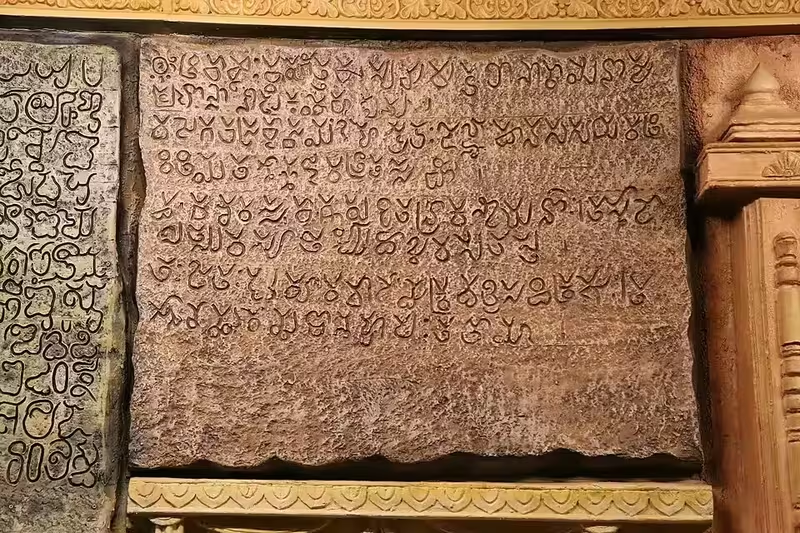
Inscriptions from this period reveal a language in transition, with Telugu gradually asserting its identity as a literary medium. The script used during this time was evolving from earlier Brahmi-derived scripts, developing the characteristic rounded forms that would become distinctive features of Telugu writing. The grammar and syntax of Old Telugu laid the foundation for the classical literary language that would flourish in subsequent centuries.
Middle Telugu Period (1000-1600 CE)
The Middle Telugu period marks the golden age of Telugu literature and the language's emergence as a sophisticated medium for poetry, drama, and religious texts. This era began with Nannaya Bhattaraka's pioneering translation of the Mahabharata into Telugu around 1025 CE, known as the "Andhra Mahabharatamu." This monumental work established Telugu as a legitimate language for epic poetry and set high standards for literary composition.
During this period, Telugu literature flourished under royal patronage, particularly from the Chalukya, Kakatiya, and later Vijayanagara dynasties. The language developed elaborate poetic conventions, sophisticated metrical patterns, and a rich vocabulary drawing from both native Dravidian roots and Sanskrit. Major poets like Tikkana, Pothana, and Srinatha created works that remain classics of Telugu literature. The Vijayanagara Empire's patronage of Telugu arts and literature was particularly significant, with Krishna Deva Raya himself composing in Telugu and supporting numerous poets at his court.
This period also saw the standardization of Telugu grammar, with several treatises on prosody and linguistics written to codify the rules of the language. The Telugu script achieved its characteristic rounded, cursive form during this era, making it one of the most aesthetically distinctive writing systems in India.
Modern Telugu Period (1600 CE-Present)
The Modern Telugu period witnessed significant changes in the language, including simplification of literary conventions, development of prose literature, and the emergence of regional dialects. The advent of print technology in the 19th century revolutionized Telugu literature, making texts more accessible and standardizing spelling and grammar.
The modern period brought new genres to Telugu literature, including novels, short stories, and journalism. The language adapted to express modern concepts and absorbed vocabulary from English and other languages. The 20th century saw the rise of Telugu cinema, which became a powerful medium for promoting and preserving the language. Contemporary Telugu continues to evolve, balancing traditional literary forms with modern colloquial usage.
The language received official recognition as a Classical Language by the Government of India in 2008, acknowledging its ancient heritage, independent tradition, and rich body of ancient literature. Today, Telugu thrives as both an official language in two Indian states and a vibrant medium for contemporary culture, media, and education.
Scripts and Writing Systems
Telugu Script Development
The Telugu script is an abugida writing system descended from the ancient Brahmi script through various intermediate forms. The script's evolution can be traced through inscriptions spanning more than 1,500 years, showing a gradual development from angular forms to the characteristic rounded shapes that distinguish modern Telugu writing. The earliest Telugu inscriptions used scripts that were transitional forms between Brahmi and the distinct Telugu script.
By the 5th-6th centuries CE, a recognizable proto-Telugu script began to emerge in the Deccan region. This early script shared similarities with other South Indian scripts like Kannada and Tamil, reflecting their common Brahmi ancestry. However, Telugu script developed unique characteristics, particularly in the shapes of certain consonants and the treatment of vowel marks.
Distinctive Features
The Telugu script is renowned for its rounded, flowing appearance, often described as one of the most aesthetically pleasing writing systems in the world. Unlike the angular forms of Devanagari or the straight lines of Tamil script, Telugu characters feature smooth curves and circular elements. This distinctive characteristic earned Telugu the description of having the most number of curves among Indian scripts.
The script consists of 60 symbols: 16 vowels, 3 vowel modifiers, and 41 consonants. Each consonant has an inherent 'a' vowel sound, and vowels can be modified using diacritical marks. The script is written from left to right, and words are generally separated by spaces in modern usage, though historically, texts were written continuously without word breaks.
Script Evolution and Standardization
The medieval period saw the Telugu script achieve its classical form, with the rounded characters becoming more uniform and standardized. Inscriptions and palm-leaf manuscripts from the Vijayanagara period show a highly developed script used for both sacred and secular texts. The invention of printing in the 19th century led to further standardization, as typefaces had to be designed for Telugu characters.
Modern Telugu script has undergone some reforms to simplify printing and digital representation while maintaining its traditional aesthetic qualities. The script is now fully supported in Unicode, enabling its use across digital platforms. Despite modernization, the essential character of Telugu writing—its graceful curves and balanced proportions—remains intact, preserving a visual tradition that connects contemporary readers with centuries of literary heritage.
Geographic Distribution
Historical Spread
The Telugu-speaking region has historically centered on the Andhra and Telangana areas of South India, corresponding roughly to the Krishna and Godavari river basins and the Deccan plateau. Ancient inscriptions indicate that Telugu was spoken across this region from at least the 6th century CE, gradually spreading its influence both inland and along the eastern coast.
The medieval period saw Telugu culture expand significantly under various dynasties. The Chalukya rulers promoted Telugu in Karnataka regions, while the Kakatiya dynasty strengthened its position in Telangana. The Vijayanagara Empire's patronage spread Telugu influence across much of South India, making it a language of administration and culture far beyond its original boundaries. Coastal trade also carried Telugu speakers to various parts of Southeast Asia.
Centers of Learning
Several cities emerged as major centers for Telugu language and literature. Hampi, the capital of the Vijayanagara Empire, became a flourishing center of Telugu literary activity, attracting poets and scholars from across the region. The royal court at Hampi patronized numerous Telugu poets, creating an environment where the language's literary potential was fully realized.
Golconda, under the Qutb Shahi dynasty, became another important center despite the rulers' Persian cultural background. The sultans patronized Telugu poets and allowed the language to flourish alongside Persian and Urdu. Other significant centers included Warangal (capital of the Kakatiya dynasty), Rajahmundry, Machilipatnam, and later, during the colonial period, Madras (now Chennai).
Modern Distribution
Today, Telugu is predominantly spoken in the states of Andhra Pradesh and Telangana, where it serves as the official language and primary medium of communication for the vast majority of the population. These two states, formed through the division of the original Andhra Pradesh state in 2014, together constitute the Telugu heartland with approximately 84 million Telugu speakers.
Significant Telugu-speaking populations also exist in neighboring states. In Karnataka, particularly in the border regions and Bangalore, several million Telugu speakers form a substantial linguistic minority. Tamil Nadu, especially Chennai and its surroundings, has large Telugu communities, as does Puducherry. Telugu speakers are also found in other parts of India, including Maharashtra, Odisha, and Chhattisgarh.
Beyond India, Telugu-speaking diaspora communities thrive in countries around the world. The United States, particularly in technology hubs like the San Francisco Bay Area and New Jersey, has large Telugu communities. Other countries with significant Telugu populations include the United Kingdom, Australia, Canada, and Gulf nations where Telugu speakers have migrated for employment opportunities. Globally, Telugu is spoken by an estimated 95 million people, making it one of the most widely spoken languages in the world.
Literary Heritage
Classical Literature
Telugu literary tradition boasts a rich classical heritage that rivals any in India. The foundation of Telugu classical literature was laid by Nannaya Bhattaraka in the 11th century with his translation of the Sanskrit Mahabharata. This work, known as "Andhra Mahabharatamu," introduced the champu style—alternating prose and verse—that would become characteristic of Telugu classical literature. Nannaya's work established Telugu as a sophisticated literary language capable of expressing complex philosophical and narrative content.
The tradition was continued by Tikkana Somayaji in the 13th century, who completed the Mahabharata translation, and Errapragada (also known as Errana) who filled in the middle portions. Together, these three poets, known as the "Kavitrayam" (Trinity of Poets), created a monumental work that remains central to Telugu literary consciousness. Their achievement demonstrated that Telugu could match Sanskrit in expressiveness while maintaining its distinct character.
Religious Texts
Telugu has an extensive corpus of religious literature spanning various traditions. Pothana's "Bhagavatamu" (15th century), a Telugu rendering of the Bhagavata Purana, stands as one of the most beloved devotional texts in the language. Written in simple, accessible Telugu, it brought profound religious philosophy to common people and remains widely read and recited today.
The Virashaiva tradition produced significant Telugu literature, expressing the devotional philosophy of Basavanna and other saints. Numerous devotional compositions (padams and kirtanas) were created by saint-poets, contributing to the bhakti movement in South India. These works combined spiritual depth with poetic beauty, making religious concepts accessible through the Telugu language's musical qualities.
Poetry and Drama
Telugu poetry reached extraordinary heights during the medieval period. The "Prabandha" tradition of long narrative poems flourished, with poets creating elaborate works on mythological, historical, and romantic themes. Srinatha, the 14th-century poet laureate of multiple kingdoms, exemplified the sophistication of Telugu poetry with his mastery of language and metrics.
The tradition of "Shatakams" (poems of one hundred verses) became particularly popular, allowing poets to display their linguistic virtuosity within a structured format. Drama also developed as a significant genre, with works combining poetry, music, and theatrical elements. The "Yakshagana" theatrical tradition and court performances fostered a dramatic literature that showcased Telugu's potential for dialogue and dramatic expression.
Scientific and Philosophical Works
Telugu was not limited to imaginative literature; it also served as a medium for scientific and philosophical discourse. Medical texts, astronomical treatises, and works on mathematics were composed in Telugu, making specialized knowledge accessible to regional scholars. Philosophical commentaries, particularly on Advaita Vedanta and other schools of Indian philosophy, were written in Telugu, contributing to intellectual discourse.
Grammatical treatises and works on poetics, such as those on "Alankara Shastra" (science of rhetoric), were composed to codify the rules of literary composition. These works established standards for Telugu poetry and prose, influencing generations of writers and preserving linguistic knowledge across centuries.
Grammar and Phonology
Key Features
Telugu grammar exhibits distinctive features characteristic of Dravidian languages while having developed unique structures over centuries. The language employs an agglutinative morphology, where words are formed by adding suffixes to root forms, allowing for the creation of complex meanings through systematic combinations. Telugu maintains three grammatical genders (masculine, feminine, and neuter), though the gender system operates differently from Indo-Aryan languages.
One of Telugu's most notable grammatical features is its elaborate system of verb conjugation, which marks tense, mood, person, number, and gender. The language distinguishes between inclusive and exclusive first-person plural forms, a feature not found in many Indo-Aryan languages. Telugu also employs postpositions rather than prepositions, with case relationships indicated through suffixes attached to noun stems.
Word order in Telugu is typically Subject-Object-Verb (SOV), differing from the Subject-Verb-Object pattern of English. The language uses a sophisticated system of honorifics and politeness levels, requiring speakers to choose appropriate forms based on social relationships and contexts.
Sound System
Telugu phonology is characterized by its extensive inventory of sounds and its emphasis on euphonic combinations. The language maintains a clear distinction between aspirated and unaspirated consonants, voiced and unvoiced sounds, and employs a full range of retroflex consonants—sounds produced with the tongue curled back—which are characteristic of South Indian languages.
A distinctive feature of Telugu phonology is that all native Telugu words end in vowels, contributing to the language's melodious quality and earning it the nickname "Italian of the East." This vowel-ending pattern gives Telugu speech a flowing, musical character. The language has a rich vowel system including short and long vowels, and diphthongs that add to its phonetic variety.
Telugu phonotactics favor certain sound combinations while avoiding others, resulting in characteristic sound patterns. When borrowing words from Sanskrit or other languages, Telugu typically adapts them to fit its phonological rules, often adding vowels to make words conform to native patterns. This tendency toward phonological adaptation has helped Telugu maintain its distinct sonic character even while absorbing extensive vocabulary from other languages.
Influence and Legacy
Languages Influenced
Telugu has had significant influence on other languages of South India and beyond. Its extensive literary tradition and cultural prestige led to Telugu vocabulary and expressions being adopted by neighboring languages. Kannada, particularly in regions historically ruled by Telugu-speaking dynasties, borrowed numerous Telugu words, especially in administrative, literary, and cultural domains.
The language has also influenced various tribal languages in central and eastern India, particularly in areas where Telugu speakers migrated or where Telugu served as a lingua franca for trade and administration. Telugu's impact extended to Southeast Asian languages through historical maritime trade connections, though to a lesser extent than Tamil.
Telugu's sophisticated literary conventions influenced poetic traditions in other South Indian languages, with the "champu" style and various metrical forms being adapted by poets writing in Kannada and other regional languages. The language's status during the Vijayanagara period made it a model for courtly literature across South India.
Loanwords
Telugu's relationship with Sanskrit has been profound and enduring. While maintaining its fundamental Dravidian structure, Telugu has borrowed extensively from Sanskrit, particularly vocabulary related to religion, philosophy, arts, science, and abstract concepts. This borrowing was not merely mechanical but involved creative adaptation, with Sanskrit words being modified to fit Telugu phonological patterns.
The process of Sanskritization enriched Telugu vocabulary while creating a stratified lexicon: "desi" (native Dravidian) words for everyday concepts and "tatsama" (Sanskrit-derived) words for formal, literary, and technical usage. This dual vocabulary system allowed Telugu to maintain its vernacular accessibility while developing capabilities for sophisticated literary and philosophical expression.
In more recent times, Telugu has absorbed words from Persian and Urdu, particularly in the Telangana region where these languages influenced local administration and culture. English has become a major source of loanwords in modern Telugu, especially for technological, administrative, and educational terminology. Contemporary Telugu freely incorporates English words, often adapting them to Telugu phonological and morphological patterns.
Cultural Impact
Beyond linguistics, Telugu has profoundly influenced South Indian cultural life. Telugu classical music, with its sophisticated ragas and talas, has been an integral part of Carnatic music tradition. Devotional songs, folk songs, and classical compositions in Telugu have enriched India's musical heritage.
Telugu cinema, commonly known as Tollywood, has emerged as one of India's largest film industries, promoting the language and culture across the country and internationally. Telugu films have reached global audiences, introducing Telugu language and culture to millions who might never have encountered it otherwise. The industry's success has ensured Telugu remains a vibrant, contemporary language.
Royal and Religious Patronage
Vijayanagara Empire
The Vijayanagara Empire (1336-1646 CE) represents perhaps the most significant period of royal patronage for Telugu language and literature. The empire's rulers, particularly Krishna Deva Raya (reigned 1509-1529), were themselves accomplished in Telugu and actively promoted the language at court. Krishna Deva Raya, despite being multilingual and learned in Sanskrit, chose to compose his literary works in Telugu, including the famous "Amuktamalyada," a devotional poem dedicated to Lord Vishnu.
The Vijayanagara court attracted the finest Telugu poets of the era, known as the "Ashtadiggajas" (Eight Elephants), who created masterworks under royal patronage. This golden period saw Telugu literature achieve unprecedented sophistication in poetic technique, literary theory, and aesthetic expression. The empire's support extended beyond poetry to include support for Telugu in administration, inscriptions, and religious institutions.
The capital at Hampi became a thriving center of Telugu culture, where poets, scholars, and artists gathered under royal protection and encouragement. This patronage continued through successive rulers, making the Vijayanagara period the classical age of Telugu literature. Even after the empire's decline, its legacy of promoting Telugu persisted in successor states.
Chalukya Dynasty
The Chalukya dynasty, particularly the Eastern Chalukyas who ruled the Vengi region (7th-12th centuries), played a crucial early role in promoting Telugu. They commissioned Telugu inscriptions and supported early Telugu poets, helping establish the language's literary credentials. The Chalukyas' patronage helped Telugu transition from purely inscriptional use to literary expression.
Under Chalukya rule, Telugu began to be used for more than administrative records, with poets starting to experiment with creative literary forms. This period laid the groundwork for the flowering of Telugu literature that would follow in subsequent centuries. The dynasty's support helped legitimize Telugu as a language worthy of royal attention and literary cultivation.
Religious Institutions
Temples and monasteries played vital roles in preserving and promoting Telugu language and literature. Major temples maintained scholars who composed devotional works in Telugu, making religious teachings accessible to common people who might not understand Sanskrit. Temples served as centers of learning where Telugu was taught alongside Sanskrit and other sacred texts.
The bhakti movement, with its emphasis on devotional poetry in vernacular languages, significantly boosted Telugu's religious literature. Saints and devotional poets composed thousands of songs and poems in Telugu, many of which remain central to religious practice today. These religious institutions ensured Telugu remained a living, evolving language connected to daily spiritual life rather than becoming merely a frozen classical language.
Modern Status
Current Speakers
Telugu today is spoken by approximately 95 million people, making it the third most spoken language in India after Hindi and Bengali, and the 15th most spoken language globally. The vast majority of Telugu speakers are concentrated in the states of Andhra Pradesh and Telangana, where the language dominates public life, education, and culture. Substantial Telugu-speaking populations exist in neighboring states and in urban centers across India.
The Telugu diaspora has grown significantly in recent decades, with large communities established in the United States, United Kingdom, Australia, Canada, and Gulf countries. These diaspora communities actively maintain the language through cultural organizations, language schools, and media, ensuring Telugu's vitality extends far beyond its traditional geographic boundaries. Second and third-generation Telugu speakers in diaspora settings often maintain at least conversational ability in the language, though with varying degrees of fluency.
Official Recognition
Telugu enjoys official language status in the Indian states of Andhra Pradesh and Telangana, where it is used for all government functions, education, and official communication. The language is one of 22 scheduled languages recognized in the Indian Constitution, entitling it to representation in national institutions and development support from the central government.
In 2008, Telugu received recognition as a Classical Language by the Government of India, a prestigious designation acknowledging its antiquity, independent tradition not borrowed from another language family, ancient literature considered a valuable heritage by speakers across generations, and literary tradition distinct from its modern form. This recognition places Telugu among an elite group of six classical languages in India, alongside Sanskrit, Tamil, Kannada, Malayalam, and Odia.
The classical language status has led to the establishment of centers for Telugu studies, increased funding for research and preservation, and heightened awareness of the language's historical importance. This recognition has strengthened efforts to document and preserve ancient Telugu texts and inscriptions.
Preservation Efforts
Various institutions work to preserve and promote Telugu language and literature. The Andhra Pradesh and Telangana governments support Telugu through education policies, cultural programs, and media. Universities maintain departments of Telugu studies, conducting research on language, literature, and linguistics. The Central Institute of Indian Languages and other national institutions support Telugu language development and standardization.
Digital preservation has become increasingly important, with projects to digitize ancient manuscripts, create digital libraries of Telugu texts, and develop language technologies. Telugu Wikipedia, with thousands of articles, represents collaborative efforts to make knowledge available in the language. Unicode support and the development of Telugu fonts and input methods have facilitated the language's use in digital contexts.
Organizations promote Telugu literature through awards, festivals, and publications. The Sahitya Akademi (National Academy of Letters) recognizes excellence in Telugu literature and supports writers. Cultural organizations host Telugu literary conferences, poetry readings, and discussions, keeping literary traditions alive while encouraging contemporary creative expression.
Learning and Study
Academic Study
Telugu is taught in schools across Andhra Pradesh and Telangana as the medium of instruction from primary through higher secondary levels. Universities in these states offer undergraduate and postgraduate programs in Telugu language and literature, training scholars and teachers. Research programs investigate various aspects of Telugu linguistics, literature, history, and culture, producing scholarly work that advances understanding of the language.
Several universities outside the Telugu-speaking region also offer Telugu programs, including institutions in other Indian states and international universities with South Asian studies programs. These programs typically focus on literature, linguistics, or Telugu as a language for research in South Indian history and culture. The availability of Telugu studies in academic institutions worldwide reflects the language's importance for understanding South Indian civilization.
Resources
Learning resources for Telugu have expanded significantly in recent decades. Traditional textbooks and grammar books are now supplemented by multimedia resources, online courses, and mobile applications. Language learning apps offer Telugu courses for beginners, while more advanced learners can access literature, news, and entertainment in Telugu through digital platforms.
Telugu cinema, television, and music provide immersive exposure to the language in contemporary usage. Streaming platforms make Telugu content available globally, allowing learners to hear authentic Telugu in various contexts. YouTube channels, podcasts, and social media in Telugu offer additional resources for language learners at all levels.
For those interested in classical Telugu literature, digital libraries provide access to texts with translations and commentaries. Academic journals publish research on Telugu language and literature, while popular publications promote contemporary Telugu writing. Cultural centers in diaspora communities often offer Telugu classes, maintaining the language across generations and introducing it to non-heritage learners interested in South Indian culture.
Conclusion
Telugu stands as a testament to the enduring vitality of India's linguistic heritage, successfully bridging ancient classical traditions with modern dynamism. From its origins as a Dravidian language in the Deccan region to its current status as one of India's most widely spoken languages, Telugu has maintained remarkable continuity while constantly evolving. Its recognition as a Classical Language honors more than 1,500 years of literary achievement, from the epic poetry of the Kavitrayam to contemporary cinema and literature.
The language's influence extends far beyond its 95 million speakers, shaping South Indian culture, contributing to Carnatic music, and enriching world cinema through Tollywood. Telugu's melodious sound, sophisticated literature, and beautiful script continue to captivate both native speakers and language enthusiasts. As Telugu navigates the challenges and opportunities of the digital age, its strong institutional support, vibrant literary culture, and passionate speaker community ensure this "Italian of the East" will continue to flourish, preserving its glorious past while embracing an equally promising future.


