Overview
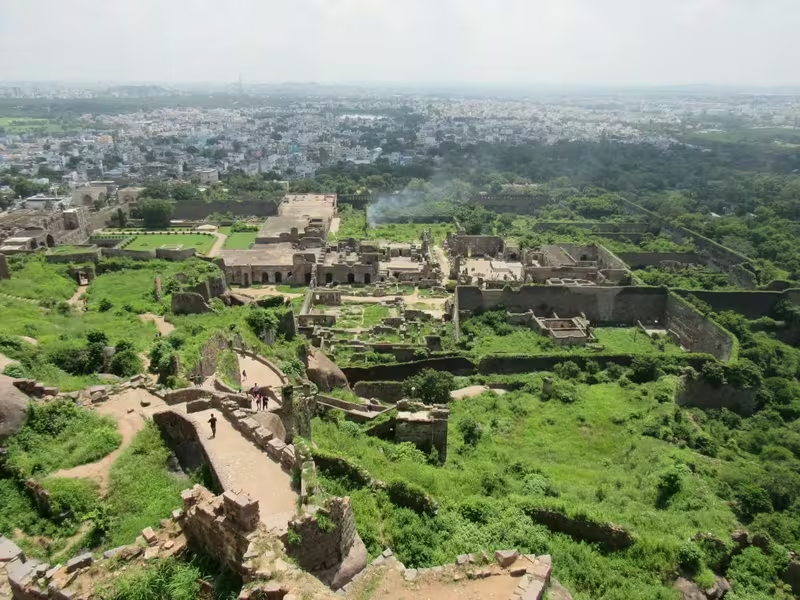
Golconda Fort stands as one of India's most magnificent fortified citadels, rising dramatically from granite hills on the western outskirts of modern Hyderabad, Telangana. This historic fortress, whose name became synonymous with immeasurable wealth due to its legendary diamond trade, represents over five centuries of Deccan history, from its humble origins as a Kakatiya mud fort in the 11th century to its zenith as the glittering capital of the Qutb Shahi dynasty.
The fort's significance extends far beyond its impressive military architecture. During the 16th and 17th centuries, Golconda emerged as the world's premier diamond trading center, controlling the output of nearby mines including the famous Kollur Mine. The term "Golconda Diamond" became globally recognized, associated with exceptional gems including the Koh-i-Noor, the Hope Diamond, and numerous other stones that would eventually grace royal crowns and museums worldwide. This economic prosperity funded spectacular architectural developments and positioned Golconda as a crucial player in Deccan politics.
Today, though abandoned and in ruins, Golconda Fort remains a testament to medieval Indian engineering prowess, featuring sophisticated acoustic warning systems, ingenious water management, and formidable defensive architecture. Recognized on UNESCO's tentative list for World Heritage Site status since 2014 as part of the "Monuments and Forts of the Deccan Sultanate," it continues to captivate visitors and historians alike with its blend of military might and mercantile glory.
Etymology and Names
The name "Golconda" likely derives from the Telugu "Golla Konda," meaning "shepherd's hill," reflecting the area's pastoral origins before its transformation into a fortified city. This etymology suggests the site's early association with local communities who used the granite hillocks for grazing livestock. An alternative theory connects the name to "Mankal," the settlement's designation during the pre-Kakatiya period.
Under successive dynasties, the name evolved in pronunciation and spelling while maintaining its essential character. Persian chroniclers of the Bahmani and Qutb Shahi periods recorded it as "Golconda" or "Golkonda," the form that would gain international recognition through European trading companies. The site's fame was such that "Golconda" became a byword in European languages for fabulous wealth, particularly in the phrase "rich as Golconda," used well into the colonial era.
The transformation from a simple descriptive place name to a globally recognized symbol of wealth paralleled the fort's own evolution from a regional stronghold to an international trading hub. This linguistic journey reflects the cultural synthesis that characterized the Deccan, where Telugu, Persian, Arabic, and later European influences merged.
Geography and Location
Golconda Fort occupies a strategic position on a granite hill approximately 120 meters above the surrounding plain, located at coordinates 17°22'59"N, 78°24'04"E. This elevated position, approximately 11 kilometers west of present-day Hyderabad's city center, provided natural defensive advantages while offering commanding views over the surrounding Deccan plateau. The granite bedrock itself became integral to the fort's architecture, with builders incorporating natural rock formations into the defensive walls.
The location's strategic value extended beyond military considerations. Positioned in the eastern Deccan, Golconda sat at the intersection of trade routes connecting the prosperous ports of the Coromandel coast with the interior kingdoms. The proximity to diamond-bearing regions, particularly the legendary Kollur Mine and other deposits in the Krishna River basin, proved economically decisive. These geological features—the volcanic pipes and alluvial deposits that produced diamonds—occurred within a relatively compact area that Golconda's rulers could effectively control.
The Deccan plateau's tropical wet and dry climate, characterized by hot summers and moderate monsoons, influenced both the fort's water management systems and its seasonal patterns of military campaigns. The granite hills provided not only defensive positions but also retained water in natural and artificial reservoirs, crucial for withstanding prolonged sieges. This combination of geological, strategic, and economic advantages made Golconda's location nearly ideal for a medieval power center.
Ancient and Early Medieval History
While Golconda's documented history begins in the medieval period, the site likely saw earlier human activity given its water sources and strategic position. However, systematic fortification began only in the 11th century under the Kakatiya dynasty, which ruled much of present-day Telangana and Andhra Pradesh from their capital at Warangal.
King Pratāparudra of the Kakatiya dynasty initiated the fort's construction around 1143 CE, though the exact date remains uncertain. The original fortification consisted of mud walls—a common building material in the Deccan that, despite its humble nature, could be remarkably effective when properly maintained. This early fort served as a regional outpost in the Kakatiya kingdom's network of fortifications, protecting the eastern approaches to Warangal.
The Kakatiya period established patterns that would define Golconda's later importance: control over local diamond deposits, strategic military positioning, and integration into regional trade networks. When the Delhi Sultanate's forces under Malik Kafur invaded the Deccan in the early 14th century, disrupting Kakatiya power, Golconda passed briefly to the Musunuri Nayakas, Telugu warrior chiefs who attempted to preserve Hindu rule in the region after the Kakatiya collapse in 1323.
The Bahmani Period
Golconda's transformation from a regional fort to a significant power center began during the Bahmani Sultanate period. The fort was ceded to the Bahmani rulers from the Musunuri Nayakas during the reign of Sultan Mohammed Shah I, amid the first major conflict between the Bahmani Sultanate and the Vijayanagar Empire—two powers that would dominate Deccan politics for nearly two centuries.
Under Bahmani control, Golconda gained importance as a provincial headquarters. The Bahmani Sultans, ruling from their capital at Gulbarga (later Bidar), appointed governors to manage their eastern territories, and Golconda's strategic position made it a natural administrative center. The fort began to see improvements beyond its original mud walls, though the major architectural transformations would come later.
The appointment of Sultan Quli Qutb-ul-Mulk as Governor of Hyderabad under the Bahmani Sultans proved historically decisive. An immigrant from Persia who had risen through military service, Sultan Quli recognized Golconda's potential. When the Bahmani Sultanate began fragmenting in the late 15th century following the death of Sultan Mahmood Shah, regional governors increasingly acted independently. Sultan Quli, observing the sultanate's disintegration, made his fateful decision to transform Golconda from a provincial outpost into an independent capital.
The Qutb Shahi Golden Age
The establishment of the Golconda Sultanate under Sultan Quli Qutb Shah in 1518 inaugurated the fort's golden age. Sultan Quli immediately undertook massive fortification projects, replacing the Kakatiya mud walls with imposing granite ramparts. The transformation from mud to stone symbolized Golconda's elevation from regional fort to capital of an independent sultanate that would endure for 169 years.
The Qutb Shahi rulers invested enormous resources in developing Golconda's defensive capabilities. The fortification system eventually encompassed three concentric walls stretching approximately 11 kilometers in circumference, with 87 bastions mounting heavy cannons. The innermost citadel, perched on the hill's summit, housed the royal apartments and treasury. Engineers designed sophisticated systems for water supply, creating reservoirs and channels that could sustain the fort during prolonged sieges.
Perhaps the fort's most remarkable feature was its acoustic engineering. The architects incorporated an acoustic warning system allowing sound to travel from the main entrance—the Fateh Darwaza or Victory Gate—to the citadel nearly a kilometer away. A clap or announcement at the entrance could be heard at the highest point, providing early warning of approaching visitors or threats. This medieval "communication system" demonstrated the advanced understanding of sound propagation and architectural acoustics achieved by Golconda's builders.
The Diamond Trade and Economic Prosperity
Golconda's transformation into a byword for wealth stemmed directly from its control over the Deccan's diamond-producing regions. The nearby Kollur Mine, located in the Krishna River basin, proved extraordinarily productive during the 16th and 17th centuries, yielding large, high-quality diamonds that commanded premium prices in global markets. Other significant deposits in the region supplemented Kollur's output, creating a virtual monopoly that Golconda's rulers zealously guarded.
The term "Golconda Diamonds" became the highest mark of quality in gem markets from Venice to Isfahan to Beijing. These diamonds were characterized by their exceptional clarity and size, with the alluvial deposits of the Krishna River system producing stones of remarkable purity. The most famous Golconda diamonds include the Koh-i-Noor (now in the British Crown Jewels), the Hope Diamond (in the Smithsonian Institution), the Regent Diamond (in the Louvre), the Wittelsbach-Graff Diamond, and the Daria-i-Noor (in the Iranian Crown Jewels).
The diamond trade attracted merchants from across the known world. European trading companies—Portuguese, Dutch, English, and French—established presences in Golconda and nearby ports like Masulipatnam, competing for access to the gem supplies. Persian, Arab, and Armenian merchants maintained traditional trading relationships, while connections extended to Southeast Asian and Chinese markets. This international commerce generated immense revenue for the Qutb Shahi treasury, funding military forces, architectural projects, and a cosmopolitan court culture.
The economic model was sophisticated: the sultans maintained direct control over major mines, leasing others to contractors while taxing all diamond sales. Royal workshops cut and polished stones, adding value before export. This system created a wealthy merchant class, skilled artisan communities, and made Golconda one of the wealthiest cities in 17th-century Asia. European travelers' accounts consistently emphasized the city's prosperity, describing bazaars filled with luxury goods and a population enjoying considerable affluence by contemporary standards.
Architecture and Monuments
The Golconda Fort complex represents the culmination of Deccan military architecture, synthesizing Persian, Indian, and local building traditions. The fortification system's scale and sophistication reflected both the wealth generated by diamond trade and the military threats the sultanate faced from Vijayanagar, rival Deccan sultanates, and eventually the Mughal Empire.
The fort's outer wall, constructed primarily during the Qutb Shahi period, incorporated natural granite outcroppings into its design, creating a formidable barrier that followed the terrain's contours. Eight massive gates punctuated these walls, each a defensive strongpoint with mechanisms to repel attackers. The main entrance, the Balahissar Gate or Bala Hissar Darwaza, featured pointed arches characteristic of Persian-influenced Islamic architecture, while the Fateh Darwaza commemorated Golconda's military victories.
Within the citadel stood palaces, administrative buildings, mosques, and arsenals, though many now survive only as ruins. The Baradari, or palace halls, featured distinctive Qutb Shahi architectural elements including domed roofs, pointed arches, and stucco ornamentation. The acoustically designed structures demonstrated sophisticated understanding of sound properties, while the water management system—featuring wells, channels, and storage tanks carved into the granite—ensured water supply during sieges.
Beyond the fort proper, the Qutb Shahi rulers developed the surrounding area with gardens, suburban palaces, and the spectacular Qutb Shahi Tombs, located about a kilometer from the fort. These tombs, where the dynasty's rulers rest, showcase Indo-Islamic architecture at its finest, with bulbous domes, intricate stucco work, and Persian-style gardens. The architectural ensemble of fort and tombs collectively represents the Qutb Shahi dynasty's artistic legacy.
Military History and the Mughal Siege
Golconda's military history culminated in one of the most famous sieges in Indian history. The fort's formidable defenses had withstood multiple attacks throughout the Qutb Shahi period, repelling assaults from neighboring sultanates and Vijayanagar forces. However, the greatest test came from the Mughal Empire under Emperor Aurangzeb, whose ambition to control the entire subcontinent inevitably targeted the wealthy Deccan sultanates.
The Mughal siege of Golconda began in 1687, during Aurangzeb's prolonged Deccan campaigns. The fort's commander, Abul Hasan Qutb Shah, the last ruler of the Qutb Shahi dynasty, prepared for a long defense. The fortifications, water systems, and stored provisions allowed the garrison to resist Mughal assaults for months. Artillery bombardments failed to breach the granite walls significantly, while direct assaults proved costly for the attackers.
According to historical accounts, the siege's resolution came not through military conquest but through betrayal. A fortress commander, allegedly bribed by the Mughals, opened a gate allowing Mughal forces to enter. The exact circumstances remain debated by historians, but the result was decisive: Golconda fell to Aurangzeb's forces, ending the Qutb Shahi dynasty and the sultanate's independence. Abul Hasan Qutb Shah was captured and imprisoned, dying in captivity years later.
The Mughal conquest marked the end of Golconda's political importance. Aurangzeb incorporated the territory into the Mughal Empire, and the fort gradually lost its military significance as the focus of power shifted to other centers. The diamond trade, while continuing, became less centralized as Mughal administrative changes and the eventual establishment of the Hyderabad princely state under the Asaf Jahi dynasty (the Nizams) created new political realities.
Decline and Abandonment
Following the Mughal conquest, Golconda entered a long period of decline. The fort continued to serve military purposes intermittently but never regained its status as a political capital. The Asaf Jahi dynasty, which established the princely state of Hyderabad in 1724 after the Mughal Empire's weakening, chose to build a new city—Hyderabad—rather than restore Golconda's former glory. The newer city, located nearby, gradually absorbed the population and economic activity.
The diamond mines themselves became exhausted during the 18th century. The alluvial deposits that had made Golconda synonymous with wealth were worked out, and as diamond discoveries in Brazil and later South Africa flooded global markets, the Deccan's mines lost their competitive advantage. This economic transformation removed the primary source of wealth that had sustained Golconda's prosperity.
The fort structures, deprived of maintenance and subject to weathering, deteriorated into picturesque ruins. The monsoon rains, while less harsh than in coastal regions, gradually eroded the mortar. The grand palaces lost their roofs, and vegetation colonized the walls. Local populations used the ruins as a stone quarry, removing dressed stone blocks for construction elsewhere—a common fate for abandoned medieval structures across India.
By the 19th century, Golconda had become primarily a destination for antiquarians and tourists rather than a living city. British colonial officers and travelers described the atmospheric ruins, often in romanticized terms that emphasized the contrast between past glory and present desolation. This perception, while perpetuating certain stereotypes about Indian history, also contributed to growing awareness of the site's historical importance.
Modern Status and Heritage Conservation
Golconda Fort today stands as one of India's most visited historical monuments, managed by the Archaeological Survey of India (ASI). The site is open to the public, attracting both domestic and international tourists who come to experience its architectural grandeur, learn its history, and enjoy panoramic views of Hyderabad from the summit. The fort's proximity to Hyderabad's urban sprawl makes it easily accessible, contributing to its popularity.
Conservation efforts have focused on stabilizing the remaining structures, preventing further deterioration, and presenting the site to visitors. The ASI has undertaken various restoration projects, though these must balance preservation with the fort's status as an archaeological ruin. A popular evening sound and light show narrates Golconda's history, though historians debate the historical accuracy of some dramatic elements included for entertainment value.
In 2014, UNESCO placed Golconda on its tentative list for World Heritage Site designation as part of a serial nomination titled "Monuments and Forts of the Deccan Sultanate," which includes sites from multiple Deccan sultanates. This recognition acknowledges Golconda's outstanding universal value as an example of medieval Indian military architecture and its role in the Deccan's cultural history. Achieving full World Heritage status would bring additional resources for conservation and further elevate the site's international profile.
Modern Hyderabad has expanded to surround Golconda, creating both opportunities and challenges. Urban development pressures have led to concerns about encroachment and environmental impacts on the fort complex. Balancing heritage preservation with the needs of a growing metropolitan area remains an ongoing challenge. However, Golconda's iconic status and tourism importance provide strong incentives for its continued protection.
Cultural Legacy
Golconda's cultural impact extends far beyond its physical ruins. The name itself entered global languages as a metaphor for fabulous wealth, appearing in literature from across the world. European literature of the 17th and 18th centuries frequently referenced Golconda when describing opulence, while the phrase "as rich as Golconda" became proverbial. This linguistic legacy persists even as knowledge of the actual historical city has faded in popular consciousness.
The fort has inspired artists, photographers, and filmmakers, serving as a location for numerous Indian films and a subject for artistic representation. The dramatic ruins against the backdrop of the Deccan plateau have made it a favorite subject for photographers, particularly at sunset when the granite walls glow golden. Contemporary artists continue to find inspiration in Golconda's architectural forms and historical resonances.
In academic circles, Golconda represents a crucial case study for understanding the Deccan Sultanates, the diamond trade's economic history, medieval military architecture, and the complex cultural synthesis that characterized the region. Historians of technology study its acoustic systems and water management, while art historians analyze its architectural synthesis of Persian and Indian elements. The site continues to generate scholarly publications examining various aspects of its history and significance.
For Hyderabad's residents, Golconda serves as a connection to the region's pre-modern past and a symbol of local identity. School groups regularly visit for educational purposes, and the fort features prominently in local cultural narratives about Hyderabad's heritage. This contemporary relevance ensures that Golconda remains not merely a historical ruin but a living part of the region's cultural landscape.