Overview
The Ajanta Caves represent one of the most significant achievements of ancient Indian art and architecture. Located in the Aurangabad district of Maharashtra, this extraordinary complex consists of 30 rock-cut Buddhist cave monuments that were created over an extended period spanning from the second century BCE to approximately 480 CE. These caves are not merely architectural wonders but serve as a comprehensive repository of Buddhist religious art, philosophy, and monastic life during ancient India.
Carved into a horseshoe-shaped cliff along the Waghora River gorge, the Ajanta Caves showcase the remarkable skill and dedication of ancient Buddhist monks and artisans who transformed solid basalt rock into elaborate prayer halls, monasteries, and artistic masterpieces. The caves are particularly renowned for their exquisite paintings and sculptures that depict various aspects of Buddhist life, including scenes from the Jataka tales (stories of Buddha's previous births), the life of Gautama Buddha, and various celestial beings such as Bodhisattvas.
The caves were designated as a UNESCO World Heritage Site in 1983, recognized under cultural criteria (i), (ii), (iii), and (vi) for representing masterpieces of human creative genius, exhibiting important interchange of human values, bearing exceptional testimony to a cultural tradition, and being directly associated with events and living traditions of outstanding universal significance. Today, the Ajanta Caves stand as a testament to the artistic excellence and religious devotion of ancient India, attracting scholars, art historians, and visitors from around the world.
History
The Ajanta Caves were created in two distinct phases, reflecting different periods of Buddhist art and patronage in ancient India. The earlier phase dates from approximately the second century BCE to the first century BCE, during which the first Buddhist caves were excavated. This initial phase coincided with the rule of the Satavahana dynasty, which was known for its patronage of Buddhist establishments across the Deccan region.
The second and more extensive phase of construction occurred during the fifth century CE, approximately 400-480 CE, under the patronage of the Vakataka dynasty. This later period saw the creation of most of the caves that visitors see today, including the most elaborate and artistically sophisticated ones. The Vakataka rulers, particularly Emperor Harishena, were great patrons of Buddhist art and architecture, and their support led to an unprecedented flourishing of artistic activity at Ajanta.
Construction
The construction of the Ajanta Caves was an extraordinary feat of ancient engineering and artistry. Working entirely by hand, artisans carved into the solid basalt rock of the cliff face, creating elaborate structures from top to bottom. This technique, known as rock-cut architecture, required immense precision and planning, as any mistake could not be easily corrected.
The caves served different purposes within the Buddhist monastic community. Some caves, known as chaityas or chaitya-grihas, were prayer halls featuring elaborate facades and containing stupas (dome-shaped structures) for worship. Other caves, called viharas, served as monasteries with residential cells for monks arranged around a central hall. The viharas typically featured a shrine with a Buddha statue at the rear wall.
The artistic work at Ajanta employed several sophisticated techniques. The paintings, which are among the most celebrated aspects of the caves, were created using a tempera technique on dry plaster. Artists first prepared the rock surface with a layer of mud mixed with organic materials, followed by a layer of lime plaster. Natural pigments derived from minerals and plants were then applied to create the vibrant colors that, remarkably, have survived for centuries, though somewhat faded.
Through the Ages
After the fifth century CE, the Ajanta Caves gradually fell into disuse as Buddhism declined in the region and patronage shifted to other religious traditions. The remote location of the caves, hidden in a horseshoe-shaped gorge and surrounded by dense forest, led to their abandonment and eventual obscurity. For more than a millennium, the caves remained largely forgotten, known only to local shepherds and villagers.
The modern rediscovery of Ajanta occurred in April 1819 when a British officer named John Smith, part of a hunting party from the 28th Cavalry regiment, accidentally stumbled upon the entrance to Cave 10 while hunting tigers in the area. This discovery sparked considerable interest among British colonial officials and scholars, leading to the documentation and study of the caves.
In the decades following their rediscovery, the caves suffered some damage from overzealous early visitors and amateur attempts at preservation. However, in the early twentieth century, the Archaeological Survey of India (ASI) began systematic conservation efforts. The caves were declared a protected monument, and scientific methods were employed to preserve the delicate paintings and structures. Major restoration work was undertaken in 1999, focusing on protecting the paintings from moisture, fungal growth, and environmental degradation.
Architecture
The architectural design of the Ajanta Caves reflects the evolution of Buddhist rock-cut architecture over several centuries. The caves are numbered 1 through 30, though this numbering was assigned arbitrarily during the British period and does not reflect their chronological order of construction. The earlier caves (notably Caves 9, 10, 12, 13, and 15A) belong to the Hinayana phase of Buddhism, while the later caves represent the Mahayana phase, which featured more elaborate iconography and greater emphasis on Bodhisattva imagery.
The chaitya halls, such as Caves 9, 10, 19, and 26, feature distinctive architectural elements including high vaulted ceilings with wooden ribs, elaborate facades with large horseshoe-shaped windows (chaitya windows), and a central nave leading to a stupa. The interiors are characterized by rows of pillars that create side aisles, allowing devotees to perform ritual circumambulation around the stupa.
The vihara caves typically follow a square plan with a central hall surrounded by small cells that served as living quarters for monks. These cells usually measure approximately 2 to 3 meters square and feature rock-cut platforms that served as beds. The later viharas are more elaborate, featuring decorated pillars, ornate doorways, and subsidiary shrines in addition to the main Buddha shrine.
Key Features
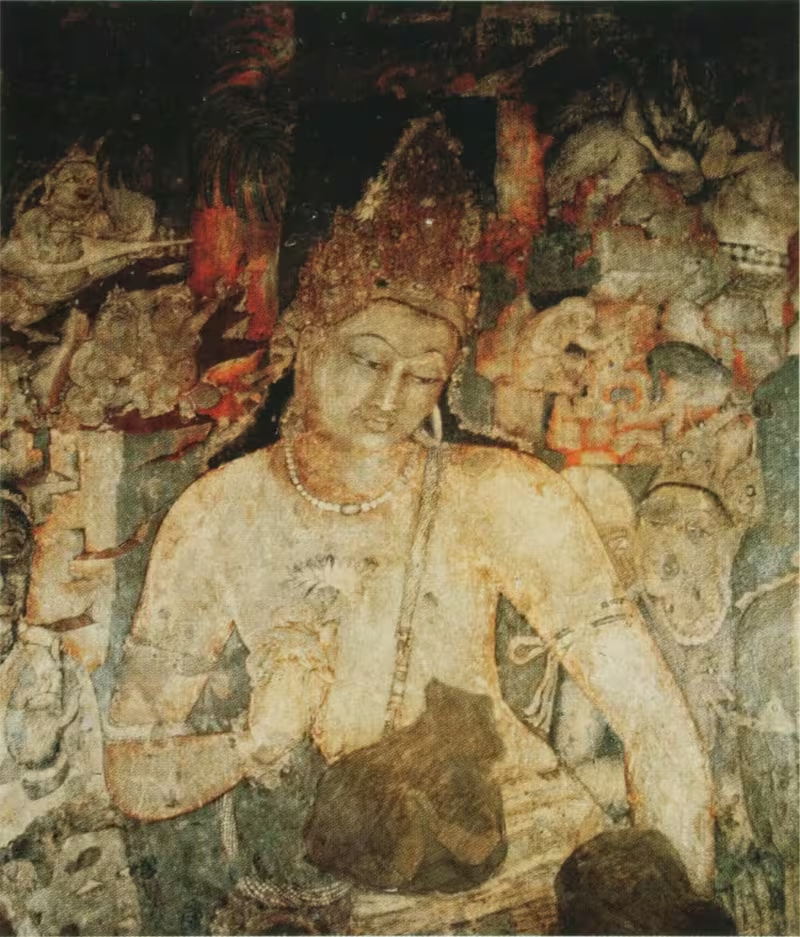
Cave 1, one of the most magnificent viharas, features some of the finest paintings at Ajanta, including the famous Bodhisattva Padmapani (holding a lotus) and Bodhisattva Vajrapani (holding a thunderbolt). The cave's pillared hall is decorated with elaborate capitals featuring various motifs, and the ceiling is adorned with intricate geometric and floral patterns.
Cave 2 is notable for its well-preserved paintings covering the walls and ceiling, depicting scenes from the Jataka tales and various celestial beings. The cave also features an intricately carved doorway leading to the main shrine.
Caves 9 and 10, among the earliest caves at the site, showcase the simpler aesthetic of early Buddhist architecture. Cave 10, the oldest surviving chaitya hall at Ajanta, features a vaulted ceiling supported by wooden ribs and a simple stupa at the far end.
Cave 16 is particularly significant as it contains an inscription identifying it as a gift from Varahadeva, a minister under Emperor Harishena. This cave features outstanding paintings, including scenes from the life of Buddha and various Jataka tales.
Cave 19 represents the pinnacle of rock-cut chaitya architecture at Ajanta, with an ornate facade featuring elaborate sculptures and a richly decorated interior with a large stupa surrounded by standing Buddha figures.
Cave 26, another magnificent chaitya hall, features a colossal reclining Buddha sculpture depicting the Parinirvana (the passing away of Buddha), which is considered one of the masterpieces of ancient Indian sculpture.
Decorative Elements
The paintings at Ajanta Caves are their most celebrated feature and are considered masterpieces of ancient Indian art. These frescoes employ a sophisticated color palette derived from natural pigments: red and yellow ochres, burnt sienna, lime white, lamp black, and a distinctive lapis lazuli blue. The artists demonstrated remarkable skill in depicting human emotions through gesture, pose, and facial expressions, a technique that came to be known as the "Ajanta style."
The paintings primarily depict scenes from the Jataka tales, which narrate the previous lives of Buddha in both human and animal forms, illustrating Buddhist moral principles. Other paintings show scenes from the life of Gautama Buddha, including his birth, enlightenment, and teaching. The caves also feature numerous images of Bodhisattvas, celestial beings who postponed their own enlightenment to help others, depicted with graceful postures and elaborate ornaments.
The sculptural decoration at Ajanta includes intricately carved doorways, pillars with elaborate capitals featuring various motifs (including animals, humans, and celestial beings), and Buddha statues in various mudras (hand gestures). The later caves feature particularly sophisticated sculptural programs that complement and enhance the painted decorations.
Cultural Significance
The Ajanta Caves hold immense cultural and religious significance as one of the most important centers of Buddhist art and learning in ancient India. They represent a crucial link in understanding the development of Buddhist philosophy, particularly the transition from Hinayana to Mahayana Buddhism, which is reflected in the changing iconography and architectural styles across the two phases of construction.
From an artistic perspective, Ajanta established stylistic conventions that influenced Buddhist art throughout Asia, particularly in Sri Lanka, China, and Southeast Asia. The "Ajanta style" of painting, characterized by flowing lines, naturalistic depictions, and sophisticated use of color and shading, became a model for Buddhist artistic expression across cultures and centuries.
The caves also provide invaluable insights into various aspects of ancient Indian society, including clothing styles, architectural practices, court life, and social customs of the period. The paintings depict a wide range of subjects beyond religious themes, including palace scenes, market places, and everyday life, offering historians a visual record of ancient Indian civilization.
UNESCO World Heritage Status
The Ajanta Caves were inscribed on the UNESCO World Heritage List in 1983 during the 7th session of the World Heritage Committee. The inscription recognized the caves under four cultural criteria:
Criterion (i): The caves represent a masterpiece of human creative genius, with paintings and sculptures that demonstrate exceptional artistic achievement and technical skill.
Criterion (ii): The caves exhibit an important interchange of human values over centuries, influencing Buddhist art throughout Asia and representing the pinnacle of ancient Indian artistic expression.
Criterion (iii): The caves bear exceptional testimony to the Buddhist cultural tradition in ancient India, documenting the evolution of Buddhist art and architecture over approximately 680 years.
Criterion (vi): The caves are directly associated with Buddhist philosophy and religious practices, containing visual representations of Jataka tales and Buddhist teachings that have continued significance for Buddhist communities worldwide.
The UNESCO designation covers a core area of 82.42 square kilometers with a buffer zone of 786.76 square kilometers, ensuring comprehensive protection for the caves and their surrounding environment. The World Heritage status has brought international attention to the importance of preserving these monuments and has facilitated funding for conservation efforts.
Visitor Information
The Ajanta Caves are open to visitors throughout the year, though they remain closed on Mondays. The caves are typically open from 9:00 AM to 5:30 PM, with the ticket counter closing earlier. The best time to visit is during the cooler months from October to March, when the weather is pleasant for exploring the extensive cave complex. The post-monsoon period (October-November) is particularly beautiful as the surrounding landscape is lush and green.
Entry fees are differentiated between Indian nationals (₹40) and foreign tourists (₹600), with additional charges for video cameras. Children under 15 years of age receive free entry. The site offers basic facilities including parking areas, restrooms, and a cafeteria. Authorized guides are available at the entrance and can provide valuable historical and artistic context during the visit.
Photography is permitted inside the caves, but the use of flash is strictly prohibited to protect the delicate ancient paintings. Visitors are also requested not to touch the paintings or sculptures, as oils from skin can cause damage to these fragile artworks. Maintaining silence inside the caves is encouraged to preserve the contemplative atmosphere and show respect for the religious significance of the site.
How to Reach
The nearest major city to Ajanta Caves is Aurangabad, located approximately 100 kilometers away. Aurangabad is well-connected by air, rail, and road to major Indian cities. Aurangabad Airport (Chikkalthana Airport) receives flights from Mumbai, Delhi, and other major cities. From Aurangabad, visitors can hire taxis or take buses to reach Ajanta, with the journey taking approximately 2-3 hours by road.
The nearest railway station is Jalgaon, located about 60 kilometers from Ajanta, which is on the main Mumbai-Delhi railway line and well-connected to major cities across India. From Jalgaon, buses and taxis are available to reach the caves. Maharashtra State Road Transport Corporation (MSRTC) operates regular bus services between Aurangabad, Jalgaon, and Ajanta.
Private vehicles and taxis can be hired from Aurangabad for a more comfortable journey. The road to Ajanta is well-maintained, passing through scenic countryside. Many visitors prefer to stay in Aurangabad and make a day trip to Ajanta, as accommodation options near the caves themselves are limited.
Nearby Attractions
The Ellora Caves, another UNESCO World Heritage Site, are located approximately 100 kilometers from Ajanta and can be visited as part of the same trip. Ellora features 34 rock-cut caves representing Buddhist, Hindu, and Jain traditions, including the famous Kailasa temple (Cave 16), which is considered one of the most remarkable rock-cut structures in the world.
Aurangabad city itself offers several historical attractions, including the Bibi Ka Maqbara (often called the "mini Taj Mahal"), built in 1660 by Mughal Emperor Aurangzeb's son as a mausoleum for his mother. The city also features the Aurangabad Caves, a smaller group of rock-cut caves, and several medieval monuments from the Mughal period.
The Daulatabad Fort, located about 15 kilometers from Aurangabad, is an impressive medieval fortress with ingenious defensive mechanisms and offers panoramic views of the surrounding countryside. The Panchakki (water mill), also in Aurangabad, is a 17th-century engineering marvel demonstrating medieval Indian hydraulic technology.
Conservation
The conservation status of the Ajanta Caves is generally considered good, though the site faces ongoing challenges. The Archaeological Survey of India (ASI), which manages the site, has implemented various measures to protect the caves and their artwork. These include controlling visitor numbers during peak seasons, installing proper lighting that minimizes heat and light damage, and maintaining optimal humidity levels within the caves.
The primary threats to the caves include environmental factors such as moisture infiltration, which can lead to fungal growth on the paintings. The basalt rock itself is relatively porous, allowing water seepage during the monsoon season. Climate change and changing rainfall patterns pose additional concerns for long-term preservation. The increasing number of tourists, while economically beneficial to the region, also presents conservation challenges through factors such as increased carbon dioxide levels inside the caves, physical wear on pathways, and potential accidental damage.
Conservation efforts have included the installation of dehumidifiers in caves with significant moisture problems, the creation of drainage systems to divert water away from the cave openings, and regular monitoring of the structural stability of the caves. The ASI has also conducted detailed documentation of the paintings using advanced photographic techniques, creating a comprehensive digital archive that serves both research and preservation purposes.
Major restoration work undertaken in 1999 focused on cleaning the paintings, removing biological growth, and stabilizing areas of flaking paint. However, conservation philosophy at Ajanta emphasizes minimal intervention, preserving the caves in their current state rather than attempting extensive restoration that might compromise their authenticity. International cooperation with conservation organizations has brought expertise and resources to support ongoing preservation efforts.
Timeline
Early Phase Begins
First caves excavated during the Satavahana period, marking the beginning of rock-cut construction at Ajanta
Early Caves Completed
Completion of early Hinayana phase caves including Caves 9, 10, 12, 13, and 15A
Second Phase Begins
Renewed activity at Ajanta begins under Vakataka patronage
Peak Activity
Intensive construction and artistic activity during the reign of Emperor Harishena
Activity Ceases
Approximate end of major construction and artistic work at Ajanta
Site Abandoned
Gradual abandonment of the caves as Buddhism declines in the region
Rediscovery
British officer John Smith accidentally rediscovers the caves while hunting
ASI Conservation Begins
Archaeological Survey of India initiates systematic conservation efforts
UNESCO World Heritage Status
Ajanta Caves inscribed on UNESCO World Heritage List
Major Restoration
Comprehensive conservation project undertaken to preserve paintings and structures
See Also
- Ellora Caves - Nearby rock-cut caves featuring Buddhist, Hindu, and Jain monuments
- Satavahana Dynasty - Early patrons of Ajanta Caves
- Vakataka Dynasty - Major patrons during the second phase of construction
- Buddhist Architecture in India - Overview of Buddhist architectural traditions