Overview
The Group of Monuments at Hampi represents one of the most significant archaeological treasures of India, showcasing the magnificent remnants of the Vijayanagara Empire’s capital city. Located in east-central Karnataka in the Vijayanagara district, this UNESCO World Heritage Site spans approximately 41.5 square kilometers of spectacular ruins set against a dramatic landscape of ancient granite formations. Hampi’s historical significance extends far beyond its medieval glory, as this sacred site is mentioned in ancient Hindu texts including the Ramayana and various Puranas as Pampa Devi Tirtha Kshetra.
The ruins of Hampi stand as an extraordinary testament to the architectural brilliance, artistic sophistication, and administrative prowess of the Vijayanagara Empire, which flourished from the 14th to 16th centuries. The site encompasses over 1,600 surviving monuments, including temples, palaces, royal structures, water systems, market streets, and fortifications, all constructed primarily from the region’s abundant granite. The architectural ensemble demonstrates a remarkable fusion of South Indian temple architecture with Indo-Islamic influences, particularly visible in the palace complexes and pavilions.
Today, Hampi continues to function as both an archaeological wonder and a living religious center. The Virupaksha Temple, dedicated to Lord Shiva, remains an active place of worship, maintaining an unbroken tradition spanning over a millennium. The site also houses an Adi Shankara-linked monastery and various other functioning religious institutions. This unique combination of ruined grandeur and continuing spiritual practice creates an atmosphere where visitors can experience both the glory of a vanished civilization and the continuity of Indian cultural traditions.
History
Ancient Origins and Mythological Significance
Long before the Vijayanagara Empire established its capital here, Hampi held sacred status in Hindu tradition. Ancient texts identify this location as Pampa Devi Tirtha Kshetra, associated with the goddess Pampa (a local form of Parvati) and the Tungabhadra River, historically known as Pampa. The Ramayana describes this region as Kishkindha, the realm of the monkey kingdom where Lord Rama forged his alliance with Hanuman and Sugriva. Numerous natural formations throughout the site are associated with events from the epic, including Anjaneya Hill (birthplace of Hanuman) and various caves believed to have sheltered Rama and Lakshmana.
Archaeological evidence suggests human habitation in the Hampi region dating back to the 1st century CE, with Buddhist and Jain remains indicating the area’s religious importance across different traditions. The Virupaksha Temple’s origins can be traced to the 7th century, though it underwent significant expansions in subsequent periods. This ancient religious heritage provided both spiritual legitimacy and geographical advantage when the site was selected as the capital of the emerging Vijayanagara Empire.
The Vijayanagara Empire Era
The Vijayanagara Empire was founded in 1336 CE by Harihara I and Bukka Raya I of the Sangama dynasty. According to tradition, the brothers established their capital at Hampi following the counsel of the sage Vidyaranya. The natural defenses provided by the Tungabhadra River and the surrounding rocky terrain made it an ideal strategic location, while its existing religious significance added spiritual authority to the new kingdom.
Over the next two centuries, successive dynasties - the Sangama, Saluva, and Tuluva - transformed Hampi into one of the most prosperous and populous cities in the world. The empire reached its zenith under Krishnadevaraya (1509-1529) of the Tuluva dynasty, who commissioned many of Hampi’s most magnificent structures. During this golden age, the city attracted traders from across Asia, Europe, and Africa. Contemporary accounts from foreign travelers, including Persian chronicler Abdur Razzaq and Portuguese visitors Domingo Paes and Fernão Nunes, describe a city of enormous wealth, sophisticated administration, and remarkable architectural splendor.
The empire controlled vast territories across South India, serving as a bulwark against the expansion of the Deccan Sultanates. Hampi’s markets bustled with trade in diamonds, spices, textiles, and horses, while its temples became centers of artistic and cultural patronage. The city’s infrastructure included sophisticated water management systems, organized markets, specialized quarters for different communities, and extensive fortification networks.
Destruction and Decline
The glory of Hampi came to a catastrophic end following the Battle of Talikota in 1565. A confederation of Deccan Sultanates - Bijapur, Ahmadnagar, Golconda, and Bidar - decisively defeated the Vijayanagara forces. The victorious armies subjected the city to systematic destruction over several months, looting treasures, desecrating temples, and demolishing palaces and public buildings. The capital was abandoned, and though the empire lingered in diminished form for another century with capitals elsewhere, Hampi never recovered its former glory.
The ruins gradually became obscured by vegetation and reduced to serving as a local pilgrimage center, primarily focused on the Virupaksha Temple, which continued functioning through the centuries. The site’s archaeological significance was recognized during British colonial rule, and systematic documentation began in the 19th century. In 1986, UNESCO designated the Group of Monuments at Hampi as a World Heritage Site, acknowledging its outstanding universal value and spurring intensive conservation efforts that continue today.
Architecture
Architectural Character and Innovation
Hampi’s architectural ensemble represents the culmination of Vijayanagara architectural style, which synthesized various regional traditions of South Indian temple architecture with innovative elements and selective Indo-Islamic influences. The buildings demonstrate sophisticated engineering, artistic refinement, and adaptation to the unique rocky landscape. The abundant granite served as the primary construction material, with builders skillfully incorporating natural rock formations into their designs.
The sacred center, focused around the Virupaksha Temple and extending to the Vittala Temple complex, showcases classic Dravidian temple architecture with towering gopurams (gateway towers), pillared mandapas (halls), and ornate sculptural programs. The royal center, in contrast, displays significant Indo-Islamic architectural influences, particularly in structures like the Lotus Mahal and the Queen’s Bath, featuring cusped arches, domes, and decorative stucco work alongside traditional Hindu elements.
Temple Architecture
The Virupaksha Temple, the oldest and most sacred structure at Hampi, exemplifies the evolution of Dravidian temple architecture. Its nine-storied eastern gopuram rises 50 meters, dominating the sacred center. The temple complex includes multiple courtyards, subsidiary shrines, and pillared halls added by successive rulers. The sanctum houses the presiding deity, Lord Virupaksha (Shiva), and the temple maintains active worship traditions.
The Vittala Temple complex represents the pinnacle of Vijayanagara artistic achievement. Though never completed or consecrated, it demonstrates extraordinary sculptural virtuosity. The main hall features 56 intricately carved pillars that produce musical notes when struck, demonstrating advanced understanding of acoustics and stone properties. The temple compound includes the famous Stone Chariot, a shrine designed as a detailed stone replica of a temple chariot complete with rotating stone wheels, representing one of the most iconic images of Hampi.
The Krishna Temple complex, with its elaborate pushkarani (sacred tank) featuring stepped geometric designs, showcases the integration of water architecture with temple structures. The Hazara Rama Temple served as the royal family’s private chapel and features extensive bas-relief panels depicting scenes from the Ramayana across its walls, creating a visual narrative of the epic.
Royal Architecture
The Royal Enclosure covers approximately 45,000 square meters and contained the administrative heart of the empire. The Throne Platform, raised on a square base adorned with sculpted friezes depicting military parades, hunting scenes, and courtly processions, served as the foundation for the emperor’s throne. The sophisticated aqueduct system channeled water throughout the complex, supplying fountains, baths, and gardens.
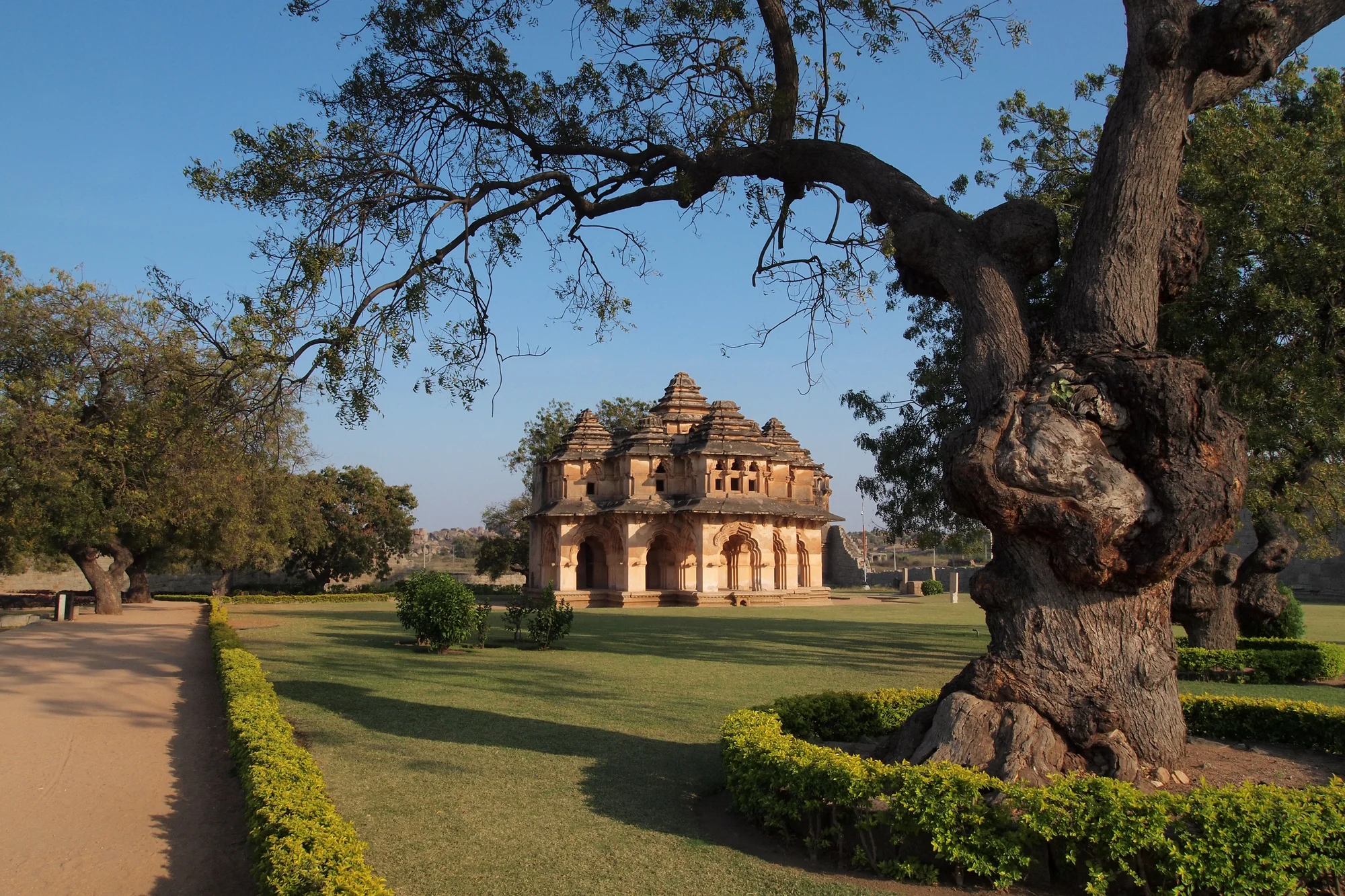
The Lotus Mahal, located in the Zenana (women’s quarters) enclosure, exemplifies the Indo-Islamic architectural synthesis. Its two-storied structure features symmetrically arranged cusped arches, pyramidal towers at corners, and decorative stucco work, while maintaining Hindu elements in its proportions and spatial organization. The building’s design provides natural cooling through its open pavilion style and strategic air circulation.
The Queen’s Bath, a large square structure with a central pool surrounded by corridors and balconies, demonstrates advanced hydraulic engineering. The building once featured elaborate interior decoration and sophisticated water heating and circulation systems, reflecting the luxury of court life.
Water Architecture
Hampi’s sophisticated water management systems represent remarkable engineering achievements. Numerous pushkaranis (stepped tanks) served both utilitarian and ritual purposes, with the Krishna Temple pushkarani and the stepped wells showcasing elaborate geometric designs. Complex aqueduct channels, some carved directly into rock, transported water from the Tungabhadra River throughout the city. Large reservoirs, including Kamalapur Tank, stored water for year-round supply. These systems enabled the support of a large urban population in a relatively arid region.
Cultural Significance
Religious Importance
Hampi’s religious significance transcends its role as a medieval capital, connecting to deep-rooted Hindu traditions. The site’s identification with locations from the Ramayana makes it a significant pilgrimage destination for devotees. The Virupaksha Temple’s continuous worship tradition, spanning over 1,300 years, represents one of India’s longest-maintained temple traditions. Annual festivals, particularly the chariot festival during Virupaksha Temple’s annual celebration, continue to attract thousands of pilgrims.
The presence of an Adi Shankara-linked monastery indicates the site’s importance in Hindu philosophical traditions. Various mathas (monastic establishments) associated with different Vaishnavite and Shaivite orders maintained presence here, making Hampi a center for religious scholarship and practice during the Vijayanagara period.
Artistic and Cultural Patronage
The Vijayanagara court at Hampi served as a major center for artistic and literary patronage. The empire supported various art forms including classical music, dance, sculpture, and painting. The temples functioned as cultural centers where devadasis (temple dancers) performed, musicians played, and religious drama was enacted. The bas-reliefs throughout Hampi’s monuments provide invaluable documentation of contemporary costume, jewelry, military equipment, and social customs.
Literary production flourished in Sanskrit, Kannada, Telugu, and Tamil. Important poets and scholars received royal patronage, producing works that enriched South Indian literary traditions. The cosmopolitan character of the capital, with its international trading community, facilitated cultural exchange between Indian and foreign traditions.
UNESCO World Heritage Status
In 1986, UNESCO inscribed the Group of Monuments at Hampi on the World Heritage List, recognizing its outstanding universal value under multiple criteria. The designation acknowledged Hampi as an outstanding testimony to the vanished Vijayanagara civilization and an exceptional example of Hindu royal architecture. The site demonstrates the distinctive architectural and artistic achievements of the Vijayanagara Empire and preserves an important chapter in South Asian history.
The World Heritage status brought international attention to conservation challenges and facilitated cooperation between the Archaeological Survey of India, international conservation organizations, and academic institutions. However, the listing has also generated tensions between conservation requirements and the needs of local communities living within and around the heritage zone. Balancing tourism development, archaeological preservation, and local livelihoods remains an ongoing challenge for site management.
Visitor Information
Planning Your Visit
Hampi’s extensive archaeological zone requires multiple days for thorough exploration. Most visitors spend 2-3 days to see the major monuments, though serious archaeology enthusiasts might allocate a week. The winter months (October through February) offer the most comfortable weather, with moderate temperatures and minimal rainfall. Summer (March-May) can be extremely hot, making midday exploration challenging.
The site divides roughly into two main zones: the Sacred Center around the Virupaksha Temple, and the Royal Center containing palace complexes and administrative buildings. Many visitors stay in the village area near Virupaksha Temple or in Kamalapur, which offers more upscale accommodation options.
Transportation
The nearest major town is Hosapete (Hospet), located 13 kilometers from Hampi, which serves as the primary transportation hub. Hospet has rail connections to major cities including Bengaluru, Goa, and Hyderabad. The nearest airport is Vidyanagar Airport, approximately 40 kilometers away, though most international visitors arrive through Bengaluru’s Kempegowda International Airport (350 kilometers) or Goa’s Dabolim Airport (280 kilometers).
Within Hampi, visitors can explore by foot, bicycle (the most popular option), auto-rickshaw, or hired motorcycles. The terrain includes both paved roads and rocky paths, with some monuments requiring climbing. Local coracle boats offer scenic crossings of the Tungabhadra River.
Key Monuments to Prioritize
First-time visitors should prioritize: the Virupaksha Temple (active worship site with spectacular gopuram), Vittala Temple complex (musical pillars and stone chariot), Royal Enclosure (throne platform and aqueducts), Lotus Mahal (Indo-Islamic architecture), Queen’s Bath (hydraulic engineering), Hazara Rama Temple (Ramayana bas-reliefs), and the sunset view from Matanga Hill or Hemakuta Hill.
Early morning visits to active temples allow observation of traditional worship rituals. The Archaeological Museum at Kamalapur provides excellent contextual information about the site’s history and contains important sculptures and artifacts recovered from excavations.
Nearby Attractions
The region offers several significant historical sites accessible as day trips from Hampi. Badami, approximately 140 kilometers away, features spectacular rock-cut cave temples from the Chalukya period. Pattadakal and Aihole, located nearby, preserve important examples of early temple architecture. Anegundi, across the Tungabhadra River from Hampi, predates the Vijayanagara capital and contains numerous ancient monuments and traditional village settings.
Conservation
Current Status and Challenges
The monuments at Hampi face multiple conservation challenges despite their protected status and ongoing maintenance by the Archaeological Survey of India. The primary threats include natural weathering of exposed granite surfaces, particularly exfoliated rock faces on sculptured elements. The region’s monsoon climate and significant temperature variations contribute to stone deterioration through repeated expansion and contraction cycles.
Tourist footfall, while economically important, creates pressures on fragile structures. Climbing on monuments, touching carved surfaces, and the cumulative impact of millions of visitors annually accelerate wear on stairs, floors, and architectural elements. Vegetation growth, particularly invasive species taking root in joints and crevices, threatens structural stability. The site’s vast area makes comprehensive monitoring and maintenance challenging with limited resources.
Conservation Efforts and Future Outlook
The Archaeological Survey of India maintains permanent conservation teams at Hampi conducting ongoing restoration work, structural stabilization, and scientific documentation. Recent initiatives have employed modern conservation technologies including 3D laser scanning for detailed recording and monitoring of structural changes. International partnerships with conservation organizations have provided technical expertise and training for specialized restoration techniques.
Challenges remain in balancing conservation with accessibility and local community needs. The designated heritage zone includes villages with resident populations whose livelihoods depend partly on tourism and agriculture. Finding sustainable approaches that preserve monuments while supporting local communities requires ongoing dialogue and innovative management solutions. The development of comprehensive visitor management plans aims to distribute tourist pressure more evenly across the site while protecting the most vulnerable structures.
Timeline
Ancient Religious Center
Early temples and religious establishments predate Vijayanagara foundation; Virupaksha Temple origins
Vijayanagara Founded
Harihara I and Bukka Raya I establish Vijayanagara capital at Hampi under guidance of sage Vidyaranya
Krishnadevaraya's Golden Age
Empire reaches zenith; major temple construction including Vittala Temple complex; city becomes major international trading center
Battle of Talikota
Vijayanagara forces defeated by Deccan Sultanate confederation; systematic destruction of city follows
British Documentation
Colin Mackenzie and other British surveyors conduct first systematic archaeological documentation
UNESCO World Heritage Listing
Hampi designated UNESCO World Heritage Site; systematic conservation programs initiated
Ongoing Conservation
Archaeological Survey of India continues restoration and preservation with international cooperation