Overview
Warangal's medieval identity is captured in the name Orugallu, a term associated with a single massive stone. That stone became linked with the city's fort, while the city itself grew into the capital of the Kakatiya dynasty and one of the most important political centres of the Telugu region. Today, Warangal's fortifications, stone gateways, temples, lakes, and hills preserve the visible legacy of that period.
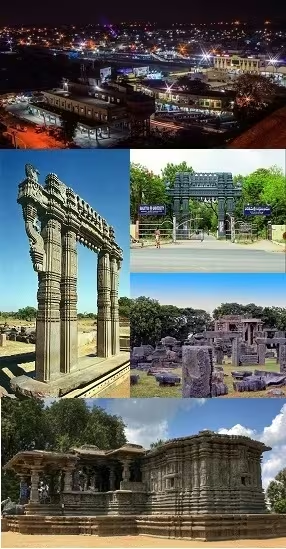
The Kakatiya dynasty was established in 1163 CE, and Warangal remained its capital during the dynasty's most influential phase. The city developed as a fortified centre of administration, political authority, religious activity, and regional culture. The monuments attributed to the Kakatiyas include the Warangal Fort, four substantial stone gateways, the Swayambhu temple dedicated to Shiva, and the Ramappa Temple near Ramappa Lake.
Warangal's history did not end with the fall of the Kakatiyas. The city was conquered by the Delhi Sultanate in 1323, renamed Sultanpur, and later recaptured by the Musunuri Nayaks in 1336. It subsequently became part of the Bahmani Sultanate, the Sultanate of Golconda, the Mughal Empire, Hyderabad state, Andhra Pradesh, and finally Telangana. This succession makes Warangal a useful lens through which to understand political change in the Deccan.
The modern city is the second-largest city in Telangana according to the supplied city description and forms part of a three-city urban area with Hanamkonda and Kazipet. It is also promoted as a heritage and cultural centre. The Kakatiya Kala Thoranam, a stylised representation of a Kakatiya stone gateway, appears on the emblem of Telangana.
Etymology and Names
During approximately 160 years of Kakatiya rule, Warangal was known by several names. Orugallu, Ekashila Nagaram, and Omatikonda are all associated with the meaning “single stone.” The names refer to a huge granite boulder present in or associated with the Warangal Fort.
The variety of names reflects both the physical character of the site and its cultural importance. The surrounding Deccan landscape is marked by granite rocks and hill formations, and stone became a defining material of the city's fortifications and temples.
After the Delhi Sultanate defeated the Kakatiya ruler Prataparudra II in 1323, Juna Khan, the crown prince of Ghiyath al-Din Tughluq, conquered the city and renamed it Sultanpur. The Musunuri Nayaks recaptured Warangal in 1336 and restored the name Orugallu. The later history of the city saw it incorporated into the Bahmani Sultanate and the Sultanate of Golconda, but the older Kakatiya names remain central to Warangal's historical identity.
Geography and Location
Warangal lies at approximately 18.0° north latitude and 79.58° east longitude, at an average elevation of 266 metres. It occupies the eastern part of the Deccan Plateau, where granite rocks and hill formations shape the terrain. These formations contribute to the distinctive landscape around the city but also leave parts of the region relatively barren.
Agriculture depends substantially on seasonal rainfall. No major river flows close to the city, so water supply has historically required systems beyond direct river access. In the modern period, the Kakatiya Canal, originating from the Sriram Sagar Project, helps meet the city's water requirements. Bhadrakali Lake, Dharmasagar Lake, and Waddepally Lake are important water bodies and sources of drinking water.
Warangal has a semi-arid climate. Summer begins in March and reaches its greatest intensity in May, when average high temperatures are in the range of 42°C. The monsoon generally arrives in June and continues until September, bringing approximately 550 millimetres of precipitation. From October to early February, the city experiences a dry and comparatively mild winter, with average temperatures of about 22–23°C.
Several hills around the city are associated with temples or religious sites. Padmakshi Hill, Mettu Gutta, Hanumathgiri Gutta, Ursu Gutta, and Govinda Rajula Gutta are among the better-known examples. Together with the lakes, these granite hills form an important part of Warangal's heritage landscape.
Ancient History
The supplied historical account does not describe an ancient urban settlement at Warangal before the rise of the Kakatiyas. Its firmly recorded historical prominence begins with the medieval Kakatiya period. The evidence presented for the city's early identity comes mainly from its political role, inscriptions praising its status in the Telugu region, and the monuments associated with Kakatiya rule.
Kakatiya inscriptions praised Warangal as the finest city in the Telugu region, extending in imagination or political description to the shores of the ocean. The city thus represented more than a royal residence: it was a statement of Kakatiya authority over a substantial Telugu-speaking domain.
The granite landscape also influenced how the city was remembered. The names Orugallu and Ekashila Nagaram associated the capital with a single stone, while the fort and gateways made the physical strength of the capital visible. The relationship between stone, fortification, and royal power remains one of the defining characteristics of Warangal's historical setting.
Historical Timeline
Early Kakatiya Period
Beta Raja I is identified as the founder of the Kakatiya dynasty. He ruled for thirty years and was succeeded by his son, Prola Raja I. During Prola Raja I's rule, the capital was shifted to Hanamkonda.
The Kakatiyas gradually developed from a regional ruling house into a major power in the Telugu region. The succession of rulers named in the historical record includes Beta Raja I, Prola Raja I, Beta Raja II, Prola Raja II, Rudradeva, Mahadeva, Ganapatideva, Prataparudra, and Rudrama Devi.
Warangal as Kakatiya Capital
During the rule of Ganapatideva, the capital moved from Hanamkonda to Warangal. This shift established Warangal as the central seat of Kakatiya authority. The city was strengthened with fortifications and embellished with major religious and ceremonial structures.
Rudradeva, who ruled from approximately 1158 to 1195 according to the supplied historical description, is identified as the first Kakatiya king to rule parts of the present-day Telangana and Andhra Pradesh. Ganapatideva expanded the political importance of the dynasty, while Rudrama Devi became the only woman identified in the account as ruling over the Telugu region.
The Kakatiya capital was remembered for its administrative and cultural distinction. Marco Polo is also associated with comments on the cultural and administrative character of the Kakatiya kingdom. Although the supplied account does not provide the details of his description, his association indicates that Warangal was known beyond the immediate Deccan.
The Fall of the Kakatiyas
The Kakatiya period ended in 1323 when Prataparudra II was defeated by the Delhi Sultanate. Juna Khan, the crown prince of Ghiyath al-Din Tughluq, conquered the city and renamed it Sultanpur. This was a major political rupture: Warangal passed from being the capital of a powerful regional dynasty to being governed within the expanding authority of the Delhi Sultanate.
The change of name did not permanently erase the city's earlier identity. In 1336, the Musunuri Nayaks recaptured Warangal and restored the name Orugallu. The Musunuri leaders united 72 Nayak chieftains, demonstrating the strength of regional resistance and the continuing political importance of the former Kakatiya capital.
The Musunuri Nayaks ruled for approximately fifty years. After their decline, Warangal became part of the Bahmani Sultanate and later the Sultanate of Golconda.
Mughal and Hyderabad Periods
Aurangzeb conquered Golconda in 1687, bringing Warangal into the Mughal Empire. The city remained within the imperial framework until the southern provinces separated from the Mughal system and formed the state of Hyderabad in 1724. Hyderabad included the Telangana region as well as parts of present-day Maharashtra and Karnataka.
In 1948, Hyderabad was annexed to India and became Hyderabad state. Under the States Reorganisation Act of 1956, Hyderabad state was divided. The Telugu-speaking Telangana region, including Warangal, became part of Andhra Pradesh.
The Telangana movement eventually led to the formation of Telangana state on 2 June 2014. Warangal became part of the new state and continued its role as a major urban and cultural centre.
Political Significance
Warangal's principal historical importance comes from its role as the Kakatiya capital. The decision to shift the capital from Hanamkonda during Ganapatideva's rule transformed Warangal into the dynasty's principal seat of administration and royal representation.
Its fortifications served both defensive and symbolic purposes. A strong capital was essential for a regional dynasty governing a large territory, while massive gateways and temples proclaimed the authority and resources of the ruling house. The city also became the site from which the Kakatiyas administered the Telugu region and projected their political identity.
Warangal's later history confirms its strategic value. The Delhi Sultanate considered the city important enough to conquer and rename. The Musunuri Nayaks treated its recapture as a central objective. Subsequent Deccan states also retained the city within their political territories. Its location on the Deccan Plateau and its existing fortifications made it a valuable centre even after the Kakatiyas had fallen.
In modern administration, the Greater Warangal Municipal Corporation oversees civic needs. Established in 1899, it is described as one of India's oldest urban local bodies. The Kakatiya Urban Development Authority, created in 1982, plans and manages the wider Kakatiya Urban Development Area. Its jurisdiction covers 1,805 square kilometres, 19 mandals, and 181 villages across Warangal, Hanamkonda, and Jangaon districts.
Religious and Cultural Importance
Warangal's cultural landscape includes monuments and institutions associated with several religious traditions. The Swayambhu temple dedicated to Shiva is one of the important Kakatiya-period structures mentioned in the historical record. The Bhadrakali Temple, Padmakshi Temple, Mettu Gutta, Govinda Rajula Gutta, and other hill shrines add to the city's religious geography.
The city also contains the Kazipet Dargah and the Roman Catholic Diocese of Warangal. Small communities of Christians, Jews, and Buddhists live alongside the Hindu majority and Muslim minority. According to the demographic figures provided, approximately 83 percent of the population follows Hinduism and 14 percent follows Islam.
Festivals are central to Warangal's living culture. Bathukamma, a floral festival celebrated by women, continues for nine days. Participants arrange flowers into the Bathukamma form, carry it to a local temple, and gather to clap, sing, and dance around it. Bonalu was declared a state festival in June 2014.
The Sammakka Saralamma Jatara, also called Medaram Jatara, is another major religious congregation associated with the wider Warangal district. These festivals connect the modern city and region with traditions that extend beyond monumental architecture.
Warangal was included in the UNESCO Global Network of Learning Cities on 2 September 2022. The recognition reflects the city's efforts to make lifelong learning available at the local level. The city has also been selected for the Heritage City Development and Augmentation Yojana and for the Smart Cities Mission's fast-track competition.
Economic Role
Agriculture remains a major part of the regional economy. Paddy, cotton, mango, and wheat are among the principal crops. Irrigation depends substantially on monsoon and seasonal rainfall, although projects such as the Godavari lift irrigation scheme are intended to bring water to drought-prone areas of Telangana.
Warangal hosts the second-largest grain market in Asia, located at Enumamula. This market strengthens the city's relationship with the agricultural hinterland and helps explain its continuing role as a regional commercial centre.
The city is also developing information technology. An incubation centre at Madikonda supports this sector, while Tech Mahindra and Cyient have opened development centres. Other technology companies have been associated with plans to establish offices in the city. In 2023, the elevator manufacturer Kone opened an office in Warangal.
Healthcare is another expanding sector. The Mahatma Gandhi Memorial Hospital is the city's largest hospital and serves patients from Adilabad, Khammam, and Karimnagar. A Warangal Multi Super Speciality Hospital was expected to be completed in 2024.
Monuments and Architecture
The Warangal Fort is the central monument of the city's historical identity. It is associated with the single granite stone that inspired several of Warangal's older names. The Kakatiya remains include four massive stone gateways, often represented through the Kakatiya Kala Thoranam. This gateway has become a symbol of Telangana and appears on the state emblem.
The Swayambhu temple, dedicated to Shiva, forms another important part of the Kakatiya architectural legacy. The Thousand Pillar Temple is among the city's best-known heritage destinations. Together, the fort, gateways, and temples demonstrate the Kakatiya preference for monumental stone construction and carefully structured sacred and political spaces.
The Ramappa Temple, situated near Ramappa Lake, is also associated with the Kakatiya period. The Warangal Fort, Thousand Pillar Temple, and Ramappa Temple are identified in the supplied account as UNESCO-recognised World Heritage Sites. Their presence makes Warangal a major destination for the study of medieval Deccan architecture.
The city's heritage is not confined to built monuments. Bhadrakali Lake, Waddepally Lake, and Dharmasagar Lake contribute to the landscape used for tourism and recreation. The area around Bhadrakali Temple Lake is being developed as a geo-biodiversity cultural park with promenades, historic caves, suspension bridges, natural trails, nesting grounds, and ecological reserves.
The Ministry of Tourism awarded Warangal the title of best heritage city for 2014–2015. The award was described as the third consecutive occasion on which the city received the honour.
Famous Personalities
Warangal and the wider region are associated with rulers, writers, educators, artists, and public figures. Rudrama Devi is particularly important to the city's political history as the only woman identified in the supplied account as ruling over the Telugu region. Rudradeva, Ganapatideva, and Prataparudra are also central to the Kakatiya story.
The city and its surrounding region are associated with poets Pothana, Kaloji Narayana Rao, Daasarathi, and Palkuriki Somanatha. Kothapalli Jayashankar and Chukka Ramaiah are known for their educational and public contributions. P. V. Narasimha Rao, a former Prime Minister of India, is among the prominent political figures connected with the region.
Modern cultural figures associated with Warangal include actors Anandhi and Eesha Rebba, filmmaker and actor Tharun Bhascker, filmmaker Sandeep Reddy Vanga, music director Chakri, lyricist Chandrabose, playback singer Manisha Eerabathini, and impressionist and ventriloquist Nerella Venu Madhav. Chess grandmaster Arjun Erigaisi and cricketer Nand Kishore are also listed among notable people connected with the city.
Decline and Revival
Warangal's decline as an imperial capital followed the defeat of Prataparudra II in 1323. The conquest by the Delhi Sultanate ended Kakatiya sovereignty, and the city was renamed Sultanpur. Yet its political importance did not disappear. The Musunuri Nayaks recaptured it in 1336, and later Deccan powers retained it as part of their territories.
The city underwent successive changes under the Bahmani Sultanate, the Sultanate of Golconda, the Mughals, and Hyderabad state. In the modern period, its revival has been based not on imperial sovereignty but on heritage, education, administration, agriculture, transport, and urban development.
Warangal's municipal institutions have also taken part in modern civic initiatives. After a Clean Cities Championship in 2012, the city became the first in India to achieve 100 percent door-to-door municipal solid waste collection according to the supplied account. Approximately 70 percent of households began separating wet and dry waste, while cement bins and dumpsters were removed from many locations. The reduced-load dumpyard was planned for gradual conversion into a nature park with vermicomposting sheds.
Modern City
Warangal, Hanamkonda, and Kazipet together form the Warangal Tri-City. National Highway 163 connects the urban area with Hyderabad, Bhuvanagiri, and Bhopalpatnam. National Highway 563 connects Ramagundam and Khammam, and State Highway 3 also passes through the city.
The city is served by Warangal and Kazipet railway stations on the New Delhi–Chennai main line. Both fall under the Secunderabad railway division of the South Central Railway zone. Kazipet has electric and diesel locomotive sheds. Other stations within the city limits include Kazipet town, Vanchanagiri, Pendial, and Hasanparthy Road.
Mamnoor Airport was built by the Nizams in 1930. It once covered 1,875 acres and had a 6.6-kilometre runway, staff and pilot quarters, a pilot training centre, and more than one terminal. Cargo and Vayudoot services operated from the airport, and it was used as a hangar for government aircraft during the Indo-China War. It remained in service until 1981.
Mamnoor is currently used as an NCC training centre for gliding sorties, skeet shooting, and aero-modelling. It has no scheduled commercial air service at present. In July 2023, the Telangana cabinet approved a proposal to develop the airport, including acquisition of the remaining 253 acres required for a terminal and runway extension. Funds for the land acquisition were approved and released in November 2024.
Warangal's modern identity therefore combines a historic fortified capital with a growing urban region. Its medieval monuments attract visitors, while its agricultural markets, universities, hospitals, transport links, and technology centres support its contemporary economy.