
The throne room of Pataliputra fell silent. Emperor Chandragupta I, his face lined with the weight of decades, rose slowly from the lion throne. The assembled courtiers—ministers in silk, generals bearing battle scars, Brahmin advisors with sacred threads—held their breath. This was the moment they had anticipated and dreaded in equal measure.
The succession.
In the shadows behind the pillars, several young men stood rigid, their royal bearing unmistakable. Princes of the Gupta dynasty, sons of the emperor, each believing himself worthy of the throne. Each waiting to hear his name.
But Chandragupta I's eyes swept past them all.
The Chosen One
"Come forward, Samudragupta," the emperor's voice rang out across the marble floor.
A younger prince stepped into the lamplight. Not the eldest. Not the most obvious choice. As Samudragupta approached his father, the Eran stone inscription would later record the reason for this stunning decision: his "devotion, righteous conduct, and valour." But in that moment, explanations mattered little to those who had been passed over.
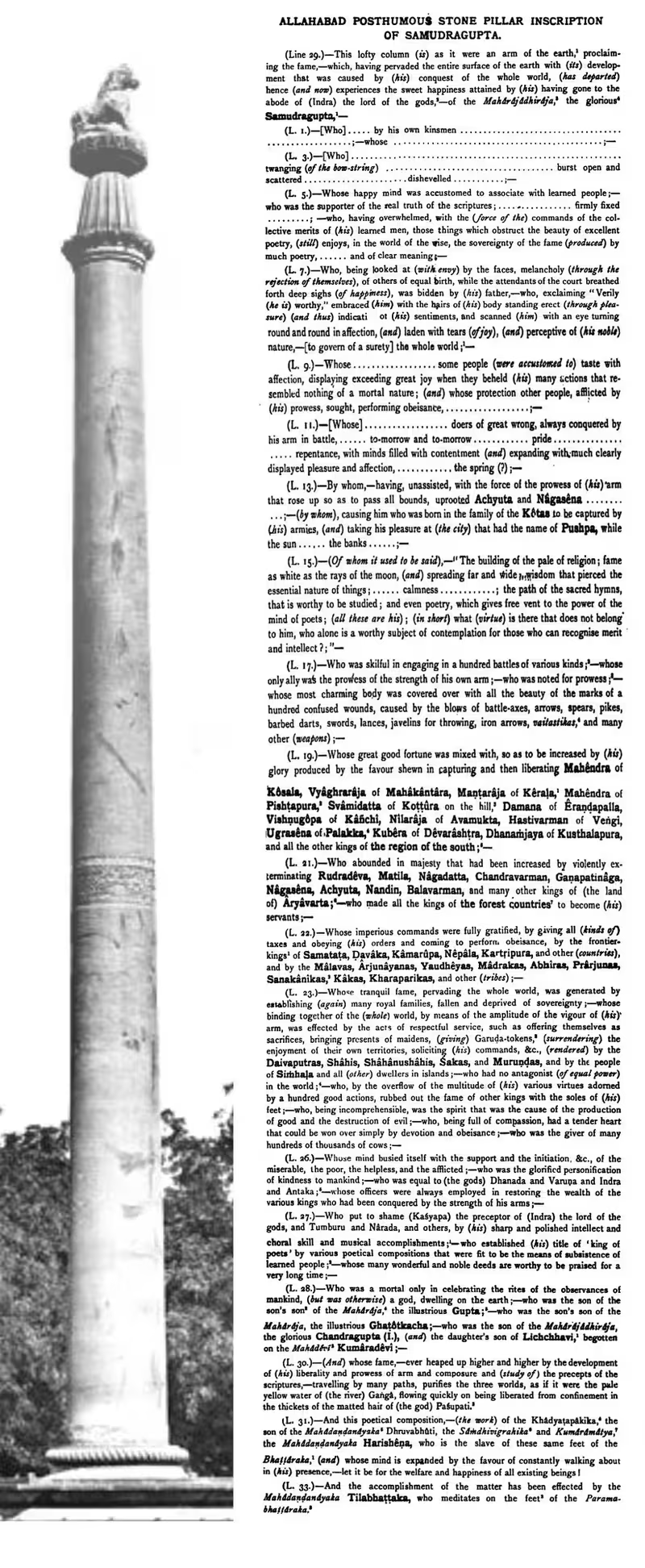
The Allahabad Pillar inscription, composed by the court poet Harisena, preserves what happened next. Chandragupta I called his chosen son before the assembled court and appointed him to "protect the earth." He praised him as a noble person, worthy of the empire's future. It was a public coronation, designed to leave no room for doubt.
Yet doubt there was.
The inscription mentions, almost in passing, other people "of equal birth" who bore "melancholy looks" as they witnessed the ceremony. Equal birth. The phrase is telling. These were not distant relatives or minor nobles. These were Samudragupta's brothers—legitimate princes with their own claims to the throne.
Samudragupta's mother, Queen Kumaradevi, came from the powerful Licchavi clan, a fact that undoubtedly strengthened his position. The Licchavi alliance had been crucial to Chandragupta I's rise, and perhaps the emperor calculated that only a son of Kumaradevi could maintain that vital connection. But to the other princes, this was cold comfort. Their mother's bloodlines were equally royal, their training equally rigorous, their ambitions equally fierce.
As Samudragupta received his father's blessing, the faces in the shadows hardened. The old emperor had made his choice. But would the empire accept it?
The Pretender's Challenge
Within months of the succession, gold coins began appearing in the markets of northern India. They bore the image of a Gupta ruler, struck in the imperial style, with an inscription that sent shockwaves through the court: "Kacha, the exterminator of all kings."
The coins closely resembled those issued by Samudragupta himself—same weight, same style, same imperial pretensions. But the name was different. And the title was a direct challenge.
Who was Kacha? Historians have debated this question for centuries. One compelling theory suggests he was exactly what the succession crisis would predict: a rival claimant to the throne, possibly one of those princes who had stood in the shadows with a "melancholy look" on his face.
The timing fits. The style fits. The audacity certainly fits. To mint coins declaring oneself "exterminator of all kings" while the newly crowned emperor was still consolidating power was not just rebellion—it was a declaration of war.
If Chandragupta I had multiple sons, as the "equal birth" reference suggests, then at least one of them refused to accept his father's decision. Perhaps he was older, more experienced in battle, supported by powerful nobles who believed primogeniture should prevail over personal preference. Perhaps he commanded loyal troops, controlled key fortresses, had his own base of power.
The Gupta Empire, barely two generations old, teetered on the brink of civil war.
In his palace, Samudragupta faced the reality of his inheritance. His father had given him the throne, but he would have to fight to keep it. The "devotion, righteous conduct, and valour" that Chandragupta I had praised would now be tested not against foreign enemies, but against his own blood.
The Reckoning
What happened next is shrouded in the careful language of royal inscriptions, which prefer to speak of glory rather than fratricide. But the evidence is there, written in blood and gold.
The Eran inscription states that Samudragupta brought "the whole tribe of kings" under his suzerainty. His enemies, it says, were so terrified of him that they trembled even when they thought of him in their dreams. These are not the descriptions of diplomatic negotiations. This is the language of conquest, of total victory, of enemies utterly crushed.
According to Wikipedia, Samudragupta remained undefeated in battle throughout his reign. He fought a hundred battles, and the wounds he received "looked like marks of glory." But which battles came first? Before he could march south to Kanchipuram or east to the Brahmaputra, before he could face the Pallava kings or the frontier tribes, he had to secure his own throne.
The coins of Kacha disappear from the archaeological record. Abruptly. Completely. No later issues, no evolution of design, no gradual decline. Just silence.
One interpretation is inescapable: Samudragupta destroyed his rival. Whether Kacha died in battle, was executed after capture, or simply vanished into exile, the result was the same. The succession crisis ended not with compromise or reconciliation, but with the absolute victory of one claimant over all others.
The price of unity was blood. The price of the Gupta dynasty's survival was the elimination of internal rivals. Samudragupta had proven his father's choice correct, but not through devotion or righteous conduct. Through valour, yes—but valour of the most ruthless kind.
The Empire Builder
With the internal threat eliminated, Samudragupta turned his attention outward. The military campaigns that would make him legendary began in earnest. As recorded in the Allahabad Pillar inscription, he defeated kings across northern India and annexed their territories. He marched along the southeastern coast, advancing as far south as Kanchipuram. He subjugated frontier kingdoms and tribal oligarchies.
At the height of his power, his empire stretched from the Ravi River in the west (present-day Punjab) to the Brahmaputra River in the east (present-day Assam), from the Himalayan foothills in the north to central India in the southwest. Numerous rulers along the southeastern coast paid him tribute. The inscription notes that many neighbouring rulers tried to please him—a diplomatic way of saying they feared his wrath.
He performed the Ashvamedha sacrifice, the ancient horse sacrifice that proved imperial sovereignty. It was a statement to the world: the succession crisis was over, the pretenders were gone, and the Gupta Empire was unified under one undisputed ruler.
But Samudragupta never forgot how he had won his throne. His coins and inscriptions emphasize not just his military victories but also his legitimacy, his righteousness, his fitness to rule. He became a patron of arts and learning, an accomplished poet who played the veena. These were not mere hobbies—they were political statements, proof that he embodied all the qualities his father had seen in him.
The warrior who had fought his way to power would be remembered not just as a conqueror, but as a philosopher-king, a ruler who brought both military might and cultural refinement to his empire.
The Legacy
Samudragupta ruled until approximately 375 CE, transforming the modest kingdom he inherited into a vast empire. His expansionist policy would be continued by his son, Chandragupta II, who would face no succession crisis. The lesson had been learned. The price had been paid.
The Allahabad Pillar still stands, its Sanskrit inscription composed by the courtier Harisena still legible after sixteen centuries. It lists Samudragupta's conquests, praises his virtues, celebrates his reign as a golden age. But it also preserves, in those few careful words about princes of "equal birth" with "melancholy looks," the memory of the crisis that nearly destroyed everything.
Modern scholars debate the dates of Samudragupta's reign—some placing his ascension around 320 CE, others around 350 CE. They argue about whether he or his father founded the Gupta calendar era. They analyze coin hoards and decipher fragmentary inscriptions.
But the essential story remains clear. Chandragupta I made a choice that violated expectations, perhaps violated tradition itself. He chose the son he believed best suited to rule, not the son custom dictated. That choice sparked a crisis that could have ended the Gupta dynasty before it truly began.
That it didn't end—that the Gupta Empire instead flourished and expanded, that it became synonymous with India's golden age—is testament to Samudragupta's ruthless effectiveness. He proved his father right, but at a cost measured in brothers' blood and civil strife.
The throne room where Chandragupta I made his fateful announcement is long gone, buried under centuries of earth and the sprawling growth of modern Patna. But the pillar remains, and the coins, and the inscriptions. They tell us of a young prince who inherited a crown and a crisis, who fought his own family to keep what his father had given him, and who transformed internal conflict into external conquest.
History remembers him as Samudragupta the Great, the warrior-poet, the empire builder. But he began as Samudragupta the Chosen, the unexpected heir, the prince who had to prove himself worthy of a father's controversial decision.
He proved it in blood and gold, in battle and verse, in conquest and culture. And in doing so, he secured not just his own throne, but the future of an empire.