Overview
On the north bank of the Tapti River, Burhanpur developed from a regional settlement into the capital of Khandesh and later a major Mughal outpost in the Deccan. Its position near the southwestern border of present-day Madhya Pradesh gave it importance as both an administrative centre and a defended urban base. The city lies about 512 kilometres northeast of Mumbai and 340 kilometres southwest of Bhopal.
Burhanpur’s historical landscape brings together several eras. Archaeological discoveries near the Tapti River and at Asirgarh Fort include coins, goddess idols, and temple remains associated with the prehistoric past. The city itself rose to prominence in the medieval period under the Faruqi dynasty, expanded under the Mughals, passed through Maratha control, and was handed to the British in 1818.
Its surviving monuments include the Shahi Qila, Jama Masjid, Asirgarh Fort, Dargah-e-Hakimi, and the tomb of Shah Nawaz Khan. Burhanpur is also a living industrial city, known especially for cotton textiles and power looms.
Etymology and Names
In 1388, Malik Nasir Khan, the Faruqi ruler of Khandesh, established Burhanpur at the urging of Shaikh Zainuddin. He named the city after the medieval Sufi saint Burhan-ud-Din. The name therefore reflects the religious and cultural world in which the Faruqi capital emerged.
The city became known as a centre of the Khandesh Sultanate and retained its importance after the Mughal annexation of Khandesh. No separate earlier or later city name is identified in the surviving account, although the city’s political identity changed as different dynasties ruled it.
Geography and Location
Burhanpur stands on the north bank of the Tapti River in southwestern Madhya Pradesh. The city’s wider landscape includes the Tapti, Utavali, and Mohna rivers, as well as several small ghats. Asirgarh Fort lies approximately 20 kilometres away on the Burhanpur–Khandwa highway.
The Tapti-side location shaped Burhanpur’s character. Water supported settlement and urban life, while the nearby fort and routes across the region contributed to the city’s military importance. Under the Mughals, Burhanpur functioned as an important outpost in the Deccan and as the administrative centre of Khandesh subah.
Ancient History
The area around Burhanpur has evidence of human activity extending back to the prehistoric era. Excavations near the Tapti River and Asirgarh Fort have uncovered coins, goddess idols, and temples. These discoveries show that the region possessed religious and settled activity before the city’s rise as a medieval capital.
Burhanpur was an important town under the Rashtrakuta dynasty between 753 and 982. The available historical account does not describe the town’s political role in detail during this period, but its inclusion in the Rashtrakuta sphere places it within the long history of settlements that preceded the Faruqi capital.
Historical Timeline
Faruqi Foundation and Expansion
Burhanpur came to prominence in 1388 when Malik Nasir Khan of the Faruqi dynasty established it as the capital of Khandesh. The new capital became the political centre of the sultanate and gradually developed an urban economy.
Miran Adil Khan II, who ruled from 1457 to 1501, strengthened the city by building a citadel and several palaces. During his long reign, Burhanpur became a major centre for trade and textile production. This connection between political power and textile manufacture remained important long after the Faruqi period.
Mughal Period
In 1601, Emperor Akbar annexed the Khandesh Sultanate. Burhanpur then became the capital of Khandesh subah, one of the Mughal Empire’s top-level provinces in the Deccan. The city served as the residence of the Mughal governor Abdul Rahim Khan-i-Khanan during the reigns of Akbar and Jahangir.
Abdul Rahim Khan-i-Khanan contributed to Burhanpur’s civic development by constructing a new water supply and several gardens. In 1609, Jahangir appointed his second son, Prince Parviz, to govern the Mughal provinces of the Deccan. Parviz selected Burhanpur as his headquarters and residence, reinforcing the city’s role as a centre of imperial administration.
Burhanpur remained closely associated with the reign of Shah Jahan. The emperor spent considerable time in the city and added to the Shahi Qila. The surviving remains include the Diwan-i-Aam and Diwan-i-Khas, though much of the palace is now ruined.
Maratha Conquest and British Transfer
During the 1720s, the Maratha Peshwa Bajirao took Burhanpur during his expedition towards Malwa and Delhi. In the 1750s, a Maratha army commanded by Sadashivrao Bhau seized the town after defeating the Nizam of Hyderabad.
As Maratha power declined, Burhanpur passed among the Maratha sardars Holkar and Scindia. In 1818, the Marathas handed the town to the British, marking the end of the principal dynastic transitions described in its early modern history.
Political Significance
Burhanpur’s importance rested on its repeated selection as a seat of power. The Faruqi sultans made it the capital of Khandesh, while the Mughals retained it as the capital of a subah after annexing the sultanate. Its position in the Deccan made it useful as a headquarters for governors and princes.
The city’s relationship with Asirgarh Fort added a military dimension. The fort’s height, strong outer walls, and architecture made it difficult to capture during its prime. Together, Burhanpur and Asirgarh formed a landscape in which administration, royal residence, and defence were closely connected.
Religious and Cultural Importance
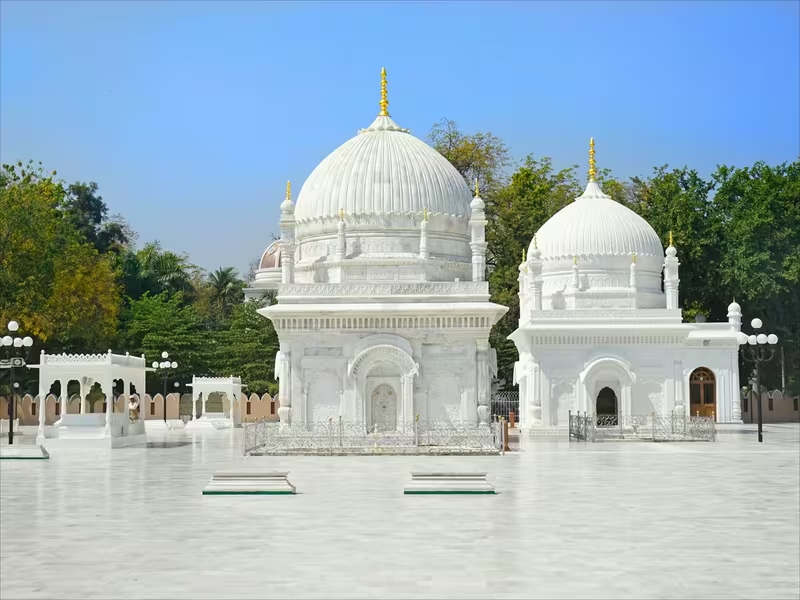
Burhanpur reflects a diverse religious environment. The city contains historic mosques, a notable gurudwara, a church, and the Dargah-e-Hakimi, a pilgrimage complex associated with the Dawoodi Bohra saint Sayyedi Abdul Qadir Hakimuddin. The complex includes the saint’s tomb, mosques, gardens, and accommodation for visitors from several countries.
The Jama Masjid remains both a historic monument and a place of worship. Its construction began under the Faruqi rulers and continued after the death of Faruqi leader Adil Shah. Emperor Akbar supervised and completed the work. The building is marked by two large minarets, three rounded cupolas, and carefully preserved artwork on its symmetrical pillars.
Economic Role
Burhanpur’s medieval prosperity was linked to trade and textiles. Under Miran Adil Khan II, the city became a major centre of textile production. That tradition continues in modern form. Burhanpur is known as the largest power-loom hub in Madhya Pradesh and has a National Textile Corporation project.
The city has companies producing interlining cloth, Grey Markin, bleached dhotis, cambric, power-loom cloth, and bakram. Cotton and oil mills also contribute to its industrial economy. Its modern identity therefore retains a strong connection with the manufacturing activity that helped the medieval city prosper.
Monuments and Architecture
The Shahi Qila stands west of the Tapti River. Built initially under the Faruqi dynasty and later associated with Shah Jahan, it once included important audience spaces such as the Diwan-i-Aam and Diwan-i-Khas. Much of the palace is in ruins, but surviving portions retain sculpture and carvings.
Its most celebrated feature is the royal hamam, built for Mumtaz Mahal. Tradition holds that Mumtaz died in Burhanpur while giving birth to her fourteenth child. A ceiling painting in the bath is said to depict a monument that inspired the Taj Mahal. Mumtaz was initially buried at the Aahukhana in Burhanpur for six months before her remains were moved. The original grave is now in disrepair, and the connection between the ceiling painting and the Taj Mahal remains a belief associated with the monument.
The Jama Masjid is centrally located in Gandhi Chowk. Its long construction history reflects the political transition from Faruqi to Mughal authority. The two minarets, three cupolas, and decorated pillars remain prominent features.
Asirgarh Fort, about 20 kilometres from Burhanpur, is noted for its elevated position and substantial outer walls. The Tomb of Shah Nawaz Khan, built of black stone beside the Utavali River about two kilometres north of Burhanpur, is another well-preserved Mughal-era monument. Shah Nawaz Khan’s birth name was Iraj; he was born in Ahmedabad and was the eldest son of Abdul Rahim Khan-i-Khanan.
Famous Personalities
Malik Nasir Khan founded Burhanpur as the Faruqi capital in 1388. Miran Adil Khan II shaped the city through fortifications, palaces, trade, and textile production. Mughal figures associated with Burhanpur include Akbar, Jahangir, Prince Parviz, Abdul Rahim Khan-i-Khanan, and Shah Jahan.
Mumtaz Mahal remains the most famous person connected with the city’s Shahi Qila. The Maratha commanders Bajirao and Sadashivrao Bhau are associated with the city’s eighteenth-century conquests.
Modern City
According to the 2011 Census, Burhanpur had a population of 210,886, including 108,187 males and 102,699 females. The city recorded 147,056 literate residents. Islam and Hinduism were followed by 50.5% and 45.8% of the population respectively, with smaller Sikh and Christian communities.
Urdu is the most commonly spoken language, while Hindi and Marathi are also prominent. Gujarati, Sindhi, and Marwari are spoken as well, and Nimadi is the local dialect.
Burhanpur is connected to other Indian cities by rail and regular buses. It has one railway station. Jalgaon Airport lies to the south and is the closest listed domestic airport; Devi Ahilya Bai Holkar Airport is the nearest customs airport within Madhya Pradesh, while Mumbai’s Chhatrapati Shivaji Maharaj International Airport is the nearest international airport identified in the account.
Timeline
See Also
- Khandesh Sultanate
- Mughal Empire in the Deccan
- Asirgarh Fort
- Shahi Qila
- Jama Masjid of Burhanpur
- Dargah-e-Hakimi