Overview
Around the middle of the 3rd century CE, a new ruling family emerged in the Deccan after the decline of Satavahana power. Known as the Vakatakas, this dynasty eventually controlled or influenced wide areas between central India and the southern Deccan. Its political history is marked by expansion, branching royal lines, alliances with the Guptas, and a final period remembered above all for the Buddhist art of Ajanta.
The Vakataka state is generally believed to have extended, at its greatest claimed extent, from the southern edges of Malwa and Gujarat in the north to the Tungabhadra River in the south. Its western limits reached the Arabian Sea, while its eastern sphere approached the edges of Chhattisgarh. These boundaries were not equally secure at all times, and several military claims preserved in inscriptions may represent political influence or temporary conquest rather than continuous administration.
The dynasty was contemporary with the Gupta Empire of northern India. This relationship became especially important when Prabhavatigupta, daughter of Gupta ruler Chandragupta II, married the Vakataka king Rudrasena II. The Vakatakas also became major patrons of literature, religious establishments, architecture, and public works. Their most visible legacy is the group of Buddhist monuments at Ajanta associated with the reign of Harishena.
Rise to Power
The origins of the Vakatakas remain debated. One line of interpretation places their early homeland in the Deccan. An inscription from Amaravati in present-day Andhra Pradesh, dated to approximately the middle of the 3rd century CE, mentions a householder named Vakataka. Historian Ramaprasad Chanda regarded this as evidence relevant to the family's early presence in the Deccan. V. V. Mirashi strengthened the southern-origin theory by comparing expressions in Vakataka and Pallava copper-plate grants and by examining titles shared with other Deccan dynasties.
These titles included Haritiputra and Dharmamaharaja. Their use by the Vakatakas linked them, in Mirashi's interpretation, to the political culture of the Deccan, where similar titles were also found among the Pallavas, Kadambas, and Chalukyas of Badami. Administrative and ministerial families associated with Deccan localities offered further support for this view.
Another interpretation places the original homeland farther north, in the Vindhya region, particularly Bundelkhand and Baghelkhand. Ajay Mitra Shastri drew attention to Puranic traditions that associate the dynasty with Vindhyashakti and describe it as Vindhyaka. The Puranas also connect Pravarasena I with Kanchanaka, identified by K. P. Jayaswal with Nachna in present-day Panna district.
The dynasty's social origins are equally uncertain. The Vakatakas are associated with the Vishnuvriddha gotra, and the Ajanta inscription describes Vindhyashakti as a dvija. These details were once treated as evidence of Brahmin descent. Epigraphist K. V. Ramesh offered a different explanation. According to the ritual practices described in the Śrauta-Sūtras, non-Brahmanical ruling families could adopt the Vedic gotra of their household priest when carrying out formal sacrifices. In this view, Vishnuvriddha does not by itself prove Brahmin ancestry.
Ramesh also interpreted dvija as a broader social designation applying to the upper levels of the varna order rather than as an exclusive term for Brahmins. He further connected the name Vakataka with a local place-name, Vakadu or kadu, meaning “forest.” The capital Vatsagulma may preserve the same root, with gulma meaning a thicket. These linguistic and inscriptional arguments support the possibility that the Vakatakas were a local non-Brahmanical ruling family that adopted Sanskritic forms, formal gotras, sacrificial practices, and prestigious political alliances after achieving power.
Early Rulers
The first known ruler was Vindhyashakti, conventionally dated to about 250–270 CE. His name appears to derive from the goddess Vindhyavasini. Very little is known about his reign. The Puranas describe him as ruler of Vidisha and assign him an exceptionally long reign of 96 years, but this figure cannot easily be reconciled with the dates usually assigned to him.
The Cave XVI inscription at Ajanta presents Vindhyashakti as the banner of the Vakataka family. It says that he increased his power through great battles and possessed a large cavalry. Yet the inscription does not place a royal title before his name. The question of his original base remains unresolved: scholars have located it variously in the southern Deccan, Madhya Pradesh, Malwa, and the Vindhya region.
Vindhyashakti's successor was his son Pravarasena I, who ruled approximately from 270 to 330 CE. Under him, Vakataka power expanded dramatically. He was the first Vakataka ruler to use the title Samrat, or universal ruler, and is generally regarded as the dynasty's principal early empire-builder.
Pravarasena I fought the Naga kings and carried his arms northward to the Narmada, according to accounts of his reign. He also annexed the kingdom of Purika, ruled by a king named Sisuka. The extent of his northern conquests is disputed. Some interpretations place his authority from Bundelkhand in the north to present-day Andhra Pradesh in the south. V. V. Mirashi considered it unlikely that Pravarasena I conquered northern Maharashtra, Gujarat, or the Konkan, but accepted the possibility that he conquered parts of northern Kuntala, including areas corresponding to Kolhapur, Satara, and Solapur. His campaigns may also have reached Dakshina Kosala, Kalinga, and Andhra.
Pravarasena I strongly identified his kingship with Vedic ritual. He performed several sacrifices, including the Agnishtoma, Aptoryama, Ukthya, Shodasin, Atiratra, Vajapeya, Brihaspatisava, Sadyaskra, and four Ashvamedhas. The Puranic tradition also associates him with substantial gifts to Brahmins during the Vajapeya sacrifice. He used both Samrat and Dharmamaharaja and called himself Haritiputra. His prime minister, Deva, is described as a learned and pious Brahmin.
Pravarasena I had four sons, according to the Puranas. His son Gautamiputra married a daughter of Bhavanaga, ruler of the powerful Bharashiva family. Gautamiputra died before his father, and the succession therefore passed to Gautamiputra's son Rudrasena I. Pravarasena I's second son, Sarvasena, established a separate centre at Vatsagulma, identified with present-day Washim. The dynasties founded by the other two sons are not known.
Branches and Political Structure
The Vakataka ruling family is generally believed to have divided into four branches after Pravarasena I. Two branches are known from inscriptions and later historical reconstruction: the Pravarapura-Nandivardhana branch and the Vatsagulma branch. The identities and histories of the other two branches remain unknown.
This division did not necessarily represent the immediate collapse of Vakataka power. Instead, the two documented branches ruled different territories while remaining connected by family relationships and a shared dynastic identity. The Pravarapura-Nandivardhana line operated from sites including Nandivardhana, near present-day Nagpur, and Pravarapura at Paunar in Wardha district. The Vatsagulma line ruled the territory between the Sahyadri Range and the Godavari River.
The evidence suggests a monarchy in which royal authority was exercised through regional courts, ministers, subordinate rulers, and local administrative units. Copper-plate grants are particularly important for understanding this system. The Washim plates of Vindhyasena, for example, record a village grant in the northern marga, or subdivision, of Nandikata, identified with present-day Nanded.
The Pravarapura-Nandivardhana Branch
Not much is known about Rudrasena I, who ruled from Nandivardhana near Ramtek hill, approximately 30 kilometres from Nagpur. An inscription at Deotek in present-day Chandrapur district is the only stone inscription of his reign identified in the account preserved here.
The Allahabad pillar inscription mentions a ruler named Rudradeva among the kings of Aryavarta. Some scholars, including A. S. Altekar, rejected the identification of Rudradeva with Rudrasena I. If Rudrasena I had been defeated and killed by Gupta emperor Samudragupta, it would be difficult to explain why his son Prithivishena I later accepted a Gupta princess as his daughter-in-law. Moreover, no inscription of Rudrasena I has been found north of the Narmada. The identification therefore remains uncertain.
The most important Gupta-Vakataka connection came through Rudrasena II, conventionally dated to 380–385 CE. He married Prabhavatigupta, daughter of Gupta emperor Chandragupta II. The Kevala-Narasimha inscriptions at Ramtek provide additional evidence for the relationship by recording the marriage of Chamunda, a daughter of Prabhavatigupta, to Prince Ghatotkachagupta, who was probably a son of Chandragupta II.
Rudrasena II died after a very short reign. Prabhavatigupta then governed as regent for approximately twenty years on behalf of her sons, Divakarasena and Damodarasena, the latter also known as Pravarasena II. This period has often been called the “Vakataka-Gupta age,” because of the close relationship between the two ruling houses. However, the idea that the Vakataka realm became practically a part of the Gupta Empire is not securely established. Prabhavatigupta's inscription refers to her father as “Deva Gupta,” but there is no independent evidence proving that this name referred to Chandragupta II.
Pravarasena II eventually became one of the best-documented Vakataka rulers. He shifted the capital from Nandivardhana to Pravarapura, a city he founded, and built a temple dedicated to Rama there. He composed the Setubandha in Maharashtri Prakrit and is also associated with several verses of the Gaha Sattasai. Seventeen discovered Vakataka copper-plate inscriptions concern his reign, giving him an unusually rich documentary record for ancient Indian history.
Pravarasena II was succeeded by Narendrasena, who ruled approximately from 440 to 460 CE. During his reign, Vakataka influence spread into some central Indian states. His successor, Prithivishena II, was the last known ruler of this branch. He came to the throne around 460 CE and was defeated by Vishnukundina king Madhava Varma II. After Prithivishena II's death around 480, his territory was probably annexed by Harishena of the Vatsagulma branch.
The Vatsagulma Branch
Sarvasena, the second son of Pravarasena I, founded the Vatsagulma branch after his father's death. His capital was Vatsagulma, present-day Washim in Maharashtra. The branch's territory lay between the Sahyadri Range and the Godavari River, and its rulers became associated with several Buddhist caves at Ajanta.
Sarvasena ruled approximately from 330 to 355 CE and used the title Dharmamaharaja. He was also a major literary figure. His Prakrit work Harivijaya, based on the story of Krishna bringing the parijata tree from heaven, is now lost but was praised by later writers. He is also associated with verses of the Gaha Sattasai. One of his ministers was named Ravi.
Sarvasena's successor, Vindhyasena, also known as Vindhyashakti II, ruled approximately from 355 to 400 CE. He is known especially through the Washim plates, which record his grant of a village in the northern marga of Nandikata during his thirty-seventh regnal year. The genealogical section of the grant is written in Sanskrit, while its formal section is in Prakrit. It is regarded as the earliest known land grant issued by a Vakataka ruler.
Vindhyasena also used the title Dharmamaharaja. His reign included a conflict with the ruler of Kuntala, his southern neighbour. His minister Pravara is named in the record. Vindhyasena was followed by his son Pravarasena II, who ruled approximately from 400 to 415 CE.
Very little is known about this Pravarasena II, who should be distinguished from the ruler of the Pravarapura-Nandivardhana branch with the same name. The Cave XVI inscription at Ajanta says that he became exalted through excellent, powerful, and generous rule. He died after a short reign, leaving a son who was only eight years old. The child's name has been lost from the inscription.
The next known ruler was Devasena, who ruled approximately from 450 to 475 CE. His administration was conducted in practice by his minister Hastibhoja. During Devasena's reign, a servant named Svaminadeva excavated the Sudarshana tank near Washim, around 458–459 CE. This project provides evidence of public works and of the role played by officials and royal servants in the Vatsagulma territories.
Harishena and the Vakataka Golden Age
Harishena succeeded Devasena around 475 CE. His reign is the best-known period of the Vatsagulma branch because of its connection with Ajanta's architecture, painting, and sculpture.
The Cave XVI inscription at Ajanta attributes campaigns to Harishena in several directions. It says that he conquered Avanti, identified with Malwa, in the north; Kosala, associated with Chhattisgarh, Kalinga, and Andhra in the east; Lata, or central and southern Gujarat, and Trikuta, associated with the Nasik region, in the west; and Kuntala, or southern Maharashtra, in the south. These claims describe an impressive sphere of power, although inscriptions of this kind may express political authority in expansive terms. The precise extent and duration of Harishena's control cannot be established in every region.
Harishena's minister Varahadeva, son of Hastibhoja, excavated the rock-cut vihara of Cave XVI at Ajanta. During Harishena's reign, three major Buddhist monuments at the site were excavated and decorated: the viharas of Caves XVI and XVII and the chaitya hall of Cave XIX. According to the art historian Walter M. Spink, all the rock-cut monuments at Ajanta except Caves 9, 10, 12, 13, and 15A were built during Harishena's reign.
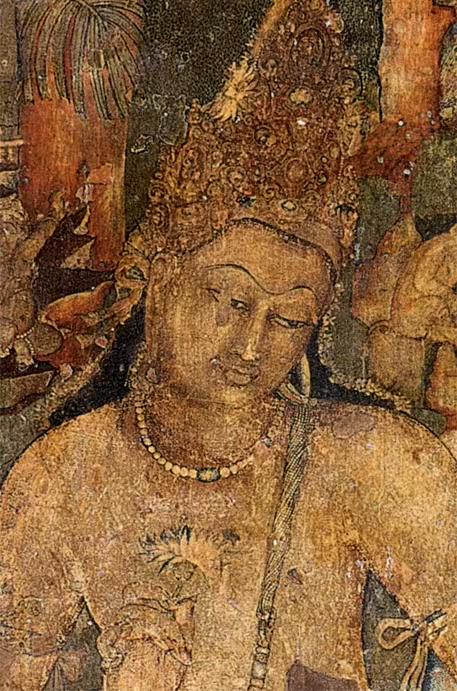
Ajanta therefore reflects more than religious devotion alone. Its caves demonstrate the ability of the Vakataka court and its ministers to direct resources toward large-scale architectural projects, sculpture, and painting. The monuments also reveal the participation of powerful officials such as Varahadeva in the cultural life of the kingdom. Their survival has made Harishena's reign central to the study of ancient Indian art.
Administration and Governance
The Vakataka political system was centred on hereditary kingship, but the division of the dynasty into branches created several regional courts. Rulers adopted high titles such as Samrat and Dharmamaharaja, performed elaborate sacrifices, and used genealogies and marriage alliances to establish legitimacy.
Ministers could exercise considerable practical authority. Deva served Pravarasena I, Ravi served Sarvasena, Pravara served Vindhyasena, and Hastibhoja administered affairs during the reign of Devasena. Varahadeva, the son of Hastibhoja, was both a minister and a patron of Ajanta's Cave XVI.
Copper-plate grants offer the clearest evidence of formal administration. They recorded the donation of villages and referred to territorial divisions such as the marga. The grants also used different languages for different purposes: the genealogical portions could be composed in Sanskrit, while the operative legal sections could appear in Prakrit. This combination indicates the coexistence of Sanskritic royal ideology with established regional administrative practice.
The dynasty's religious policy was not limited to a single tradition. Pravarasena I strongly patronised Vedic sacrifice and made gifts to Brahmins. At the same time, Vakataka rulers and their ministers supported Buddhist monuments at Ajanta. The evidence therefore points to a courtly environment in which Vedic ritual, Brahmanical legitimacy, and Buddhist institutional patronage could coexist.
Military Campaigns
The first major phase of Vakataka expansion occurred under Pravarasena I. His conflicts with the Naga kings, the annexation of Purika, and campaigns toward the Narmada formed the foundation of Vakataka imperial power. Accounts of his reign place his influence across a large section of the Deccan and possibly into central India, but the exact northern frontier is disputed.
Vindhyasena fought the ruler of Kuntala, demonstrating the strategic importance of the southern Deccan to the Vatsagulma branch. The location of Vatsagulma between the Sahyadris and the Godavari placed the branch near routes connecting the interior Deccan with western and southeastern regions.
Harishena's inscriptional conquests represent the widest military programme associated with the dynasty. His claimed campaigns touched Malwa, Kosala, Kalinga, Andhra, Gujarat, Nasik, and southern Maharashtra. These campaigns may have involved direct conquest, subordinate alliances, or temporary extension of influence. The surviving evidence does not allow every claim to be reconstructed as a permanent territorial annexation.
The dynasty also faced defeats. Prithivishena II was defeated by Vishnukundina king Madhava Varma II, and the Pravarapura-Nandivardhana territories were probably absorbed by Harishena after his death. These events show that Vakataka politics involved both internal consolidation and competition with neighbouring states.
Economy and Trade
Detailed information about Vakataka taxation, trade routes, and commercial institutions is not preserved in the available records. The absence of securely identified Vakataka coins is particularly notable: although the dynasty replaced the Satavahanas in much of the Deccan, it does not appear to have continued their coin-minting tradition in a form that can currently be identified.
Copper-plate land grants provide a different view of the economy. They show the royal authority's role in transferring villages and defining the administrative locations to which those villages belonged. Such grants also demonstrate the importance of land, agrarian settlements, and the legal documentation of royal gifts.
Public works formed another aspect of economic and administrative activity. During Devasena's reign, Svaminadeva excavated the Sudarshana tank near Washim. The project indicates investment in water management and the capacity of officials to organise labour and resources beyond the immediate royal court.
The location of Vakataka territories also placed the dynasty across important regional connections. Its branches occupied areas between the western ranges, the Godavari, the Narmada, and central Indian territories. However, the available evidence does not permit a detailed reconstruction of long-distance trade or the volume of commercial exchange.
Decline and Fall
The end of Vakataka rule is uncertain. Harishena was succeeded by two rulers whose names are not known, and the dynasty's final political events are poorly documented. One possibility is that the Vakatakas were defeated by the Kalachuris of Mahismati.
A different account appears in the eighth ucchvāsa of Dandin's Dashakumaracharita, written probably about 125 years after the fall of the dynasty. According to this narrative, Harishena's son was intelligent and accomplished but neglected political science, surrendered himself to pleasure, and encouraged similar behaviour among his subjects. The ruler of Ashmaka then sent his minister's son to the Vakataka court. The visitor gained influence, promoted the king's dissolute habits, and weakened the army.
The Ashmaka ruler subsequently encouraged the Kadamba ruler of Vanavasi to invade. The Vakataka king called his feudatories together and prepared to fight on the bank of the Varada, or Wardha, River. During the battle, some feudatories treacherously attacked him from the rear, and he was killed. The dynasty ended with his death in this account.
The narrative is literary and was written long after the events it describes, so its details must be treated carefully. It is nevertheless connected by some historians with the Davanagere copper-plate record of Kadamba king Ravivarma, dated to 519 CE. The record claims Kadamba suzerainty from the Narmada to the Kaveri near Talakad. This may imply that the Kadambas conquered and annexed former Vakataka territories sometime after 500 CE. The precise sequence of the dynasty's dissolution remains unresolved.
Legacy
The Vakataka legacy is visible in political, literary, religious, and artistic history. The dynasty helped shape the post-Satavahana political order of the Deccan and maintained connections with the Gupta Empire without being simply reducible to a Gupta province. Its rulers used Sanskritic titles and rituals while operating within regional Deccan traditions.
The two best-known Vakataka literary figures were Sarvasena and Pravarasena II. Sarvasena's Harivijaya is lost, but later writers praised it. Pravarasena II's Setubandha, composed in Maharashtri Prakrit, survives as evidence of the importance of Prakrit in royal literary culture. Both rulers are also associated with verses of the Gaha Sattasai.
Ajanta is the dynasty's most enduring monument. The caves associated with Harishena's reign contain rock-cut viharas, a chaitya hall, sculpture, and painting. Cave XVI was excavated by Varahadeva, a minister of Harishena, while Caves XVII and XIX were also developed during the same period. These monuments preserve the scale of Vakataka patronage and show how royal courts and high officials supported Buddhist institutions.
The Vakatakas also left an important epigraphic record. Their copper-plate grants illuminate royal genealogy, land donation, administrative divisions, language use, and the relationship between rulers and officials. Pravarasena II's unusually large number of surviving grants makes his reign particularly valuable for historians.
Although the dynasty disappeared around the turn of the 6th century, its former territories became part of the political worlds of the Chalukyas of Badami, Kadambas, Vishnukundinas, and Kalachuris. The Vakatakas therefore occupy a crucial place in the history of the Deccan: they connected the political traditions of the Satavahana aftermath with the regional kingdoms that followed, while leaving behind one of ancient India's greatest artistic achievements.