Overview
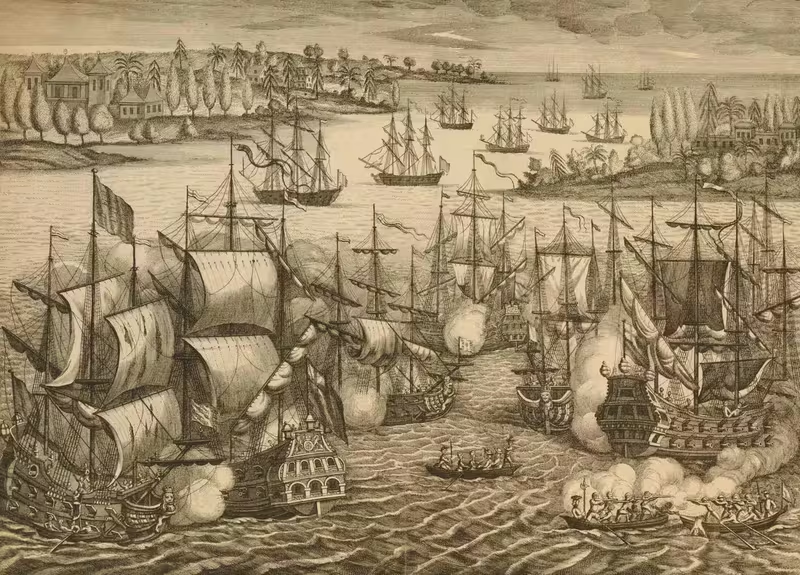
On 29–30 November 1612, four ships of the English East India Company fought a Portuguese force off Suvali, a coastal settlement near Surat in Gujarat. The English squadron, commanded by Captain Thomas Best, consisted of the Red Dragon, Hosiander, James, and Solomon. Opposing it were four Portuguese galleons and 26 rowing barks, vessels that carried no armament according to the surviving account.
The engagement was relatively small, but its consequences reached beyond the two days of fighting. Portugal had long sought to control maritime trade with India, while English commercial ventures were searching for routes into the East Indies and the spice trade. The English victory strengthened their position at Surat, helped secure a trading agreement with the Governor of Gujarat, and contributed to a more favourable Mughal attitude towards English merchants.
Background
Portuguese dominance over trade with India during the late fifteenth and sixteenth centuries created a formidable obstacle for English companies. The Company of Merchant Adventurers, founded in 1551 and later known as the Muscovy Company, and the English East India Company, established in 1600, were both attempting to reach the commercial networks of the East.
English voyages were organized as separate ventures, each financed through subscription stock. The expedition associated with the Battle of Swally was the East India Company's tenth voyage, commanded by Thomas Best between 1612 and 1614. The voyage did not begin as a straightforward expedition to Surat: earlier English voyages had also pursued routes towards other parts of Asia, including Japan, India, Sumatra, and the spice-producing regions.
Best's fleet departed Gravesend on 1 February 1612. It passed via present-day Trinidad and reached Daman on 3 September. Two days later, on 5 September, the ships arrived at Surat, then the principal Mughal port in the region, situated near the mouth of the Tapti River.
Prelude
A Portuguese squadron of 16 barks entered Surat on 13 September 1612. The arrival heightened the pressure on the English, who needed formal permission to trade and establish a factory. On 22 September, Best sent an emissary to the Mughal emperor requesting the right to trade and settle at Surat. He reportedly intended to leave India if permission was refused.
The Company's need for a profitable outcome was also shaped by its charter. In 1609, King James I had extended the Company's charter on the condition that it would be cancelled if no profitable ventures were concluded within three years.
Tensions increased on 30 September, when Best learned that two of his men, the purser Canning and William Chambers, had been arrested ashore. In response, he detained a ship belonging to the Governor of Gujarat and offered to release it in exchange for the two prisoners.
On 10 October, Best moved his ships to Suvali, a small town approximately 12 miles, or 19 kilometres, north of Surat. The Governor may have been occupied with a Rajput rebellion at a fort in the town, though the surviving account presents this as uncertain. Between 17 and 21 October, negotiations produced an agreement granting the English trading privileges, subject to the approval of the Mughal emperor.
The Event
A skirmish took place on 29 November, but neither side suffered much damage. The decisive movement came at daylight on 30 November. Sailing in the Red Dragon, Best passed through the line of four Portuguese galleons led by Captain Major Nuno da Cunha. Three Portuguese vessels ran aground during the manoeuvre. The Hosiander then joined the Red Dragon on the other side of the Portuguese formation.
The Portuguese managed to refloat all three grounded galleons. The action therefore did not end in the destruction or capture of the Portuguese squadron. Instead, the opposing forces remained in a tense standoff.
At about 9 p.m., the Portuguese attempted to set the English ships alight. A bark was sent towards them as a fire ship. The English watch detected the attack, and cannon fire sank the bark. Eight people were killed in the attempt. The failure of the fire-ship attack prevented the Portuguese from turning the standoff into a close-range assault.
Key Phases
- Initial skirmish: The two naval forces clashed on 29 November without significant damage.
- English breakthrough: On the morning of 30 November, the Red Dragon passed through the Portuguese formation, causing three galleons to run aground.
- Portuguese counterattack: A bark was sent as a fire ship that night, but it was sunk by English cannon fire.
- Standoff and departure: Neither side destroyed the opposing squadron, and the confrontation continued until Best sailed for Diu on 5 December.
Turning Points
The English passage through the Portuguese line was the battle's most important tactical moment. Although the grounded galleons were later refloated, the manoeuvre demonstrated that the smaller English squadron could challenge Portuguese control of the waters near Surat. The failed fire-ship attack was the second critical moment: English vigilance and cannon fire prevented a potentially damaging assault.
Participants
English East India Company
Captain Thomas Best commanded the English force. The ships named in connection with the battle were the Red Dragon, Hosiander, James, and Solomon. The Red Dragon and Hosiander are the vessels most directly described during the fighting, while the James and Solomon were also associated with the Company's eighth voyage.
Best's objective was commercial as well as military. He needed to secure permission to trade at Surat, and the naval confrontation strengthened his position during negotiations with the Gujarat authorities.
Portuguese Naval Force
Captain Major Nuno da Cunha led the four Portuguese galleons. They were supported by 26 rowing barks. The Portuguese retained enough control to refloat the three vessels that had grounded, but their fire-ship attack failed and the English were able to remain in the area before departing for Diu.
Aftermath
Best sailed for Diu on 5 December. On 6 January 1613, he received a letter from the Governor of Gujarat confirming that Emperor Jahangir had ratified the trading agreement. Best then sent Anthony Starkey overland towards England on 16 January with letters reporting the English success. Starkey later died, and English accounts claimed that two Jesuit priests had poisoned him; this allegation is presented as a claim rather than an established fact.
Best continued to Ceylon on 18 January, then travelled onwards to Sumatra. He returned to England around April 1614 without revisiting India.
Historical Significance
The Battle of Swally marked an early breakthrough for the English East India Company in India. It did not immediately create English political dominance, nor did it end Portuguese activity in the region. Its importance lay in demonstrating that the Portuguese could be challenged at sea and that English merchants could negotiate from a position of greater confidence.
The battle also influenced Mughal diplomacy. The Subahdar, or Governor, of Gujarat reported the event to Emperor Jahangir. Thereafter, Jahangir was more favourable towards the English than towards the Portuguese. This shift helped the English obtain a foothold in the commercial world of Surat.
The Company was also encouraged to establish a small navy to defend its commercial interests against European rivals and pirates. That modest naval beginning is regarded as a root of the modern Indian Navy.
Legacy
Suvali, anglicized as Swally, became useful to the English as a port near Surat. It was considered protected from sudden squalls and military attacks, and it remained navigable during low tides. Its position was also advantageous because the ports at Surat presented complications involving both French and Portuguese activity.
The English later constructed facilities at the port and restricted its use, charging duties for permission to enter. Suvali's development thus followed directly from the practical requirements exposed by the confrontation: safe anchorage, access to Surat, and protection for early English trade.
Historiography
The battle is generally remembered as a relatively small naval engagement with consequences disproportionate to its size. The surviving narrative emphasizes the English manoeuvre, the failed Portuguese fire-ship attack, and the subsequent Mughal ratification of trading privileges. It also connects the battle with the later development of an English Company navy.
Accounts associated with Robert Kerr's collection of voyages, Sir Thomas Roe's journal, and William Foster's study of Thomas Best's voyage provide the principal documentary framework for understanding the episode. The event is best interpreted not as the immediate conquest of Indian waters, but as an early commercial and diplomatic opening whose importance became clearer in the centuries that followed.