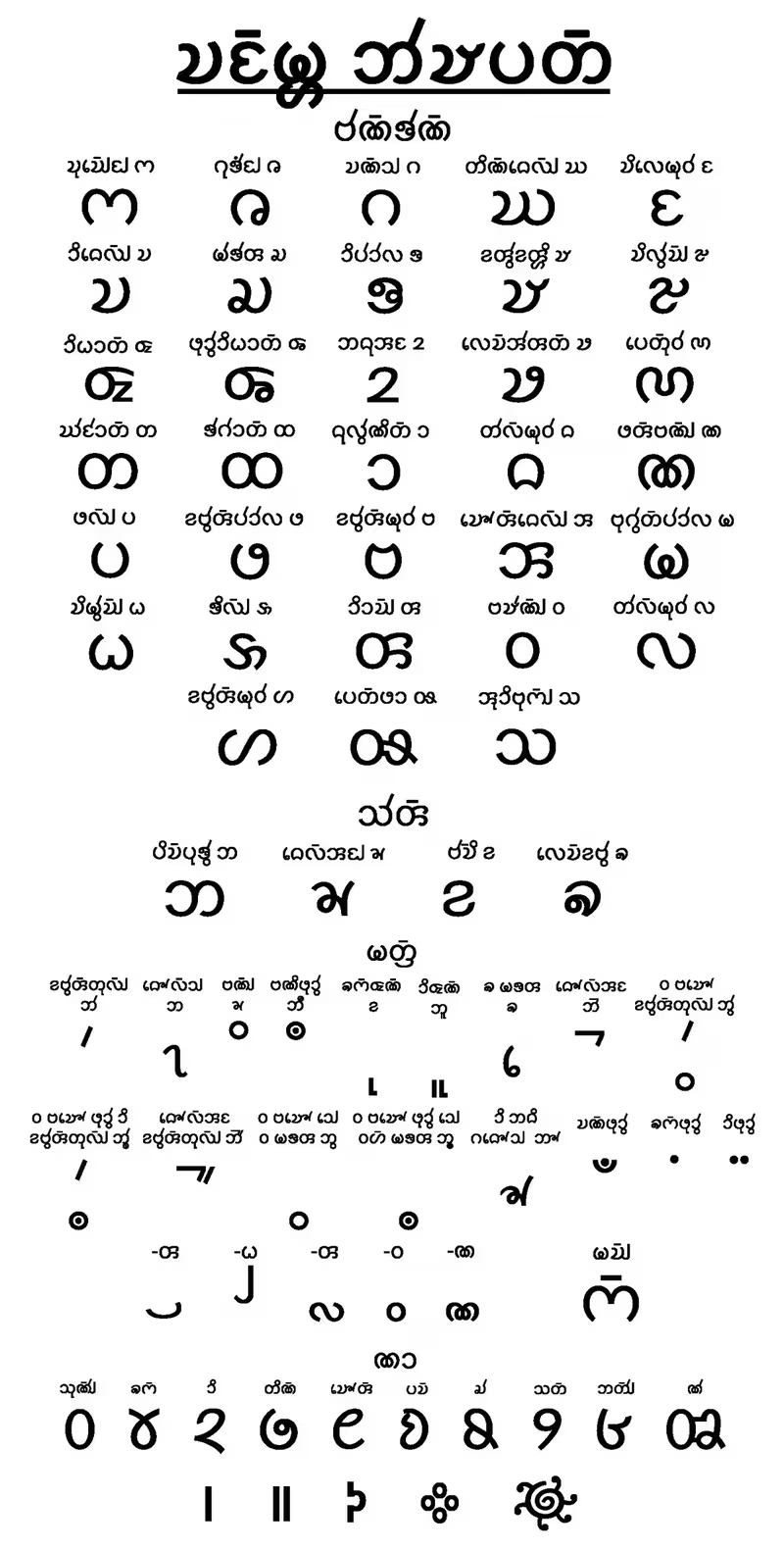
Chakma Script: An Abugida with a Distinctive Written Tradition
The Chakma script, also called Ajhā Pāṭh, is an abugida used for the Chakma language and, more recently, for Pali. Its history reaches back to Arakan, where it probably developed by the thirteenth century before the Chakma people migrated into Chittagong in the fourteenth century. The script belongs to the Brahmic family and is connected through the Burmese script to Pallava. Its letter forms have also been identified as deriving from the Arakanese script.
Chakma writing has several features that distinguish it from other Brahmic systems. Consonants normally carry an inherent vowel, but in Chakma that vowel is a long ā, rather than the short a found in many Eastern Indo-Aryan languages. Consonant clusters are represented with conjunct characters, while a visible vowel-killer marks the removal of the inherent vowel when no conjunct is used. The script also possesses its own numerals, punctuation marks, and a modern Unicode encoding.
Origins and Classification
Linguistic Family
Chakma is a Brahmic-type abugida used for an Eastern Indo-Aryan language. The script itself evolved from the Burmese script, which was ultimately derived from Pallava. On the basis of its letter forms, Chakma is stated to derive from the Arakanese script.
Origins
The script probably developed in Arakan up to the thirteenth century. The Chakma people later migrated into Chittagong during the fourteenth century, creating the historical setting in which the script and language continued to develop.
Name Etymology
The script is known as Chakma and is also called Ajhā Pāṭh. The historical material identifies these as names for the writing system but does not provide a separate etymology for either expression.
Historical Development
Arakan Development (up to the 13th Century)
The earliest phase described for Chakma is its probable development in Arakan. Its relationship to the Arakanese script is based on the shapes of its letters, while its broader historical lineage passes through Burmese to Pallava.
Migration to Chittagong (14th Century)
The Chakma people migrated into Chittagong in the fourteenth century. This movement forms a central stage in the history of the script, linking its earlier Arakan development with its later use among Chakma communities.
Orthographic Reform (2001–2004)
The book Cāṅmā pattham pāt recommended an orthographic reform in 2001. The proposal limited the standard repertoire of conjuncts to forms composed with five letters: yā, rā, lā, wā, and nā. The book Phadagaṅ, published in 2004, showed these conjuncts alongside forms made with bā, mā, and hā.
Modern users generally prefer simple subjoining, while older ligating forms are regarded as old-fashioned. This difference is stylistic rather than orthographic.
Modern Period
The Chakma language and script have been introduced into non-government schools in Bangladesh and schools in Mizoram. Chakma is also taught in government and private schools in Tripura, Mizoram, Arunachal Pradesh, and Bangladesh. In Tripura, instruction began in 2004 using the Bengali script and shifted to the Chakma script in 2013. Currently, 87 schools offer Chakma language instruction.
Scripts and Writing Systems
Chakma Script
Chakma is an abugida: consonant letters include an inherent vowel. Its inherent vowel is a long ā, an unusual feature among Eastern Indo-Aryan languages. Four independent vowels exist. Other initial vowels can be formed by adding vowel signs to ā, producing forms such as ī, ū, ai, and oi. Some modern writers extend this practice to i, u, and e.
Vowel Signs and Nasal Marking
Candrabindu, called cānaphudā, can be used together with anusvara, or ekaphudā, and visarga, or dviphudā. The writing system therefore permits combinations such as forms transcribed as aḥṃ, aṃṃ, uṃṃ, and muṃ.
Consonants and Conjuncts
The maayyaa, or vowel-killer, is used to form conjoined consonants. Chakma has two vowel-killing characters for compatibility with modern user expectations. The explicit maayyaa visibly removes the inherent vowel, as in the form for k.
Consonant clusters may be written with conjunct characters. Earlier writing displayed a wider range of conjunct pairs, including relatively complicated glyphs. Contemporary practice has reduced and regularized this repertoire.
Punctuation and Numerals
Chakma uses single and double danda punctuation, a unique question mark, and the Phulacihna section sign. The Phulacihna has variant glyphs, some resembling flowers or leaves. The script also has its own numerals from zero through nine and a written form for ten.
Geographic Distribution
Historical Spread
The script probably originated in Arakan and was carried into Chittagong after the Chakma migration in the fourteenth century.
Modern Distribution
Chakma is taught in schools across Bangladesh and in the Indian states of Tripura, Mizoram, and Arunachal Pradesh. Its use in education includes both government and private institutions.
Modern Status
Educational Preservation
School instruction is an important contemporary setting for Chakma. Bangladesh has introduced the language and script in non-government schools, while Mizoram also includes it in school education. Tripura introduced Chakma instruction in primary schools in 2004 and adopted the Chakma script for that instruction from 2013.
Digital Encoding
Chakma was added to the Unicode Standard in January 2012 with the release of Unicode version 6.1. Its Unicode block occupies U+11100–U+1114F, with some code points remaining unassigned.
Conclusion
Chakma script preserves a distinctive branch of the Brahmic writing tradition. Its historical path runs from probable development in Arakan, through the Chakma migration into Chittagong, to continued educational use in Bangladesh and northeastern India. The script’s long inherent ā, visible vowel-killer, specialized conjunct system, combined diacritic possibilities, unique punctuation, and independent numerals give it a recognizable written identity. Orthographic reform has encouraged simpler subjoined conjuncts, while Unicode encoding has supported its use in digital text. Together, school instruction and modern encoding connect Chakma’s historical development with its continuing role in contemporary literacy.