Operation Vijay and the Annexation of Portuguese India, 1961
Introduction
At dawn on 18 December 1961, Indian forces advanced into three Portuguese-held territories on the western coast of the Indian subcontinent: Goa, Daman, and Diu. The operation, codenamed Operation Vijay, was not a single attack on one continuous frontier. It was a coordinated campaign involving separate land operations in Goa, Daman, and Diu, naval action in coastal waters, the capture of Anjidiv Island, and air strikes against selected targets. By the evening of 19 December, the Portuguese governor-general had signed an instrument of surrender.
The map marks the final territorial configuration of Portuguese India before its incorporation into the Republic of India. It also shows the earlier occupation of Dadra and Nagar Haveli in 1954, an event that had already weakened Portugal's position on the subcontinent. The campaign ended 451 years of Portuguese rule over the remaining Portuguese exclaves in India. In India, the action is widely referred to as the Liberation of Goa; in Portugal, it has been described as the Invasion of Goa.
The political context was shaped by two very different positions. The Indian government regarded Goa, Daman, and Diu as historically Indian territories that remained under colonial rule after British withdrawal in 1947. Portugal's Estado Novo government instead treated its overseas possessions as extensions of metropolitan Portugal and rejected the idea that they were colonies whose future could be negotiated. Prime Minister Jawaharlal Nehru initially favoured political pressure and international opinion, while Defence Minister Krishna Menon eventually supported military action.
Historical Context
Portuguese rule after Indian independence
When India became independent in August 1947, Portugal retained several territories on the subcontinent. These included the districts of Goa, Daman, and Diu, collectively known as the State of India. Portugal also controlled Dadra and Nagar Haveli, two landlocked exclaves within Indian territory.
The Portuguese-held territories covered approximately 1,540 square miles, or about 4,000 square kilometres, and had a population of approximately 637,591. Goa contained a majority Hindu population, estimated at 61 percent, alongside a Christian population of approximately 37 percent—mostly Catholic—and a Muslim population of about 2 percent. Agriculture remained central to the economy, while mining, especially iron ore and some manganese, expanded during the 1940s and 1950s.
The Estado Novo regime under António de Oliveira Salazar was a dictatorship strongly committed to colonialism. At a time when other former colonial powers were increasingly accepting demands for self-determination, Lisbon maintained that its overseas territories formed part of Portugal itself. This position made a negotiated transfer of Goa, Daman, and Diu difficult.
The Goan resistance movement
Resistance to Portuguese rule took both non-violent and armed forms. Tristão de Bragança Cunha, a French-educated Goan engineer, founded the Goa Congress Committee in Portuguese India in 1928. His writings, including Four Hundred Years of Foreign Rule and Denationalisation of Goa, criticised Portuguese rule and sought to build political awareness among Goans.
The Goa Congress Committee received messages of solidarity from figures associated with the Indian independence movement, including Rajendra Prasad, Jawaharlal Nehru, and Subhas Chandra Bose. In 1938, Cunha met Bose in Bombay. On Bose's advice, the Goa Congress Committee opened a branch office at Dalal Street and became affiliated with the Indian National Congress.
A major phase of public protest began in June 1946, when socialist leader Ram Manohar Lohia entered Goa to visit Juliao Menezes. Lohia advocated Gandhian techniques and non-violent resistance. On 18 June, Portuguese authorities disrupted a protest in Panaji against the suspension of civil liberties and arrested Lohia, Cunha, and other organisers. The date is now commemorated as Goa Revolution Day. Demonstrations continued intermittently from June through November.
Armed groups also operated against Portuguese rule. The Azad Gomantak Dal and the United Front of Goans carried out attacks intended to weaken Portuguese administration and disrupt economic activity. Accounts of these operations describe attacks on roads, transport links, telegraph and telephone lines, and other infrastructure. The Indian government supported the establishment of armed groups such as the Azad Gomantak Dal with financial, logistical, and military assistance. These groups operated from bases in Indian territory, often under the cover of Indian police forces.
Diplomacy and increasing tension
On 27 February 1950, India asked Portugal to open negotiations concerning the future of its colonies in India. Lisbon rejected the request, arguing that the territories were not colonies but parts of metropolitan Portugal. Portugal also argued that the Republic of India had not existed when Goa came under Portuguese rule and therefore had no claim to the territory.
After Portugal failed to respond to later Indian communications, India withdrew its diplomatic mission from Lisbon on 11 June 1953. In 1954, India introduced visa restrictions affecting movement between Goa and India. These restrictions severely disrupted transport between Goa, Daman, Diu, Dadra, and Nagar Haveli. India also imposed sanctions intended to pressure Portugal, while the Indian Union of Dockers boycotted shipping to Portuguese India.
The position of the enclaves became even more precarious in 1954. Between 22 July and 2 August, pro-Indian forces attacked Portuguese positions in Dadra and Nagar Haveli. The Portuguese territories were landlocked and had no Portuguese military garrisons, only police forces. Because they were surrounded by Indian territory, Portugal could not send reinforcements without crossing India.
The International Court of Justice later ruled, in a decision dated 12 April 1960, that Portugal possessed sovereign rights over Dadra and Nagar Haveli but that India had the right to deny passage to Portuguese armed personnel across Indian territory. This left Portugal without a practical route for military relief.
On 15 August 1955, between 3,000 and 5,000 unarmed Indian activists attempted to enter Goa at six locations. Portuguese police violently repulsed them, killing between 21 and 30 people. The incident strengthened Indian public opinion against Portugal's continued presence. India closed its consulate in Goa on 1 September 1955.
Portugal proposed a referendum on Goa's future in 1956, and the idea was repeated by presidential candidate General Humberto Delgado in 1957. The proposal was rejected by Portuguese defence and foreign affairs ministers. Salazar also sought mediation from the United Kingdom and Brazil and asked the United Nations Security Council to intervene. Mexico offered to use its influence in Latin America to reduce tensions.
India's position hardened. Krishna Menon stated that India had not renounced the use of force in Goa. On 10 December 1961, nine days before the operation, Nehru told the press that the continuance of Portuguese rule in Goa was impossible. The immediate background to the invasion included a maritime incident on 24 November, when Portuguese ground troops fired on the passenger boat Sabarmati near Anjidiv, killing one passenger and injuring the chief engineer.
Territorial Extent and Boundaries
A fragmented colonial geography
The map's most important geographic feature is fragmentation. Portuguese India was not a compact state stretching continuously along the coast. Goa formed the largest and most politically significant territory. Daman lay approximately 193 kilometres north of Bombay, near the boundary between Gujarat and Maharashtra. Diu was an island off the southern tip of Gujarat. Dadra and Nagar Haveli were inland enclaves surrounded by Indian territory.
This arrangement created serious administrative and military problems. Daman and Diu were separated from Goa, while the two inland enclaves could be reached from the coastal Portuguese territories only by crossing Indian land. India exploited this geographic vulnerability through travel restrictions, sanctions, and the denial of passage to Portuguese reinforcements.
Goa
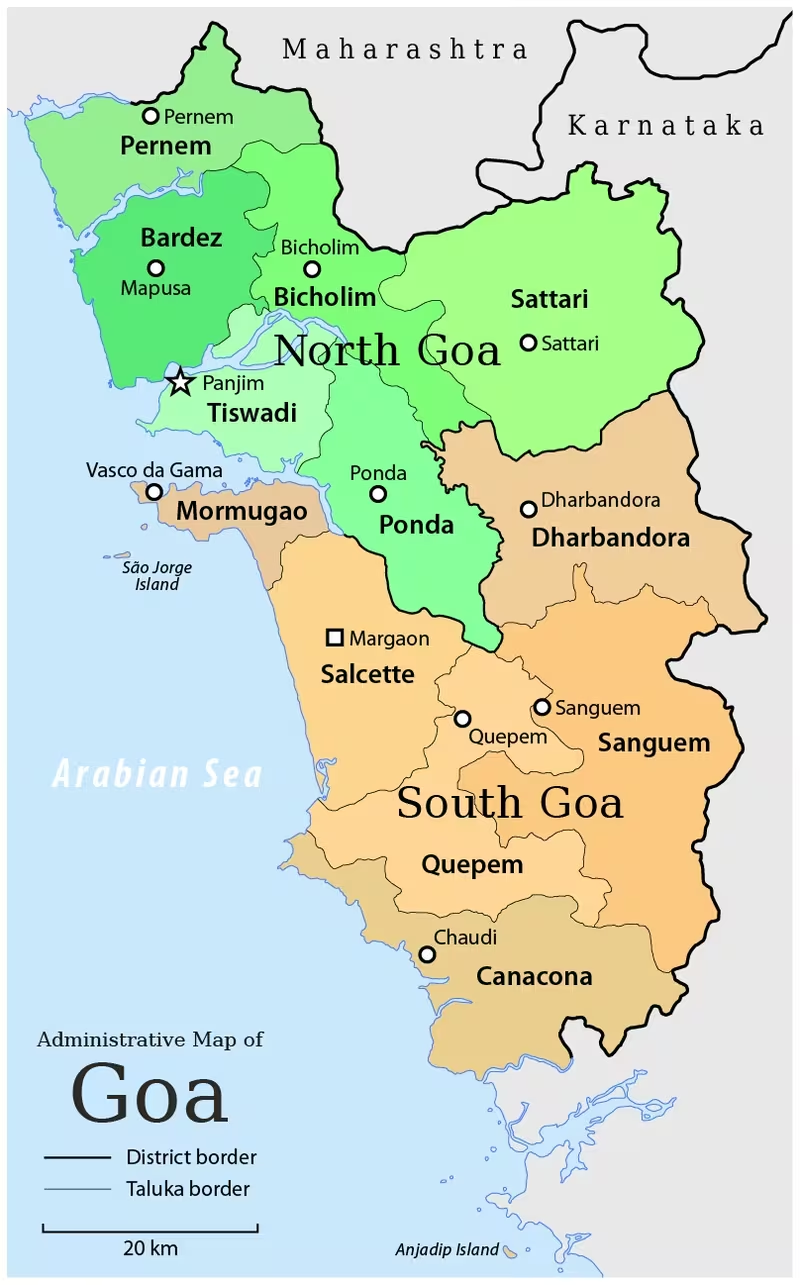
Goa occupied the central position in the campaign and contained the political capital, Panaji, the harbour of Mormugão, Dabolim Airport, and important river crossings. The main Indian objective was to secure Panaji and Mormugão. Indian forces approached Goa from the north, east, and south, using multiple axes to prevent Portuguese forces from concentrating against one advance.
The northern and north-eastern operations crossed areas around Maulinguém, Bicholim, Chapora, Colvale, Assonora, and Tivim. The central advance moved toward Panaji through Banastari. An eastern column advanced toward Ponda through Usgão, while forces moving farther south reached Margão and then Mormugão and Dabolim.
The Mandovi River was a major natural obstacle. Portuguese forces destroyed bridges at Banastarim and elsewhere to delay the Indian advance. Indian troops eventually crossed the Mandovi and entered Panaji on the morning of 19 December.
Daman
Daman covered approximately 72 square kilometres. The Daman Ganga River divided the capital into Nani Daman and Moti Daman. The territory's landscape included marshes, salt pans, streams, paddy fields, and groves of coconut and palm. The principal defensive locations were the fortress of São Jerónimo, Daman Fort, the air control tower, and the airfield.
The Indian attack began before dawn on 18 December. The 1st Maratha Light Infantry advanced through the enclave in stages, first targeting the airfield and then moving toward the two sections of the capital and the fort. Portuguese forces used artillery, mortars, defensive shelters, and small minefields, but their ammunition and communications were limited. The airfield and remaining Portuguese positions fell on 19 December.
Diu
Diu was an island approximately 13.8 kilometres long and 4.6 kilometres wide, with an area of about 40 square kilometres. Marshes and narrow channels separated it from the mainland. At the time of the conflict, there were no bridges across the channels, and only fishing boats and small craft could use the waterways.
The Portuguese defence centred on Diu Fortress, the airfield, and positions near Gogol, Amdepur, Passo Covo, and Kob Forte. Indian forces attacked from the north-west and north-east. The marshy channels made the first crossings difficult. Indian troops attempted to use rafts made from bamboo cots tied to oil barrels, but Portuguese machine-gun and artillery fire repulsed several attacks.
Indian air strikes began at dawn on 18 December, followed by naval bombardment from the cruiser INS Delhi. The Portuguese garrison withdrew from forward positions and formally surrendered on 19 December. The territorial geography of Diu made it possible for Indian forces to combine pressure from the mainland, the air, and the sea.
Dadra and Nagar Haveli
The map includes Dadra and Nagar Haveli as an earlier stage in the territorial transformation. Pro-Indian forces attacked Dadra and Nagar Haveli in July 1954. Dadra police station fell on the night of 22 July, and Naroli police station was taken on 28 July. The Portuguese administrator and police forces in Nagar Haveli surrendered to Indian police forces on 11 August.
Although the International Court of Justice recognised Portuguese sovereign rights over the enclaves, it also held that India could prevent Portuguese armed personnel from crossing Indian territory. The enclaves therefore remained physically isolated from Daman and the rest of Portuguese India.
Administrative Structure
Portuguese administration
Before December 1961, Goa, Daman, and Diu were administered as Portuguese districts within the State of India. The governor-general combined civil and military authority. General Paulo Bénard Guedes held the unified command of the Armed Forces of the State of India before General Manuel António Vassalo e Silva succeeded him in 1958.
The Portuguese military structure was divided into land, naval, and internal-security components. The Land Forces of the State of India were commanded through the Portuguese Army's Independent Territorial Command of India. Naval forces operated as the Naval Forces of the State of India. Police, fiscal, and rural guards provided internal security, customs enforcement, border protection, and rural policing.
The district-level arrangement was shaped by the separation of the territories. Goa, Daman, and Diu each had its own local military and security forces. This made coordination difficult when India began simultaneous operations across the three enclaves.
Indian military administration
After the Portuguese surrender, Goa, Daman, and Diu were declared a federally administered union territory under the President of India. Major General K. P. Candeth became military governor. Military administration was initially headed by Major General Kunhiraman Palat Candeth as lieutenant governor.
On 8 June 1962, military rule was replaced by civilian government. The lieutenant governor appointed an informal Consultative Council of 29 nominated members to assist in administering the territory. The political transition therefore followed rapidly after the military campaign, although the initial post-surrender government remained centrally supervised.
Infrastructure and Communications
Roads, bridges, and river crossings
The military geography of Operation Vijay was strongly shaped by transport infrastructure. Portuguese commanders planned to demolish bridges and mine roads and beaches under the Plano de Barragens, or Barrage Plan. In Goa, bridges at Bicholim, Chapora, Colvale, Assonora, and Banastarim were destroyed or prepared for destruction.
The Indian advance nevertheless proceeded rapidly. The 50th Para Brigade crossed minefields, roadblocks, and four river obstacles. In the east, the destruction of the Borim Bridge forced the 4th Sikh Infantry to improvise a crossing of the Zuari River using military tankers and chest-high water. From the landing point at Embarcadouro de Tembim near Raia, the force moved toward Margão.
The Portuguese plan depended on delaying an invading force through the destruction of infrastructure. Its effectiveness was limited by weak communications and insufficient mines. A Portuguese officer later described the plan as incomplete and unrealistic because the forces lacked the portable communications equipment needed to coordinate a prolonged defence.
Communications
Indian air strikes targeted communications as well as military positions. The Portuguese wireless station at Bambolim was attacked by Hawker Hunter aircraft. The destruction of onshore radio facilities affected Portuguese communication with Lisbon and between local commands.
The Portuguese chain of command also became confused on 17 December when instructions were issued that orders should pass directly from headquarters to defending troops rather than through local command posts. This bypassing of intermediate commands contributed to uncertainty during the withdrawal.
Maritime communications
The isolation of Dadra and Nagar Haveli led Salazar's government to establish an airline link between the enclaves and Portuguese Indian ports after land transport was blocked. Maritime communications were also significant. Mormugão was a major harbour and a key point in the defence of Goa. Portuguese naval units were expected to protect the harbour, support coastal artillery, and maintain contact with Lisbon.
Portugal attempted to send naval reinforcements, but Egypt denied the ships access to the Suez Canal. The geography of the Arabian Sea therefore became part of the wider diplomatic and military contest.
Economic Geography
Agriculture and mining
The economy of Portuguese India was primarily agricultural. Goa's coastal and riverine landscape supported cultivation, while Daman contained paddy fields, salt pans, and irrigated or wet lowlands. Coconut and palm groves formed part of the landscape around Daman and other coastal areas.
Mining expanded in Goa during the 1940s and 1950s, especially iron ore and some manganese. Economic pressure against Portuguese rule focused partly on these networks and on the movement of goods. India's restrictions on transit between Goa, Daman, Diu, Dadra, and Nagar Haveli caused significant hardship and contributed to economic depression in the landlocked enclaves.
Ports and shipping
Mormugão was the principal port mentioned in the campaign. The harbour had military as well as commercial significance. The Portuguese sloop NRP Afonso de Albuquerque was stationed there and was expected to support the coastal defence of the harbour and adjoining beaches.
India's wider pressure also extended to shipping. The Indian Union of Dockers boycotted Portuguese Indian shipping in 1954. During the campaign, the waters around Goa and Diu became operational spaces for Indian frigates, a cruiser, patrol boats, and the aircraft carrier INS Vikrant.
Transport restrictions
The political geography of Portuguese India made transport unusually vulnerable. Daman and Diu were separate coastal enclaves, while Dadra and Nagar Haveli depended on routes through Indian territory. India's visa restrictions and sanctions paralysed ordinary movement between the enclaves. This meant that Portugal could not easily reinforce its isolated possessions, even before the full-scale operation began.
Cultural and Religious Geography
Goa's population in the period before annexation was estimated at 61 percent Hindu, 37 percent Christian, mostly Catholic, and 2 percent Muslim. These figures describe the population within a territory governed by Portugal, but they do not imply a uniform political response to Portuguese rule. The anti-colonial movement included Goan nationalists, Indian political organisations, non-violent campaigners, and armed groups.
The Portuguese administration and Catholic institutions remained important in Goan public life. The archbishop of Goa and Daman was Portuguese-born at the time of annexation. José Vieira Alvernaz was archbishop and titular Patriarch of the East Indies. The Holy See did not publicly state a position on the annexation, but the appointment of a native head of the Goan Church was delayed until 1963, when Msgr Francisco Xavier da Piedade Rebelo became Bishop and Vicar Apostolic of Goa.
Cultural change was one of the issues raised by the Portuguese government after the surrender. Salazar argued that the integration of Goa into India would create tensions with its existing culture and predicted that some Goans would wish to emigrate to Portugal. The Portuguese government offered citizenship to Goan natives who wished to move to Portugal rather than remain under Indian rule. Later, the eligibility rules were restricted to people born before 19 December 1961.
Goan society was also connected to wider Indian and overseas networks. The Goan diaspora was estimated at approximately 175,000, including about 100,000 people within the Indian Union, mainly in Bombay. These networks shaped political mobilisation and the circulation of information about Portuguese rule.
Military Geography
Indian forces and operational design
The Indian campaign used land, air, and naval forces in a coordinated operation lasting more than 36 hours. Lieutenant-General Chaudhari of Southern Command fielded the 17th Infantry Division, commanded by Major General K. P. Candeth, and the 50th Parachute Brigade under Brigadier Sagat Singh.
The attack on Daman was assigned to the 1st Battalion of the Maratha Light Infantry. Operations in Diu were assigned to the 20th Battalion of the Rajput Regiment and the 5th Battalion of the Madras Regiment. In Goa, the 50th Para Brigade advanced in three main columns:
- The eastern column, led by the 2nd Para Maratha, moved toward Ponda through Usgão.
- The central column, consisting of the 1st Para Punjab, moved toward Panaji through Banastari.
- The western column, comprising the 2nd Sikh Light Infantry and armoured units, crossed the border near Tivim.
The 63rd Indian Infantry Brigade advanced from the east in two columns. The 2nd Bihar and 3rd Sikh linked up near Mollem before advancing toward Ponda and southern Goa. The 4th Sikh Infantry later moved through the Zuari crossing toward Margão and Mormugão.
Portuguese defence planning
Portuguese forces in India were organised under the Armed Forces of the State of India. Their strength varied in contemporary accounts. One estimate placed the total Portuguese presence in 1955 at around 8,000 personnel across land, naval, police, and fiscal forces. By 1960, the land force had been reduced to approximately 3,300 soldiers as Portugal shifted military resources toward Angola and other African territories.
At the time of the invasion, Portuguese ground forces in the three enclaves included approximately 3,995 men, among them 810 native Indo-Portuguese soldiers. Many had limited military training and were primarily used for security and anti-extremist operations. Internal security forces added between 900 and 1,400 police and guards, according to different estimates.
The defence of Goa was organised under the Plano Sentinela, or Sentinel Plan. Goa was divided into four sectors: North, Centre, South, and Mormugão. Four battlegroups were assigned to slow the Indian advance. The plan depended on exchanging territory for time, using demolitions, roadblocks, mines, and controlled withdrawals.
Portugal's naval force in Goa was small. The sloop NRP Afonso de Albuquerque carried four 120-millimetre guns and four automatic rapid-firing guns. Three light patrol boats, each carrying a 20-millimetre Oerlikon gun, were based in Goa, Daman, and Diu. Portugal had no regular air force presence in India. Air defence depended on a few obsolete anti-aircraft guns.
Goa operations
The first fighting in Goa began on 17 December near Maulinguém. Indian forces occupied the town, and Portuguese reconnaissance units withdrew or attempted to reposition. Portuguese forces destroyed bridges at Bicholim, Chapora, Colvale, and Assonora in an effort to slow the advance.
On 18 December, the Indian columns moved quickly. The western column crossed the frontier near Tivim and advanced toward Mapuca and Panaji. Portuguese reconnaissance units withdrew southward, using armoured cars to cover their retreat. Indian troops reached Betim, across the Mandovi from Panaji, by the evening.
The eastern advance moved through Usgão and toward Ponda. The destruction of bridges slowed the movement but did not prevent the Indian forces from reaching southern Goa. Portuguese forces encountered the 4th Sikh Infantry near Verna and surrendered after fierce fighting. Indian troops then continued toward Mormugão and Dabolim Airport.
On the morning of 19 December, Indian troops crossed the Mandovi and entered Panaji without resistance. Fort Aguada was also captured, and political prisoners held there were freed. Portuguese forces formally surrendered later that day.
Air operations
Indian air operations began with attacks on Dabolim Airport. Twelve English Electric Canberra aircraft conducted the first raid on 18 December, dropping approximately 63,000 pounds of explosives. The runway was destroyed, but the terminal building and other airport facilities were deliberately left undamaged under the Indian Air Command's instructions.
A second Canberra raid struck the same target. A third operation used Hawker Hunters against the Portuguese wireless station at Bambolim. Indian de Havilland Vampires patrolled in support of ground forces, though they did not receive requests to attack.
The campaign included incidents of friendly fire. Two Vampires mistakenly fired rockets at positions occupied by the 2nd Sikh Light Infantry, injuring two soldiers. Indian ground troops also fired on an Indian Air Force T-6 Texan, causing minimal damage.
In Daman, Indian Mystère aircraft flew 14 sorties against Portuguese artillery positions. In Diu, Indian aircraft attacked the airfield's control tower, parts of Diu Fort, the runway, a Portuguese ammunition dump, and the patrol boat NRP Vega. These operations gave India effective air superiority during the campaign.
Naval operations
The Indian Navy deployed several groups around Goa, including the cruiser INS Mysore, frigates, destroyers, minesweepers, support vessels, and the aircraft carrier INS Vikrant. The carrier operated approximately 121 kilometres from Goa's coast, helping deter foreign intervention and a possible Portuguese naval response.
At Mormugão, INS Betwa and INS Beas entered the harbour on 18 December and opened fire on NRP Afonso de Albuquerque. The Portuguese sloop returned fire but was heavily outnumbered and restricted by the harbour's confined waters. Its control tower, propulsion system, and command structure were damaged. The ship was eventually run aground near Bambolim, and its crew abandoned it after setting it on fire.
At Anjidiv, Indian marines from INS Mysore and INS Trishul stormed the island under covering fire. The first assault was repulsed, killing seven Indian marines and wounding 19. After further shelling, the island was secured on 19 December. The last Portuguese soldier captured in India, Goan private Manuel Caetano, was taken on 22 December after swimming to the Indian shore.
At Diu, INS Delhi bombarded the Portuguese-held fortress. The patrol boat NRP Vega engaged Indian aircraft but was forced to withdraw after its captain and gunner were killed. The crew abandoned the boat and was taken prisoner.
Political Geography and International Reactions
India's military action was preceded by years of diplomatic disagreement. New Delhi argued that Goa, Daman, and Diu were Indian territories unlawfully held by Portugal. Lisbon insisted that they were parts of Portugal and that their transfer could not be negotiated.
The conflict produced sharply divided international reactions. The Soviet Union supported India and vetoed a United Nations Security Council resolution condemning the operation. Leonid Brezhnev, visiting India during the war, publicly applauded the campaign. The United Arab Republic, Morocco, Indonesia, Ceylon, Liberia, Ghana, and several other states expressed support, often presenting the operation as part of the wider struggle against colonialism.
The United States condemned India's use of force. In the Security Council, Adlai Stevenson demanded the immediate withdrawal of Indian forces. The US Senate Foreign Relations Committee attempted to reduce India's 1962 foreign aid appropriation by 25 percent, despite opposition from President John F. Kennedy.
The United Kingdom expressed regret and stated that it deeply deplored India's decision to use military force, while also recognising that the continued Portuguese presence was anachronistic. The Netherlands similarly criticised the use of force. Brazil strongly supported Portugal, reflecting its close political and cultural ties with Lisbon. Pakistan condemned the operation and argued that the future of Goa should have been determined through a United Nations-sponsored plebiscite.
The People's Republic of China offered qualified support for the anti-colonial struggle while also suggesting that Nehru had used the operation to recover political prestige. The Vatican did not issue a direct public response, though the ecclesiastical administration of Goa changed gradually after annexation.
Legality and Competing Interpretations
The legal status of the annexation remained contested. India had recognised Portuguese sovereignty over Goa after independence in 1947, but later argued that colonial acquisitions made under earlier historical conditions could not be defended under twentieth-century international law. Indian arguments also described Goa as an integral part of India and invoked the principle of self-determination.
Some legal scholars argued that the action was contrary to the United Nations Charter's restrictions on the use of force. Quincy Wright described the episode as legally significant because it revealed a major difference between Eastern and Western interpretations of international law. Alina Kaczorowska-Ireland argued that forceful annexation after the UN Charter was illegal under the principle of jus cogens. Sharon Korman argued that self-determination might accommodate a new political reality without removing the illegality of the original annexation.
The Indian Supreme Court recognised the validity of the annexation and rejected the continued applicability of the law of occupation. Portugal did not recognise the incorporation of the territories into India until 1974. A treaty signed on 31 December 1974 recognised India's full sovereignty over Goa, Daman, Diu, Dadra, and Nagar Haveli.
Legacy and Territorial Transformation
Operation Vijay transformed the political map of western India. The Portuguese State of India ceased to exist, and Goa, Daman, and Diu became a federally administered union territory under Indian authority. The operation cost 22 Indian and 30 Portuguese lives. A total of 4,668 personnel were taken prisoner, including military and civilian personnel, Portuguese, Africans, and Goans.
Portuguese forces were initially interned at camps in Goa, including facilities at Navelim, Aguada, Ponda, and Alparqueiros. Most prisoners were later transferred to Ponda, where conditions improved. Repatriation negotiations were delayed by disagreements over the aircraft and routes to be used. Most prisoners had returned by May 1962, travelling through Karachi in chartered French aircraft before continuing to Lisbon.
The immediate post-war administration was military, but it shifted to civilian government on 8 June 1962. The political and cultural consequences continued for decades. Portugal maintained a formal refusal to recognise the annexation until the fall of the Estado Novo in 1974. Relations between India and Portugal then improved, culminating in the December 1974 treaty.
The map therefore records more than a short military operation. It shows the final collapse of a fragmented European colonial presence on the Indian subcontinent, the strategic importance of enclaves and transport corridors, and the way land, sea, and air power combined to alter a territorial arrangement that had endured for centuries.