Overview
A low mound rising only about 5.5 metres above the surrounding plain preserves the remains of Bhirrana, an archaeological settlement in Haryana’s Fatehabad district. The mound measures approximately 190 metres from north to south and 240 metres from east to west. Beneath it lie successive occupation layers associated with Hakra Ware traditions, the Early Harappan period, the Early Mature Harappan phase, and the Mature Harappan culture.
Bhirrana matters because its excavated remains document a long process of settlement development. The earliest levels contained subterranean pit dwellings, distinctive pottery, and copper artefacts. Later inhabitants built mud-brick houses, introduced more formal town planning, enclosed the settlement with fortifications, and created a layout divided into a citadel and Lower Town. In its final identified phase, Bhirrana displayed many features associated with a developed Harappan town: wide roads, drains, craft objects, seals, beads, figurines, and multi-roomed houses.
The chronology of the site is not settled. Two charcoal samples from the earliest levels have been used to propose dates in the 8th–7th millennium BCE. Other charcoal samples from early levels produced dates between 3200 and 2600 BCE, while archaeological comparisons have placed Hakra Ware at Bhirrana in the later fourth millennium BCE. Archaeologist Gregory Possehl expressed reservations about making broad chronological claims from the radiocarbon evidence. Bhirrana must therefore be understood both as an archaeological site and as a case study in the difficulties of dating early South Asian cultures.
Etymology and Names
The settlement is known as Bhirrana, with Bhirdana and Birhana also used as variants. Its IAST form is Bhirḍāna. The available archaeological descriptions record these names but do not establish a securely documented ancient name for the settlement.
The name “Saraswati” is associated with the site in modern archaeological interpretation because Bhirrana lies along channels linked with the seasonal Ghaggar River. Some Archaeological Survey of India interpretations identify the Ghaggar’s ancient channels with the Rigvedic Saraswati. This identification, and the attempt to connect Harappan communities directly with Vedic traditions, remains controversial. The association should therefore be treated as an interpretation rather than as an established ancient name for Bhirrana.
Geography and Location
Bhirrana lies in a small village in Fatehabad district, in the north Indian state of Haryana. It is approximately 220 kilometres north-west of New Delhi and about 14 kilometres north-east of the Fatehabad district headquarters, near the road to Bhuna. The site is located north of Bhirrana village, off the Shekhupur road, and close to the New Delhi–Fazilka national highway.
The settlement stands on a flat alluvial plain. Its position belongs to a wider archaeological landscape formed by the paleo-channels of the seasonal Ghaggar River, which flows through modern Haryana from the Nahan area towards Sirsa. Numerous archaeological sites occur along these former or shifting channels. Water access, fertile alluvial ground, and communication across the Ghaggar-Chautang region helped create conditions in which settled communities could grow and interact.
The mound’s modest height can conceal the scale of its history. A rise of 5.5 metres may appear slight in a flat landscape, but it represents accumulated occupation debris, building remains, floors, pits, pottery, and other material deposited over successive phases. Bhirrana’s importance lies less in monumental architecture than in the stratified sequence preserved within this mound.
Ancient History
Earliest Occupation and the Hakra Ware Phase
According to the excavation interpretation associated with L. S. Rao, Bhirrana’s earliest cultural phase is represented by Hakra Wares Culture. The lowest levels included subterranean dwelling pits cut into the natural soil. Their walls and floors were plastered with yellowish alluvium from the Saraswati valley, as described in the excavation reports. Some pits were also used for industrial activity or for practices interpreted as sacrifices.
The pottery assemblage of this phase was varied. It included Mud Appliqué Wares, deeply and lightly incised wares, tan or chocolate-slipped pottery, brown-on-buff wares, bichrome wares painted in black and white, Black-on-Red Ware, and plain red wares. These forms have been compared with pottery traditions from other settlements in Haryana and the Cholistan region. Such similarities have been interpreted as evidence of cultural contact and interaction across the Ghaggar-Chautang and Cholistan areas.
The artefacts from the earliest phase also included a copper bangle, a copper arrowhead, terracotta bangles, beads of carnelian, lapis lazuli, and steatite, a bone point, and stone saddle and quern stones. The presence of smelted copper is particularly important. It indicates a Chalcolithic level of technological development rather than a purely Neolithic one.
Two charcoal samples from the early levels have been dated to the 8th–7th millennium BCE. These dates would make Bhirrana considerably earlier than conventional chronologies for the Harappan sequence. However, other charcoal samples from the early levels—described as about half a dozen—were dated to 3200–2600 BCE. Typological comparisons have also placed Bhirrana’s Hakra Ware in the later fourth millennium BCE. The earliest proposed dates therefore remain a matter of scholarly debate.
Early Harappan Settlement
During the Early Harappan phase, the entire site was occupied. Unlike the later settlement, it was an open-air settlement without fortifications. Houses were made from buff-coloured mud bricks, described as having a 3:2:1 ratio.
The pottery combined the six fabrics associated with Kalibangan-I with many Hakra Ware forms inherited from the earlier phase. This mixture suggests continuity as well as change. Bhirrana was not abandoned and replaced by an entirely unrelated community; rather, its material culture developed through successive stages.
The objects recovered from this phase reveal a wide range of activities. They include a quarter-foil-shaped shell seal, copper arrowheads, bangles and rings, beads of carnelian, jasper, lapis lazuli, steatite, shell, and terracotta, as well as pendants and bone objects. Terracotta bull figurines, rattles, wheels, gamesmen, marbles, and bangles point to domestic, symbolic, and recreational uses. Sandstone sling balls, pounders, and other tools add to the evidence for everyday work.
Early Mature Harappan Transformation
A major change occurred in the Early Mature Harappan phase. The settlement was enclosed within a fortification wall, and a more formal town plan appeared. The settlement was divided into two principal units: a citadel and a Lower Town. This arrangement reflects a new level of organisation in the use of space.
The mud-brick buildings were aligned with a slight deviation from true north. Streets, lanes, and smaller by-lanes followed a similar orientation. The pottery assemblage contained both Early Harappan and Mature Harappan forms, showing that the new urban arrangement developed alongside older ceramic traditions rather than appearing without transition.
Artefacts from this phase included beads made from semi-precious stones, with two caches placed in miniature pots. Copper, shell, terracotta, and faience bangles were also found, along with a fishhook, chisel, and arrowhead of copper. Terracotta animal figurines and other small objects add evidence for craft production and household life.
Mature Harappan Settlement
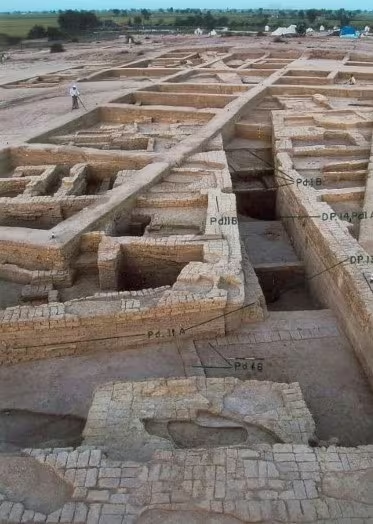
The final identified period of occupation belongs to the Mature Harappan culture. Bhirrana had by then acquired the characteristics of a developed Harappan settlement. Its massive fortification wall was made from mud bricks, while houses were built of sun-baked mud bricks. Wide linear roads separated the houses.
Water and waste management are represented by a main drain using baked bricks. It ran across the width of the northern arm of the fortification wall and was intended to carry wastewater away from the houses. A circular baked-earth structure has been interpreted as a possible tandoor or community kitchen, a form of cooking installation still familiar in rural India.
Multi-roomed houses provide a view of domestic organisation. One exposed house had ten rooms, while another had three. A separate house contained a kitchen, courtyards, and chulhas, or cooking stoves. Charred grains were found beside one of the stoves, connecting the architectural remains with food preparation.
The artefacts of this period included steatite seals, copper, terracotta, faience, and shell bangles, inscribed copper celts, bone objects, terracotta spoked wheels, animal figurines, and beads of lapis lazuli, carnelian, agate, faience, steatite, and terracotta. These materials indicate connections across different craft traditions and access to both local and non-local resources.
Dancing Girl Graffiti
One of Bhirrana’s most memorable finds is a pottery graffito depicting a dancing girl. The figure’s posture has been compared with the famous bronze Dancing Girl from Mohenjo-daro. L. S. Rao argued that the resemblance might indicate that the Bhirrana craftsman had first-hand knowledge of the Mohenjo-daro image.
Other graffiti from Bhirrana have been described as depicting “mermaid”-type deities and dancing girls. These figures have been interpreted by some as possible apsaras or water nymphs connected with water rites. Such interpretations remain conjectural. The graffiti are nevertheless valuable because they show that symbolic and figurative expression formed part of the settlement’s material culture.
Excavation and Historical Interpretation
The Archaeological Survey of India’s Excavation Branch-I, Nagpur, excavated Bhirrana during three field seasons from 2003 to 2006. Publications by Rao and other researchers presented the site as a sequence of four principal periods: Hakra Wares Culture, Early Harappan Culture, Early Mature Harappan Culture, and Mature Harappan Culture.
Rao’s interpretation gives Bhirrana an unusually early chronology and describes all phases of the Indus Valley Civilisation as represented at the site. The proposed chronology has attracted attention because it places the beginnings of the settlement earlier than conventional dates for the Harappan tradition.
At the same time, the interpretation has been contested. The use of Bhirrana in arguments about an indigenous and continuous history of Indian civilisation, and its association with the Vedas and the Saraswati River, has raised questions about the relationship between archaeology and modern ideological narratives. Criticism has also focused on the scientific quality of the excavations and on whether the radiocarbon dates can support the broad temporal claims made for the site.
Gregory Possehl, a leading specialist in the Indus Valley Civilisation, expressed reservations about chronological assertions based on Bhirrana’s radiocarbon samples. A careful account should therefore distinguish between the archaeological sequence—well represented by changing structures and artefacts—and the precise dates assigned to its earliest layers.
Political, Cultural, and Economic Importance
Bhirrana was not identified in the available evidence as the capital of a named kingdom or the residence of a historically recorded ruler. Its political importance lies instead in the growth of organised settlement. The construction of a fortification wall and the division between citadel and Lower Town show that the community eventually adopted a more structured urban plan.
Culturally, the site records interaction between regional traditions. Hakra Ware forms are found alongside pottery related to the Early Harappan tradition of Kalibangan-I. Beads of carnelian, lapis lazuli, jasper, agate, steatite, shell, and faience show the importance of specialised craft production and exchange networks. Copper tools and ornaments, terracotta toys or figurines, seals, wheels, and grinding stones illuminate different aspects of daily life.
The settlement’s economy included food preparation, craft working, and the handling of raw materials. Charred grains beside a cooking stove provide direct evidence of food-related activity, while querns, pounders, beads, bangles, and copper objects suggest a variety of domestic and productive tasks.
Excavated Architecture and Heritage
Bhirrana’s architecture is mostly made from mud brick and earth rather than monumental stone. Its heritage value comes from the combination of structures and stratigraphy: pit dwellings in the earliest phase, open mud-brick houses in the Early Harappan period, fortifications and planned divisions in the Early Mature phase, and developed streets and drainage in the Mature Harappan period.
The site’s surviving archaeological record should be read as a settlement history rather than as a single monument. The fortification wall, citadel, Lower Town, houses, kitchens, drains, pits, and pottery layers together reveal the changing organisation of the community.
Modern Status
Bhirrana remains an archaeological site near the modern village of the same name in Fatehabad district. It forms part of the wider group of sites found along the Ghaggar’s paleo-channels in Haryana. Its location near modern roads makes it geographically accessible, but the available historical account does not provide detailed information about visitor facilities, conservation arrangements, or a formal tourism circuit.
For students of Indian history, Bhirrana is especially useful because it demonstrates how archaeological conclusions are assembled from several kinds of evidence: pottery typology, settlement layout, architecture, artefacts, and radiocarbon dating. It also shows why those forms of evidence must be compared carefully rather than treated as interchangeable.
Timeline
Earliest proposed dates
Two charcoal samples from early levels have been used to propose dates in the 8th–7th millennium BCE; the interpretation remains contested.
Early-level radiocarbon range
Several charcoal samples from early levels produced dates within a range of approximately 3200–2600 BCE.
Early Harappan development
Bhirrana was occupied as an open settlement with buff mud-brick houses and a mixed Hakra and Kalibangan-I pottery tradition.
Fortified settlement
The settlement developed a fortification wall and a citadel–Lower Town arrangement during the Early Mature Harappan phase.
Mature Harappan occupation
The site displayed planned roads, mud-brick houses, drains, seals, beads, figurines, and other Mature Harappan features.
Excavations begin
The Archaeological Survey of India’s Excavation Branch-I, Nagpur, began three seasons of excavation at Bhirrana.