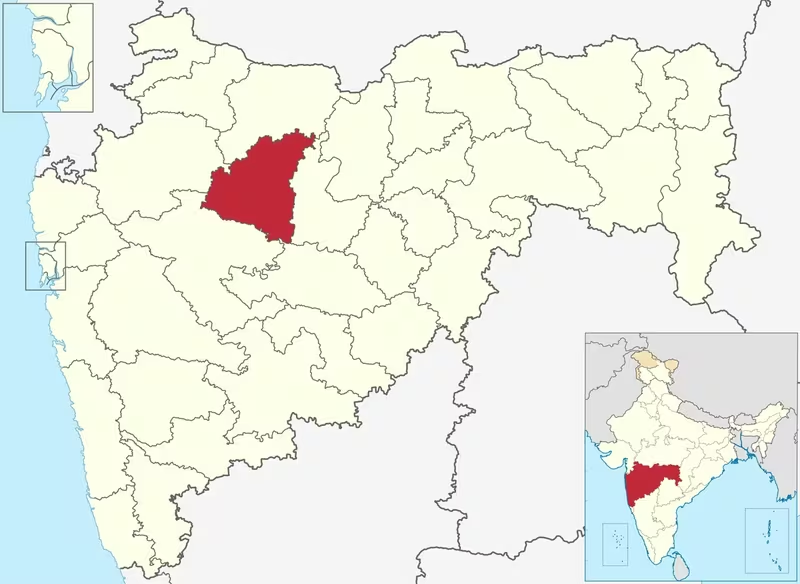
Overview
On the left bank of the Godavari, at an elevation of about 458 metres, stands Paithan, the ancient city known as Pratishthana. Its location in the Godavari valley helped make it a durable settlement, a political centre, and an inland marketplace. From the second century BCE to the second century CE, it served as the capital of the Satavahana dynasty, whose power expanded across a large part of the Indian subcontinent.
Paithan's importance did not end with the Satavahanas. The city was known in different periods as Pratishthana, Pratishthanapura, Pishtapura, and Supratisthana. Archaeological remains, coins, beads, bangles, terracotta objects, and other antiquities point to a long history of settlement and exchange. Foreign coins and references in the first-century Greek Periplus of the Erythraean Sea indicate connections extending beyond the inland Deccan.
The town is equally important in the religious and cultural history of Maharashtra. Hindu, Buddhist, Jain, and Vedic traditions flourished here, while medieval bhakti movements gave Paithan a particularly strong association with Marathi devotional literature. Saint Eknath lived and died here, and the town is also connected with Dnyaneshwar, Nivruttinath, Sopandev, Muktabai, Bhanudas, Jaganade Maharaj, Changdev Maharaj, and the Mahanubhava tradition.
Etymology and Names
The oldest widely used historical name of Paithan is Pratishthana, a Sanskrit term interpreted as “standing firmly.” The longer form Pratishthanapura means the city of Pratishthana. The name reflects the town's enduring place in political and cultural history, although the surviving historical record does not establish a single uncontested moment when the settlement acquired it.
In another historical tradition, Paithan appears as Pishtapura, also Sanskrit. The Chalukya ruler Pulakesin II is said to have taken the city and commemorated the conquest in a poem describing Pishtapura as being reduced to flour. The name Supratisthana, meaning “standing very firmly,” expresses the city's perceived political importance, prosperity, and advanced civilisation.
Puranic tradition gives Paithan a mythic beginning. It says that King Sudyumna, a son of Manu, established Pratishthana in the valley of the Sahya mountains beside the Godavari. In the story, Sudyumna was transformed into Ila after entering Shiva's forest, alternated between male and female forms, and became the ancestor of the Somavamsa line. This is a sacred origin tradition rather than a securely dated account of urban foundation.
Geography and Location
Paithan lies at 19.48°N and 75.38°E, about 56 kilometres south of present-day Chhatrapati Sambhajinagar, on the left bank of the Godavari. The river was central to the town's historical identity. It supported settlement, connected Paithan to the wider Godavari valley, and helped establish it as a centre of pilgrimage and commerce.
The wider region is associated with the Goda Valley civilisation, with evidence reaching back to the second millennium BCE. Its riverine position also placed Paithan within routes linking the interior of India to other towns and, through commercial networks, to western markets. The town's location was therefore valuable not because it was coastal, but because it connected inland production and political power to longer-distance trade.
Paithan's modern transport links include bus routes to Chhatrapati Sambhajinagar, Ahilyanagar, Shevgaon, Beed, Jalna, Nanded, Jalgaon, Bhusawal, Pune, Mumbai, and Borivali. The nearest railway station is at Chhatrapati Sambhajinagar, around 50 kilometres away, while the nearest airport is about 53 kilometres away.
Ancient History
Archaeological evidence from Paithan and its surroundings includes prehistoric and protohistoric antiquities. Historical-period remains have been recorded from the Satavahana era through the Yadava period. Surface finds from the mounds include beads, terracotta objects, bangles, and Satavahana coins. Punch-marked coins, which predate the Satavahanas, indicate earlier commercial activity, while foreign coins confirm contact with the western world.
The Satavahanas made Pratishthana their capital. The dynasty is described as ruling from the second century BCE to the second century CE, and its first king, Simuka, is associated with the city's rise as the centre of a large empire. Under Satavahana rule, Paithan became a political capital and a major commercial centre. The dynasty's reputation for broad territorial power is reflected in the title “Trisamudratoyapitvahana,” associated with its command over a realm extending between three seas.
Paithan's economic life was especially notable for textiles. Its fine cloth, including the tradition later associated with Paithani silk saris, earned a reputation in western markets. The account preserved in the historical tradition even states that the Roman parliament imposed restrictions on luxurious imports to curb extravagance. The precise details of that policy are not established here, but the tradition conveys the scale of Paithan's commercial reputation.
The city also supported multiple religious traditions. Buddhism, Jainism, and Vedic religion were present from the period when Paithan became a Satavahana capital. Its importance was therefore not limited to royal administration: it was also a place of religious institutions, learning, craft production, and exchange.
Historical Timeline
Satavahana Period
Pratishthana's most clearly defined political role was as the Satavahana capital. From this base, the dynasty expanded its influence across a large part of present-day India. The city became a seat of power and an inland emporium, linking the Deccan to other Indian markets and to the western world.
The Periplus of the Erythraean Sea, a Greek work from the first century CE, is especially important for Paithan's wider historical profile. It mentions the city in the genitive plural form, Παιθάνων. Paithan is one of the few inland towns included in that account, suggesting that its commercial importance was visible to observers concerned with routes and trade.
Later Ancient and Medieval Periods
Paithan continued to be occupied and significant after the Satavahanas. The city passed through the control or influence of successive dynasties, and archaeological material from later periods demonstrates continued activity. It was associated with the ancient Janapadas, including Asmaka, and with the region known as Mulaka or Moolaka, encompassing areas corresponding to parts of present-day Chhatrapati Sambhajinagar, Nashik, Jalna, and Washim.
During the rule of Pulakesin II, the Chalukya ruler took the city under the name Pishtapura. The conquest was recorded in a poem using the image of reducing Pishtapura to flour. Paithan's continued appearance in dynastic histories reflects its political and strategic value.
The city also attracted the attention of Muslim conquerors, whose rule and culture influenced local life and manners. The available historical account does not provide a full sequence of the dynasties that controlled Paithan during every medieval century, but it presents the town as a place that repeatedly absorbed new political and cultural influences. Its importance continued until the Yadava period.
Maratha Period
By the seventeenth century, Maratha rulers recognised Paithan's combined religious and economic importance. Chhatrapati Shivaji halted there in 1679 while travelling toward Jalna. During the visit, he issued a charter appointing Kawale, a leading priest of Paithan, as royal priest. The arrangement reflected Paithan's status as a moksha-tirtha, a pilgrimage centre believed to offer spiritual liberation. Shivaji's son and successors continued to honour the charter for a long period.
The Peshwas, who administered the Maratha state, also maintained close ties with Paithan. In 1761, Peshwa Balaji Bajirao married into the Wakhare family, identified with Paithan's moneylending community. His successors, including Peshwas Madhavrao and Narayanrao, retained the association. Madhavrao's letters show particular appreciation for Paithan's textiles.
Political Significance
Paithan's political importance rested first on its role as a capital. As Pratishthana, it was the centre from which the Satavahana dynasty governed an expanding empire. Its position beside the Godavari gave the capital access to a fertile river valley and to routes across the Deccan.
The city's political value endured after it ceased to be the Satavahana capital. Its control mattered to later rulers because Paithan combined commercial wealth, religious prestige, and access to regional routes. The Chalukya conquest under Pulakesin II illustrates this strategic interest, while Shivaji's visit and the Peshwas' relationships show that the town remained relevant in early modern Maharashtra.
Religious and Cultural Importance
Paithan is widely associated with saints and spiritual teachers from several traditions. Saint Eknath, one of the most important Marathi devotional figures linked with the town, was born there and attained samadhi there. His shrine draws pilgrims during the annual Paithan yatra, also called Nath Shashti.
The town's association with Marathi bhakti extends to Saint Dnyaneshwar and his siblings. Apegaon, identified as their birthplace, lies about 12 kilometres east of Paithan on the northern bank of the Godavari. Through devotional works written in accessible Marathi, these saints and philosophers helped carry bhakti ideas to wider audiences during a period of Islamic expansion.
Paithan is consequently known as Santpura, “the city of saints.” It is also important to followers of the Mahanubhava Sampradaya, as Sarvajna Chakradhar Swami is said to have stayed there for a long period.
Jain tradition gives Paithan another major sacred identity. The Paithan Jain Tirth is an ancient Digambar Jain atishay kshetra, or pilgrimage place associated with miracles. Its principal image is a black sand idol of Munisuvratnath, the twentieth Jain Tirthankar. The tradition that Rama, Lakshman, and Sita worshipped the image belongs to sacred belief; the idol's antiquity is also emphasised through the claim that it comes from a time when stone images were not generally made.
Economic Role
Paithan was a major inland centre of trade and commerce. Its connections reached important Indian towns and western markets, and its exports gained international recognition. The city was especially known for high-quality textiles. The Paithani sari tradition remains its most recognisable craft legacy, marked by silk and intricately worked gold or silver borders.
Archaeology complements the literary and historical picture. Beads, terracotta objects, bangles, and coins reveal production, ornament use, and exchange. Punch-marked coins suggest activity before the Satavahana period, while foreign coins point to contact with regions beyond India.
Paithan's prosperity was therefore based on more than its political status. Its craft communities, merchants, religious institutions, and riverine connections together created a dense urban culture. The town's commercial and religious importance reinforced one another: pilgrims, rulers, traders, priests, and artisans all contributed to its enduring prominence.
Monuments and Architecture
The Paithan Jain Tirth is the town's best-known ancient religious site in the supplied historical record. Its black sand image of Munisuvratnath is treated as an object of exceptional antiquity and devotion.
The shrine of Saint Eknath is central to Paithan's modern pilgrimage life. It is connected with Nath Shashti and the annual Paithan yatra. The temple of Saint Jaganade Maharaj stands near the Dashkriya Vidhi ghat, a little east of the Eknath Maharaj temple. Jaganade Maharaj, who lived from 1624 to 1688, was associated with Tukaram Maharaj and recorded several of Tukaram's abhangs.
Dnyaneshwar Udyan is a modern attraction developed on the lines of the Brindavan Gardens at Mysore. Near Paithan, the Jayakwadi Dam is a major embankment dam with 27 gates. Its reservoir attracts resident and migratory birds and has been established as the Jayakwadi Bird Sanctuary.
Famous Personalities
Saint Eknath is Paithan's most prominent religious personality. The town was his home and samadhi place, and his shrine remains a destination for devotees.
Saint Dnyaneshwar and his siblings are connected to the nearby village of Apegaon. Other saints associated with Paithan include Nivruttinath, Sopandev, Muktabai, Bhanudas, Changdev Maharaj, and Jaganade Maharaj. Sarvajna Chakradhar Swami's long stay connects the town with the Mahanubhava Sampradaya.
Paithan is also connected with political figures. Simuka, identified as the first Satavahana king, is associated with the city's role as the dynasty's capital. Pulakesin II captured it under the name Pishtapura, while Chhatrapati Shivaji visited in 1679. Modern personalities associated with Paithan include Shankarrao Chavan, Yogiraj Maharaj Gosavi, and the historian Balasaheb Patil.
Decline and Revival
Paithan experienced “many ups and downs” across its long history. It ceased to be the central capital of the Satavahanas and later passed through the control of other dynasties, but the town did not disappear. Its continued archaeological record, religious institutions, textile tradition, and connections with Maratha rulers demonstrate repeated adaptation rather than a single moment of decline.
In the modern period, Paithan combines heritage and civic life. Its educational institutions, pilgrimage sites, craft traditions, gardens, and bird sanctuary all contribute to its renewed public identity. The town's historical importance now rests on the interaction of archaeology, living religious practice, and cultural production.
Modern City
Paithan is a municipal town in Chhatrapati Sambhajinagar district, Maharashtra. In the 2001 census, it had a population of 34,556. Its literacy rate was recorded as 67 percent, with male literacy at 75 percent and female literacy at 60 percent; 14 percent of the population was under six years of age.
Visitors encounter several layers of history: the ancient city of Pratishthana, the Satavahana capital, the Jain pilgrimage centre, the shrine of Saint Eknath, the Paithani textile tradition, and the modern landscape around Jayakwadi. The dam and its bird sanctuary add an environmental dimension to a town already shaped by the Godavari.