Overview
At the mouth of the Kaveri River, where the river meets the Bay of Bengal, stood Poompuhar—an ancient port known in Tamil as Puhar, Kaveri Poompattinam, and Kaveripattinam. For a period, it served as a capital of the early Chola kings and connected the Tamil country with maritime regions associated with Southeast Asia, the Roman Empire, and Greece.
Poompuhar is remembered through both literature and archaeology. Sangam works describe a wealthy city of markets, mansions, gardens, temples, merchants, and ships. The Silappathikaram, Manimekalai, and Pattinappaalai preserve detailed images of its urban life. At the same time, marine archaeological research has identified submerged wharves, pier walls, offshore pottery, and other remains. These discoveries suggest that erosion, floods, and possibly tsunami activity transformed the settlement and carried portions of it beneath the sea.
Etymology and Names
The name Puhar is associated with the city’s position at the entrance, or mouth, of the Kaveri. Ancient Tamil literature also calls it Kaveri Poompattinam, a name that connects the settlement directly to the river and its port function. Kaveripattinam is another historical form.
The ancient city should not be confused with modern Kaveripattinam. In literary and Buddhist writings, the names Puhar, Kaveripattinam, and Kaveri Poompattinam refer to the major settlement located near the Kaveri’s meeting with the Bay of Bengal.
Geography and Location
Poompuhar lies in present-day Mayiladuthurai district in Tamil Nadu, beside the Bay of Bengal. Its recorded elevation is approximately 1 metre. The city’s location at the Kaveri’s mouth gave it a natural connection to the riverine interior and to maritime routes across the eastern coast.
This geography shaped both Poompuhar’s prosperity and its vulnerability. The river provided access inland, while the coast allowed ships and overseas merchants to reach the city. Yet a settlement at the edge of a river and sea was exposed to shifting sediments, coastal erosion, flooding, and destructive waves. Marine archaeologists have concluded that progressive erosion and floods washed away much of the ancient town. Periodic tsunami activity has also been proposed as part of the explanation.
Ancient History
Poompuhar is extensively mentioned in Sangam literature, conventionally dated from about 300 BCE to 300 CE. The city appears most vividly in Pattinappaalai, a poem by Kadiyalur Uruthirangannanaar from the Ten Idylls anthology. The poem praises Karikala Chola, identified in the tradition as a second-century Chola ruler, while describing Puhar’s harbor, markets, houses, and merchants.
A verse in Purananuru says that large ships entered the port without slackening sail and unloaded precious overseas goods onto the beach. This image presents Puhar as an active harbor capable of receiving substantial vessels. The city’s commercial energy also appears in descriptions of tall mansions, warehouses, platforms, corridors, and streets displaying many kinds of flags.
Archaeological research adds a physical dimension to these literary accounts. Submerged wharves and several-metre lengths of pier walls have been excavated or identified in recent investigations. Offshore, east of the modern town, marine archaeologists have found pottery dating to the 4th century BCE. These discoveries establish that coastal activity at the site reaches back at least to the early historic period.
The city was apparently rebuilt more than once after episodes of destruction. Tamil literary tradition, especially Manimekalai, relates that Kaveripattinam or Puhar was swallowed by the sea. The date and precise mechanism of this destruction remain difficult to establish, but the submerged remains provide archaeological support for the memory of a coastal city lost to the sea. Some accounts place a major destruction around 300 BCE and associate it with tsunami activity, while marine research also emphasizes erosion and flooding.
City Layout
The fifth book of Silappathikaram describes Puhar as a carefully organized urban settlement on the northern bank of the Kaveri. It had two principal districts: Maruvurpakkam, near the shore, and Pattinappakkam, farther west. Gardens and orchards separated the two areas. Daily markets operated in this central stretch beneath the shade of trees.
The daytime market was called Naalangadi, while the night market was known as allangadi. This distinction suggests a city whose commercial life continued beyond daylight hours. The literary descriptions also mention broad streets, residences with numerous rooms, doorways of different sizes, high platforms, and wide halls and corridors.
Maruvurpakkam
Maruvurpakkam stood near the beach and shipyard. It contained terraced mansions and warehouses, including buildings with windows said to resemble the eyes of deer. Because it was close to the landing place, the district attracted overseas travellers, merchants, and yavanas, a term used in the literature for foreigners.
The neighborhood was also home to fisher communities and a wide range of working people. Weavers, silk merchants, fish and meat sellers, potters, grain traders, jewellers, and diamond makers are all associated with Maruvurpakkam. Its inhabitants and occupations reveal the interdependence of fishing, craft production, storage, retail trade, and long-distance commerce.
Pattinappakkam
Pattinappakkam was the more prestigious western district. The king and nobles lived there alongside wealthy traders, physicians, astrologers, soldiers, and court dancers. Five public halls, or manrams, were located in this part of the city: Vellidai Manram, Elanchi Manram, Nedankal Manram, Poothachathukkam, and Pavaimanram.
Gardens such as Elavanthikaicholai, Uyyanam, Chanpathivanam, Uvavanam, and Kaveravanam added to the city’s cultivated landscape. Together, the two districts present Puhar as an urban settlement with distinct social and occupational zones rather than as an unplanned coastal village.
Merchants and Maritime Trade
Pattinappaalai offers an idealized portrait of Puhar’s merchants. They are described as people who avoided murder and theft, respected the rights of others, and neither took more than was due nor gave less than was owed. Their prosperity came from trading in many kinds of merchandise, and they lived close together as an established commercial community.
This literary portrait should be read as a moral ideal as well as a description of economic life. It nevertheless reflects the importance of organized merchants in Puhar’s society. The city’s port received goods from overseas, while its markets, warehouses, workshops, and river connections enabled those goods to circulate through the Tamil country.
The port’s wider connections are associated with Southeast Asia, the Roman Empire, and Greece. Poompuhar is also mentioned in the Periplus of the Erythraean Sea, an important indication of its place within descriptions of maritime commerce in the Indian Ocean world.
Religious and Cultural Importance
Poompuhar’s cultural importance rests heavily on Tamil literary memory. Silappathikaram, attributed to Ilango Adigal, describes the city’s wealth, beauty, streets, temples, and harbor. Manimekalai, composed by Seethalai Saathanar, is set in Kaveripattinam and connects the city with Buddhist themes and traditions.
Buddhist literature offers another view of the settlement. The fifth-century writer Buddhadatta described Kaveripattana as crowded with men and women, supplied with clear river water, precious stones, bazaars, gardens, entrance towers, and a large mansion. He wrote of living in an old residence and composing his work in the city, near a beautiful vihara built by Kanhadasa.
In another work, Buddhadatta explained that he wrote while staying at a monastery built by Venhudassa, or Vishnudasa, on the Kaveri near a town called Bhootamangalam, close to Kaveripattinam. These references indicate that the wider Poompuhar region supported Buddhist institutions as well as the temples and civic spaces described in Tamil literature.
At Pallavanesvaram, part of the ancient urban area, archaeologists found the ruins of a Buddhist monastery dated to the 4th or 5th century, along with a Buddha statue and a Buddhapada, or footprint of the Buddha.
Monuments and Architecture
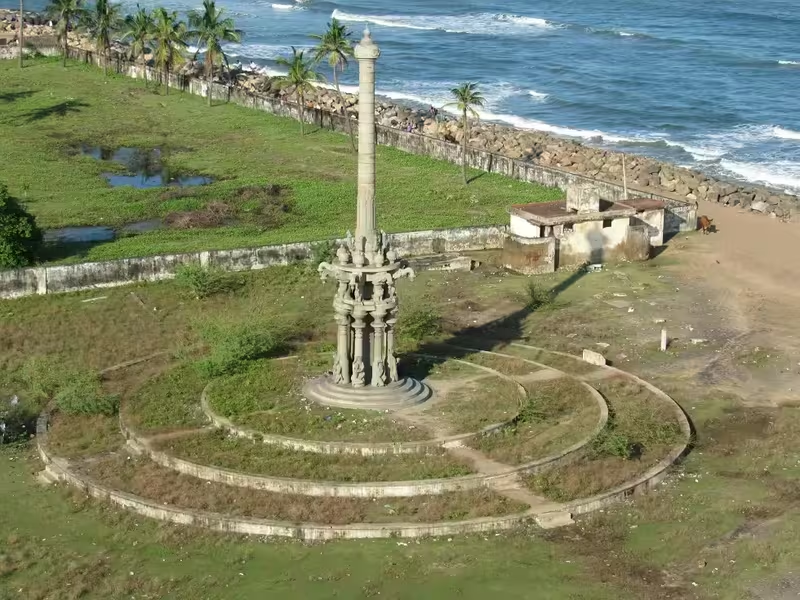
Modern Poompuhar presents its history through several heritage sites. The Silappathikara Art Gallery is a sculptural building whose stone panels depict scenes from Silappathikaram. Sculptors from Mamallapuram Art College created the carvings, which represent episodes and aspects of Tamil culture associated with the epic.
The Masilamani Nathar Koil was built in 1305 by Maravarma Kulasekara Pandiyan. Although the sea has heavily eroded parts of the temple, its architectural richness remains a major attraction. Its condition also illustrates the continuing coastal pressures that have shaped Poompuhar’s heritage.
The Underwater Archaeological Site Museum displays antiquities recovered during offshore and onshore explorations and excavations conducted in 1981. It is described as the only museum of its kind in India. Together with the submerged wharves and pier walls, the museum helps connect Poompuhar’s literary identity with material evidence from the coast and seabed.
Decline and Revival
Poompuhar did not simply disappear at a single, securely dated moment. Literary tradition remembers the city as swallowed by the sea, while marine archaeology points to progressive erosion, floods, and possible tsunami events. The ancient town was rebuilt several times, suggesting repeated attempts to occupy and restore the coastal site.
The combination of literary memory and underwater remains makes Poompuhar unusual. Its decline was not merely the result of political change or the abandonment of a landlocked settlement. The physical environment itself altered the city. Today, granite stones have been placed along the beach to help prevent further erosion.
Poompuhar’s revival is therefore primarily cultural and archaeological. The present town preserves the memory of the ancient port through museums, monuments, festivals, and the study of submerged remains.
Modern Poompuhar
Poompuhar is now part of Mayiladuthurai district and the Sirkazhi assembly constituency in Tamil Nadu. The town remains associated with the Bay of Bengal coast, the Kaveri, and the ancient port remembered in Tamil texts.
Its beach is described as a natural and ancient beach at the site of the old harbor. Chitra Pournami, celebrated during the full moon in the Tamil month of Chithirai, is an important festival there. Visitors can also see the Silappathikara Art Gallery, Masilamani Nathar Koil, and the underwater archaeology museum.
Poompuhar matters because several forms of evidence meet in one place: Sangam poetry, Buddhist writings, temple history, offshore pottery, submerged architectural remains, and ongoing coastal change. It is at once a literary city, an archaeological site, and a modern heritage landscape.
Timeline
Early Historic Puhar
Pottery found offshore east of modern Poompuhar dates to the 4th century BCE, demonstrating the antiquity of activity at the site.
Chola Port City
Puhar flourished as a major port and served for a period as a capital of the early Chola kings.
Literary Celebration
Pattinappaalai praises Karikala Chola and describes Puhar’s ships, markets, mansions, and merchants.
Destruction by the Sea
Literary tradition and archaeological research associate the city’s destruction with the sea, erosion, floods, and possible tsunami activity.
Buddhist Kaveripattinam
Buddhadatta describes Kaveripattana as a prosperous city with bazaars, gardens, river water, and Buddhist establishments.
Masilamani Nathar Koil
Maravarma Kulasekara Pandiyan built the temple that remains one of modern Poompuhar’s principal monuments.
Archaeological Investigations
Offshore and onshore explorations and excavations recovered antiquities now displayed in the underwater archaeological museum.