Nepali Language: From the Sinja Valley to a Himalayan Lingua Franca
Around 981 CE, an inscription associated with the reign of King Bhupal Damupal was written at Dullu in present-day Dailekh District. It is believed to be the earliest known inscription in the Nepali language. More than a dated linguistic record, the inscription points to the western Himalayan setting in which Nepali emerged and developed.
Nepali is an Indo-Aryan language of the Indo-Iranian branch of the Indo-European family. It originated in the Sinja Valley of Karnali Province, once the capital of the Khasa Kingdom, and was originally spoken by the Khas people. Over the centuries, it spread eastward through western Nepal, the Gandaki basin, parts of Uttarakhand, parts of Tibet, and the Kathmandu Valley. Its history includes contact with Sanskrit, Prakrit, Apabhraṃśa, Indo-Aryan languages of the Terai and central hills, Newar, and local Tibeto-Burman languages.
Today Nepali is the official language of Nepal and serves as a lingua franca there. It is also official in Sikkim and in the Gorkhaland Territorial Administration of West Bengal. Its literature includes religious adaptations, poetry, prose, folk narratives, and the influential nineteenth-century work of Bhanubhakta Acharya. Written mainly in Devanagari, Nepali remains a major language of the Himalayan region and of a worldwide diaspora.
Origins and Classification
Linguistic Family
Nepali belongs to the Indo-Aryan group of the Indo-Iranian branch within the Indo-European language family. It is commonly classified within the Eastern Pahari group of the Northern zone of Indo-Aryan.
The language developed in close contact with other Pahari languages. Its history also reflects contact with languages spoken in the Terai and central hills. During the period of the Sena dynasty, Nepali was influenced by Awadhi, Bhojpuri, Braj Bhasha, and Maithili. These contacts contributed to changes in vocabulary, grammar, and phonology.
Nepali grammar underwent significant syncretisation, a process shared by modern Indo-Aryan languages. Compared with older forms of the language, it lost much of the complex declensional system. Its grammar also became more simplified as Nepali expanded geographically and functioned as a lingua franca.
Origins
Nepali originated in the Sinja Valley of Karnali Province. The valley served as the capital of the Khasa Kingdom around the tenth to fourteenth centuries. Early forms of present-day Nepali developed in western Nepal during this period from Middle Indo-Aryan Apabhraṃśa vernaculars.
The language evolved from Sanskrit, Prakrit, and Apabhraṃśa. It was originally spoken by the Khas people, an Indo-Aryan ethno-linguistic group native to the Himalayan region of South Asia. After the decline of the Khasa Kingdom, the region was divided among the Baise Rajya, or twenty-two principalities, in the Karnali-Bheri area and the Chaubise rajya, or twenty-four principalities, in the Gandaki region.
The currently widespread form of Nepali is believed to have emerged through the eastward migration of a branch of Khas people from the Karnali-Bheri-Seti region. They settled in the lower valleys of the Karnali and the Gandaki basin. The various dialects associated with the Khasa Kingdom, western Nepal, Uttarakhand, and parts of Tibet later expanded into the Gandaki basin.
Name Etymology
The original name of Nepali was Khas Kura (खस कुरा), meaning the language or speech of the Khas people. The Khas were associated with the Khasa Kingdom, where the language developed.
Following the unification of Nepal led by Prithvi Narayan Shah of the Shah dynasty, the language became known as Gorakhā Bhāṣā (गोरखा भाषा), meaning “the language of the Gorkhas.” In the hilly region known as the Pahad, where snow was not generally present, it was also called Parvate Kurā (पर्वते कुरा), or “the speech of the hills.”
The term Nepali, derived from Nepal, was officially adopted by the Government of Nepal in 1933. That year, the Gorkha Bhasa Prakashini Samiti, founded in 1913 to promote Gorkha Bhasa, changed its name to Nepali Bhasa Prakashini Samiti. The institution is now known as Sajha Prakashan. The term Nepali had been used before this official adoption, notably by Jaya Prithvi Bahadur Singh. In 1951, the term Gorkhali in the former national anthem “Shriman Gambhir” was also changed to Nepali.
Historical Development
Early Nepali and the Khasa Kingdom (10th–14th Centuries)
The earliest forms of Nepali developed in western Nepal between the tenth and fourteenth centuries. This was the period of the Khasa Kingdom, whose capital was in the Sinja Valley. The language grew from Middle Indo-Aryan Apabhraṃśa vernaculars and retained connections with Sanskrit and Prakrit.
The Dullu inscription, associated with the reign of King Bhupal Damupal around 981 CE, provides the earliest known written evidence traditionally connected with Nepali. The surviving record is located in Dailekh District.
Nepali was initially the language of the Khas people. Its later expansion was connected to migration, political change, and contact among the communities of the western Himalayan region. After the Khasa Kingdom declined, the political fragmentation of the area into the Baise Rajya and Chaubise rajya created a setting in which related forms and dialects developed across a broad region.
Expansion and Contact (15th–18th Centuries)
The currently popular form of Nepali is believed to have developed after a mass eastward migration of a branch of Khas people. The migrants moved from the Karnali-Bheri-Seti region into the lower valleys of the Karnali and the Gandaki basin.
The language was shaped by contact with several Indo-Aryan languages. During the rule of the Sena dynasty, speakers of Nepali and the Senas had close connections. Nepali was influenced by Awadhi, Bhojpuri, Braj Bhasha, and Maithili, and it became a lingua franca in the area. Its vocabulary expanded, its phonology softened, and its grammar became simpler.
Nepali also developed in contact with local Tibeto-Burman languages. In the Kathmandu Valley, then known as Nepal Mandala, inscriptions in Nepali appeared during the reigns of Lakshmi Narasimha Malla and Pratap Malla. These inscriptions indicate a significant increase in the number of Nepali speakers in the valley.
During this period, Nepali borrowed words from several Sino-Tibetan languages, especially Newar. The borrowed vocabulary reflects older forms of the languages from which the words came.
Middle Nepali and the Gorkha Kingdom (16th–18th Centuries)
The institutionalisation of Nepali is associated with the Shah kings of the Gorkha Kingdom in modern-day Gorkha District. After the unification of Nepal, the language entered the court of the Kingdom of Nepal during the eighteenth century and became the state language.
One early Middle Nepali work is Ram Shah ko Jivani, a biography of King Ram Shah by an unknown writer. Another important text is Divyopadesh, associated with Prithvi Narayan Shah and written toward the end of his life, around 1774–75. It contains the old Nepali dialect of the era and is considered the first essay in Nepali literature.
Nepali prose became increasingly standardised in the Lal mohar, or royal charters. These documents covered diplomacy, taxation, and administration. The language of the Lal mohar was close to modern Nepali, though it differed in grammar and used a pre-modern orthography.
Some later changes brought the written language closer to modern usage. For example, Kari (करि) changed to Gari (गरि), while Hunu (हुनु) merged with cha (छ) to produce huncha (हुन्छ).
Nineteenth-Century Literature
Nepali developed a significant literature during the nineteenth century. Around 1830, several poets wrote on themes drawn from the Sanskrit epics, including the Ramayana and the Bhagavata Purana. This literary activity was followed by Bhanubhakta Acharya’s translation of the Ramayana into Nepali.
Bhanubhakta’s Bhanubhakta Ramayana became highly popular for its colloquial language, religious sincerity, and realistic descriptions of nature. The work translated the epic from Sanskrit into Nepali and helped give literary expression to a widely accessible form of the language.
Alongside the Ramayana tradition, nineteenth-century literature included Adhyatma Ramayana, Sundarananda Bara from 1833, Birsikka, an anonymous collection of folk tales, and other poetic and narrative works. The rapid development of literature during this period is described as a literary explosion that established Nepali as a major literary language.
Modern Period
The modern period began in the early twentieth century. The Rana dynasty made efforts to develop Nepali as a language of education. Dev Shumsher established Gorkhapatra, while Chandra Shumsher Jung Bahadur Rana established the Gorkha Bhasa Prakashini Samiti.
At a time when Nepali literature was more limited than Hindi and Bengali literature, movements in Varanasi and Darjeeling sought to create a uniform Nepali identity. This identity was later adopted in Nepal following the 1951 Nepalese revolution and during the Panchayat system.
In 1957, the Royal Nepal Academy was established to develop and promote Nepali literature, culture, art, and science. During the Panchayat period, Nepal promoted the ideology of “One King, One Dress, One Language, One Nation,” placing Nepali at the centre of Nepali nationalism. This period is considered a golden age for the language.
Scripts and Writing Systems
Devanagari
Nepali is generally written in the Devanagari script. Modern Nepali texts, official writing, literary works, and educational materials use Devanagari. The sample of Article 1 of the Universal Declaration of Human Rights in Nepali is written in Devanagari and begins:
धारा १। सबै व्यक्तिहरू जन्मजात स्वतन्त्र हुन् ती सबैको समान अधिकार र महत्व छ।
Nepali writing uses features that can be represented through Latin transliteration and the International Alphabet of Sanskrit Transliteration system. Subscript dots represent retroflex consonants, macrons represent etymologically or contrastively long vowels, and h indicates aspirated plosives. Tildes denote nasal vowels.
Tibetan Script
In regions with predominantly Tibetic populations, the Tibetan script has also been used. Tibetan expressions and pronunciation occur in these settings, reflecting the multilingual environment in which Nepali developed and spread.
Script and Orthographic Features
Nepali orthography records distinctions that are also relevant to pronunciation. Final schwas may or may not be preserved in speech. A final schwa is retained when the final syllable is a conjunct consonant, as in अन्त (anta, “end”), सम्बन्ध (sambandha, “relation”), and श्रेष्ठ (śreṣṭha, “greatest” or a surname).
In verb forms, the final schwa is always retained unless the schwa-cancelling halanta is present. Orthographic distinctions can affect meaning: गईन means “she did not go,” while गईन् means “she went.” Schwas may also be preserved in music and poetry to add syllables when needed.
Geographic Distribution
Historical Spread
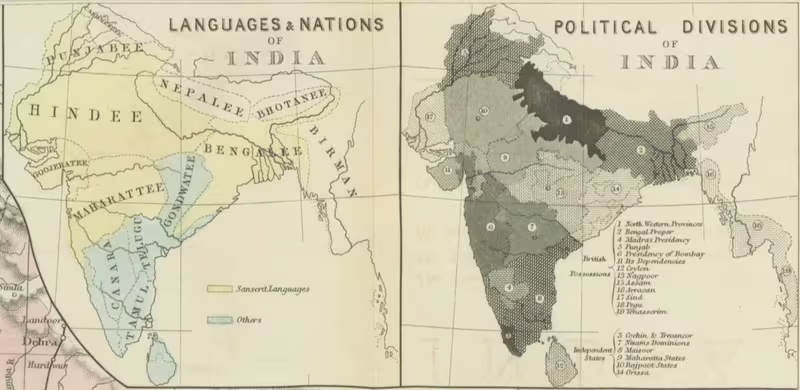
Nepali originated in the Sinja Valley and expanded across western Nepal, parts of Uttarakhand, and areas of Tibet. It later spread into the Gandaki basin and the Kathmandu Valley. Political unification and the movement of people helped establish it as a language of administration and a lingua franca.
Nepali was also carried beyond Nepal by soldiers, migrants, writers, and communities connected to the Gorkhas. In Myanmar, Nepali speakers entered British Burma as Gurkha soldiers of the British Raj. After Burmese independence, many Gurkhas joined the Myanmar Army and later worked in a variety of professions.
Centers of Learning and Literary Activity
The Kathmandu Valley became an important centre of Nepali use during the reigns of Lakshmi Narasimha Malla and Pratap Malla. Inscriptions from this period show the growing presence of Nepali speakers.
Varanasi and Darjeeling were important centres of the modern movement to create a uniform Nepali identity. Expatriate writers outside Nepal, especially in Darjeeling and Varanasi, made a notable contribution to Nepali literature.
Modern Distribution
Nepali is spoken by approximately 19 million native speakers and an additional 14 million second-language speakers. In Nepal, the 2011 national census reported that 44.6% of the population spoke Nepali as a first language and 32.8% as a second language. Another figure from the same census gives 20,250,952 people, or about 77.20% of the population, as first- and second-language speakers.
The 2011 census of India recorded 2,926,168 Nepali speakers. Nepali is the official language of Sikkim and the Gorkhaland Territorial Administration in West Bengal. It is also spoken in Arunachal Pradesh, Assam, Himachal Pradesh, Manipur, Meghalaya, Mizoram, and Uttarakhand.
Nepali is spoken by about a quarter of Bhutan’s population. Native Nepali speakers in Bhutan are known as Lhotshampa. Nepali has no official status in Bhutan. In Australia, Nepali is among the most spoken languages in Tasmania, the Northern Territory, and several areas of New South Wales. Nepali newspapers and magazines are regularly published in Australia.
Literary Heritage
Classical and Early Literature
Nepali literature developed rapidly during the nineteenth century. Early works drew on Sanskrit religious and epic traditions while also using accessible Nepali forms. Adhyatma Ramayana, Sundarananda Bara, and Birsikka belong to this formative literary period.
The Middle Nepali period also produced prose associated with royal and administrative writing. Ram Shah ko Jivani and Divyopadesh preserve historical forms of Nepali prose and reflect the language’s development within the Gorkha and Nepalese courts.
Religious Texts
The Ramayana has been especially important in Nepali literary history. Around 1830, Nepali poets wrote on themes from Sanskrit epics and the Bhagavata Purana. Bhanubhakta Acharya’s translation of the Ramayana became particularly influential.
The popularity of the Bhanubhakta Ramayana rested on its colloquial flavour, religious sincerity, and realistic natural descriptions. Its success helped establish Nepali as a language capable of carrying major religious and literary narratives to a broad audience.
Poetry and Prose
Bhanubhakta Acharya is associated with a major turning point in Nepali literature. His Ramayana helped promote linguistic and cultural unity in Nepal in a way comparable, in cultural effect, to the political unification associated with Prithvi Narayan Shah.
Later, the trio of laureates Lekhnath Paudyal, Laxmi Prasad Devkota, and Balkrishna Sama brought Nepali literature to a level comparable with other world literatures. Nepali literary activity also continued among expatriate writers. As Nepali-speaking communities migrated around the world, books began to be published from many parts of the global diaspora.
Diasporic literature introduced new ways of thinking and created a new branch within Nepali-language literature.
Scientific and Institutional Writing
The Royal Nepal Academy was founded in 1957 with the objective of developing and promoting Nepali literature, culture, art, and science. Nepali also functions in administrative and educational contexts, particularly in Nepal, where it is the official language.
Grammar and Phonology
Key Features
Nepali is highly fusional in its verbal morphology and agglutinative in its case morphology. Its word order is relatively free, although the dominant arrangement is subject–object–verb.
The language has several levels of honorific expression. Three major levels are commonly identified, with two additional levels associated with dialect and class. These are described as low, medium, high, very high, and royal. Low honorifics are used when no respect is due; medium honorifics indicate equal status or neutrality; and high honorifics express respect. Some speakers use the very high grade. The royal honorific was used for members of the royal family and among royals themselves, often with unique or uncommon vocabulary.
Nepali frequently uses infixes to show verbal negation. These forms can also function as echo responses to yes-or-no questions.
Vowels
Nepali distinguishes six oral vowels and five nasal vowels. The vowel /o/ has no phonemic nasal counterpart, although it may occur in free variation with [õ].
Nepali has ten diphthongs:
- /ui̯/
- /iu̯/
- /ei̯/
- /eu̯/
- /oi̯/
- /ou̯/
- /ʌi̯/
- /ʌu̯/
- /ai̯/
- /au̯/
Consonants
The sounds [j] and [w] are nonsyllabic allophones of [i] and [u]. Every consonant except [j], [w], and /ɦ/ has a geminate counterpart between vowels.
The sounds /ɳ/ and /ʃ/ occur in some loanwords, including /baɳ/ बाण, “arrow,” and /nareʃ/ नरेश, “king.” These sounds may sometimes be replaced with native Nepali phonemes.
Murmured stops may lose their breathy voice between vowels and at the ends of words. Non-geminate aspirated and murmured stops may also become fricatives. Examples include /pʰ/ becoming [ɸ], /bʱ/ becoming [β], /kʰ/ becoming [x], and /ɡʱ/ becoming [ɣ].
Sounds conventionally transcribed with retroflex symbols are not always purely retroflex in Nepali. They may instead be apical postalveolar sounds. Some speakers use purely retroflex sounds after /u/ and /a/, while others use apical articulation in all positions.
Influence and Legacy
Languages and Contact
Nepali developed through sustained contact with Indo-Aryan, Tibeto-Burman, and Sino-Tibetan languages. Sanskrit, Prakrit, and Apabhraṃśa contributed to its early formation. Later contact with Awadhi, Bhojpuri, Braj Bhasha, and Maithili influenced the language during the Sena period.
Nepali borrowed words from Sino-Tibetan languages, especially Newar, during its development in the Kathmandu Valley. Local Tibeto-Burman languages also helped shape the language as it expanded and became a lingua franca.
Cultural Impact
Nepali has served as a language of political administration, literature, education, national identity, and everyday communication. Its institutionalisation under the Gorkha Kingdom and its later position as the state language of Nepal gave it a central role in the formation of modern Nepali national identity.
Its literary development also contributed to cultural and emotional unity. Bhanubhakta Acharya’s Ramayana, in particular, connected religious tradition with colloquial Nepali and accessible literary expression.
Nepali continues to connect communities across Nepal, India, Bhutan, Myanmar, and the global diaspora. Its presence in newspapers, magazines, literature, administration, and public life demonstrates its continuing cultural reach.
Royal and Religious Patronage
The Gorkha and Nepalese Courts
The institutionalisation of Nepali began under the Shah kings of the Gorkha Kingdom. After the unification of Nepal, Nepali moved into the court of the Kingdom of Nepal during the eighteenth century and became the state language.
The royal charter tradition known as the Lal mohar helped standardise Nepali prose. These documents dealt with diplomatic writing, taxation, and administration. Their language was close to modern Nepali, despite differences in grammar and orthography.
Literary and Educational Institutions
During the Rana period, Dev Shumsher and Chandra Shumsher Jung Bahadur Rana supported the development of Nepali publishing and education through Gorkhapatra and the Gorkha Bhasa Prakashini Samiti.
The Royal Nepal Academy, established in 1957, promoted Nepali literature, culture, art, and science. Its creation represented an institutional effort to develop Nepali as a modern language of literary and intellectual activity.
Modern Status
Current Speakers
Nepali has approximately 19 million native speakers and an additional 14 million second-language speakers. It is spoken throughout Nepal and by communities across the Himalayan region and beyond.
In India, Nepali has a significant presence in Sikkim, West Bengal, Arunachal Pradesh, Assam, Himachal Pradesh, Manipur, Meghalaya, Mizoram, and Uttarakhand. It is also used by Nepali-speaking communities in Myanmar, Bhutan, Australia, the Middle East, Brunei, and other parts of the world.
Official Recognition
Nepali is the official language of Nepal. On 31 August 1992, it was added to the list of scheduled languages of India. It is the official language of Sikkim and of the Gorkhaland Territorial Administration in West Bengal.
In West Bengal, Nepali was recognised as an official language for the Darjeeling district, Kalimpong, and Kurseong in 1961. In Sikkim, the Sikkim Official Languages Act of 1977 made Nepali one of the official languages of the state.
The Nepali Language Movement in India sought inclusion in the Eighth Schedule to the Constitution of India. The Lok Sabha passed a motion to add Nepali to the Eighth Schedule on 20 August 1992.
Preservation and Literary Development
The language has been supported through literary institutions, newspapers, magazines, official recognition, and education. The Nepali Language Publishing Committee, now Sajha Prakashan, was established to advance the language. The Royal Nepal Academy continues the institutional tradition of promoting Nepali literature and culture.
Nepali literature is also being developed by diaspora communities. Writers outside Nepal, including those in India and other parts of the world, have created new literary forms and themes.
Learning and Study
Academic Study
Nepali can be studied as an Indo-Aryan language, a Pahari language, a language of the Himalayan region, and a literary language with a substantial modern tradition. Its history offers opportunities to examine language contact, grammatical simplification, migration, political unification, and the relationship between language and national identity.
Its phonology is also significant for linguistic study. The language includes oral and nasal vowels, ten diphthongs, geminate consonants, aspirated and murmured stops, and dialectally variable retroflex or apical postalveolar sounds.
Resources
Learning resources include Nepali dictionaries, Nepali typing tools, lists of Nepali words, and open-access introductory textbooks. The comprehensive Nepali Brihat Shabdakosh is associated with the Nepal Academy. Nepali newspapers and magazines are published in Australia and other parts of the diaspora.
Conclusion
Nepali’s history begins in the western Himalaya, where the language developed in the Sinja Valley among the Khas people and the communities of the Khasa Kingdom. From Middle Indo-Aryan vernaculars, Sanskrit, Prakrit, and Apabhraṃśa, it developed into a language shaped by Pahari, Indo-Aryan, Tibeto-Burman, and Sino-Tibetan contact.
The Dullu inscription, the royal prose of the Lal mohar, the writings associated with the Gorkha and Nepalese courts, and the literature of Bhanubhakta Acharya all mark important stages in its development. Modern Nepali is written principally in Devanagari, spoken across Nepal and the Himalaya, and used by communities around the world. Its official status, extensive literary heritage, flexible grammatical structure, and continuing diaspora literature ensure that Nepali remains both a major language of South Asia and a living record of Himalayan history.