Tulu Language: A Coastal Dravidian Tradition
The coastal districts of Karnataka and the northern part of Kerala preserve a language whose history reaches from ancient references in Tamil literature to modern schools, universities, theatre, and cinema. Tulu, known in the language itself as Tuḷu Bāse, is spoken primarily in Dakshina Kannada, southern Udupi, and northern Kasaragod. Its speakers are commonly called Tuluva or Tulu people, while the region is unofficially known as Tulu Nadu.
Tulu belongs to the southern branch of the Dravidian language family. Linguists describe it as the first branch to separate from Proto-South Dravidian, which itself descends from Proto-Dravidian. This early separation helps explain why Tulu shares characteristics with other Dravidian languages while also preserving features not found in Tamil–Kannada. Among its distinctive grammatical traits are pluperfect and future perfect forms made without an auxiliary verb.
The language has a substantial spoken population. The 2011 Indian census recorded 1,846,427 native Tulu speakers, compared with 1,722,768 in 2001. Counting is difficult because migrants from the traditional Tulu-speaking region are often recorded as Kannada speakers. Tulu’s written history includes inscriptions, religious works, translations, and poetry, while its oral heritage includes paddanas, riddles, devotional songs, cultivation songs, and the stories of Siri, Koti, and Chennayya. Its cultural presence continues through Yakshagana, plays, periodicals, films, schools, and language institutions.
Origins and Classification
Linguistic Family
Tulu is a Dravidian language belonging to the southern branch of the family. It is described as the first branch to split from Proto-South Dravidian, which in turn descends from Proto-Dravidian. Tulu shares many characteristics with the central Dravidian languages. Because of these similarities, it was sometimes grouped with central Dravidian languages in earlier classifications. Later linguistic work confirmed its position within South Dravidian and its early separation from that branch.
The early divergence of Tulu is reflected in its structure. It has several features that are not found in Tamil–Kannada. The language forms the pluperfect and future perfect without an auxiliary verb, a feature compared with the corresponding tense distinctions of French and Spanish. Tulu also retains phonological contrasts and grammatical distinctions that vary across its dialects.
Origins
Several linguists, including S. U. Panniyadi, L. V. Ramaswami Iyer, and P. S. Subrahmanya, have argued that Tulu is among the oldest languages in the Dravidian family. Their argument rests partly on the preservation of features associated with Proto-Dravidian. On this view, Tulu branched independently from its Proto-Dravidian roots approximately 2,500 years ago.
The ancient region associated with Tulu is Tulu Nadu. The area where the language is spoken today was known to ancient Tamils as Tulu Nadu. The Tamil poet Mamular, who belonged to the Sangam Age, described Tulu Nadu and its dancing beauties in one of his poems. The poetical work Akananuru, associated with Sangam literature and dated to approximately 300 BCE, mentions Tulunad in its fifteenth poem. This reference indicates that the language or the linguistic community associated with Tulu Nadu is at least around 2,300 years old.
The exact identification of Tulu in some ancient evidence remains disputed. The second-century BCE Greek play known as the Charition mime is set in coastal Karnataka, the principal area where Tulu is spoken. The Indian characters speak a language different from Greek. Scholars agree that this language is Dravidian, but they disagree about which particular form of Dravidian it represents. The uncertainty arises partly because Old Kannada, Old Tamil, and Tulu may at that time have been dialectical varieties of a shared proto-language. Over succeeding centuries, these varieties developed into distinct languages.
Name Etymology
The etymology of the word Tulu remains uncertain. Several explanations have been proposed.
The linguist P. Gururaja Bhat, in Tulunadu, connects tuluva with turuva. In this interpretation, turu means “cow,” and the name refers to a place dominated by the Yadava or cowherd community. The associated expression describes a land in which cattle were predominant.
The linguist Purushottama Bilimale has suggested another interpretation: tulu may mean “that which is connected with water.” The Tulu word tulave, meaning jackfruit, can also mean “watery.” Other Tulu words associated with water include talipu, teli, teḷi, teḷpu, tuḷipu, tulavu, and tamel. Kannada has related words such as tuḷuku, meaning something possessing characteristics of water, and toḷe.
These proposals do not establish a single accepted etymology. They do, however, show how the name has been connected both with pastoral life and with the watery landscape of the coastal region.
Historical Development
Sangam-Age and Early Historical Tulu
The literary references to Tulu Nadu in ancient Tamil works provide an early historical setting for the language. Mamular’s description of Tulu Nadu and the mention of Tulunad in the fifteenth poem of Akananuru connect the region with the Tamil literary world of the Sangam Age.
The Charition mime offers a separate but uncertain point of comparison. The play, dated to the second century BCE, centers its plot on coastal Karnataka. Its Indian characters speak a Dravidian language, but the text does not settle whether that language should be identified specifically as Tulu, Old Kannada, Old Tamil, or another related form. The debate illustrates the difficulty of assigning modern language labels to linguistic varieties that existed before the differentiation of present-day languages was complete.
Early Inscriptions
The oldest available inscriptions in Tulu date from the seventh and eighth centuries CE. They are written in the Tulu script and were found in and around Barkur. Barkur was the capital of Tulu Nadu during the Vijayanagara period. Another group of inscriptions was found at the Ullur Subrahmanya Temple near Kundapura.
The Kannada Halmidi inscriptions mention the Tulu country as the kingdom of the Alupas. The region was also known to the Greeks of the second century as Tolokoyra, meaning Tulu Country. Together, these references place Tulu within a region that was recognized by different linguistic and political traditions.
The surviving inscriptions are important not only for the history of the language but also for the history of its scripts. They demonstrate that Tulu had a writing tradition distinct from the later dominance of the Kannada script. The inscriptions around Barkur and Kundapura also connect written Tulu with the historical geography of coastal Karnataka.
Medieval Tulu
The various medieval inscriptions of Tulu from the fifteenth century were written in the Tigalari script. Two Tulu epics from the seventeenth century, Sri Bhagavato and Kaveri, were also written in Tigalari.
The written record from this period includes religious literature and translations. The Tulu translation of the Sanskrit Mahabharata, titled Mahabharato, is attributed to Arunabja, a poet who lived in Kodavur near Udupi. The work is associated with the late fourteenth to mid-fifteenth century. Another listed work is Kaveri, dated 1391. Sri Bhagavata, written by Vishnu Tunga, dates from 1626. A Tulu translation of Devi Mahatmyam is also listed among the early literary works, with a date of 1200.
The chronology of these works reflects the complexity of Tulu literary history. The language’s written literature is smaller than that of Telugu, Tamil, Kannada, and Malayalam, but Tulu is nevertheless described as one of only five literary Dravidian languages.
The Shift Toward Kannada Script
The Tigalari script was used by Tulu Brahmins and Havyaka Brahmins to write the Vedas and other Sanskrit works. It was also used for Tulu and Kannada. The script is descended from Brahmi through the Grantha script and is considered a sister script of Malayalam.
During the eighteenth century, the Kannada script increasingly replaced Tigalari for writing Tulu. The use of Kannada was encouraged by the non-availability of printing in the Tulu script. As a result, the older script became marginalized. The Kannada script gradually became the contemporary writing system for Tulu, and modern Tulu literature is generally written in Kannada.
Modern Period
Modern Tulu exists in a changing environment shaped by multilingualism, migration, education, print, performance, and digital activity. Tulu is spoken alongside Kannada, Malayalam, Beary, Havyaka, Konkani, and Koraga in and around Tulu Nadu. The language is also spoken by emigrant communities in Maharashtra, Bengaluru, Chennai, the Gulf countries, and the English-speaking world.
The language has faced pressure from mainstream languages. Because Tulu has traditionally been transmitted orally, forms and meanings may change over time. The language is described as less popular than some other regional languages and as facing the danger of becoming endangered or extinct. At the same time, schools, universities, academies, periodicals, theatre groups, film producers, and cultural organisations continue to support its use.
The Tulu characterset was approved by the Central Institute of Indian Languages in 2021. This development gives renewed visibility to the script tradition even though Kannada remains the main script for contemporary Tulu writing.
Scripts and Writing Systems
Tigalari Script
The Tigalari script is the historic script most closely associated with written Tulu. Historical inscriptions found around Barkur and Kundapura use it, as do various medieval inscriptions dating from the fifteenth century. The seventeenth-century Tulu works Sri Bhagavato and Kaveri were also written in Tigalari.
Tigalari developed from Brahmi through the Grantha script and is considered a sister script of Malayalam. Its use extended beyond Tulu. Tulu Brahmins and Havyaka Brahmins used it for the Vedas and other Sanskrit works, while Tulu and Kannada were also written in it.
The script resembles Malayalam. Tulu and Kannada alphabets include a stress on vowels associated with “a” and “o” sounds. Although relatively few vernacular works in Tulu and Kannada survive in Tigalari, the script remains significant for the study of manuscripts, inscriptions, religion, and regional literary history.
Kannada Script
The Kannada script became the contemporary script for Tulu over time. In the eighteenth century, the use of Kannada for writing Tulu, combined with the lack of printed material in Tigalari, contributed to the older script’s marginalization. Today, contemporary Tulu works and literature are written in Kannada.
The Kannada script does not possess a separate symbol specifically representing the Tulu vowel [ɛ~æ], which often occurs at the end of words. This vowel is commonly written using the ordinary e sign. As a result, some forms that appear identical in writing can be pronounced differently.
For example, the first-person singular and third-person singular masculine forms of a verb may be spelled identically in all tenses, both ending in e. In maḷpuve, meaning “I make,” the final vowel is pronounced close to the vowel in the English word “man,” while in maḷpuve, meaning “he makes,” it resembles the vowel in “men.”
S. U. Paniyadi used a special vowel sign in his 1932 grammar to represent Tulu /ɛ/ in the Kannada script. According to Bhat, Paniyadi used two talekaṭṭus for this purpose, a convention also adopted by Upadhyaya in the 1988 Tulu Lexicon. The long counterpart of this vowel occurs in some words.
Tulu also has an [ɯ]-like vowel, or schwa /ə/, represented in different descriptions as ŭ, ɯ, or u̥. Brigel and Männer compared its pronunciation with the e in the French je. Bhat describes it as /ɯ/. In descriptions using the Kannada script, Brigel and Männer used a virama, or halant, to represent it, while Bhat refers to the use of a talekaṭṭu.
Script Evolution
Tulu’s script history is marked by a movement from an older Tigalari manuscript tradition to widespread modern use of Kannada. This was not a complete disappearance of Tigalari. The script continues to be studied by scholars and manuscriptologists, particularly for research and religious purposes. The official script of the eight Tulu monasteries, the Ashta Mathas of Udupi, remains Tulu. When pontiffs of these monasteries are appointed, they write their names using the Tulu script.
The National Mission for Manuscripts has conducted workshops on Tigalari with the assistance of the scholar Keladi Gunda Jois. The Central Institute of Indian Languages approved the Tulu characterset in 2021, providing an additional modern framework for representing the script.
Geographic Distribution
Historical Spread
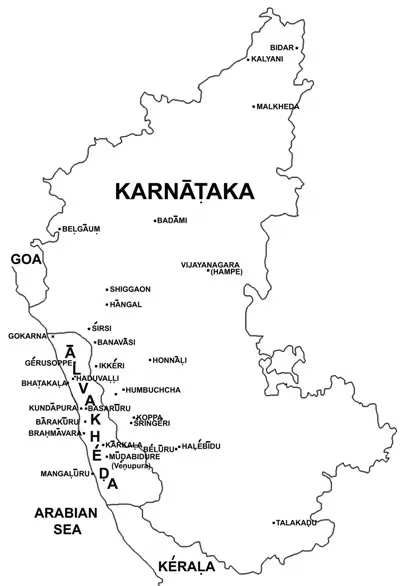
Tulu Nadu is the principal homeland of the Tulu-speaking people. According to Malayalam works such as the Keralolpathi, a larger region stretching from the Chandragiri River in present-day Kasaragod district to Gokarna in present-day Uttara Kannada district was ruled by the Alupas and known as Alva Kheda. This kingdom is described as the homeland of the Tulu-speaking people.
The present-day Tulu linguistic majority area is smaller. It comprises Dakshina Kannada and part of Udupi in Karnataka, together with the northern part of Kasaragod district in Kerala. The southern limit in Kasaragod is associated with the Payaswani River, also known as the Chandragiri.
Centers of Tulu Culture
Mangalore, Udupi, and Kasaragod are centers of Tulu culture. Tulu is widely spoken in Dakshina Kannada, partly in Udupi, and to some extent in Kasaragod. The region contains communities with different mother tongues, including Beary, Havyaka, Konkani, and Koraga. Tulu therefore functions in a multilingual environment, including as a language of inter-community communication.
Outside the principal Tulu-speaking area, significant numbers of native speakers live in Kalasa and Mudigere taluks of Chikkamagaluru district and in Tirthahalli and Hosanagar of Shimoga district. Migrant and emigrant populations are found in Maharashtra, Bengaluru, Chennai, the Gulf countries, and the English-speaking world.
Modern Distribution
The 2011 Indian census reported 1,846,427 native Tulu speakers in India. The corresponding figure in the 2001 census was 1,722,768. These figures do not necessarily capture the entire migrant Tulu-speaking population. People who have moved away from their traditional region may be recorded as Kannada speakers in census reports.
Tulu remains concentrated in southern India, especially in Karnataka. Kerala’s northern Kasaragod district is another important area of use. The language’s spread beyond Tulu Nadu is connected largely with migration and the movement of Tulu-speaking communities.
Literary Heritage
Classical and Early Written Literature
The written literature of Tulu is not as extensive as the literature of other literary Dravidian languages, but it has a distinct history. The earliest surviving literary work identified in the language is the Tulu translation of the Sanskrit Mahabharata, known as Mahabharato. It is attributed to Arunabja, who lived in Kodavur near Udupi.
Other important works include Kaveri, dated 1391; the Tulu translation of Devi Mahatmyam, dated 1200; and Sri Bhagavata, written by Vishnu Tunga in 1626. These works demonstrate the use of Tulu for religious and epic material.
Tigalari was particularly important for religious and literary writing. The script was used for Sanskrit works as well as for Tulu texts. The survival of these works links Tulu literary history with the manuscript culture of coastal Karnataka.
Religious Texts
Religious writing has played a central role in Tulu literary and scribal traditions. The Tulu translation of Devi Mahatmyam and the Tulu Mahabharato represent the adaptation of major Sanskrit religious and epic material into Tulu.
The Ashta Mathas of Udupi preserve the Tulu script as their official script. Founded by Madhvacharya, these eight monasteries continue the tradition of writing the names of their appointed pontiffs in Tulu script. The association of Tigalari with Vedic and Sanskrit works among Tulu Brahmins and Havyaka Brahmins also reflects the religious contexts in which the script was maintained.
Poetry and Oral Epics
Tulu is especially known for oral literature. Epic poems called paddanas are performed in a highly stylized manner during the Hindu rituals of Bhuta Kola and Nagaradhane, traditions associated with Tulu people.
The paddanas often recount legends about gods or historical personalities. The longest is the Siri Paddana, which tells the story of a woman named Siri. She demonstrates strength and integrity during adverse circumstances and ultimately attains divinity. The poem is also described as portraying the independent nature of Tulu women.
The Finnish scholar Lauri Honko wrote down the entire Siri Paddana. It is said to fall four lines short of Homer’s Iliad, a comparison that illustrates the scale of the oral epic.
Another important tradition is the legend of Koti and Chennayya. Together with the Epic of Siri, it belongs to the category of Tulu epic poetry. These traditions preserve history, social ideals, religious imagination, and regional identity through performance.
Riddles, Devotional Songs, and Cultivation Songs
Riddles form another important part of Tulu oral tradition. They are often tongue-twisting and commonly concern kinship and agriculture.
Bhajans are sung in temples throughout the Tulu region. They are dedicated to different gods and goddesses and include both Hindu and Jain traditions. Some are sung in the Carnatic style, while others use a style similar to that of Yakshagana.
Kabitol refers to songs sung during the cultivation of crops, traditionally an important occupation in the region. O Bele is regarded as the finest among these cultivation songs. The variety of Tulu oral forms shows that the language’s literary life extends well beyond written books.
Modern Literature and Periodicals
Modern Tulu literature is generally written in the Kannada script. Mandara Ramayana, written by Mandara Keshava Bhatt, is described as the most notable modern work. It received the Sahitya Akademi Award for best poetry.
Modern periodicals published from Mangalore include Madipu, Mogaveera, Saphala, and Samparka. Writers associated with Tulu literature include Kayyar Kinhanna Rai, M. K. Seetharam Kulal, Amruta Someshwara, B. A. Viveka Rai, Kedambadi Jattappa Rai, Venkataraja Puninchathaya, Paltadi Ramakrishna Achar, Sunitha M. Shetty, Vamana Nandavara, and Balakrishna Shetty Polali.
The Tulu Sahitya Academy, established by the Karnataka state government in 1994, promotes Tulu literature. The Kerala Tulu Academy, established by the Kerala government in 2007, works to retrieve and propagate Tulu language and culture in Kerala.
Theatre and Yakshagana
Yakshagana, a traditional theatre form prevalent in coastal Karnataka and northern Kerala, has preserved important features of Tulu. Tulu-language Yakshagana is popular among Tuluva audiences and can also be understood as a form of temple art.
Several Yakshagana groups are attached to temples, including the Kateel Durga Parameshwari Temple and the Udupi Krishna Temple. Eight professional troupes perform Tulu Yakshagana during the regular season and the off-season, both within Karnataka and outside the state.
Tulu Yakshagana is particularly popular among Tulu audiences in Mumbai. More than 2,000 Yakshagana performers participate in performances in different parts of Mumbai each year. Notable performers include Kalladi Koraga Shetty, Pundur Venkataraja Puninchathaya, Guru Bannanje Sanjiva Suvarna, and Pathala Venkatramana Bhat.
Tulu plays are also a major form of entertainment. They are often centered on comedy and are popular in Tulu Nadu as well as among Tulu-speaking audiences in Mumbai and Bengaluru.
Cinema and Television
The Tulu film industry is small, producing approximately five films each year. The first Tulu film, Enna Thangadi, was released in 1971. Films are usually released in theatres across Tulu Nadu and on DVD.
The film Suddha won the award for Best Indian Film at the Osian’s Cinefan Festival of Asian and Arab Cinema in New Delhi in 2006. Oriyardori Asal, released in 2011, was described as the most commercially successful Tulu film as of 2015. Chaali Polilu became the longest-running and highest-grossing film in Tulu film history, completing 470 days at PVR Cinemas in Mangalore.
The 2014 film Madime was reported to have been remade in Marathi, making it the first Tulu film to be remade in another language. Shutterdulai was the first remake in Tulu cinema, followed by Eregla Panodchi as the second remake.
The Tulu film industry has also reached notable production milestones. Brahmashree Narayana Guruswamy, released on 2 May 2014, was the fiftieth Tulu film. Panoda Bodcha marked the seventy-fifth release anniversary of a Tulu film, and Karne, released on 16 November 2018, was the hundredth Tulu movie. The 2018 film Umil became the first Tulu movie to have its dubbing rights sold to Hindi, reportedly for Rs. 21 lakh.
The television series Guddada Bhootha, aired in 1990, was a successful Tulu entertainment production. Its suspense storyline was based on a Tulu drama and portrayed rural life in Tulu Nadu. Its title song, “Dennana Dennana,” was sung by B. R. Chaya. The song and its music were later used in the Kannada film Rangitaranga.
Grammar and Phonology
Parts of Speech and Nouns
Tulu has five parts of speech: nouns, including substantives and adjectives; pronouns; numerals; verbs; and particles.
Substantives have three grammatical genders: masculine, feminine, and neutral. They have two numbers, singular and plural, and eight cases: nominative, genitive, dative, accusative, locative, ablative or instrumental, communicative, and vocative. According to Bhat, Tulu has two distinct locative cases.
The nominative case is unmarked. Other cases are expressed through suffixes. The plural may be formed with -rŭ, -ḷu, -kuḷu, or -āḍḷu. For example, mēji means “table,” while mējiḷu means “tables.”
The communicative case is used with verbs such as “tell,” “speak,” “ask,” “beseech,” and “inquire.” It identifies the person toward whom a message, question, or request is directed, as in “I told him” or “I speak to them.” It can also express a relationship, as in “I am on good terms with him” or “I have nothing against him.” Bhat calls it the sociative case. It resembles a comitative case but refers to communication or relationship rather than physical companionship.
Postpositions are generally used with a noun in the genitive case. An example is guḍḍe-da mittŭ, meaning “on the hill.”
Pronouns
Tulu personal pronouns are irregularly inflected. The first-person singular yānŭ, meaning “I,” becomes yen- in oblique cases.
The language distinguishes inclusive and exclusive “we.” Nama means “we, including you,” while yenkuḷu means “we, not including you.” This distinction does not exist in the verb.
The second-person pronouns are ī, with oblique form nin-, for singular “you,” and nikuḷu for plural “you.” The third person distinguishes three genders and also differentiates proximate and remote forms. For example, imbe means “he,” proximate, while āye means “he,” remote.
The suffix -rŭ produces a polite form. Thus īrŭ means “you” respectfully, and ārŭ can mean “he,” remote and respectfully.
Verbs
Tulu verbs have three forms: active, causative, and reflexive or middle voice. They conjugate for person, number, gender, tense, mood, and polarity.
The tense system includes present, past, pluperfect, future, and future perfect. The mood system includes indicative, imperative, conditional, infinitive, potential, and subjunctive. Verbs also distinguish positive and negative polarity.
The pluperfect and future perfect are especially notable because they are formed without an auxiliary verb. This feature is one of the characteristics that differentiates Tulu from Tamil–Kannada.
Tulu sentences generally have a subject and a predicate. There are exceptions, and the verb may be omitted in some sentences. A verb can take a plural form when a sentence contains multiple nominatives or nominatives of different genders that agree with a preceding sentence. The interpretation of present and past tense can vary according to the situation and the person involved.
Vowels
Tulu has five short and five long vowels: a, ā, e, ē, u, ū, i, ī, o, and ō. These vowel distinctions are common in Dravidian languages.
The language also has a vowel represented phonetically as [ɛ~æ]. This vowel generally occurs word-finally and developed from the older ai. Its presence is comparable to features found in Kodava Takk and, in certain respects, Konkani and Sinhala.
The pair /e/ and /ɛ/ contrasts in all Tulu dialects. The long counterpart of /ɛ/ occurs in some words, although long versions of /ɛ/ and /ɯ/ are highly restricted.
Tulu also has an [ɯ]-like vowel, or schwa /ə/, which may be romanized as ŭ, ɯ, or u̥. Brigel and Männer compare its pronunciation with the vowel in the French word je. Descriptions differ concerning its precise phonetic value.
Tulu is characterized by the rounding of front vowels when they occur between a labial and a retroflex consonant. An example is the historical form peṇ, which corresponds to Tamil peṇ, Kannada heṇṇu, and Tulu poṇṇu. Similar features occur in Kodava and spoken Tamil.
Consonants
The contrast between /l/ and /ɭ/ is preserved in the South Common dialect and in the Brahmin dialect, although it is lost in several other dialects. The Brahmin dialect also has /ʂ/ and /ɦ/. Aspirated consonants occur sometimes in Brahmin Tulu but are not phonemic.
In the Koraga and Holeya dialects, /s/ and /ʃ/ merge with /t͡ʃ/. The Koraga dialect of Tulu is distinct from the Koraga language.
Initial consonant clusters are rare and occur mainly in Sanskrit loanwords. Tulu is also characterized by alternation among r, l, s, c, and t across dialects. The forms sarɛ and tarɛ illustrate one such alternation.
The historical alveolar sounds ṯ, ṯṯ, and nṯ became postalveolar or dental. Singular forms commonly become a trill in other Dravidian languages. Examples include the contrast between Tamil oṉṟu, āṟu, nāṟu, nāṟṟam, muṟi, and kīṟu and corresponding Tulu forms such as oñji, āji, nāduni, nāta, mudipuni or muyipuni, and kīruni or gīcuni.
The retroflex approximant mostly became /ɾ/, and also /ɭ/ or /ɖ/. Examples include Tamil ēẓu and puẓu alongside Tulu forms such as ēḷŭ, ēlŭ, ēḍŭ, and puru.
Dialects
Tulu has four principal dialect groupings: Common Tulu, Brahmin Tulu, the Jain dialect, and the Adivasi dialect.
Common Tulu
Common Tulu is spoken by the majority of Tulu speakers, including members of the Bunts, Billava, Vishwakarma, Mogaveera, Tulu Madivala, Tulu Gowda, Kulala, Devadiga, Jogi, and Padmashali communities. It is the language of commerce, trade, and entertainment and is used mainly for communication across communities.
Common Tulu is further divided into eight regional varieties:
- Northwest Tulu is spoken in Udupi.
- Central Tulu is spoken in Mangalore.
- Northeast Tulu is spoken in Karkala and Belthangady.
- Northern Tulu is spoken in Kundapura and is also called KundaTulu because of the influence of the Kundagannada dialect.
- Southwest Tulu is spoken in Manjeshwar and Kasaragod. It is known as Kasaragod Tulu and shows Malayalam influence.
- Southcentral Tulu is spoken in Bantwal.
- Southeast Tulu is spoken in Puttur, Sullia, and some villages and taluks of Kodagu.
- Southern Tulu is spoken south of Kasaragod and the Payaswini or Chandragiri River. It is known as Thenkaayi Tulu and shows Malayalam influence.
Brahmin Tulu
Brahmin Tulu is spoken by Tulu Brahmins, including Shivalli Brahmins, Sthanika Brahmins, and Tuluva Hebbars. It is more strongly influenced by Sanskrit than other varieties.
Jain Dialect
The Tulu Jain dialect is spoken by Tulu Jains. In this variety, initial T and S are replaced by H. Thus Tare is pronounced Hare, and Saadi becomes Haadi.
Adivasi Dialect
The Adivasi dialect is spoken by the Koraga, Mansa, and other tribal communities of Tulu Nadu.
Languages closely related to Tulu form the Tuluoid branch. These include Koraga varieties such as Mudu and Korra, as well as Kudiya and Bellari.
Influence and Legacy
Relations with Other Dravidian Languages
Tulu’s strongest linguistic relationships are with the Dravidian languages, particularly the languages of the southern branch. Its early separation from Proto-South Dravidian gives it a distinctive place in the history of the family. It shares features with central Dravidian languages but was later confirmed as a South Dravidian language.
Tulu has often developed alongside Kannada and Malayalam in the same region. Kannada is now the principal script for contemporary Tulu writing, while several Tulu dialects show Malayalam influence, especially in Kasaragod and southern varieties. The Brahmin dialect reflects strong Sanskrit influence.
Language Contact
Tulu Nadu is multilingual. Alongside Tulu, residents may have Beary, Havyaka, Konkani, or Koraga as their mother tongues. Common Tulu functions as a language of commerce, trade, entertainment, and inter-community communication.
The dialects provide visible evidence of contact. Northern Tulu has been influenced by the Kundagannada dialect. Southwest and Southern Tulu show Malayalam influence. Brahmin Tulu is more influenced by Sanskrit. The dialect system also records shifts in consonants and vowels across communities and regions.
Cultural Impact
Tulu’s cultural influence is particularly visible in oral performance. The paddanas associated with Bhuta Kola and Nagaradhane preserve stories of gods, historical figures, and social ideals. The Siri Paddana presents the strength and integrity of its central woman, while the Koti and Chennayya tradition preserves another major body of Tulu epic heritage.
Yakshagana has helped preserve the language’s finer features through performance. Tulu-language plays and cinema extend its cultural presence to urban centers such as Mumbai and Bengaluru, where Tulu-speaking migrant communities live.
Royal and Religious Patronage
The Alupas and Tulu Nadu
The Kannada Halmidi inscriptions mention the Tulu country as the kingdom of the Alupas. Malayalam works describe a broader region, Alva Kheda, as the homeland of the Tulu-speaking people. These historical references connect the language with political territories in coastal Karnataka and northern Kerala.
Barkur, described as the capital of Tulu Nadu during the Vijayanagara period, is an important location for the study of early Tulu inscriptions. The inscriptions around Barkur and Kundapura provide evidence for the historical use of the Tulu script.
Religious Institutions
Religious institutions played a significant role in preserving both Tulu writing and performance. Tulu Brahmins and Havyaka Brahmins used Tigalari to write Vedic and Sanskrit works, as well as Tulu and Kannada. The Ashta Mathas of Udupi continue to use the Tulu script officially, particularly in the writing of the names of appointed pontiffs.
Temples also support Tulu performance traditions. Yakshagana groups are associated with institutions such as the Kateel Durga Parameshwari Temple and the Udupi Krishna Temple. Bhuta Kola, Nagaradhane, temple bhajans, and ritual performance have helped carry Tulu oral literature across generations.
Modern Status
Current Speakers
The 2011 Indian census recorded 1,846,427 native Tulu speakers in India. The 2001 census recorded 1,722,768. Tulu is also spoken by emigrant populations, although census categories may record migrants from Tulu Nadu as Kannada speakers.
The language is spoken by approximately 1.8 million people around the globe according to the account of its modern status. Its main concentration remains in Dakshina Kannada, southern Udupi, and northern Kasaragod.
Official Recognition
Tulu is not an official language of India or of any other country. There have been continuing efforts to include it in the Eighth Schedule of the Constitution.
At the First Vishwa Tulu Sammelan at Ujire-Dharmasthala in December 2009, Karnataka Chief Minister B. S. Yediyurappa promised to send a fresh proposal for inclusion. An online campaign supporting the demand was organised in August 2017. The issue was presented to Prime Minister Narendra Modi during his visit to Dharmasthala Temple in October 2017.
In 2018, P. Karunakaran, a Member of Parliament from Kasaragod, raised the demand for inclusion. On 19 February 2020, Vedavyas Kamath, a member of the Mangaluru South segment of the Legislative Assembly, submitted a memorandum to Karnataka Chief Minister B. S. Yediyurappa and the minister for tourism, Kannada and culture, C. T. Ravi, seeking official status. In February 2020, MLA Umanath Kotian urged the state government to pressure the Union government to add Tulu to the Eighth Schedule. In July 2021, members of the BJP, Congress, and Janata Dal (Secular) supported the idea.
Preservation Efforts
The Karnataka Tulu Sahitya Academy, established by the Karnataka government in 1994, promotes Tulu literature and education. It introduced Tulu in schools around coastal Karnataka. Schools named in connection with this initiative include Alva’s High School in Moodbidri, Dattanjaneya High School in Odiyoor, Ramakunjeshwara English-medium High School in Ramakunja, and Vani Composite Pre-University College in Belthangady.
The language began in 16 schools and later expanded to more than 33 schools, 30 of them in Dakshina Kannada. More than 1,500 students have chosen to study Tulu.
The Government of Kerala established the Kerala Tulu Academy in 2007. Based in Hosangadi, Manjeshwar, in Kasaragod, the academy focuses on retrieving and spreading Tulu language and culture through seminars, periodicals, and related activities.
The Govinda Pai Research Centre at MGM College, Udupi, began an eighteen-year Tulu lexicon project in 1979. The project included different dialects, occupational vocabularies, ritual vocabulary, and folk literature in the form of paddanas. The Centre published a six-volume, trilingual Tulu–Kannada–English lexicon. It received the Gundert Award for the best dictionary in the country in 1996.
Mangalore University teaches Tulu at postgraduate level and has accepted proposals for certificates, diplomas, and postgraduate diploma courses in Tulu in regular and correspondence modes. Dravidian University in Kuppam has a department dedicated to Tulu studies, translation, and research. The Government Degree College at Kasaragod introduced a certificate course in Tulu for the 2009–2010 academic year and also introduced Tulu as an optional subject in its Kannada postgraduate course.
Research and Documentation
German missionaries Kammerer and Männer were the first people identified with systematic research on Tulu. Kammerer collected approximately 3,000 words and their meanings before his death. Männer continued the work and published the first Tulu dictionary in 1886 with the help of the then-Madras government. His English–Tulu dictionary followed in 1888.
The first dictionary did not cover every aspect of the language, but it established an important foundation for later documentation. More recent lexicographic work has expanded coverage to include dialects, occupational terms, ritual vocabulary, and oral literature.
Scholars and manuscriptologists continue to study the Tigalari script. Workshops conducted by the National Mission for Manuscripts have contributed to the preservation and study of the script, while the 2021 approval of the Tulu characterset provides a modern reference point for its continued representation.
Learning and Study
Academic Study
Tulu is studied as a Dravidian language with distinctive historical, grammatical, and phonological features. Research has addressed its classification, dialects, phonology, grammar, inscriptions, manuscripts, and oral literature.
The language’s classification has been especially important. Earlier scholars sometimes grouped Tulu with central Dravidian languages because of shared characteristics. Later work established that it belongs to South Dravidian and separated first from Proto-South Dravidian.
Tulu dialect studies compare Brahmin, non-Brahmin, Jain, tribal, and regional varieties. These comparisons document changes such as the development of ḻ into ḷ in Brahmin varieties and r in others, the loss or alteration of initial vowels, and shifts among t, c, s, and h.
Dictionaries and Written Resources
Männer’s 1886 Tulu–English dictionary and 1888 English–Tulu dictionary are early major resources. The later six-volume Tulu–Kannada–English lexicon produced by the Govinda Pai Research Centre provides broader documentation.
Modern written resources include Tulu periodicals such as Madipu, Mogaveera, Saphala, and Samparka. Modern literary works, including Mandara Ramayana, are generally available in the Kannada script.
Oral and Performance Resources
Learners can encounter Tulu through paddanas, riddles, bhajans, cultivation songs, Yakshagana, plays, television, and cinema. These forms preserve different registers and vocabularies.
The paddanas are particularly valuable for understanding ritual language and epic poetry. Yakshagana offers a performance-based setting in which Tulu’s spoken forms, poetic styles, and dramatic conventions remain active. Tulu plays and films extend the language into contemporary entertainment.
Conclusion
Tulu connects an ancient coastal region with a living modern language community. Its history reaches back through references to Tulu Nadu in Sangam literature, uncertain but significant evidence from the Greek Charition mime, inscriptions associated with the Alupas and Barkur, and written records in the Tigalari script. Its place within South Dravidian is equally distinctive: Tulu separated early from Proto-South Dravidian and retained grammatical and phonological features not found in Tamil–Kannada.
The language’s literary heritage includes translations, religious works, epics, modern poetry, periodicals, and an extensive oral tradition. Paddanas, Bhuta Kola, Nagaradhane, Yakshagana, theatre, and cinema continue to carry Tulu into new settings. Although Kannada has become its principal contemporary script and official recognition remains a continuing demand, schools, academies, universities, lexicographers, performers, and writers are sustaining the language. Tulu’s enduring significance lies in this combination of historical depth, structural individuality, and active cultural use.