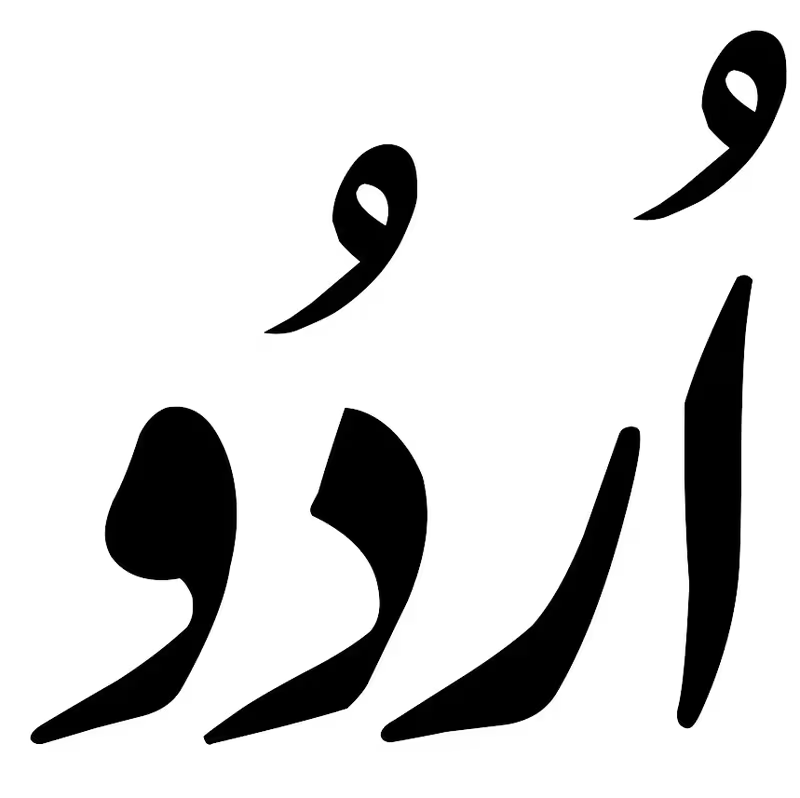
Urdu: The Language of Poetry and Refinement in South Asia
Urdu is an Indo-Aryan language that emerged in the Indian subcontinent during the medieval period, developing into one of the most eloquent and sophisticated literary languages of South Asia. Written in a modified Perso-Arabic script known as Nastaliq, Urdu represents a unique synthesis of indigenous Indian linguistic elements with Persian, Arabic, and Turkish influences. The language became synonymous with courtly culture, refined poetry, and literary excellence during the Mughal period, and continues to be spoken by approximately 70 million people across South Asia and diaspora communities worldwide. As the national language of Pakistan and a scheduled language of India, Urdu occupies a significant position in the linguistic and cultural landscape of the subcontinent, embodying centuries of shared heritage and literary achievement.
Origins and Classification
Linguistic Family
Urdu belongs to the Indo-Aryan language family, a branch of the larger Indo-European language family. More specifically, it is classified within the Central Zone of Indo-Aryan languages, sharing its grammatical structure and much of its basic vocabulary with other languages of this group, particularly Hindi. The Indo-Aryan languages trace their ancestry to Sanskrit through various Prakrit and Apabhramsha stages, and Urdu follows this linguistic lineage while incorporating substantial Persian and Arabic elements.
Origins
Urdu emerged around the 12th-13th centuries CE in the region around Delhi and the surrounding areas of northern India. The language developed as a lingua franca in the military camps and bazaars where soldiers, traders, and officials from diverse linguistic backgrounds needed to communicate. The word "Urdu" itself derives from the Turkish word "ordu" meaning "camp" or "army," reflecting its origins in these multilingual military and commercial environments. The language evolved from earlier forms of Hindustani, the common speech of the Delhi region, but began to acquire its distinctive character through intensive contact with Persian-speaking administrators, scholars, and literary figures who came to India during the Delhi Sultanate period.
Name Etymology
The name "Urdu" is derived from the Turkic word "ordu" (اردو), meaning "camp," "army," or "horde." This etymology points to the language's origins in the military camps and bazaars of medieval northern India, where diverse linguistic communities interacted. The language was initially known by various names including "Hindustani," "Hindi," "Dehlavi" (the language of Delhi), and "Rekhta" (especially in reference to its literary form). The term "Urdu" specifically came to prominence in the 18th century, and by the 19th century, it had become the standard designation for this language, particularly as written in the Perso-Arabic script, distinguishing it from Hindi written in Devanagari.
Historical Development
Early Development Period (1200-1526 CE)
The earliest phase of Urdu's development coincided with the establishment of the Delhi Sultanate in the early 13th century. During this period, the language began to take shape as Persian-speaking administrators, soldiers, and scholars from Central Asia and Iran settled in India and interacted with local populations speaking various Prakrit-derived languages. This contact situation created a linguistic environment where the Indo-Aryan grammatical structure of local dialects began to absorb Persian and Arabic vocabulary, particularly in domains related to administration, culture, religion, and sophisticated discourse. The language of this period was still primarily oral and had not yet developed the rich literary tradition that would characterize later periods.
Mughal Period (1526-1857 CE)
The Mughal era represents the golden age of Urdu's development as a literary and cultural language. Under Mughal patronage, particularly from the reign of Akbar onward, Urdu poetry and literature flourished. The Mughal courts became centers of literary activity where Persian traditions merged with indigenous Indian forms to create a distinctive Urdu literary culture. The language gained prestige as the medium of sophisticated poetry, with poets developing elaborate forms such as the ghazal, masnavi, and qasida. The Nastaliq script, a beautiful cursive form of Perso-Arabic calligraphy, became standardized for writing Urdu, adding to its aesthetic appeal and cultural prestige.
Colonial Period (1857-1947 CE)
Following the end of Mughal rule and the establishment of British colonial administration, Urdu underwent significant changes. The language continued to develop as a literary medium, with modern prose forms emerging alongside traditional poetry. Educational institutions were established where Urdu was taught, and printing technology enabled the wider dissemination of Urdu literature and journalism. However, this period also saw the beginning of increasing differentiation between Urdu and Hindi, as the two registers of Hindustani began to be associated with different religious communities and political identities. The British colonial administration's policies regarding language in education and administration contributed to this linguistic divergence.
Post-Partition Period (1947-Present)
The partition of India in 1947 marked a crucial turning point in Urdu's history. Urdu was adopted as the national language of Pakistan, where it serves as a lingua franca despite being the mother tongue of only a small percentage of the population. In India, Urdu became a scheduled language under the Constitution, with official status in several states. The language continues to evolve, with modern Urdu incorporating new vocabulary from English and other sources while maintaining its rich literary heritage. Contemporary Urdu remains vital in poetry, literature, cinema, and popular culture across South Asia, though debates continue regarding its preservation and promotion in educational systems.
Scripts and Writing Systems
Perso-Arabic Script (Nastaliq)
Urdu is written in a modified form of the Perso-Arabic script, using the elegant Nastaliq calligraphic style. This script is written from right to left and consists of letters that change form depending on their position within a word. The Urdu alphabet includes all the letters of the Persian alphabet, which itself extends the Arabic alphabet, plus additional letters created to represent sounds specific to Indo-Aryan languages, such as retroflex consonants. These special characters distinguish Urdu script from Persian and Arabic, reflecting the language's adaptation to represent the phonology of the Indian subcontinent.
Script Features and Characteristics
The Nastaliq style of writing Urdu is characterized by its flowing, diagonal baseline and aesthetic elegance, making it one of the most beautiful scripts in the world. Unlike Arabic or Persian, which can be written in various styles, Urdu strongly prefers Nastaliq for literary and formal purposes. The script does not typically indicate short vowels, which must be inferred from context, though diacritical marks can be added for clarity, especially in educational or religious texts. This abjad nature of the script means that literacy in Urdu requires substantial familiarity with the language's vocabulary and grammar.
Script Evolution and Standardization
Over centuries, the Urdu script evolved from early Persian and Arabic writing traditions adapted to Indian linguistic needs. Additional letters were created by modifying existing Arabic and Persian letters with dots or other diacritical marks to represent sounds like ٹ (retroflex t), ڈ (retroflex d), and ڑ (retroflex r), which do not exist in Persian or Arabic. In the modern period, particularly with the advent of printing and later digital technology, efforts have been made to standardize Urdu orthography, though some variation in spelling practices persists. The development of Urdu fonts for computers and digital devices has been an ongoing challenge due to the complex cursive nature of Nastaliq script.
Geographic Distribution
Historical Spread
Urdu historically developed and spread across northern India, with its primary centers in Delhi, Lucknow, and other urban centers of the Gangetic plain. During the Mughal period, the language spread wherever Mughal administration and culture extended, reaching into the Deccan plateau and other regions of the subcontinent. As a language of administration, literature, and sophisticated culture, Urdu was adopted by elites across religious communities in many parts of India. The language also spread through Sufi spiritual traditions and Muslim religious education, creating communities of Urdu speakers throughout South Asia.
Centers of Learning
Delhi and Lucknow emerged as the two most important centers of Urdu language and literature. Delhi, as the seat of Mughal power, established the earliest traditions of Urdu poetry and prose. Lucknow, particularly under the Nawabs of Awadh in the 18th and 19th centuries, became renowned for its refined Urdu culture, distinctive dialect, and elaborate literary etiquette known as "Lakhnavi tehzeeb." Other important centers included Hyderabad in the Deccan, which developed its own distinctive Dakhini variant of Urdu, and various cities across northern India where Urdu educational institutions and literary circles flourished.
Modern Distribution
Today, Urdu is spoken across multiple countries in South Asia and beyond. In Pakistan, where it serves as the national language, Urdu functions as a lingua franca despite being the mother tongue of a relatively small portion of the population (approximately 7%). In India, significant Urdu-speaking populations exist in Uttar Pradesh, Bihar, Telangana, Maharashtra, and other states, with Urdu recognized as an official language in several Indian states. Diaspora communities in the United Kingdom, United States, Canada, Gulf countries, and Australia maintain Urdu language and culture. The total number of Urdu speakers worldwide is estimated at approximately 70 million, though many more people can understand the language due to its mutual intelligibility with Hindi and its prominence in South Asian popular culture.
Literary Heritage
Classical Literature
Urdu's literary heritage is among the richest in South Asian languages, with a tradition spanning several centuries. The classical period of Urdu literature, particularly from the 17th to 19th centuries, produced an extraordinary body of poetry characterized by sophisticated metaphor, elaborate imagery, and profound emotional expression. The ghazal became the signature form of Urdu poetry, with poets exploring themes of love, loss, mysticism, and existential reflection within its structured format. Urdu literature also developed extensive prose traditions, including dastan (romance narratives), qissa (stories), and later, modern novels and short stories.
Religious Texts
While not primarily a religious language like Arabic or Sanskrit, Urdu has played a significant role in Islamic religious education and literature in South Asia. Religious texts, including Quranic commentaries, hadith collections, and works of Islamic theology and jurisprudence, have been written or translated into Urdu, making Islamic knowledge accessible to South Asian Muslims. Sufi literature in Urdu has been particularly influential, with mystical poetry and prose exploring spiritual themes in language accessible to broader audiences beyond the Persian-reading elite.
Poetry and Drama
Urdu poetry represents the pinnacle of the language's literary achievement. Forms such as the ghazal, nazm (modern poem), masnavi (narrative poem), and rubai (quatrain) have been perfected by generations of poets. The mushaira (poetry recitation gathering) became a central institution of Urdu literary culture, where poets would present their work before knowledgeable audiences. Urdu drama and theater developed particularly during the colonial period, with the emergence of modern theatrical forms alongside traditional dramatic poetry. In the 20th century, Urdu became a major language of cinema, with film songs and dialogues continuing the language's poetic traditions in new media.
Scientific and Philosophical Works
While Urdu's reputation rests primarily on its literary and poetic achievements, the language has also served as a medium for scientific, philosophical, and scholarly discourse. During the 19th and 20th centuries, Urdu was used for educational texts covering various subjects, from mathematics and medicine to history and philosophy. Scholarly journals and magazines in Urdu contributed to intellectual discourse, and the language served as a vehicle for modernist and reformist thought in South Asian Muslim communities. Translation of scientific and philosophical works from English and other languages into Urdu continues to be an important activity in making knowledge accessible to Urdu-speaking populations.
Grammar and Phonology
Key Features
Urdu shares its basic grammatical structure with Hindi and other Indo-Aryan languages, featuring a Subject-Object-Verb (SOV) word order. The language employs postpositions rather than prepositions, and makes extensive use of compound verbs to express subtle distinctions in meaning. Urdu has two grammatical genders (masculine and feminine) and distinguishes between direct and oblique cases in its noun and pronoun systems. The verbal system is complex, with multiple aspects, moods, and tenses that allow for precise expression of temporal and modal relationships.
Sound System
Urdu's phonological system reflects its Indo-Aryan heritage while incorporating sounds from Persian and Arabic. The language includes retroflex consonants (sounds produced with the tongue curled back), which are characteristic of South Asian languages. From Persian and Arabic, Urdu has adopted sounds like the voiced pharyngeal fricative and distinctions between different "h" and "k" sounds. However, many native Urdu speakers do not consistently maintain all the phonetic distinctions present in Arabic and Persian, often pronouncing Arabic loanwords according to Urdu phonological patterns.
Influence and Legacy
Languages Influenced
Urdu has significantly influenced many languages of South Asia, contributing vocabulary related to administration, culture, and sophisticated expression. Hindi, with which Urdu shares a common grammatical base, has absorbed many Urdu words, particularly in literary and cultural contexts. Regional languages of Pakistan, including Punjabi, Sindhi, and Pashto, have incorporated substantial Urdu vocabulary. In India, languages like Bengali, Gujarati, and even Dravidian languages like Telugu and Tamil have borrowed Urdu words, particularly through the medium of cinema and popular culture.
Loanwords
Urdu's vocabulary represents a synthesis of multiple linguistic sources. From Persian, Urdu has borrowed extensively in domains of administration, arts, and abstract concepts, with words like "darbar" (court), "khush" (happy), and "zindagi" (life). Arabic has contributed religious and scholarly vocabulary, including words like "kitab" (book), "ilm" (knowledge), and "adab" (literature/manners). Turkish loanwords, though fewer, include military and administrative terms. The language has also borrowed from Sanskrit and Prakrit sources, particularly in everyday vocabulary and grammatical particles. In the modern period, English has become a major source of loanwords for technical and contemporary concepts.
Cultural Impact
Urdu's cultural impact extends far beyond its role as a spoken language. The language has shaped literary sensibilities, aesthetic values, and cultural practices across South Asia. The tradition of Urdu poetry has influenced not only literature but also music, with ghazal singing becoming a classical art form. In cinema, Urdu has been the dominant language of dialogue and song lyrics, shaping the cultural imagination of millions across linguistic boundaries. The language's association with refinement, courtesy, and sophisticated expression continues to influence social interactions and cultural expectations in many South Asian contexts.
Royal and Religious Patronage
Mughal Empire
The Mughal emperors, from Babur through the last formal rulers, played a crucial role in Urdu's development, though the extent and nature of their patronage evolved over time. Akbar's court, while primarily Persian-speaking, created an environment where linguistic synthesis was encouraged. Shah Jahan and particularly Aurangzeb saw increased use of the local language alongside Persian in administrative and cultural contexts. The Mughal court system, with its elaborate cultural protocols and aesthetic values, provided the institutional framework within which Urdu literary culture could flourish. Noble families and provincial Mughal administrators extended this patronage throughout the empire.
Delhi Sultanate
The Delhi Sultanate period (1206-1526 CE) laid the foundations for Urdu's emergence, though the language was not yet called by that name. The Sultanate brought Persian-speaking rulers and administrators to Delhi, creating the linguistic contact situation from which proto-Urdu evolved. While Persian remained the language of high culture and administration, the need for communication between the Persian-speaking elite and local populations speaking Prakrit-derived languages created the conditions for a new hybrid linguistic form.
Religious Institutions
Sufi khanqahs (spiritual centers) played a significant role in Urdu's spread and development. Sufi saints often used the local language to communicate spiritual teachings to broader audiences, contributing to Urdu's role as a vehicle for religious and mystical expression. Madrasas (Islamic educational institutions) taught Urdu alongside Arabic and Persian, making it a language of religious education. The tradition of naat (poetry in praise of Prophet Muhammad) and hamd (poetry in praise of God) in Urdu created a substantial body of devotional literature that remains important in South Asian Muslim religious life.
Modern Status
Current Speakers
Urdu currently has approximately 70 million native speakers worldwide, with the largest concentrations in Pakistan and India. In Pakistan, while Urdu is the national language and widely understood, it is the mother tongue of only about 7% of the population, primarily the Muhajir community who migrated from India at partition. In India, Urdu speakers are found mainly in Uttar Pradesh, Bihar, Telangana, and other states, with significant urban populations in cities like Delhi, Mumbai, and Hyderabad. Diaspora communities in the United Kingdom, Canada, the United States, and Gulf countries maintain Urdu language use, though younger generations increasingly shift to English or other dominant languages.
Official Recognition
Urdu holds official status in multiple contexts across South Asia. In Pakistan, it is designated as the national language and serves as one of the official languages alongside English. In India, Urdu is recognized as one of the 22 scheduled languages under the Eighth Schedule of the Constitution, and has official status in the states of Jammu and Kashmir, Telangana, Uttar Pradesh, Bihar, and West Bengal. Despite these official recognitions, debates continue regarding the practical implementation of Urdu language rights, particularly in education and government services.
Preservation Efforts
Various institutions work toward Urdu's preservation and promotion. In Pakistan, the National Language Authority and Muqtadra Qaumi Zaban work on standardizing and promoting Urdu. In India, the National Council for Promotion of Urdu Language (NCPUL) operates centers across the country supporting Urdu education and literature. Universities in both countries maintain departments of Urdu, and numerous literary organizations host mushairas and publish Urdu literature. However, concerns persist about declining Urdu literacy rates, particularly in India, and the challenges of maintaining the language among younger generations facing economic pressures toward English education.
Learning and Study
Academic Study
Urdu is taught and studied at universities across South Asia and internationally. Major universities in Pakistan and India offer undergraduate and graduate programs in Urdu language and literature. International institutions, including universities in the United Kingdom, United States, Germany, and Australia, maintain Urdu programs as part of South Asian studies. Academic study of Urdu encompasses classical literature, modern writing, linguistics, and the language's historical development. Research in Urdu literature continues to produce scholarly works, critical editions, and translations, maintaining the intellectual engagement with the language's rich heritage.
Resources
Learning resources for Urdu have expanded significantly in the digital age. Traditional resources include printed textbooks, literature anthologies, and dictionaries. Modern learners can access online courses, mobile applications, and digital libraries containing Urdu texts. Websites and YouTube channels offer instruction in Urdu script and language. However, quality standardized learning materials remain limited compared to major world languages, and the challenge of mastering Nastaliq script continues to be a barrier for new learners. Broadcasting services, particularly radio and television programs from Pakistan and India, provide exposure to spoken Urdu for learners at various levels.
Conclusion
Urdu stands as a remarkable testament to South Asia's cultural synthesis and literary sophistication. Emerging from the multilingual environment of medieval India, the language evolved into one of the world's most eloquent vehicles for poetic expression, carrying forward traditions of Persian literary aesthetics while developing distinctively South Asian characteristics. Despite the political and social challenges of the modern era, including partition's impact and debates over linguistic identity, Urdu continues to serve approximately 70 million speakers while influencing the broader cultural landscape of South Asia through cinema, music, and literature. The language's future depends on sustained institutional support, educational initiatives, and the continued creativity of writers, poets, and speakers who value its unique literary heritage. As a living link to centuries of shared cultural history and a continuing medium of artistic expression, Urdu represents both the complexity of South Asian identity and the enduring power of language to transcend political boundaries and unite communities through the beauty of words.


