Overview
Between the parallel ridges of the Rajgir Hills lies the ancient valley of Rajagriha, the “house of the king.” Today called Rajgir, the city stands in Nalanda district of Bihar, but its historical importance belongs to the wider region of Magadha. It was the first capital of that kingdom, a place from which Magadha grew into one of the most powerful political formations of early Indian history.
Rajgir’s landscape explains much of its early character. The old settlement occupied a narrow valley enclosed by hills, while fortifications followed the ridgelines above it. The surrounding terrain offered protection, controlled access, and a distinctive setting for a city that was at once a royal capital, a religious centre, and a place of retreat. Ceramics dating to about 1000 BCE have been found in the area, although the precise date at which the city itself was founded remains unknown.
The city is remembered in several overlapping historical and religious traditions. The Mahabharata associates it with King Jarasandha and the kingdom of Magadha. Buddhist traditions connect it with Bimbisara, Ajatashatru, the Buddha, Sariputta, and the First Buddhist Council. Jain traditions associate Rajgir with Mahavira, the Tirthankara Munisuvrata, Jain monks, and numerous temples on the five sacred hills. Hindu traditions preserve the sanctity of its hot springs, while later Islamic history is represented by Makhdum Kund.
Rajgir’s importance did not end when Magadha’s capital moved to Pataliputra. It continued as a sacred landscape, an administrative centre, and a place of pilgrimage. Its ancient walls, caves, springs, hilltop shrines, Buddhist monuments, Jain temples, wildlife sanctuary, and proximity to Nalanda make it a place where political, religious, environmental, and archaeological histories remain closely connected.
Etymology and Names
The modern name Rajgir derives from the older Sanskrit name Rājagṛha, with the Pali form Rajagaha. The name is generally understood as “house of the king,” “royal house,” or, in the modern interpretation of Rajgir, “royal mountain.” The name presents the settlement as a royal residence and a centre of political authority.
Rajgir has also been known by several other names. Girivraja, appearing in the Ramayana and in Pali texts as Giribajja, is explained by the commentator Buddhaghosa as meaning “an enclosure of hills.” This description corresponds closely to the physical setting of the old city, which lay within a valley surrounded by ridges.
The name Vasumati is associated with the Ramayana tradition, where the city’s foundation is attributed to Vasu, described as the fourth son of Brahma. The Mahabharata instead attributes the foundation to Bhradratha and uses the name Barhadrathapura. These accounts belong to literary and legendary traditions rather than to a securely dated archaeological history, but they show how Rajgir’s identity was repeatedly connected with royal founders.
Another name, Kusagrapura, appears in Jain writings and in the account of the Chinese Buddhist pilgrim Xuanzang. It means “the place of superior reed grass.” The range of names attached to the city reflects different religious, literary, and geographical descriptions. Rajagriha emphasises kingship; Girivraja describes the hills; Vasumati and Barhadrathapura remember legendary founders; and Kusagrapura evokes the local landscape.
Geography and Location
Modern Rajgir lies just north of the Rajgir Hills, an isolated pair of parallel ridges rising sharply from the surrounding plains. The ancient settlement stood in the narrow valley between these sets of hills. The relationship between the city and its terrain was central to its history: the hills created a naturally defensible setting, while the valley provided space for habitation and movement.
The ancient city was enclosed by two main systems of fortification. The Inner Fortification was an earthen embankment within the valley. Beyond it, the Outer Fortification consisted of cyclopean walls that followed the crests of the surrounding hills. These walls survive with substantial breaks, but their scale demonstrates the effort invested in protecting the settlement. The outer wall is described as almost 50 kilometres long. It may have served not only as a defence against attackers but also as protection from monsoon water flowing down the hills into the valley.
Sixteen towers were built at irregular intervals along the walls to strengthen the defences. One notable structure is the Pippala stone house on the eastern slope of Vaibhara Hill. It may initially have housed guards. Later tradition associated it with the Buddha, and its eleven small cells may subsequently have been used as meditation rooms by Buddhist monks.
The names and identities of Rajgir’s hills vary between texts. The Mahabharata itself gives two different lists of five hills in the same chapter, making it difficult to match every literary name with a modern ridge. Modern names include Vaibhara, Vipula, Chatha-giri, Shaila, Udaya, Sona, and Ratnagiri. Ratnagiri is the highest, rising to approximately 305 metres.
Rajgir is also known for its hot springs. Brahmakund is the best-known spring today, while Suryakund belongs to a cluster of springs on the northern side of the hills. The waters of several springs merge into a stream. Suryakund’s water is described as stagnant and murky and provides habitat for frogs. The Panchane River, whose name comes from Pañcānanā, or “having five mouths,” flows to the east of Rajgir.
The area has a monsoon climate. Rainfall is concentrated in July and August, with the broader rainy season extending from mid-June to mid-September. The recorded annual rainfall figures vary in the available descriptions, with approximately 113 centimetres given in one account and 1,860 millimetres for the mid-June to mid-September period in another. Summer temperatures may reach 44°C, while winter temperatures may fall to about 6°C.
The hills also preserve a remnant forest ecosystem. Rajgir Wildlife Sanctuary, also known as Pant Wildlife Sanctuary, covers 35.84 square kilometres in the Nalanda Forest Division. Notified in 1978, it is enclosed by five hills identified as Ratnagiri, Vipulgiri, Vaibhagiri, Songiri, and Udaygiri. Its animals include blue bull, chital, Indian crested porcupine, small Indian civet, and jungle cat. Birds include painted spurfowl, Eurasian thick-knee, and painted sandgrouse. Bengal monitors, Indian bullfrogs, Jerdon’s bullfrogs, ornate narrow-mouthed frogs, and Indian tree frogs are among the reptiles and amphibians recorded there.
Ancient History
Rajgir’s foundation date is not securely established. Archaeological ceramics found in the city date to about 1000 BCE, suggesting occupation during the early first millennium BCE. The presence of such material does not by itself establish when the urban settlement or its fortifications were created, but it places Rajgir within a long period of habitation before its best-known association with the Magadhan kings.
The city appears in the Mahabharata under the name Girivraja. Its king, Jarasandha, is described as an enemy of the Pandavas and an ally of their opponents. The epic recounts a wrestling match between Jarasandha and Bhima, one of the Pandava brothers. Jarasandha’s body was believed to rejoin whenever it was dismembered. According to the story, Bhima defeated him by splitting his body into two halves and throwing them in opposite directions so that they could not reunite. A location known as Jarasandha’s Akhara is still associated with martial practice and this tradition.
The epic account belongs to the world of sacred and heroic narrative rather than a securely dated political chronology. It nevertheless preserves Rajgir’s long-standing association with Magadhan kingship. The city’s historical prominence becomes clearer in the traditions concerning the Haryanka rulers Bimbisara and Ajatashatru.
Historical Timeline
Rajgir’s history is best understood as a succession of changing roles rather than as a simple rise and fall. It began as a fortified settlement and royal capital, became a major setting for Buddhist and Jain activity, retained administrative importance after the political centre moved away, and later developed into a multi-religious pilgrimage town.
The Haryanka Dynasty
Rajgir was the capital of the Haryanka dynasty. Bimbisara is dated to 558–491 BCE, while Ajatashatru is dated to 492–460 BCE. Both are closely connected with the city.
Bimbisara is remembered as a contemporary and supporter of the Buddha. Buddhist traditions describe the king as offering the Buddha a forest monastery at Rajgir. The site is identified with Venuvana, or Bamboo Grove, now associated with a government-maintained tourist area. The Buddha spent several months in the region, meditated and preached at Gridhra-kuta, the Hill of the Vultures, and delivered teachings that included the Atanatiya Sutra.
Ajatashatru is associated with a troubled episode in the royal household. He kept his father Bimbisara captive at Rajgir. The traditions do not agree on whether Bimbisara or Ajatashatru was responsible for constructing the city’s fortifications or particular buildings. This disagreement is important: Rajgir’s monumental landscape cannot always be assigned confidently to one ruler.
During Ajatashatru’s reign, Rajgir remained the capital of Magadha. The city’s political position was eventually altered by Udayin, the son of Ajatashatru, who ruled from approximately 460 to 440 BCE. Udayin moved the capital to Pataliputra, the city now identified with Patna. Pataliputra’s location offered different strategic and administrative advantages, and Rajgir’s role as the principal capital came to an end.
The Shishunaga Dynasty
Shishunaga founded his dynasty in 413 BCE, initially using Rajgir as its capital before the capital was again moved to Pataliputra. This brief return of political centrality shows that Rajgir remained an important royal centre even after Udayin’s relocation.
Rajgir is sometimes listed among the capitals associated with several early dynasties and with the Mauryan Empire. The more precise historical point is that it was the first capital of Magadha, the kingdom whose expansion eventually created the political conditions for the Mauryan Empire. The capital of the Mauryan state was Pataliputra, not Rajgir.
The Buddha and Rajgir
Rajgir was one of the most important locations in the Buddha’s career. He spent months meditating and preaching in the hills and groves around the city. Gridhra-kuta, or Vulture Peak, became one of the principal settings of his teaching activity. Venuvana served as a place of retreat and residence for the Buddha and his sangha.
The Buddha is said to have preached to Bimbisara and other inhabitants of Magadha, helping establish the city as a major early centre of Buddhism. Rajgir is also associated with the Atanatiya Sutra. On one of the hills, Saptaparni Cave is traditionally identified as the site of the First Buddhist Council, held under the leadership of Maha Kassapa after the Buddha’s death.
The council’s historical details belong to Buddhist tradition, and the exact identification of every ancient location remains dependent on textual comparison and archaeological interpretation. The association has nevertheless shaped Rajgir’s religious geography for centuries.
Mahavira and Jain Rajgir
Rajgir is equally important in Jain history. Mahavira, the twenty-fourth Tirthankara, spent many years in Rajgir and Nalanda. According to the Kalpa Sutra, he spent ten rainy-season retreats, or chaturmasyas, at Rajgir. The city was the capital of King Shrenik, described in Jain tradition as a devoted follower of Mahavira.
Rajgir is also identified as the birthplace of Munisuvrata, the twentieth Jain Tirthankara. Jain tradition holds that four of Munisuvrata’s five Kalyanakas occurred here: conception, birth, initiation into monkhood, and attainment of omniscience. His nirvana is associated with another location, Sammet Shikharji.
The eleven chief disciples, or ganadharas, of Mahavira are believed to have attained nirvana at Rajgir. Jain accounts also describe the religious importance of each of the city’s five hills. As a result, Rajgir is not simply a city with isolated Jain shrines; the hills themselves form a sacred pilgrimage circuit.
Gupta and Pala Periods
Rajgir declined in political prominence after the capital shifted to Pataliputra, but it was not abandoned. The accounts of the Chinese Buddhist pilgrim Xuanzang in the seventh century describe two old Buddhist monasteries that still had active communities. At the same time, Xuanzang focused largely on Rajgir’s ancient associations and attributed many of the monuments he saw to Bimbisara or Ashoka. He did not record much contemporary patronage or construction at Rajgir.
This differs from his descriptions of Nalanda and Bodh Gaya, where he recorded recent activity and patronage. The later pilgrim Yijing likewise referred mainly to Rajgir’s ancient past. These observations have led historians to describe the city in this period as a place sustained by sacred memory but no longer at the centre of contemporary Buddhist development.
Yet Rajgir continued to support other forms of religious and civic activity. The Maniyar matha, variously interpreted as a Shiva temple or a Naga shrine, dates broadly to the fifth century, although it may have been built over an older structure. Ceramic and sculptural evidence suggests that Hindu worship continued from the Gupta period into the seventh through ninth centuries.
Buddhist activity appears to have diminished, but Buddhist objects have been dated as late as the tenth to twelfth centuries. Some may have been produced at Nalanda and later brought to Rajgir. Jain patronage continued more consistently. A ruined Jain temple on Vaibhara Hill may date to the fifth century, while an image of Rishabhanatha donated by Acharya Vasantanandi is dated to the eighth or ninth century.
Rajgir also retained administrative importance. During the Gupta and Pala periods, it was the capital of a vishaya within Magadha bhukti. A copper seal belonging to the guild of blacksmiths and carpenters of the Rajgir vishaya, palaeographically dated perhaps to the fifth century, indicates organised craft and commercial activity.
Political Significance
Rajgir’s political importance rested first on its relationship with Magadha. As the first capital of the kingdom, it was a seat of royal power during the reigns of Bimbisara and Ajatashatru. The city’s location among hills gave it a defensive character, while the valley supported settlement and movement.
The fortification system is the clearest surviving expression of this political and military role. The cyclopean walls used large stones and followed the ridges surrounding the old city. Their scale suggests that Rajgir was not merely a ceremonial royal residence. It was a settlement whose rulers invested in long-term defence. The walls may also have reduced the danger posed by seasonal water flowing from the hills into the valley.
Rajgir’s political role changed when Udayin moved the capital to Pataliputra. The city then became one of several important centres within the Magadhan sphere rather than the principal seat of the kingdom. Its later position as a vishaya capital during the Gupta and Pala periods demonstrates that administrative value survived the loss of imperial centrality.
The literary traditions surrounding Jarasandha also preserve the memory of Rajgir as a royal and martial city. Jarasandha’s Akhara, whether understood as a historical location or as a later memorial landscape, continues to express this association.
Religious and Cultural Importance
Few ancient Indian cities combine Buddhist and Jain associations as closely as Rajgir. The Buddha and Mahavira both taught in the region during the sixth and fifth centuries BCE, and both traditions developed durable sacred geographies around the hills and valley.
Buddhist Heritage
The Buddha’s retreats at Venuvana and Gridhra-kuta made Rajgir a major early Buddhist location. Venuvana is remembered as a forest monastery offered by Bimbisara. Gridhra-kuta became a site of preaching and meditation. Saptaparni Cave is traditionally identified with the First Buddhist Council, where senior monks gathered under Maha Kassapa.
The city was also associated with Sariputta, one of the Buddha’s two chief disciples, and with Jivaka, a physician connected with Bimbisara and the Buddha. These associations made Rajgir significant not only as a royal setting but also as a place connected to the organisation and transmission of the Buddhist community.
Jain Heritage
Jain sacred sites are distributed across Rajgir’s hills. Jain travellers and records from the sixteenth through eighteenth centuries mention changing numbers of temples, especially on Vaibhara, Suvarnagiri, and Vipulachalgiri. The fluctuations in the recorded numbers reflect the changing condition of the shrines and the continuing development of pilgrimage.
The five principal Jain hills are:
- Vipulachalgiri, the first hill, where Mahavira is said to have preached at the Gunashila Caitya. Historical records describe several temples on the hill during the seventeenth and eighteenth centuries. A shrine to Aimutta Muni is also located here.
- Ratnagiri, the second hill, associated with temples to Rishabhanatha and now home to a four-faced Shvetambara temple whose principal deity is Chandraprabha.
- Udayagiri, the third hill, located about 1.5 kilometres from Ratnagiri and associated today with the Shyamaliya Parshvanatha temple.
- Suvarnagiri, the fourth hill, where historical accounts mention between five and seventeen temples at different times. A Shvetambara temple dedicated to Rishabhanatha remains on the hill.
- Vaibharagiri, the fifth hill, associated with Munisuvrata’s attainment of omniscience and with the nirvana of Mahavira’s eleven ganadharas. It preserves six Shvetambara temples as well as archaeological remains of Gupta-period temples.
The Naulakha Jain Temple, also called Gaon Mandir, stands at the foothills. It covers 8,007 square feet, and its spire rises to about 87 feet including the flagstaff. Eighty-five decorative kalashas adorn the spire. Its principal image is a black stone idol of Munisuvrata installed in 1447 CE by Jinadasa, a lay follower.
The temple was renovated in 1763, 1961, and 2008. A new 9.1-foot image of Munisuvrata was installed in 1961. The temple also contains images of Rishabhanatha and Shantinatha dated to 1447, as well as an undated image of Parshvanatha possibly from the fifteenth century. An image of Mahavira was consecrated in the underground cellar in 2008.
Vaibhara Hill contains several important Jain shrines. The Purushadaniya Parshva temple includes footprints dated to 1844 and 1855. The Mahavira temple was renovated in 1607 and contains Mughal-period artistic elements and footprints dated to 1874. The Munisuvrata temple, known as Bada Mandira, dates to 1865 and has a nine-tiered spire. The Dhanna-Shalibhadra temple was installed in 1468 and rebuilt in 1954 and 2008. Current footprints marking the nirvana of the eleven ganadharas were installed in 1774 by Jagat Seth Mehtab Rai.
Hindu and Islamic Sacred Sites
Rajgir’s hot springs have held religious significance since ancient times. Brahmakund is particularly important to Hindu visitors, who associate the waters with healing and with the seven sages, or Saptarshi. Several springs merge in the area, creating a natural setting where geology and religious practice remain inseparable.
Makhdum Kund, also known as Dargah-e-Makhdoomiya, represents a later Islamic layer in Rajgir’s sacred landscape. It contains the tomb of Makhdoom Syed Ghulam Ali and a prayer space associated with Sharfuddin Yahya Maneri. Its thermal spring is said to be approximately 800 years old and is used by visitors for bathing and ablution.
Monuments and Architecture
Rajgir’s architecture ranges from massive defensive works to caves, temples, monastic remains, and modern religious monuments.
Cyclopean Walls
The ancient walls are among the most striking remains of Rajgir. Built from large stones, they run along the crests of the surrounding hills and are associated with the old city. Archaeological dating places the cyclopean walls at about the sixth century BCE. Their construction reflects the city’s early military importance and its adaptation to the hill landscape.
The walls’ dual defensive and hydraulic function is especially significant. They were designed not simply to keep people out but also to manage the environmental risks of a valley settlement exposed to monsoon runoff. Their scale, however, should not be treated as proof of a single building campaign: the surviving remains include large breaks, and the precise history of construction is uncertain.
Sona Bhandar Caves
Sona Bhandar is a cave complex on the foothills of Rajgir. The principal cave is approximately 34 feet long and 17 feet wide. Local legend identifies it as the hiding place of King Shrenik’s treasure behind a sealed wall. The cave’s historical evidence points in a different direction.
An inscription states that the cave was built for Jain ascetics by Acharya Vairadevasuri, probably in the fourth century CE. The walls contain carved figures of Tirthankaras including Padmaprabha, Parshvanatha, and Mahavira. The outer walls bear the Jain Dharmachakra and inscriptions in mixed Sanskrit and Pali dated broadly to the third or fourth centuries CE.
The caves have been compared architecturally with the Barabar and Nagarjuni caves associated with the Mauryan period. Some earlier observers proposed Buddhist connections, but an inscription identifying a Jain patron and Jain ascetic use shifted the interpretation. Xuanzang’s description of Digambara Jain monks meditating on Vaibhara Hill has also encouraged the view that the caves were associated with Jain practice. A Vishnu sculpture found from a mound indicates that at least part of the complex was later used or interpreted within a Hindu religious context.
Maniyar Matha
The Maniyar matha is associated variously with Shiva worship or a Naga shrine. It dates broadly to the fifth century, although it may occupy the site of an older structure from the early centuries BCE. Later sculptural material, including pieces dated to the seventh through ninth centuries, suggests that Hindu activity continued in the Rajgir area over an extended period.
Vishwa Shanti Stupa
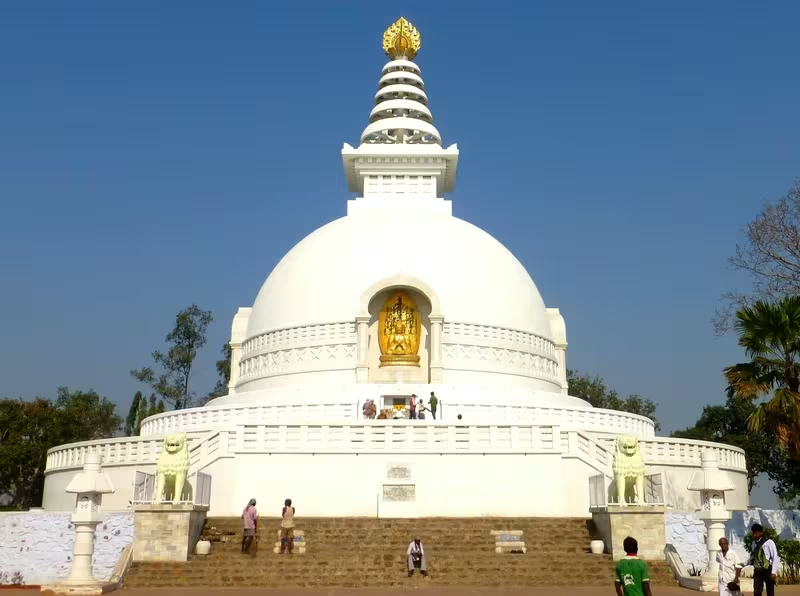
The Vishwa Shanti Stupa stands on Ratnagiri Hill. Established by the Japanese Buddhist monk Nichidatsu Fujii, founder of the Nipponzan Myohoji order, it was inaugurated on 25 October 1969. It is described as one of eighty peace pagodas worldwide and as the oldest peace pagoda in India.
A ropeway leads to the stupa and is itself a well-known attraction. The ropeway was gifted by Fuji Guruji in the 1960s. The anniversary of the stupa’s establishment is marked by Buddhist monks, devotees from Southeast Asian countries, and representatives of the Bihar government.
Other Sites
Important places connected with Rajgir’s historical and religious landscape include Bimbisara’s Jail, Gridhra-kuta, Venuvana, Jarasandha’s Akhara, the Sariputta Stupa, the Rajgir Heritage Museum, Ghora Katora Lake, the Rajgir glass bridge, and the Japanese temple beside Venuvana.
The ancient Nalanda site lies near Rajgir, and the modern Nalanda University was established nearby. The university began its first academic session on 1 September 2014.
Economic Role
Rajgir’s earlier economy included royal administration, agriculture, craft production, and religious activity. The copper seal of the blacksmiths’ and carpenters’ guild from the Rajgir vishaya provides evidence for organised artisanal activity during the Gupta period. The city’s location within Magadha and near Nalanda connected it to a wider network of political, religious, and educational centres.
In the modern period, tourism is the main economic activity, supplemented by agriculture. Hotels, resorts, transport providers, pilgrimage services, and local commerce serve visitors travelling to Rajgir, Nalanda, Pawapuri, and nearby destinations. Rajgir is reported to rank first in Bihar for revenue collected through tourism.
The town also has important institutional and industrial establishments. An ordinance factory for the defence forces is located in Rajgir. The Bihar Police Academy and a Central Reserve Police Force Recruit Training Centre serving Bihar, Jharkhand, and West Bengal are also based there. Plans and projects connected with an IT city, a multimedia hub, and Rajgir Film City represent more recent attempts to broaden the local economy.
Famous Personalities
Rajgir is associated with rulers, religious teachers, physicians, and literary figures.
- Bimbisara, ruler of the Haryanka dynasty, made Rajgir a central setting of early Magadhan and Buddhist history.
- Ajatashatru, Bimbisara’s successor, ruled from Rajgir and is remembered for imprisoning his father there.
- Udayin, son of Ajatashatru, moved the capital from Rajgir to Pataliputra.
- Jarasandha, the legendary king of Magadha in the Mahabharata, is associated with Girivraja and Jarasandha’s Akhara.
- Mahavira, the twenty-fourth Jain Tirthankara, spent rainy-season retreats in Rajgir and taught in the surrounding region.
- Gautama Buddha preached and meditated at Rajgir and maintained close connections with Bimbisara and the early Buddhist sangha.
- Sariputta, one of the Buddha’s two chief disciples, is linked with the city.
- Jivaka, a physician and contemporary of Bimbisara and the Buddha, is also associated with Rajgir.
- Munisuvrata, the twentieth Jain Tirthankara, is believed in Jain tradition to have been born at Rajgir.
Decline and Revival
Rajgir’s decline was gradual and relative rather than absolute. Its most important political role ended when the capital shifted to Pataliputra. The city also became less prominent than Nalanda and Bodh Gaya in the accounts of Chinese Buddhist pilgrims. Xuanzang and Yijing described an ancient sacred landscape whose active Buddhist institutions were fewer than those of Nalanda.
At the same time, Rajgir remained inhabited and religiously active. Hindu shrines developed or continued, Jain communities maintained temples and pilgrimage routes, and Rajgir retained administrative importance during the Gupta and Pala periods. Buddhist objects continued to reach the site, even if Buddhist institutional activity was no longer dominant.
Later Jain travellers recorded numerous temples on the hills, showing that the pilgrimage network remained active from the sixteenth to eighteenth centuries. Modern renovations and new construction have continued this process of renewal. The Vishwa Shanti Stupa added a twentieth-century Buddhist monument to the older landscape, while the modern Nalanda University renewed Rajgir’s association with learning.
Modern City
The 2011 Indian Census recorded 41,587 residents in Rajgir: 21,869 males and 19,718 females. The population aged from zero to six years was 6,922. The town had 7,030 households. A total of 24,121 residents were recorded as literate, giving a reported literacy figure of 58 percent for the total population. The effective literacy rate for the population aged seven and above was 69.6 percent, with a male literacy rate of 78.1 percent and a female literacy rate of 60.1 percent. The Scheduled Castes population was 11,724 and the Scheduled Tribes population was 42.
Rajgir is now a major destination on Buddhist and Jain circuits in Bihar. It is also visited for Hindu sacred bathing at the hot springs and for the Islamic heritage of Makhdum Kund. The town’s attractions include the old city walls, caves, hill temples, springs, peace pagoda, ropeway, wildlife sanctuary, museum, glass bridge, and nearby archaeological sites.
Rajgir’s festivals and public events include Rajgir Mahotsav, Purushottam Maas Mela, the Sariputta World Peace Walk, and the Makar Sankranti Mela. The annual observance connected with the Vishwa Shanti Stupa attracts Buddhist monks and devotees from several Southeast Asian countries.
The town is connected by rail, road, and bus services. Rajgir railway station links it with other parts of India, while Gaya Junction is approximately 78 kilometres away. The Shramjeevi Superfast Express connects Rajgir with New Delhi, and the Bakhtiyarpur–Gaya line provides wider rail access. Gaya International Airport is approximately 78 kilometres away, while Patna’s Jay Prakash Narayan Airport is approximately 101 kilometres away.
By road, Rajgir is connected with Nalanda, Pawapuri, Bihar Sharif, Gaya, Bodh Gaya, and Patna. National Highway 120 passes through the city, and State Highway 71 links it with Giriyak, Islampur, and Jehanabad. Electric rickshaws, buses, and tongas provide local transport.
Modern development has brought both opportunities and pressures. Tourism supports the local economy, but the survival of ancient walls, caves, springs, temples, forest, and archaeological remains depends on careful management. Rajgir’s heritage is not confined to a single monument. It is a connected cultural landscape in which the hills, water, fortifications, pilgrimage routes, and living religious institutions all contribute to the meaning of the place.
Timeline
Early archaeological evidence
Ceramics dating to about 1000 BCE are found in the Rajgir area, although the city’s precise founding date remains unknown.
Magadhan royal centre
Rajgir emerges in historical and literary traditions as the capital of Magadha and the city of kings.
Bimbisara’s reign
Bimbisara of the Haryanka dynasty rules from Rajgir and is associated with the Buddha and Venuvana.
Ajatashatru’s reign
Ajatashatru succeeds Bimbisara and continues to rule from Rajgir.
Capital moves to Pataliputra
Udayin, son of Ajatashatru, moves the Magadhan capital from Rajgir to Pataliputra.
Shishunaga dynasty
Shishunaga establishes his dynasty with Rajgir as its initial capital before the capital again moves to Pataliputra.
Gupta-period activity
Hindu and Jain activity continues, while Rajgir serves as an administrative centre in Magadha.
Xuanzang visits Rajgir
The Chinese Buddhist pilgrim records two old Buddhist monasteries and focuses on Rajgir’s ancient associations.
Naulakha Jain Temple image
A black stone image of Munisuvrata is installed at the foothill Jain temple by Jinadasa.
Mahavira temple renovation
The Jain temple on Vaibhara Hill is renovated and receives Mughal-period artistic elements.
Vishwa Shanti Stupa inaugurated
The peace pagoda on Ratnagiri Hill is inaugurated on 25 October.
Wildlife sanctuary notified
Rajgir Wildlife Sanctuary is notified across the forested Rajgir Hills.
Nalanda University session begins
The modern Nalanda University near Rajgir begins its first academic session on 1 September.
Rajgir Zoo Safari opens
Rajgir Wildlife Safari opens to the public on 16 February.