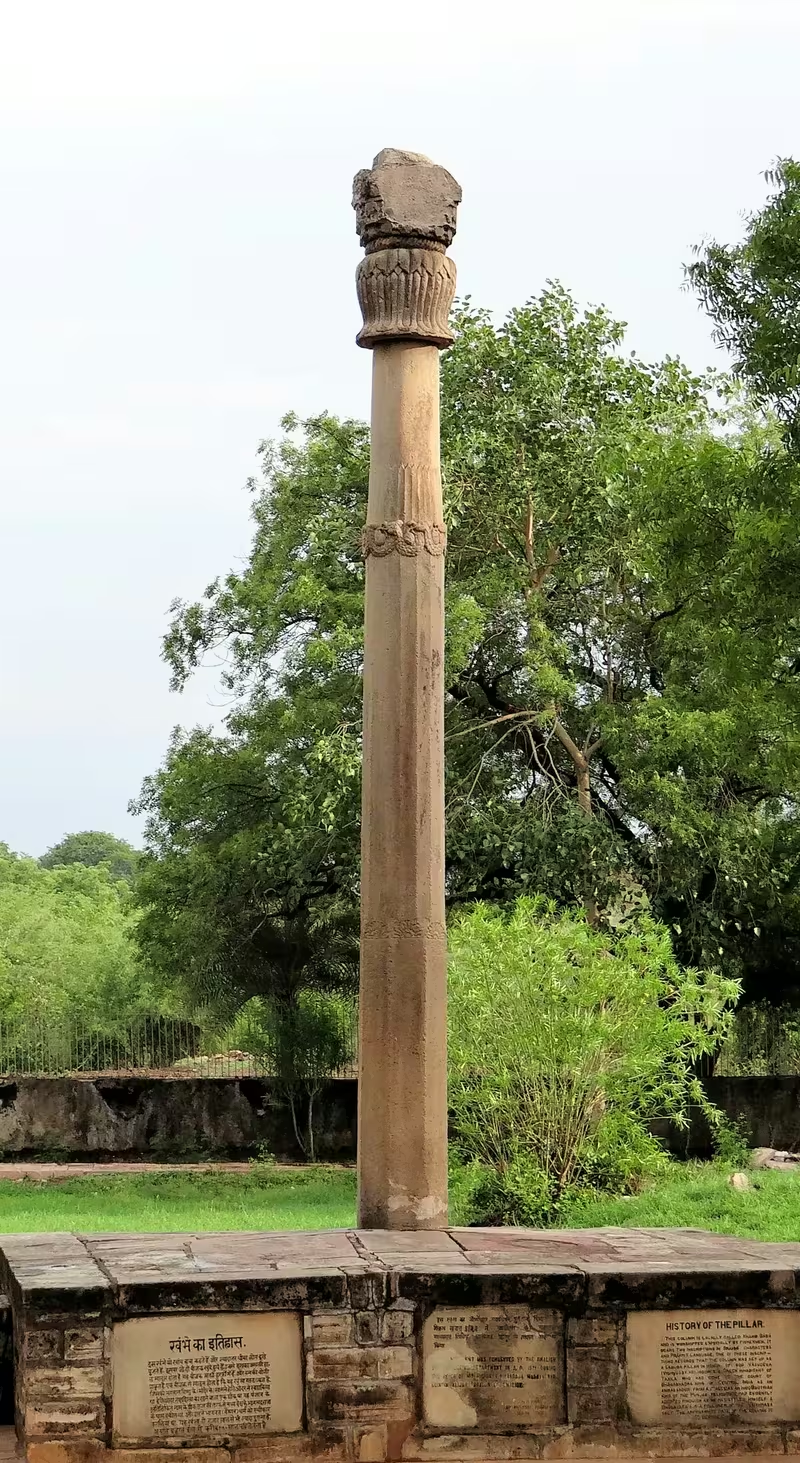
Heliodorus Pillar: A Greek Ambassador’s Dedication to Vāsudeva
At Besnagar, near Vidisha in Madhya Pradesh, a stone pillar rises above the remains of an ancient temple complex. Erected around 113 BCE, it carries a Brahmi inscription recording the dedication of Heliodorus, an ambassador from Taxila sent by the Indo-Greek king Antialcidas to the Indian ruler Bhagabhadra. The inscription venerates Vāsudeva as Devadeva—the “God of Gods” and Supreme Deity—and praises Bhagabhadra as the savior.
The pillar is commonly identified as a Garuda-standard, although its crowning emblem has not survived. Its importance lies not only in the inscription but also in its archaeological setting. Excavations conducted in the twentieth century revealed foundations of an elliptical shrine, temple halls, later raised platforms, and a line of eight pillars. The Heliodorus pillar was therefore part of a substantial Vāsudeva temple site rather than an isolated monument.
The monument preserves some of the earliest archaeological evidence for Vāsudeva-Krishna devotion and early Vaishnavism. It also raises a question that remains debated: did Heliodorus adopt the Bhagavata religious tradition, or was the dedication a diplomatic act consistent with Greek practice toward foreign gods? The pillar cannot settle that question by itself, but its inscription documents an important encounter between Indo-Greek diplomacy, local kingship, and the worship of Vāsudeva.
Discovery and Provenance
Discovery
Alexander Cunningham first discovered the pillar in 1877 near the ancient city of Besnagar, in the neighborhood of Vidisha. The site lies near the confluence of the Betwa and Halali rivers, formerly known as the Bais River. Its position was historically significant because the fertile region lay along a trade route connecting the northern Gangetic valley with the Deccan and the kingdoms of southern India.
When Cunningham saw the pillar, it was thickly covered with ritually applied red paste, or vermilion. It was still an object of worship and ritual animal sacrifice. A priest had built a home on a nearby mound and enclosed it with a compound wall. Local people called the pillar Khamba Baba or Kham Baba.
The red crust prevented Cunningham from seeing the inscription. Even so, he recognized that the monument was unusual and historically important. He noted its crowning form, carved fan, rosettes, faceted symmetry, and transition from angular sections to a round upper shaft. He suspected that an inscription lay beneath the crust and described the pillar as “the most curious and novel” of his discoveries.
Cunningham also found several detached architectural elements in the surrounding area. A fan-palm pinnacle lay near the standing pillar. He initially believed that it had once crowned the Heliodorus pillar and produced a composite reconstruction combining the two pieces. Later research showed that the fan-palm pinnacle could not fit the surviving pillar. The fan-palm design is otherwise associated with the worship of Saṃkarṣaṇa-Balarama, one of the Vrishni heroes.
A second capital, found a short distance away, carried a makara emblem: a mythical composite creature combining features of an elephant, crocodile, and fish. Cunningham believed that this capital belonged to a lost pillar from the Ashokan period because of the form of its bell. About a kilometer away, he found a third capital bearing a kalpadruma, or wishing tree. That design is associated with the goddess Sri Lakshmi.
These discoveries suggested that the standing pillar belonged to a larger religious complex, although the precise relationships among the capitals were not yet understood. Later research connected the surviving pillar with a Garuda emblem and with a temple dedicated to Vāsudeva.
Surveys and Excavations
The first major follow-up survey took place between 1909 and early 1910, nearly three decades after Cunningham’s discovery. An Indian and British archaeological team led by H. H. Lake cleaned away the thick red crust. Beneath it, they found inscriptions in Brahmi script.
The discovery produced an unexpected result. The longer inscription referred to Heliodorus, a Greek ambassador of the second century BCE, and to the deity Vāsudeva. A second, shorter inscription on the same pillar recorded a series of human virtues. Scholars later identified this passage as a verse from the Mahabharata.
The inscriptions attracted further archaeological attention. A partial excavation conducted between 1913 and 1915 under D. R. Bhandarkar revealed brick foundations and an extensive group of substructures. The work was left incomplete because the priest occupying the mound claimed rights to his house and compound wall, which his ancestors had built over the site.
Although incomplete, the excavation demonstrated that the area had been repeatedly affected by flooding. Silt deposited over roughly two thousand years had raised the ground level. The dig exposed rectangular, square, and other foundations aligned with the cardinal axes. Broken architectural elements, plates, and capitals indicated that the pillar formed part of a larger ancient complex.
Full archaeological access became possible during the excavation conducted between 1963 and 1965 under Khare. Local religious practice was moved to a nearby tree, and the priest’s family relocated. Archaeologists could then excavate the mound and the area surrounding the pillar.
The later excavation revealed the brick foundation of a sanctum, or garbhagriha, together with pillared halls. The plan was elliptical. Excavators also found foundations belonging to an even earlier temple. The discoveries established that the pillar was part of a long-lived sacred site whose structures had been rebuilt after floods and changes in ground level.
Journey Through History
The Heliodorus pillar remained associated with religious practice long after the ancient temple had disappeared. By the nineteenth century, it was still receiving vermilion and ritual attention. The local name Khamba Baba reflects the continued presence of the pillar within the religious landscape of Besnagar.
The monument’s physical setting changed over time. Floods deposited layers of silt around the pillar, and later platforms were added to accommodate the raised ground. The pillar itself stands above earlier remains, and secondary foundations were constructed after major floods to match the new surface level.
The excavations indicate at least three major phases of religious construction. An elliptical shrine, probably dating to the fourth or third century BCE, had a brick foundation and likely a wooden superstructure. Flooding destroyed this structure around 200 BCE. Soil was then added and the ground level raised for a second temple to Vāsudeva. A wooden pillar, described as a Garuda dhvaja, stood in front of its east-facing elliptical shrine.
This second temple was also destroyed by flooding, perhaps in the second century BCE. In the late second century BCE, after further preparation of the ground, another Vāsudeva temple was constructed. This later temple contained eight stone pillars aligned along the north-south axis. Only one of those pillars has survived: the Heliodorus pillar.
Current Home
The pillar remains at the Besnagar archaeological site near Vidisha in Madhya Pradesh. It stands close to the confluence of the Betwa and Halali rivers, approximately 60 kilometres northeast of Bhopal, 11 kilometres from the Buddhist stupa of Sanchi, and 4 kilometres from the Hindu site of Udayagiri.
Its setting is essential to understanding the object. The surviving shaft, inscriptions, platform, and excavated foundations together reveal a temple landscape. The pillar is not merely a detached inscription-bearing column; it is the surviving member of a line of architectural supports belonging to an ancient Vāsudeva shrine.
Physical Description
Materials and Construction
The Heliodorus pillar is made of stone and differs in appearance from the highly polished, tapered pillars associated with the ancient Ashokan tradition. It is neither tapered nor polished, and it is approximately half the diameter of Ashokan pillars.
The pillar rests on a square platform measuring approximately 12 feet on each side. The platform itself rises about 3 feet above the surrounding ground. Beneath the visible structure, excavation revealed a much deeper construction than early observers had realized. A metal-stone interface occurs at the base, and the shaft is supported by two placement stones held together with a layer of stone and metal.
Above the foundation is an untrimmed section of stone. The shaft then changes into a series of carefully shaped geometric sections. The lower visible shaft has an octagonal cross-section, followed by a sixteen-faceted section and then a short thirty-two-faceted portion. Above these is a short round section that would have supported the capital and crowning emblem.
The changing geometry is one of the pillar’s most distinctive features. The shaft moves from broad angular planes to increasingly numerous facets and finally to a circular upper section. This transition produces the visual effect that Cunningham noticed even before the inscription was exposed.
Dimensions and Form
The pillar rises approximately 17.7 feet above its square platform. The currently visible octagonal section is about 4 feet 10 inches high. The sixteen-faceted section is fully visible and measures approximately 6 feet 2 inches in height. The thirty-two-faceted section is about 11.5 inches high, while the round upper section measures approximately 2 feet 2 inches.
The bell capital is about 1 foot 6 inches deep and 1 foot 8 inches wide. Above it was an ornate square abacus measuring approximately 1 foot 7 inches on each side.
The crowning emblem is missing. The pillar is nevertheless identified as a Garuda-standard on the basis of its religious association with Vāsudeva and the inscriptional and archaeological evidence from the site. A possible fragment of the lost capital is preserved in the Gwalior Museum.
Condition
The pillar survives substantially above its platform, but its upper emblem is no longer present. Its base extends deep beneath the modern ground level and incorporates remains of earlier construction. The shaft, ornamental bands, bell capital, abacus, and inscriptions remain available for study.
The monument has also undergone changes caused by its environment. Floods repeatedly buried and altered the site, leading to the addition of platforms and secondary foundations. Earlier archaeological reports did not recognize the full depth of the pillar or the metal-stone interface at its base because these features were below the accumulated soil.
The pillar’s ritual history also affected its surface. When Cunningham found it, the stone was covered in a thick layer of red vermilion. Cleaning carried out during the 1909–1910 survey exposed the Brahmi inscriptions beneath the crust.
Artistic Details
Two ornamental bands mark important transitions in the shaft. The lower band, placed at the junction of the octagonal and sixteen-faceted sections, consists of half-rosettes. The upper band, at the junction of the sixteen- and thirty-two-faceted sections, is a festoon decorated with birds, flowers, leaves, and hanging vines.
Earlier scholars identified the birds as geese or swans. Closer examination determined that they are pigeon-like birds rather than geese or swans. The festoon is approximately 6.5 inches long.
The capitals from the Besnagar site have similarities to Sunga capitals from Sanchi, but they are not identical. The Sanchi examples lack the clockwise birds, makara, and band found at Besnagar. They include elephants and lions, which are absent from the Besnagar examples. These differences are significant because elephants and lions are commonly associated with the Buddhist art of the period. The two artistic traditions nevertheless appear to have informed one another.
The surrounding site contained several symbolic capitals. These included a fan-palm capital, generally associated with Saṃkarṣaṇa; a makara capital, associated with Pradyumna; and a banyan-tree capital with eight treasures, associated with Lakshmi. The presence of these objects suggests that the religious complex involved several Vrishni deities in addition to Vāsudeva.
Historical Context
The Era
The pillar was erected during a period of interaction between Indian rulers, Indo-Greek kingdoms, and regional religious communities. Heliodorus is identified in the inscription as an ambassador of Antialcidas, an Indo-Greek king from Taxila. He was sent to the Indian ruler Bhagabhadra.
The pillar is usually dated to approximately 113 BCE, within the late second century BCE. Its date is especially useful for the study of Indian art because the reign of Antialcidas provides a relatively precise chronological marker. Following the Pillars of Ashoka, the Heliodorus pillar is one of the next major pillars associated with a datable inscription.
The Besnagar region was positioned along a major trade route and near important Buddhist and Hindu sites. The pillar stood close to Sanchi and Udayagiri, while the wider religious and cultural networks of the period connected Besnagar with places such as Taxila and Mathura.
Vāsudeva-Krishna was already regarded as a deity by this period. Coins of Agathocles of Bactria, dated approximately 190–180 BCE, depict Vāsudeva-Krishna and Saṃkarṣaṇa. Literary evidence has also been used to suggest that the worship of Vāsudeva may have existed as early as the fourth century BCE.
At this stage, however, Vāsudeva worship should not automatically be equated with the later, fully developed Vaishnava theology. The worship of Vāsudeva between the fourth and second centuries BCE appears to have centered on a warrior-hero tradition connected with the Vrishni clan. The later association of Vāsudeva with Vishnu and Narayana developed progressively, especially during the Kushan and Gupta periods.
Purpose and Function
The pillar was a religious standard associated with Vāsudeva. Its lost crowning emblem is understood to have been Garuda, the sun bird and vehicle of Vāsudeva. In this form, the object would have functioned as a Garuda dhvaja, or Garuda-standard, placed before the temple.
The pillar’s architectural setting reinforces this interpretation. Excavations uncovered the remains of an elliptical shrine, a sanctum, a circumambulation passage, an antechamber, and a gathering hall. The complex also contained post-holes, iron nails, and other evidence for wooden architectural elements.
The pillar had a symbolic role as a stambha. A stambha joined earth, space, and heaven. It could therefore express the cosmic axis and the totality of the deity. In the case of the Heliodorus pillar, the vertical form, the Garuda association, and the dedication to Vāsudeva combined architectural, theological, and political meanings.
The nearby capitals indicate that the temple complex may have included several standards or shrines. The fan-palm emblem was associated with Saṃkarṣaṇa, the makara with Pradyumna, and other motifs with Lakshmi. These discoveries suggest a religious environment centered on Vāsudeva but incorporating other Vrishni figures and related deities.
Commissioning and Creation
The pillar records the dedication of Heliodorus, but the identity of the craftsmen who carved it is unknown. The inscription names Heliodorus as an ambassador of Antialcidas and identifies him as a worshipper or devotee of Vāsudeva. It also names Bhagabhadra, the Indian ruler to whom Heliodorus had been sent.
The identity of Bhagabhadra remains contested. Earlier scholars proposed that he was the fifth ruler of the Sunga dynasty, based on certain Puranic lists. Later excavations near Mathura, including work at Sonkh, suggested that the Sunga dynasty may have ended before the pillar was installed. On that basis, Bhagabhadra may instead have been a local ruler.
The monument may have been created as an act of personal devotion, a diplomatic dedication, or both. Its inscription gives Heliodorus a religious identity connected to Vāsudeva, but the precise motivation behind the dedication cannot be determined with certainty.
Significance and Symbolism
Historical Importance
The Heliodorus pillar and the Hathibada Ghosundi inscriptions are among the earliest known inscriptions connected with devotion to Vāsudeva-Krishna and early Vaishnavism. Alongside religious texts such as the Bhagavad Gita, they provide early evidence for the existence and development of Vāsudeva worship.
The pillar has often been described as one of the earliest surviving records of a foreign convert to Vaishnavism. That interpretation rests on Heliodorus’s self-identification and his dedication to Vāsudeva. It presents the monument as evidence that the religious tradition had reached beyond local communities and attracted at least one prominent foreign visitor.
A different interpretation emphasizes Greek religious practice. Greeks could make dedications to foreign gods as a way of appropriating their power or seeking their favor. From this perspective, Heliodorus’s dedication does not necessarily demonstrate conversion to Hinduism. It may instead have been a diplomatic or religious gesture that followed a wider Greek pattern.
Whatever interpretation is preferred, the pillar documents a significant cross-cultural encounter. An Indo-Greek ambassador commissioned or dedicated a monument at an Indian temple site, using local script and religious language to honor Vāsudeva.
Artistic Significance
The Heliodorus pillar is an important marker in the evolution of Indian stone architecture during the Sunga period. It is associated with a date considerably more precise than that of many surviving monuments, and its motifs have helped scholars date nearby architectural and sculptural material.
The carved half-rosettes, festoons, birds, and faceted shaft demonstrate a sophisticated approach to stone ornamentation. The pillar is neither a simple monolithic shaft nor a direct repetition of the Ashokan form. Its proportions, surface treatment, and decorative bands represent a distinct architectural development.
The motifs also assist in dating parts of the Buddhist complex at Sanchi. The reliefs of Sanchi Stupa No. 2 are dated to the last quarter of the second century BCE partly because their architectural motifs resemble those of the Heliodorus pillar and because the paleography of their inscriptions is comparable.
The capitals discovered near the pillar show that different religious artistic traditions shared visual forms while adapting them to distinct symbolic programs. The Besnagar capitals resemble Sunga capitals at Sanchi in certain respects but include different combinations of birds, makaras, elephants, lions, and decorative bands.
Religious and Cultural Meaning
Garuda is traditionally the vehicle of Vāsudeva. In the Mahabharata, which was probably compiled between the third century BCE and the third century CE, Garuda appears as the vehicle of Vishnu. The identification of the Heliodorus pillar as a Garuda-standard therefore connects its vertical form with the deity worshipped in the temple.
The relationship between Vāsudeva and Vishnu, however, developed over time. Early evidence suggests that the worship of Vāsudeva between the fourth and second centuries BCE was connected with a warrior-hero tradition. The later amalgamation of Vāsudeva with Vishnu and Narayana developed progressively. By the Gupta period, the term Vaishnava had become more prominent than Bhagavata for followers of this worship, and Vishnu had become more popular than Vāsudeva.
The Heliodorus pillar belongs to the earlier stage of this history. Its inscription calls Vāsudeva Devadeva, the God of Gods, and presents him as the Supreme Deity. It therefore demonstrates that Vāsudeva already possessed a high theological status in the late second century BCE, even though later Vaishnava forms had not yet fully developed.
The pillar’s stambha form adds another layer of meaning. It links the earthly temple with the heavens and expresses cosmic order. The Garuda-standard was not merely a decorative pole; it served as a visible sign of the deity and of the temple’s sacred presence.
Inscriptions and Text
The Longer Inscription
The longer inscription is written in the Brahmi script of the Sunga period. Its language is Monumental Prakrit with several Sanskritized spellings. It records the religious dedication of Heliodorus and identifies the deity as Vāsudeva.
The inscription praises Vāsudeva as Devadeva, meaning “God of Gods,” and describes him as the Supreme Deity. It also honors Bhagabhadra as the savior. Heliodorus is identified as an ambassador of Antialcidas, the Indo-Greek king of Taxila, sent to the Indian ruler Bhagabhadra.
This combination of personal identity, diplomatic status, and religious dedication makes the inscription unusually valuable. It provides information about political contacts between Indo-Greek and Indian rulers while also recording the presence of a Vāsudeva-centered religious tradition.
The Shorter Inscription
A second inscription appears on the pillar in the same script. It records a verse from the Hindu epic Mahabharata and concerns human virtues. Scholars have translated the virtues in different ways. John Irwin, for example, rendered them as “Restraint, Renunciation and Rectitude.”
The shorter inscription is important because it connects the pillar’s religious message with an ethical teaching. It also demonstrates that the monument was not limited to a single dedicatory formula. Its surface carried both a historical record of Heliodorus’s dedication and a statement about qualities valued within the religious tradition.
Language and Script
The use of Brahmi is significant for both dating and interpretation. The letter forms belong to the Sunga period, and the paleography helps establish the monument’s chronological position. The language is primarily Prakrit, although some spellings have been Sanskritized.
The inscriptions were hidden from Cunningham by the thick ritual coating that covered the pillar in the nineteenth century. Once the crust was removed during the 1909–1910 survey, the text could be read and its connection to Heliodorus and Vāsudeva recognized.
Scholarly Study
Key Research
Alexander Cunningham’s 1877 discovery initiated the modern study of the pillar. Although he could not initially read the inscription, he recognized the monument’s unusual form and documented nearby capitals and architectural fragments.
The 1909–1910 survey led by H. H. Lake exposed the inscriptions. John Marshall reported the discovery and drew attention to the reference to Heliodorus and Vāsudeva.
D. R. Bhandarkar’s partial excavation between 1913 and 1915 showed that the pillar belonged to a larger complex. The later excavation conducted under Khare between 1963 and 1965 provided the most extensive archaeological context. It revealed the temple foundations, repeated flood deposits, raised platforms, and the line of eight pillars.
Scholars including E. J. Rapson, Sukthankar, Richard Salomon, and Shane Wallace have analyzed the inscriptions. Richard Salomon provided translations of the dedication. Art historians and archaeologists have also studied the pillar’s capitals, ornament, relationship to Sanchi, and possible connection with the lost Garuda capital.
The site has been compared with the ancient temple complex at Nagari near Chittorgarh. The Besnagar and Nagari remains share features such as elliptical foundations and early temple arrangements. The archaeological evidence from Besnagar and Nagari has led Susan Mishra and Himanshu Ray to describe them as perhaps the earliest Hindu temples discovered by archaeologists.
The Missing Garuda Capital
The Garuda capital has not been found in place. One possibility is that Cunningham excavated it without recognizing its relationship to the pillar. The suspected fragment may have been transferred to the Gwalior Museum along with other objects from Besnagar.
A fragment in the museum depicts bird feet holding a Naga, with the tail end resting on part of a vedika. This fragment has been proposed as a possible remnant of the lost Garuda capital.
Susan L. Huntington suggested that the capital may have resembled a portable Garuda standard represented in a nearly contemporary relief at Bharhut. In that relief, a man riding a horse holds a portable pillar-standard crowned by a bird-man creature similar to a Kinnara.
The Bharhut relief has an additional connection with Vidisha. Its dedicatory inscription identifies the first pillar as the gift of Chāpadevāyā, the wife of Revatimita, from Vedisa. This connection has led to the suggestion that the Garuda standard shown at Bharhut may have been modeled on the one at Besnagar—or that both represented a shared local form.
Debates About Heliodorus’s Religious Identity
The pillar has often been presented as evidence that Heliodorus converted to Vaishnavism. His dedication to Vāsudeva and the Garuda-standard association make this interpretation plausible. Edwin F. Bryant argued that Heliodorus converted to the Krishna religion during his period as an envoy, while other scholars have described the pillar as evidence that the tradition had developed firm roots by the first century BCE.
Other scholars have urged caution. A. L. Basham and Thomas Hopkins argued that Heliodorus may not have been the earliest Greek to adopt Bhagavata or Vaishnava devotional practices. Hopkins suggested that there may have been other Greek devotees, including the king who sent Heliodorus as ambassador.
An alternative interpretation, associated with Harry Falk, treats the dedication as an example of normal Greek religious behavior. Greeks could honor foreign gods because they wished to appropriate their power. Under this interpretation, a dedication to Vāsudeva does not prove that Heliodorus converted to Hinduism.
Allan Dahlquist proposed another reading, questioning whether Vāsudeva necessarily referred to Vishnu-Krishna and suggesting possible connections with other religious traditions. Later scholars criticized this interpretation for overlooking indications in Greek and Indian evidence pointing toward Vāsudeva-Krishna worship. References in ancient Greek accounts, early Buddhist literature, and related inscriptions have been used to support the identification of Vāsudeva with the Krishna tradition.
The debate illustrates the limits of interpreting a short ancient inscription. The pillar clearly records Heliodorus’s dedication to Vāsudeva. It does not, by itself, reveal whether that dedication represented a personal conversion, a diplomatic act, a shared religious practice, or a combination of these motives.
Legacy and Influence
Impact on Art History
The Heliodorus pillar provides a chronological anchor for the study of early Indian art. Its association with Antialcidas and its datable inscription help scholars compare its carved ornament with other monuments of the late second century BCE.
The pillar’s decorative bands have also contributed to the dating of Sanchi Stupa No. 2. Similar rosettes and architectural motifs, together with comparable inscriptions, connect the monuments within the artistic environment of the period.
The excavated site has altered the understanding of early Hindu architecture. The remains of the elliptical shrine, sanctum, circumambulation passage, antechamber, and gathering hall show that substantial temple structures existed in central India by the late first millennium BCE and early centuries BCE. The Heliodorus pillar is especially important because it survives as an architectural element connected with a named deity and a documented temple complex.
The group of associated capitals broadens the picture. Rather than representing a single isolated cult symbol, the Besnagar remains suggest an organized religious landscape involving Vāsudeva and other Vrishni figures, including Saṃkarṣaṇa and Pradyumna.
Modern Recognition
The pillar is recognized as one of the earliest surviving archaeological records of devotion to Vāsudeva-Krishna. Its inscription is frequently discussed in relation to the beginnings of Bhagavata worship and the gradual development of Vaishnavism.
Its importance also lies in its evidence for cultural exchange. The monument links a Greek ambassador, an Indo-Greek king, an Indian ruler, Brahmi writing, an early Vāsudeva temple, and a religious standard associated with Garuda.
The pillar’s modern history is equally significant. It was not discovered as an abandoned object untouched by later communities. It was found within a living ritual setting, coated with vermilion and known by a local name. Archaeological study therefore had to negotiate not only with buried architecture and flood deposits but also with continuing religious practice.
Viewing Today
The Heliodorus pillar stands at the Besnagar archaeological site near Vidisha in Madhya Pradesh. It can be understood together with the nearby excavated temple foundations and the associated capitals discovered in the surrounding area.
Visitors encounter a surviving stone shaft with geometric facets, carved ornamental bands, a bell capital, and an abacus. The Garuda emblem that once crowned the pillar is missing. A possible fragment of the lost capital is associated with the Gwalior Museum, but the standing pillar remains at Besnagar.
The site’s location places it near several major ancient religious landscapes. It is approximately 11 kilometres from Sanchi and 4 kilometres from Udayagiri. The surrounding archaeological setting helps explain why Besnagar was an important center during the period: it stood near river confluences, trade routes, and communities associated with Buddhist and Hindu traditions.
Conclusion
The Heliodorus pillar preserves a rare convergence of architecture, inscription, diplomacy, and religious history. Erected at Besnagar around 113 BCE, it records the dedication of a Greek ambassador from Taxila to Vāsudeva, whom the inscription honors as the God of Gods and Supreme Deity. Its shaft, faceted construction, rosettes, festoon, and lost Garuda capital belong to the developing artistic world of the late second century BCE.
Archaeological excavations have shown that the pillar was part of an extensive Vāsudeva temple complex repeatedly altered by floods and rebuilding. Its inscriptions provide early evidence for Bhagavata devotion, while its association with Garuda connects the monument with the evolving religious identity of Vāsudeva-Krishna. Whether Heliodorus was a convert or made a diplomatic dedication remains debated. In either case, the pillar stands as enduring evidence of cultural contact and of the early formation of a tradition that would become central to Vaishnavism.