Overview
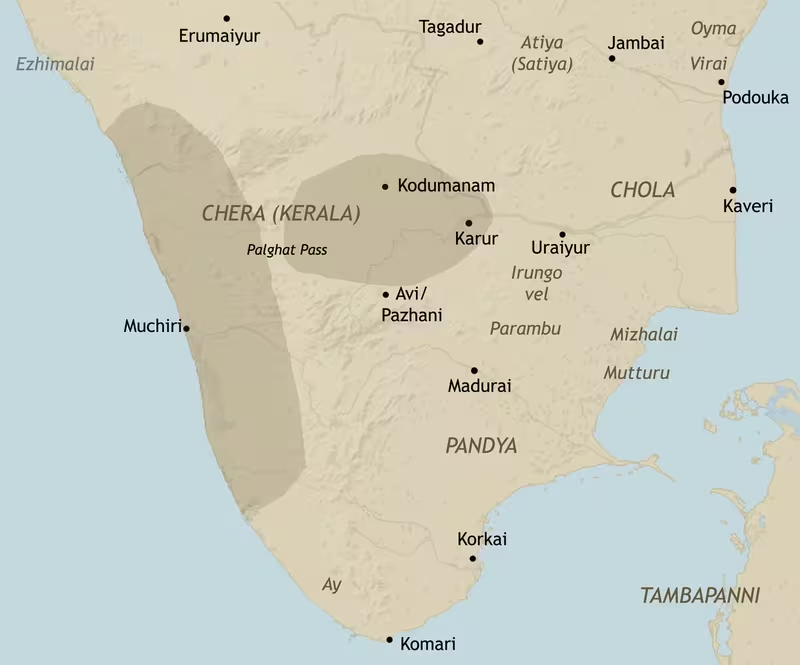
The Chera kingdom occupied a strategic position between the western coast of the Indian peninsula and the interior plains of Tamilakam. Its territory included much of present-day central Kerala and western Tamil Nadu, especially the Kongu country. The dynasty’s political centres and ports connected the Arabian Sea with inland settlements, while the Palakkad Gap offered a natural passage across the Western Ghats. Through this corridor, goods and people moved between the Malabar Coast and the interior of Tamil Nadu.
The Cheras were one of the three crowned dynasties of early Tamilakam, alongside the Cholas and Pandyas. They appear in records from at least the third century BCE, when the Mauryan emperor Ashoka referred to them under the name “Kedalaputo,” probably related to the expression “Kerala Putra.” Greek and Roman writers later recorded the dynasty in forms such as “Keprobotras,” “Kaelobotros,” and “Kerobottros.” These names are generally understood as attempts to represent an Indo-Aryan or southern Indian title associated with the Cheras.
The early historic Cheras flourished between approximately the second century BCE and the third or fifth century CE, although the dates and succession of individual rulers remain difficult to establish. Their history is reconstructed from Sangam poetry, Greek and Roman descriptions, Tamil-Brahmi inscriptions, coins, and archaeological excavations. These types of evidence do not form a continuous royal chronicle. Instead, they illuminate particular rulers, places, commercial relationships, religious communities, and political practices.
The Chera name continued to be used by later ruling houses. Chera rulers of Karur, the Satiyaputra or Adigaman rulers of Thagadur, the medieval Chera Perumals of Mahodayapuram, and the Kulasekhara rulers of Venad were associated with Chera descent or identity. These later lineages should not automatically be treated as a single uninterrupted dynasty, but their claims show the continuing prestige of the Chera name in southern Indian political culture.
Origins and Names
The origin of the word “Chera” remains debated. The ancient Tamil term Cheralam has been interpreted as possibly referring to a mountain range, an explanation that would connect the name with the mountainous geography of Kerala and the Malabar Coast. Another proposal derives the name from the Tamil word cherppu, meaning seashore, which would associate it with the western coastal region.
Other explanations connect “Chera” with the term Kerala. The Malayalam word keram, meaning coconut palm, has sometimes been proposed as a possible source, although the relationship may run in the opposite direction: keram may itself have developed from the name Kerala. Another interpretation links keram to the Sanskrit word narikela, meaning coconut tree. None of these explanations has achieved universal acceptance.
The title also appears in several related forms. “Cheraman” is generally associated with a shortened form of Cheramakan, which has been connected with the expression Keralaputras. “Cheralar” and “Cheral” occur as variants of the dynastic title. The name therefore could refer to a ruling family, its people, or the region under its authority.
Ashoka’s inscriptions provide the earliest external reference usually associated with the Cheras. They mention the “Kedalaputos” among the southern peoples beyond the direct limits of the Mauryan empire. Later, Pliny the Elder, the author of the Natural History, referred to the Cheras as “Kaelobotros.” The Periplus Maris Erythraei, a first-century CE Greek sailing manual, used the form “Keprobotras,” while Claudius Ptolemy used “Kerobottros” in the second century CE.
These variations reflect the difficulties faced by writers recording foreign names in different languages. They also show that the Chera region was known beyond the Tamil country by the early centuries of the Common Era.
Rise to Power
The precise circumstances of the Chera kingdom’s foundation are unknown. No surviving inscription describes a founder who established the dynasty at a clearly recorded date. Instead, the Cheras emerge gradually in the historical record as one of the major political powers of southern India.
Their rise was closely connected with geography. The Chera country lay along the Malabar Coast, where monsoon winds enabled maritime movement between Arabia, the Red Sea, and southern India. Behind the coast stood the Western Ghats, whose valleys and passes led toward the Tamil plains. The Palakkad Gap was especially important because it provided a relatively accessible route between the Malabar Coast and the interior. The Noyyal River valley, Kodumanal, and Karur formed part of this wider network.
Agriculture, fishing, cattle rearing, craft production, and trade supported the developing political centres. The Chera rulers also benefited from the demand for black pepper and other products available in the western highlands. Ports such as Muchiri and Thondi became points where goods from the interior entered maritime commerce.
The early Cheras were not necessarily a unified, centrally administered territorial state in the later imperial sense. Several branches of the ruling family appear to have exercised authority at the same time. One branch was associated with central Kerala and the Malabar Coast, with Muchiri-Vanchi and Thondi as important regional centres. Another, often connected with the Irumporai or Porai line, was based in the Kongu country, with Vanchi-Karur as its capital.
These branches may have competed for leadership of the wider Chera country. The evidence suggests a political system in which kings, royal relatives, and local chieftains operated through alliances, tribute, gift exchange, warfare, and control of productive and commercial resources.
The Chera Country and Its Capitals
The location of the Chera capital is complicated by the repeated use of the name Vanchi. Early historic sources associate a Vanchi with Karur in the Kongu country and another Vanchi with the Malabar Coast. The distinction between Vanchi-Karur, also called Karuvur, and Muchiri-Vanchi has therefore been important in historical discussions.
Modern Karur, on the Amaravati River in Tamil Nadu, was a major political and economic centre. Excavations there have revealed evidence of craft production, jewel making, inland trade, and coin manufacture. The city was positioned along routes leading from the western coast through the Palakkad Gap and the Noyyal valley. Pugalur, where important Chera inscriptions were discovered, lies approximately ten miles north of Karur near the Kaveri River.
Muchiri, known in Greek and Roman records as Muziris, was the foremost Chera port described in the early maritime accounts. Its exact ancient location has not been established with certainty. Archaeological excavations at Pattanam, near Kochi, have produced evidence that increasingly supports its identification with Muziris, although the question remains an archaeological and historical interpretation rather than a settled fact.
Pattanam has yielded remains of a brick-lined wharf constructed with laterite granules, lime, and clay. Excavators have also found amphora fragments, terra sigillata, carnelian intaglios, Roman glass, and large quantities of copper coins. These discoveries indicate sustained interaction with merchants and commodities connected to the western Indian Ocean and Mediterranean trade.
Thondi, another major port, stood on the western coast and appears in both literary and historical traditions. The port served as a point of contact between Chera rulers and maritime commerce. Together, Muchiri and Thondi gave the Cheras access to a commercial system extending from the Arabian Sea to the Middle East and Mediterranean regions.
Sources for Chera History
The history of the early Cheras is reconstructed from several different bodies of evidence.
Tamil Literature
The Sangam corpus, conventionally dated between approximately the second century BCE and the third century CE, contains poems about Chera, Chola, and Pandya rulers. Much of this poetry consists of praise, and it often celebrates royal generosity, courage, military success, and patronage of poets. Such poems are valuable historical evidence, but they also served political purposes. The praise of a ruler could help legitimize his authority and reputation.
The Pathitrupathu is especially important for Chera history. It forms part of the Ettuthokai anthology and consists of decads of poems associated with Chera rulers and their court poets. Two of the ten decads are no longer available, and the surviving poems have not yet been arranged into a fully connected chronology. The work therefore preserves names, achievements, relationships, and political memories without providing a complete dynastic sequence.
The Purananuru and Akananuru also mention Chera rulers and events. Some names may refer to the same individual under different titles, while others may have been repeated across branches of the family. Establishing a precise succession from the poems alone is consequently difficult.
Greek and Roman Accounts
The Periplus Maris Erythraei describes the trade of the Chera region in the first century CE. Pliny the Elder also referred to the southern Indian kingdom, and Ptolemy provided geographical information in the second century. These writers were interested primarily in trade routes, ports, commodities, and political geography rather than in recording a complete history of the Chera rulers.
Their accounts are nevertheless important because they confirm the international visibility of the Chera coast. They describe a region reached by merchants connected with Roman, Arab, and Greek maritime networks.
Inscriptions
Tamil-Brahmi inscriptions provide direct evidence for Chera names, titles, religious donations, and social relationships. Two nearly identical inscriptions from Pugalur near Karur record three generations of Chera rulers. They mention the construction of a rock shelter for Chenkayapan, a Jain monk, during the investiture of Kadungon Ilam Kadungo. The inscription identifies him as the son of Perum Kadungon and grandson of Athan Cheral Irumporai, also written Irumpurai.
This record is significant for several reasons. It preserves a royal genealogy, refers to an investiture ceremony involving an heir, and documents a donation connected with Jain religious life. It also places a branch of the Chera family in the Karur region.
At the Edakkal Caves in the Western Ghats, a short Tamil-Brahmi inscription contains the expression “Katummi Puta Cera,” interpreted as Kadummi Putra Chera. Another inscription reads “Ko Athan,” which may refer to a different Chera ruler. Additional Tamil-Brahmi inscriptions have been found at Kodumanal, Aiyamalai, and Arachalur.
These inscriptions do not provide a continuous narrative, but they establish the presence of Chera-related names and authority across the western Tamil and Kerala borderlands.
Coins
Coins offer another important line of evidence. Chera coins often display a bow and arrow, the traditional dynastic emblem. Copper issues were frequently square and could be produced through punch-marking. Some included legends in Tamil-Brahmi. Bronze dies discovered in the Karur riverbed indicate that coins were minted in the region.
Silver punch-marked coins imitating imperial Mauryan types have also been reported. Their Chera bow symbol on the reverse suggests that older monetary forms were adapted for local political purposes.
Several silver portrait coins are associated with named Chera rulers or titles. One coin found near Karur in the Krishna River region bears a portrait and the Tamil-Brahmi legend “Makkotai.” Another carries the legend “Kuttuvan Kotai.” These impure silver coins are tentatively dated to around the first century CE or slightly later. Their reverse sides are blank, and their portraits have strong similarities to contemporary Roman silver coinage.
Other coins bear the legends “Kollippurai,” “Kollipporai,” and “Kol-Irumporai.” A silver coin depicting a figure wearing a Roman-style bristled-crown helmet bears a bow and arrow on the reverse. A joint issue showing the Chola tiger on one side and the Chera bow and arrow on the other has been interpreted as evidence of an alliance between the two dynasties.
Chera coins have also been found at Pattanam. The archaeological record further shows that Chera authorities counter-struck silver Roman coins, demonstrating that foreign currency circulated within their commercial environment.
The Gajabahu–Chenguttuvan Chronology
The dating of the Sangam-age Cheras is often connected to the so-called Gajabahu–Chenguttuvan synchronism. In the Silappathikaram, Ilango Adigal presents Chenguttuvan as his elder brother and describes the consecration of a temple to Pattini, identified with Kannaki, at Vanchi. A king named Gajabahu is said to have attended the ceremony. This Gajabahu is identified with Gajabahu, a second-century ruler of Sri Lanka.
If the identification is accepted, Chenguttuvan and related Chera rulers would belong to either the first or last quarter of the second century CE. Archaeological and epigraphic evidence broadly supports a second-century setting, although the chronology depends on several interpretive assumptions. It should therefore be treated as a useful historical framework rather than an indisputable fixed date.
Chenguttuvan is the most celebrated Chera ruler in early Tamil literary tradition. His epithet “Kadal Pirakottiya” is associated with maritime achievement, while the Silappathikaram presents him as the ruler who established the Pattini cult at Vanchi. The literary account is important for understanding Chera political memory and religious culture, even though its narrative cannot be treated as a straightforward royal chronicle.
Major Chera Rulers in Literary Tradition
The surviving Tamil poems mention numerous Chera rulers. Some appear in genealogical or political contexts, while others are known mainly through individual episodes.
Chenguttuvan
Chenguttuvan is the best-known Chera ruler in Tamil literary tradition. The Silappathikaram connects him with Kannaki, the heroine whose story becomes the foundation of the Pattini tradition. According to the poem, Chenguttuvan consecrated a temple for Pattini at Vanchi and was supported or witnessed by rulers from outside the Chera country.
His importance lies not only in the historical question of his reign but also in the durability of the tradition surrounding him. Through the Silappathikaram, Chenguttuvan became associated with maritime power, royal ceremony, religious patronage, and the institutionalization of the Pattini cult.
Mantharam Cheral Irumporai
“Yanaikatchai” Mantharam Cheral Irumporai is described as ruling a broad territory from the Kolli Hills near Karur to Thondi and Mantai on the western coast. He reportedly defeated enemies at Vilamkil but was later captured by the Pandya ruler Nedum Chezhian II. He escaped captivity and regained his territories.
The story reflects the competitive political world of early historic southern India. Political control could be disrupted through warfare and captivity, but a ruler’s authority could also be restored through escape, alliance, and renewed control of territory.
Anthuvan Cheral Irumporai and Chelva Kadumko Vali Athan
Anthuvan Cheral Irumporai, placed around the middle of the second century CE in the literary tradition, is described as the father of Chelva Kadumko Vali Athan. Anthuvan was associated with the Chola ruler Mudittalai Ko Perunar Killi. A well-known anecdote recounts that the Chola ruler’s royal elephant wandered into Karuvur, illustrating the proximity and interaction of the Chera and Chola political worlds.
Kanaikkal Irumporai
Kanaikkal Irumporai is remembered for defeating a chief named Muvan and imprisoning him. The story states that he removed the prisoner’s teeth and planted them on the gates of Thondi. Kanaikkal was later captured by the Chola ruler Chengannan and died by starvation.
This episode is presented in the poems as an example of the violence and personal rivalries characteristic of early Tamil politics. It also demonstrates the importance of Thondi as a Chera-controlled centre.
Other Rulers
The literary tradition also names Perum Cheral Irumporai, “Thagdur Erinta” Perum Cheral Irumporai, Kuttuvan Kodai, Kudakko Nedum Cheral Athan, Perum Cheral Athan, Ko Kothai Marpa, Kottambalattu Tunchiya Makkodai, Vanchan, and “Kadalottiya” Vel Kelu Kuttuvan.
Man Venko is remembered as a friend of both the Pandya ruler Ugra Peruvaluti and the Chola ruler Perunar Killi, who is associated with the performance of a royal sacrifice. These traditions portray the Chera rulers as participants in a complex diplomatic environment in which alliances crossed dynastic boundaries.
Administration and Political Organization
The political structure of the early Chera kingdom remains debated. Some historians interpret the inscriptions, coinage, urban centres, specialized crafts, literary evidence, and long-distance trade as signs of an early state polity. In this interpretation, the Chera, Chola, and Pandya rulers were hereditary kings who exercised authority through courts, tribute, military power, ports, and control over valuable goods.
The Pugalur inscriptions refer to a Chera ruler as “Ko,” while royal heirs carried forms such as “Ko” or “Kon” in their names. The reference to the investiture of Kadungon Ilam Kadungo may indicate a recognized succession ceremony. Rulers also appear to have controlled or influenced trade centres and may have imposed rudimentary tolls and customs duties.
Other historians use the terms “chiefdom” or “potential monarchy” rather than state. They argue that the early historic rulers exercised limited control over agricultural communities and depended substantially on tribute, plunder, gift exchange, and redistributive relationships. On this view, there was no extensive regular taxation system or centralized coercive administration comparable to that of later empires.
Both interpretations acknowledge the presence of political hierarchy. At the top stood the three crowned rulers, the Vendars. Beneath them were numerous Velir chiefs and other local authorities. These rulers and chiefs formed alliances, fought one another, exchanged gifts, and competed for access to agricultural, pastoral, mineral, and commercial resources.
The available evidence does not justify describing the Chera state as either a fully centralized bureaucracy or a politically unstructured tribal society. A balanced interpretation recognizes a hereditary ruling order with urban and commercial centres, but also accepts that its territorial control may have been uneven and dependent on personal relationships, tribute, military success, and redistributive generosity.
Society and Culture
Sangam literature presents early Tamil society through two major themes: war and love. Poems classified as Puram celebrate the courage, generosity, and martial reputation of rulers. Akam poems explore human emotions through landscapes, seasons, social settings, and emotional conventions.
The landscape system connected particular ecological zones with specific occupations, emotions, deities, and social experiences. This literary framework reflects the close relationship between environment and culture in the Chera country, where mountains, forests, river valleys, agricultural plains, and the sea all formed part of daily life and political economy.
Agriculture, fishing, cattle rearing, hunting, craft production, and maritime commerce were all important. Iron forging was practiced, and specialized communities contributed to the production and circulation of goods. Poets, bards, musicians, and other performers held a respected position in courtly society. Rulers were praised for rewarding poets with valuable gifts, including gold and precious stones.
Women appear in a variety of roles in the early Tamil texts, and the surviving evidence has been interpreted as suggesting that women enjoyed a comparatively high status when contrasted with some later medieval settings. Women poets are included in the literary tradition. The evidence, however, reflects literary representation as well as social practice and should not be treated as a complete description of every community.
Social organization was not defined primarily by the later caste structure. Early Tamil texts refer instead to kudis, clan-based descent groups associated with production, lineage, and hereditary occupations. Varna categories had limited relevance in the society reflected by these texts, and restrictions on inter-dining and social interaction characteristic of later caste practice are not central features of the early evidence.
Religion and Belief
Most of the Chera population probably followed indigenous Dravidian religious traditions. These included the worship of sacred forces associated with objects, places, people, and natural features. One such force was Ananku, which was believed to inhabit particular beings or things and to require ritual regulation.
Ritual specialists and particular communities performed ceremonies intended to control or direct these sacred powers. The poems also refer to the worship of departed heroes, trees, ancestors, and deities associated with war and fertility. Korravai, a war goddess, was connected with offerings of meat and toddy. In later religious developments, she was assimilated with forms of Durga.
Jainism and Buddhism reached southern India through migrations and cultural contacts from northern India from around the third century BCE. They remained minority traditions but left visible traces. The Pugalur inscriptions record a donation of a rock shelter for a Jain monk, demonstrating the presence of Jain religious communities in the Chera sphere.
Brahmanical traditions were also present. The religious landscape was therefore plural, combining local practices with Jain, Buddhist, and Brahmanical influences. The evidence does not support the idea that one single religious tradition dominated all Chera communities.
The Pattini or Kannaki tradition associated with Chenguttuvan represents one of the most influential religious memories connected with the Cheras. In the Silappathikaram, Kannaki becomes a powerful embodiment of chastity, justice, and divine authority. Chenguttuvan’s consecration of a temple for Pattini at Vanchi helped connect royal power with religious institution-building.
Economy and Trade
The Chera economy rested on agriculture, pastoral activity, fishing, metalworking, craft production, inland exchange, and maritime commerce. The first phase of urbanization in the Chera country and the wider southern Indian region is generally placed between the third century BCE and the third century CE.
Karur was a major inland centre. Archaeological evidence shows that it was important for jewel making, craft production, and trade. The city also appears to have hosted a Chera mint. Excavations have yielded copper coins bearing Chera symbols, while the Amaravati River and nearby areas have produced substantial quantities of foreign coins.
The route between Karur and the Malabar Coast ran through the Palakkad Gap. From coastal ports such as Muchiri and Thondi, goods could move along river valleys and overland routes to Kodumanal and Karur. This route connected the Arabian Sea with the interior political and economic centres of Tamilakam.
The coastal trade carried pepper, ivory, timber, pearls, gems, and other commodities toward the Middle East and Mediterranean regions. Pepper was especially important. The Western Ghats provided a rich environment for spices, while rivers and mountain passes helped connect production zones to ports.
The monsoon system strengthened the Cheras’ commercial position. Seasonal winds enabled ships to travel directly between Arabia and southern India. By the first century CE, merchants connected with Roman Egypt and the wider Mediterranean world were participating in Indian Ocean commerce. Pliny the Elder complained about the outflow of Roman gold in exchange for luxuries from India and China, including spices, silk, and muslin.
Roman coins found in Kerala and Tamil Nadu provide material evidence of this trade. Hoards and stray finds have been recorded in central Kerala and the Coimbatore–Karur region, including locations such as Kottayam, Kannur, Valluvally, Iyyal, Vellalur, and Kattankanni.
The commercial relationship was not necessarily conducted on equal terms between local rulers, merchants, and foreign traders. Historians continue to debate the political economy of this exchange. Nevertheless, the literary evidence shows that Chera rulers consumed luxury goods associated with Indian Ocean commerce. Their involvement probably included the protection or control of ports, the collection of tolls, and the redistribution of imported goods through courts and elite networks.
Muziris and the Indian Ocean
Muziris, known in Tamil as Muchiri, was the most important port associated with the Chera country. The Periplus Maris Erythraei describes the port as a place visited by large ships linked to Roman, Arab, and Greek commerce. Its exact location remains uncertain, but Pattanam near Kochi has emerged as a strong archaeological candidate.
The findings at Pattanam illustrate the cosmopolitan character of the port. Amphora fragments indicate the arrival of Mediterranean containers. Terra sigillata reflects imported tableware. Carnelian intaglios and Roman glass point to the circulation of luxury and craft goods. A brick-lined wharf suggests organized maritime infrastructure rather than a simple beach landing place.
Hundreds of copper coins attributed to the Cheras have been recovered from Pattanam. Together with the imported materials, these coins indicate that the port functioned within a system where local political authority and international commerce interacted.
The port’s prosperity depended on more than overseas merchants. Goods had to be collected from the interior, transported through the Western Ghats and river valleys, stored, exchanged, and loaded onto ships. The Chera political economy therefore connected mountain production, inland craft centres, royal institutions, and maritime markets.
Roman commercial dominance declined with the weakening of the Roman Empire in the third and fourth centuries CE. Chinese and Arab or Middle Eastern navigators increasingly became important in the Indian Ocean. The decline of Roman trade did not end maritime exchange, but it changed its major participants and economic conditions.
Iron and Steel Production
The early Chera region formed part of a wider southern Indian zone known for advanced ironworking. Ancient Tamil, Greek, and Roman references describe high-carbon steel from South Asia. The crucible steel process may have begun in southern India around the sixth century BCE, with evidence associated with Kodumanal in Tamil Nadu, as well as sites in Telangana and Karnataka.
This steel was later known as wootz. Producers heated magnetite ore with carbon inside a sealed clay crucible placed in a charcoal furnace. The process removed slag and produced cakes of high-carbon steel. Another method involved smelting ore into wrought iron and repeatedly heating and hammering it to remove impurities.
The carbon source may have included bamboo and leaves from plants such as avārai, or Senna auriculata. The resulting steel was exported in cakes and became known in the western world as an exceptionally fine material. The Romans referred to it as “Seric.”
Evidence from Kodumanal and other sites demonstrates the importance of specialized metalworking in the wider Chera-connected economy. Iron and steel production required access to ore, fuel, skilled labour, and trade routes. Its presence reinforces the picture of a region with highly developed craft traditions rather than an economy based only on agricultural production and pepper exports.
Military Campaigns and Rivalries
The early Cheras operated in a political environment marked by recurrent warfare. The three crowned kings competed with one another, while smaller Velir chiefs controlled local territories and resources. Alliances could be temporary, and rulers sometimes maintained relationships with more than one major dynasty.
The literary accounts refer to battles, captures, escapes, sieges, and the destruction of rival strongholds. Mantharam Cheral Irumporai’s conflict with the Pandya ruler Nedum Chezhian II illustrates the vulnerability of even a powerful ruler to capture. His later escape and recovery of territory show the importance of personal authority and military loyalty.
Chera conflict with the Cholas is also prominent in the poems. Kanaikkal Irumporai’s capture by Chengannan and subsequent death by starvation forms one such episode. At other times, Chera and Chola interests appear to have aligned, as suggested by a joint coin combining the Chola tiger with the Chera bow and arrow.
The literary record should not be read as a complete list of military events. Praise poems emphasize heroic action and may exaggerate the scale or permanence of a ruler’s success. Yet the repeated references to warfare, tribute, alliances, and royal generosity confirm that military power was central to the political order.
The Chera emblem itself, the bow and arrow, represented dynastic identity. Its appearance on coins indicates that the symbol was used in a political and economic context as well as in literary memory.
Decline of the Early Historic Cheras
Chera power declined substantially after the early historic period, particularly between the third and fifth centuries CE. The reasons are not recorded in a single narrative. Political competition, the fragmentation of authority among collateral branches, changing trade patterns, and the rise of other regional powers all formed part of the changing environment.
The Chera rulers of Vanchi-Karur appear to have retained authority over the former Chera territories, including parts of present-day Kerala, during the period after the early historic peak. The wider region then experienced the rise of the Kalabhras, followed by Chalukya or Pallava-Pandya influence and later the expansion of Rashtrakuta and Chola power.
The decline was therefore not an instant disappearance. Chera political identity continued in different locations and lineages. The early historic kingdom lost its coherence, but its name and traditions remained available to later rulers.
Medieval Chera Continuities
By around the ninth century CE, central Kerala appears to have separated from the larger Chera or Kerala kingdom and formed the medieval Chera kingdom of Kerala, associated with Mahodayapuram. This polity maintained a fluctuating relationship with the Cholas and Pandyas. Its history included periods of alliance as well as open conflict.
The port of Kollam became a major centre of Indian Ocean trade with the Middle East and Southeast Asia. The medieval Cheras, like the Pandyas, used the Vattezhuthu script extensively. Their commercial and political world was different from that of the early historic Cheras, but the older association between Kerala, maritime trade, and Chera identity remained powerful.
In the early eleventh century CE, the Cholas attacked the Chera kingdom of Kerala. The conflict was connected in large part with control of the Indian Ocean spice trade, especially pepper. Chola pressure eventually forced the Chera kingdom into submission. When the kingdom was dissolved in the early twelfth century, many of its constituent chiefdoms became independent.
Some historians associate the Alvar saint Kulasekhara and the Nayanar saint Cherman Perumal with early medieval Chera rulers. These identifications remain part of a wider discussion about the relationship between devotional traditions, royal titles, and the formation of Kerala’s historical memory.
Other later groups also claimed Chera association. In the late twelfth century, Satiyaputra Kerala or Adigaman Chera rulers governed Thagadur, identified with Dharmapuri in northern Tamil Nadu, under Chola authority. In southern Kerala, the rulers of Venad, known as the Kulasekharas, were also identified with the Chera dynasty from the twelfth century onward.
Cultural Contributions
The Cheras’ cultural legacy is especially visible in Tamil literature. The Pathitrupathu preserves a body of poems dedicated to Chera rulers and their courtly environment. The Purananuru and Akananuru provide additional references to kings, chiefs, warfare, generosity, landscape, and social relationships.
The Silappathikaram gives Chenguttuvan a central role in a major Tamil epic tradition. Through the story of Kannaki, it links the Chera court with questions of justice, chastity, kingship, ritual, and sacred power. The tradition of Pattini worship later extended beyond the immediate Chera region.
The Chera contribution to material culture can be traced through coinage, iron and steel technology, port construction, craft production, and inscriptions. Karur’s jewellery workshops and Pattanam’s maritime remains demonstrate the relationship between political authority, specialized production, and long-distance exchange.
The Pugalur inscriptions are also culturally important. They preserve early Tamil-Brahmi writing, royal genealogies, and evidence of Jain religious patronage. The Edakkal inscriptions extend the geographical range of Chera-related evidence into the Western Ghats.
No large surviving temple complex can be securely attributed to the early historic Cheras on the basis of the evidence presented here. Their architectural record is better represented by rock shelters, port infrastructure, and the literary memory of temple consecration than by monumental stone buildings.
Legacy
The Cheras shaped the history of southern India in several connected ways. They helped form the political landscape of early Tamilakam alongside the Cholas and Pandyas. Their control of, or association with, the Malabar Coast placed them within one of the most important maritime zones of the ancient world.
Their history also demonstrates that political authority in early South India was linked to geography. The Western Ghats, the Palakkad Gap, river valleys, inland craft centres, and coastal ports created a network through which goods, ideas, religious traditions, and people moved.
The Chera name survived the decline of the early historic kingdom. Later rulers in Kerala, Kongu, Thagadur, and Venad invoked Chera ancestry or identity. These later claims do not prove uninterrupted dynastic continuity, but they show that the memory of Chera sovereignty remained politically useful and culturally meaningful.
For modern historical study, the Cheras are an important example of how different kinds of evidence must be combined. Poems preserve royal ideals and political memories. Inscriptions provide names and donations. Coins reveal symbols, minting practices, and commercial contacts. Archaeology reconstructs cities, ports, craft production, and routes. Greek and Roman accounts place the Chera coast within the wider Indian Ocean world.
Together, these records portray a politically competitive, commercially active, and culturally diverse region. They do not provide a simple chronological story, but they make the Cheras central to the history of ancient Kerala, western Tamil Nadu, Tamil literature, and maritime Asia.
Timeline
Early external references
The Cheras are associated with the Keralaputras or Kedalaputos mentioned in the edicts of the Mauryan emperor Ashoka.
Early Chera political presence
The Chera country developed across central Kerala and western Tamil Nadu, with routes linking the Malabar Coast and the interior.
Muziris in maritime trade
The Periplus Maris Erythraei describes the Chera port of Muziris or Muchiri as a major centre visited by ships connected with Roman, Arab, and Greek commerce.
Chera literary traditions
Rulers associated with the Sangam corpus, including Anthuvan Cheral Irumporai and Chelva Kadumko Vali Athan, are placed in the early centuries of the Common Era.
Chenguttuvan and the Pattini tradition
The Gajabahu–Chenguttuvan synchronism places the celebrated Chera ruler Chenguttuvan broadly in the first or second century CE and associates him with the consecration of a Pattini temple.
Pugalur inscriptions
Tamil-Brahmi inscriptions near Karur record three generations of Chera rulers and a donation of a rock shelter to a Jain monk.
Mantharam Cheral Irumporai
Literary tradition associates Mantharam Cheral Irumporai with territory extending from the Kolli Hills to the western ports and with conflict against the Pandyas.
Changing political order
Chera power began to decline in comparison with the early historic period as political authority fragmented and other regional powers gained influence.
Post-early historic transition
The Chera territories experienced the rise of the Kalabhras and later Chalukya, Pallava, and Pandya interventions.
Medieval Chera kingdom
Central Kerala appears to have formed a medieval Chera kingdom associated with Mahodayapuram.
Chola pressure
The Cholas attacked the Chera kingdom of Kerala, partly to challenge its position in the Indian Ocean spice trade.
Dissolution of the medieval kingdom
The medieval Chera kingdom was dissolved in the early twelfth century, after which many constituent chiefdoms became independent.
Continuing Chera identity
The Chera name continued among the Kulasekharas of Venad and other later ruling lineages in Kerala and Tamil Nadu.