Overview
In the fifteenth century, the Gajapati Empire stretched along much of India’s eastern coast, reaching from the Ganges region near Hoogly in the north to the Kaveri and Tiruchirappalli region in the south. Its political centre was Kataka, the historic name for modern Cuttack. From this base, the Gajapati monarchs ruled Odisha and a wide network of territories, while competing repeatedly with the Vijayanagara Empire and, later, the Golconda Sultanate.
The dynasty emerged around 1434 after the death of Bhanu Deva IV, the last ruler of the Eastern Ganga dynasty. Kapilendra Deva, associated with the Suryavamsa lineage, founded the new ruling house. The Gajapatis inherited the Eastern Gangas’ military organisation but expanded it into a powerful imperial system. Their authority rested on a standing army, local military communities, tributary states, fortified centres, and the political importance of the Jagannath tradition.
The dynasty’s history was also a period of religious and cultural change. Gajapati rulers patronised Vaishnavism, supported temples dedicated to Vishnu, and helped extend the Jagannath cult across Kalinga. Odia literature, architecture, drama, dance, and other arts flourished. Yet the empire’s military strength did not remain constant. Southern territories were lost during the early sixteenth century, and political uncertainty after the reign of Prataparudra weakened the dynasty before its end around 1541.
Rise to Power
The Gajapatis succeeded the Eastern Gangas, who had ruled Kalinga for centuries. The early Eastern Ganga rulers governed from Kalinga-nagara, identified with Mukhalingam near present-day Srikakulam, before shifting their capital to Cuttack in the thirteenth century. This earlier movement established Cuttack as an important political centre for the rulers of Odisha.
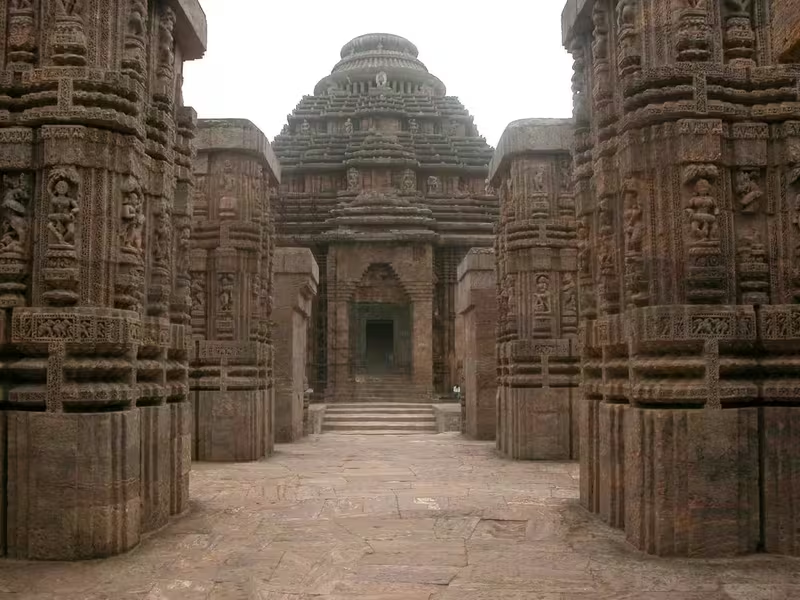
The Eastern Ganga period had already connected royal power with major religious and architectural projects. Raja Choda Ganga Deva was influenced by the philosopher Ramanujacharya and renovated the temple at Puri. Narasingha Deva I built the Sun Temple at Konark and the Varaha Lakshmi Narasimha temple at Simhachalam. The Gajapatis inherited this political and sacred landscape, but their foundation represented a new ruling house.
Kapilendra Deva established the Gajapati monarchy after the death of Bhanu Deva IV. The new dynasty drew on the military institutions of its predecessors and strengthened them. The empire was organised as a military state in which defending and expanding royal territory were central responsibilities of the government and society. The growth of Gajapati authority was therefore not simply a change of dynasty at the capital; it was also the creation of a more expansive imperial order.
Traditions associated with Gajapati Langula Narasimha Deva preserve memories of campaigns and fortified positions beyond the core of Odisha. One account places a Gajapati fort on an island in Kolleru Lake, with an opposing force encamped at Chiguru Kota. The story describes an attempt to excavate a channel through the modern Upputeru so that the lake’s water would flow towards the sea and expose the fort to attack. Such accounts combine military memory with local geography and illustrate the wider reach attributed to Gajapati power.
Golden Age
The greatest expansion took place under Kapilendra Deva. By the fifteenth century, Gajapati authority extended from the Ganges region near Hoogly to the Kaveri in the south. The empire’s reach followed the eastern coast and included territories corresponding to parts of modern West Bengal, Odisha, Andhra regions, and Tamil Nadu. By 1464, the Gajapati state was described as one of the most powerful empires in medieval India.
This expansion placed the Gajapatis in sustained rivalry with Vijayanagara. The two powers contested influence in the eastern and southern regions of the subcontinent. Gajapati strength was supported by the military resources of the central kingdom as well as those of feudal tributary states, which were expected to provide soldiers during wartime.
The empire’s cultural importance grew alongside its territorial expansion. The monarchs regarded themselves as servants of Lord Jagannath and began their days with worship and blessings. This relationship between kingship and the deity helped give the Jagannath tradition a political reach that extended beyond Puri. The Jagannath temple became a centre of religious activity as well as drama, dance, and other artistic forms.
Prataparudra continued to rule during a later phase of the dynasty. His reign was marked by the arrival and influence of Chaitanya Mahaprabhu, who came to the Gajapati realm and remained at Puri for eighteen years. The devotional movement associated with Chaitanya affected the religious atmosphere of the kingdom and the outlook of the emperor. The consequences of this influence for the state were complex: devotional culture expanded, while the older militarism associated with the Kalinga emperors diminished.
Administration and Governance
The Gajapati state was a centralised monarchy with strong military foundations. It also included tributary states, whose rulers were required to provide a fixed number of soldiers when war began. Military responsibility extended through several levels of society, and the emperor maintained a large standing force containing both professional soldiers and local military groups.
The military hierarchy included commanders with titles such as Senapati, Champati, Routray, Paikaray, Sahani, Dandapata, Dandasena, and Samantray. Paikaray referred to a cavalry commander, while Sahani was associated with the elephant force. Other titles applied to frontier guardians, commanders, fort officers, and local military leaders. The terminology indicates a differentiated system rather than an undivided royal host.
Infantry organisation was expressed through several units. A Dala consisted of twenty-seven Paikas, generally drawn from the same locality and commanded by a Dalabehera. A Bhuiyan contained seventy Paikas and was led by a Paikaray. Multiple Bhuiyan units formed a Vahini, commanded by a Vahinipati, while several Vahinis made up a Chamu, an entire regiment under a Chamupati or Champati.
Administrative control also followed military conquest. The Paridhana detachments left commanding officers and fort officers in charge of captured territories and strongholds. Officers known as Nayaks or Gadanayaks were associated with these duties. The Prahari served as guards and also performed military-police functions at home. Together, these arrangements connected the army with frontier management, local authority, and the maintenance of order.
Military Campaigns
Gajapati warfare depended on multiple specialised divisions. Sarala Das, an Odia poet who lived during Kapilendra Deva’s reign, described these formations in his Odia Mahabharata. The Hantakaru Dala moved at the front of the marching army, scouting ahead, clearing forests, and marking roads. Its responsibilities resemble those of an engineering and reconnaissance division.
The Aguani Thata formed the advance units, while the Dhenkiya served as attack groups. Archers, called Banua or Dhanuki, used composite bows and poisoned arrows. Sword-and-shield warriors formed the frontline, and Phadikara fighters carried close-combat weapons and wore leather armour. The army also included cavalry and a substantial elephant corps.
The rear division, or Pachhiani Thata, protected the flanks and the back of the army. Royal bodyguards and guards for commanders formed the Angavala. Music and performance had a military role as well: the Itakara carried instruments and used war music and dance to motivate soldiers, reporting to the officer responsible for non-combatants.
Contemporary accounts give very large estimates for Gajapati forces. Buhan-i-Mansir attributes two hundred thousand elephants to Kapilendra Deva, a figure that would be exceptional even by the standards of contemporary Indian armies. Nizamuddin describes a Gajapati camp on the Godavari with an infantry force of seven hundred thousand. The Portuguese-Jewish traveller Fernão Nunes estimated that Prataparudra’s army included 13,000 elephants and 20,000 horses during conflict with Vijayanagara. These figures should be treated as contemporary estimates rather than precise modern censuses, but they indicate the impression made by Gajapati military power.
War instruments included drums, horns, and ceremonial devices such as the Damalu, Damame, Tamaka, Bizighosa, Daundi, Ghumura, Bheri, Turi, and Ranasingha. Weapons included bows, arrows, swords, maces, spears, and other cutting or piercing arms. Accounts also describe the use of horses, elephants, and iron instruments to break through gateways and fort walls.
Cultural Contributions
Vaishnavism shaped Gajapati kingship and patronage. The rulers were devoted to Vishnu and commissioned temples dedicated to him. Their close association with Lord Jagannath made Puri the symbolic centre of the kingdom. The expansion of Jagannath worship across the empire connected regional communities to a shared religious and political tradition.
The Jagannath temple at Puri became a major setting for artistic development. Drama and dance, including forms associated with the later Odissi tradition, flourished around the temple environment. The Gajapati period also witnessed growth in literature and gave increased importance to the Odia language.
Religious patronage was not limited to Vaishnavite monuments. During Kapilendra Deva’s reign, the Shaivite Kapilesvara Temple was constructed at Bhubaneswar. The Narendra tank was also built within the premises of the Jagannath temple at Puri. It became associated with the Chandan Yatra festival of Lord Jagannath.
The dynasty’s cultural legacy therefore combines imperial Vaishnavism, the Jagannath tradition, Shaivite architecture, Odia literary development, and the performance arts. These elements were supported by royal patronage but also took shape through the activities of temples, poets, performers, and local communities.
Economy and Trade
The available accounts emphasise the Gajapati military, religious institutions, and territorial administration more than taxation, commercial policy, or urban markets. The empire’s control of a long eastern-coast corridor would have connected many regions, but the surviving details considered here do not establish the precise form of its trade networks or revenue system.
What can be seen clearly is the material and organisational base required by the army. The state supported infantry, cavalry, elephants, fortifications, transport, military music, and local contingents. Tributary rulers supplied soldiers, while conquered forts were placed under designated officers. Temple construction and maintenance likewise required sustained royal and regional patronage. These features point to an economy capable of supporting both military mobilisation and extensive religious and artistic activity, even though its exact mechanisms remain less clearly described.
Decline and Fall
The Gajapati Empire began losing its southern territories in the early sixteenth century. Vijayanagara and the Golconda Sultanate took large portions of the realm, reducing the territorial scale achieved under Kapilendra Deva. The long rivalry with Vijayanagara was therefore central not only to Gajapati expansion but also to the contraction of the empire.
The religious transformation associated with Chaitanya Mahaprabhu created another important change. Prataparudra was deeply influenced by Chaitanya’s teachings and withdrew from the military tradition of earlier Kalinga rulers. He eventually retired to the life of an ascetic, leaving the future of the empire uncertain.
The succession crisis that followed proved decisive. Govinda Vidyadhara used the uncertainty to assassinate Prataparudra’s sons and seize the throne. This act ended the established line of Gajapati rulers and brought the empire’s history to a close around 1541. The end was therefore not caused by a single military defeat alone; it resulted from territorial losses, a weakening of militarism, royal withdrawal, and violent succession politics.
Legacy
The Gajapati Empire remains central to the history of Odisha because it joined imperial expansion with a powerful religious and cultural programme. Its rulers strengthened the political importance of Cuttack, patronised temples, promoted the Jagannath tradition, and supported Odia language and literature.
Its military organisation is equally notable. The descriptions of Paikas, infantry formations, archers, cavalry, elephants, scouts, fortress officers, and war musicians reveal a society in which military service reached into local communities. The title Gajapati itself—formed from words meaning elephant and master—expressed the prestige of elephant warfare and royal command.
The dynasty’s most enduring legacy is the relationship between Odisha’s kingship and Lord Jagannath. The Gajapatis presented themselves as servants of the deity, while the temple at Puri became a centre of religious, artistic, and political life. Even after the empire’s territorial power declined, this cultural and devotional inheritance continued to shape Odisha’s identity.
Timeline
Foundation of the Gajapati Empire
Kapilendra Deva establishes the Gajapati monarchy after the death of Eastern Ganga ruler Bhanu Deva IV.
Imperial Expansion
The Gajapati state is described as one of the most powerful empires in medieval India, extending widely along the eastern coast.
Prataparudra’s Reign
Prataparudra becomes the leading Gajapati ruler during a period marked by religious change and continued rivalry with Vijayanagara.
Chaitanya at Puri
Chaitanya Mahaprabhu arrives in the Gajapati realm and remains at Puri for eighteen years.
End of the Empire
After Prataparudra’s withdrawal and the assassination of his sons, Govinda Vidyadhara usurps the throne and the Gajapati Empire ends.