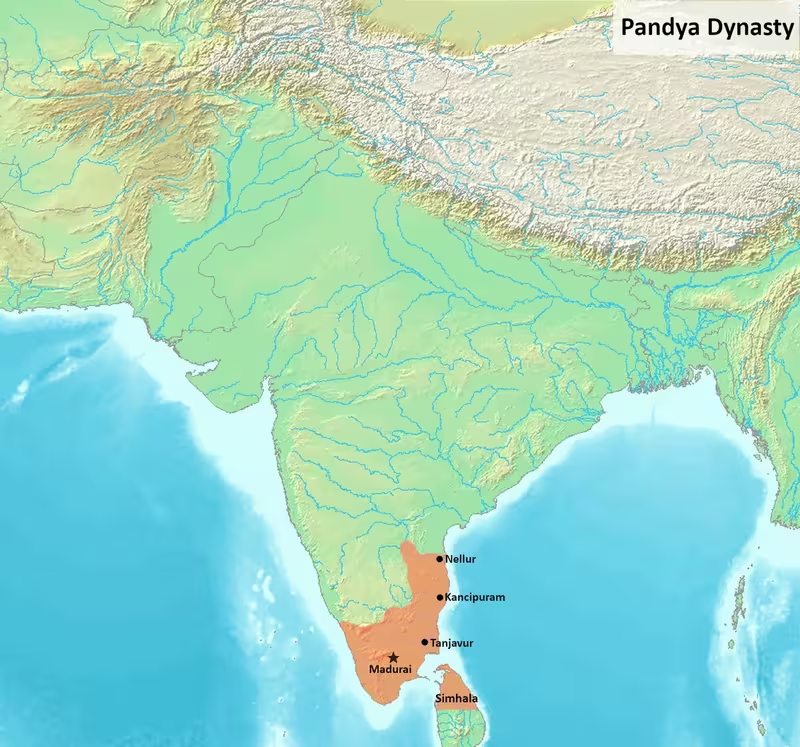
Overview
From the pearl fisheries of Korkai to the temple city of Madurai, the Pandya dynasty shaped the political and cultural history of southern India for many centuries. Its early rulers appear in Tamil poetry, Mauryan inscriptions, Greek and Roman descriptions, Tamil-Brahmi records, coins, and port archaeology. Its later kings created an empire that, during the second half of the 13th century, extended across much of southern India and exerted authority in Sri Lanka.
The chronology of the Pandyas is not a simple uninterrupted sequence of equally powerful rulers. The dynasty's territorial reach, political organisation, and visibility changed repeatedly. Early Pandya chiefs ruled from Pandya Nadu, associated especially with Madurai and Korkai. Their power declined when the Kalabhras displaced the established Tamil ruling houses. A revival began under Kadungon in the late 6th century CE, but the revived kingdom faced sustained pressure from the Pallavas, Chalukyas, Rashtrakutas, Hoysalas, Cholas, Cheras, Kakatiyas, and rulers of Sri Lanka.
The greatest expansion came under Maravarman Sundara I, Jatavarman Sundara I, and Maravarman Kulasekara I. The empire was governed through a system in which several royal relatives shared authority, although one ruler held primacy from Madurai. This arrangement allowed the Pandyas to control extensive territories, but it also made succession disputes especially dangerous. After a civil war at the beginning of the 14th century and repeated sultanate invasions, the imperial structure collapsed. Pandya rulers continued from Tenkasi and other southern centres, leaving a political legacy that survived even after Madurai passed under the authority of the Madurai Sultanate, Vijayanagara, and the Nayaks.
Rise to Power
Origins and early political identity
The origin of the Pandya name remains uncertain. One interpretation connects it with the ancient Tamil word pandu, meaning “old,” contrasting the Pandyas with proposed meanings for the Cholas as a “new country,” the Cheras as a “hill country,” and the Pallavas as a “branch.” Another theory derives the name from the Sanskrit Pandu, associating the dynasty with King Pandu and the Pandavas. These explanations remain theories rather than settled conclusions.
Tamil traditions describe the Chera, Chola, and Pandya rulers as three brothers who once ruled together at Korkai. In the story, the Chera and Chola brothers left to establish their own kingdoms, while the Pandya remained at the original southern centre. This legend resembles other origin stories in which related rulers divide a common ancestral realm. It reflects the close political relationship remembered among the three Tamil dynasties, but it does not provide a fixed historical chronology.
The Pandyas were one of the mu-ventar, the “three crowned rulers” of the Tamil region. Their traditional territory, Pandya Nadu, included the inland city of Madurai and the coastal port of Korkai. Madurai became the principal political and cultural centre, while Korkai was especially associated with maritime trade and pearl fishing.
The fish was the dynasty's emblem. The epic poem Silappatikaram identifies a fish emblem with the Pandyas, and coins attributed to the dynasty bear a single fish or a pair of fish. The emblem was not merely decorative: it linked royal authority to the dynasty's identity and to the maritime world of the southern coast.
Evidence from the Mauryan age
The Pandyas are mentioned in the edicts of the Mauryan emperor Ashoka, whose reign belongs to the 3rd century BCE. In the Second and Thirteenth Major Rock Edicts, Ashoka names the Cholas, Pandyas, Satiyaputras, and Keralaputras among the southern peoples. The wording presents these polities as lying beyond the main Mauryan domains, rather than as provinces incorporated into the Mauryan empire.
Ashoka's Thirteenth Major Rock Edict describes the reach of the “conquest by dharma” among the Cholas, Pandyas, and as far as the Tamraparni river. The Second Major Rock Edict refers to medical provision for people and animals in areas including the Chola, Pandya, and Keralaputra territories and as far as Ceylon. These references show that the Pandyas were recognised as an established southern power during the Mauryan period, even though the edicts do not describe their internal administration.
The Greek ambassador Megasthenes, writing in the 4th century BCE, also described a southern kingdom ruled by a woman whom he called Pandaia. He located the kingdom south of the rest of India and extending to the sea. His account describes 365 villages, each expected to supply the royal household for one day of the year. He associated the queen with Herakles, although later interpretations have connected the figure with other Indian divinities. The account is important for showing that a southern kingdom known by a name resembling Pandya was part of the political geography known to Mediterranean observers. At the same time, Megasthenes' description should not be treated as a complete administrative record of the Pandya state.
The earliest inscriptions and coins
The earliest Pandya ruler identified in an inscription is Nedunjeliyan, whose name occurs in the Mangulam Tamil-Brahmi inscription near Madurai. The inscription is generally assigned to the 3rd or 2nd century BCE. It records the donation of rock-cut beds to a Jain ascetic. The people named in the record include Nedunjeliyan, Kadalan, and Izhanchadikan. Whether this Nedunjeliyan was the same person as later literary rulers with similar names cannot be assumed.
The Mangulam record is valuable for several reasons. It places a Pandya ruler in the Madurai region during the early historic period, demonstrates the use of Tamil-Brahmi in royal or elite donations, and connects the political world of the Pandyas with Jain religious communities. It also shows that the surviving record is not limited to royal victories. Religious gifts and local inscriptions provide evidence for social and institutional activity around the dynasty.
Coins attributed to the early historic Pandyas include silver punch-marked coins and copper pieces bearing the fish symbol. These coins help confirm the importance of the emblem and suggest the use of currency in the Pandya region. Their precise attribution and dating are not always certain, and individual types cannot automatically be assigned to a particular ruler.
The Kalinga ruler Kharavela's Hathigumpha inscription, generally placed in the 1st century BCE, claims that he destroyed an old confederacy of Tamil countries that had lasted for 132 years. It also claims the acquisition of pearls from the Pandyas. The inscription presents the event from Kharavela's perspective and is not a neutral account, but it indicates that the southern Tamil polities were important enough to figure in the political claims of a ruler from eastern India.
Early Pandya Society and the Sangam World
The early historic Pandyas are celebrated in Tamil poetry associated with the Sangam corpus. These poems refer to roughly a dozen Pandya rulers and describe warfare, kingship, patronage, cities, trade, warfare, and social relationships. The chronology of the poems and the rulers remains difficult to establish, but they offer an unusually rich picture of the political ideals and cultural environment of early Tamilakam.
Later Tamil tradition speaks of three Sangams, or literary academies, held at Madurai under Pandya patronage. Works such as Iraiyanar Agapporul preserve this tradition. The historicity and chronology of the three academies are debated, yet the tradition clearly associates Madurai and the Pandya rulers with the preservation and patronage of Tamil learning.
Several rulers appear in early literary and inscriptional traditions. Nedunjeliyan, known as the victor of Talaiyalanganam, is praised in poems for military success. Palyagasalai Mudukudimi Peruvaludi is remembered as a patron of several sacrificial fires. Other names associated with this period include Mudattirumaran, Koon Pandya, Puda-Pandya, Nan Maran, Maran Valudi, Kadalan Valuthi, Ukkirap Peruvaludi, Bootha Pandyan, and Arivudainambi.
The poems do not function like a continuous royal chronicle. They praise patrons, commemorate victories, express grief, and describe landscapes and social life. Names may recur, titles may be conventional, and later traditions may connect rulers who cannot be securely placed in one chronological sequence. Nevertheless, the literary evidence establishes the Pandyas as active participants in the competitive political world of early Tamilakam.
Two works are particularly important for reconstructing the Pandya country. Mathuraikkanci, composed by Mankudi Maruthanar, gives a lengthy description of Madurai and the Pandya realm under Talaiyalanganam Nedunjeliyan. The king is presented as lord of Korkai and war leader of the southern Parathavar people. The poem also refers to his victories at Talaiyalanganam, Mizhalai, and Mutturu.
Netunalvatai, attributed to Nakkirar, describes the palace of Nedunjeliyan. Alongside the Akananuru and Purananuru collections, these works provide glimpses of royal courts, warfare, trade, urban life, and the cultural expectations surrounding kingship.
The early Pandya state emerged within a landscape of chiefdoms, ports, agricultural zones, and hereditary ruling houses. The Cheras, Cholas, and Pandyas frequently fought one another, yet they were also linked through commerce and shared cultural forms. Their gradual movement from chiefdoms toward more consolidated kingdoms occurred over a long period and did not follow a single uniform pattern.
Foreign Accounts and the Wider World
The Pandya kingdom occupied the southern end of the Indian peninsula, where sea routes connected the eastern and western coasts with Sri Lanka, Southeast Asia, and the Middle East. This position brought the dynasty into contact with merchants and travellers from the Mediterranean world, western Asia, Sri Lanka, and China.
The Buddhist Mahavamsa, composed in the 5th century CE, describes the arrival of Prince Vijaya and his followers in Sri Lanka. According to the account, emissaries travelled to Madhura in southern India to seek a bride for Vijaya. The Pandya king agreed to send his daughter, along with craftsmen and families from eighteen guilds. The narrative belongs to Sri Lankan historical tradition and combines dynastic memory with origin legend, but it indicates the importance of a southern Indian royal house in the story of Sri Lanka's early ruling order.
Greek and Latin writers referred to the Tamil region as Lymyrike, Damirice, or related forms. The Periplus of the Erythraean Sea, written in the 1st century CE, describes a Pandian kingdom and identifies Nelcynda as belonging to another kingdom from Muziris. Nelcynda stood on a river and was connected by river and sea routes to the Arabian Sea. The description reflects the commercial geography of the western coast and the wider Tamil region.
Pliny the Elder referred generally to the Pandya ruler of Madurai. Ptolemy, writing around the 2nd century CE, used names such as Pandya Mediterranea and Modura Regia Pandionis. Strabo reported that an Indian king called Pandion sent gifts to Augustus Caesar. Another account describes an ambassador from a king called Pandion, or possibly Porus, meeting the emperor's circle around 13 BCE. The Roman emperor Julian is also said to have received a Pandya embassy around 361 CE.
A 3rd-century Chinese text, the Weilüe, mentions a kingdom called Panyue or Hanyuewang. The scholar John E. Hill identified it with the Pandya kingdom, while other interpretations connect it to an ancient state in what is now Burma or Assam. The Chinese traveller Xuanzang later described a kingdom south of Kanchipuram known as Malakutta, which his Buddhist informants associated with Madurai.
These accounts do not always agree in detail. Their names are transcriptions into foreign languages, and the geographical information sometimes reflects the perspective of merchants or travellers rather than local political divisions. Taken together with Tamil inscriptions, coins, and archaeology, however, they demonstrate that the Pandya region was connected to long-distance networks.
The Kalabhra Interruption and Pandya Revival
The early historic Pandyas eventually faded from view when the Kalabhras rose to power in south India. The chronology and character of Kalabhra rule remain difficult to reconstruct, but the Kalabhras displaced the established Chera, Chola, and Pandya ruling houses from the central political stage.
A Pandya revival began under Kadungon in the late 6th century CE, usually dated to approximately 560–590. The Velvikudi copper-plate inscription describes Kadungon as the destroyer of the Kalabhra kings and presents his restoration as a recovery of Pandya authority. Its language is shaped by later political and religious concerns, but it preserves the memory of a dynastic revival after a period of disruption.
Kadungon's revival occurred alongside the expansion of the Pallava ruler Simhavishnu. Simhavishnu consolidated Pallava power from south of the Krishna river to the Kaveri region, while the Pandyas re-established themselves south of the Kaveri. The Cholas, meanwhile, were politically subordinate to the Pallavas and had lost their earlier prominence.
The restored Pandya kingdom became one of the three major powers in the politics of south India. The other two principal forces were the Pallavas of Kanchi and the Chalukyas of Badami, later replaced in the Deccan by the Rashtrakutas. The Pandyas fought the Pallavas, formed occasional alliances with Deccan powers, intervened in the Chera country and Venadu, and competed for control of the Kaveri basin.
Kadungon was followed by Maravarman Avanisulamani. His successor Sendan, who ruled approximately from 620 to 650, expanded into the Chera country, including western Tamil Nadu and central Kerala. Arikesari Maravarman, generally placed around 640–670, fought the Pallavas of Kanchi.
The political situation was fluid. Pallava king Narasimhavarman I claimed victories over the Pandyas, while the Chalukya ruler Paramesvaravarman I fought in the Kaveri basin against the Pallavas, Gangas, and possibly the Pandyas. Later Pandya rulers Maravarman Rajasimha I and Nedunjadaiyan Varaguna-varman I threatened the Pallava king Nandivarman II.
During the 8th century, Pandya influence expanded into Kongu and Venadu. Varagunavarman I invaded the Pallava country and conquered the Kongu region and parts of south Kerala. The Pandya ruler Srimara Srivallabha carried the conflict across the sea. He invaded Sri Lanka, defeated King Sena I, and sacked Anuradhapura. The Sri Lankan king Sena II later retaliated by invading the Pandya country, sacking Madurai, and installing Varagunavarman II as king.
The proposed association between the beginning of the Kollam Era in 825 and the liberation of Venadu from Pandya control illustrates the uncertainty of regional chronology. It is a possible interpretation rather than an established explanation.
The Pallavas recovered under Nandivarman III, who defeated the Pandyas and their Telugu-Chola allies with the assistance of the Gangas and the rising Cholas. The Pandya revival had created a powerful southern kingdom, but it also drew the dynasty into conflicts that stretched across nearly all of south India.
Chola Expansion and Pandya Resistance
The 9th century saw the return of the Cholas as a major power. While the Pandyas, Pallavas, Rashtrakutas, Gangas, and rulers of Sri Lanka competed for influence, the Chola chief Vijayalaya seized Thanjavur from the Mutharaiyar ruler around 850. The Mutharaiyars had transferred their loyalty from the Pallavas to the Pandyas, so the conquest weakened Pandya influence north of the Kaveri.
Pandya ruler Varagunavarman II marched into the Chola country but faced a formidable alliance consisting of the Pallava prince Aparajita, the Chola ruler Aditya I, and the Ganga king Prithvipati I. The Pandya army suffered a crushing defeat near Kumbakonam around 880.
By approximately 897, Aditya I had become master of the old Pallava, Ganga, and Kongu territories. It is possible that he conquered Kongu from the Pandya ruler Parantaka Viranarayana. The wording of the surviving historical reconstruction reflects uncertainty about the exact sequence of these conquests, but the broad political development is clear: Chola power was expanding from the Kaveri delta while Pandya power was being pushed southward.
Chola ruler Parantaka I invaded Pandya territory in 910 and captured Madurai from Maravarman Rajasimha II. Rajasimha received support from the Sri Lankan king Kassapa V but was defeated at Vellur. He fled to Sri Lanka and later sought refuge in the Chera country, leaving his royal insignia in Sri Lanka.
The Chola kingdom itself later suffered a major defeat at Takkolam in 949, when a Rashtrakuta-led confederacy defeated the Cholas. In the mid-10th century, the Chola state contracted sharply, and some of its southern vassals declared independence. This opened a temporary space for Pandya resistance. Vira Pandya may have defeated the Chola king Gandaraditya and asserted independence.
The Chola ruler Sundara Parantaka II responded by defeating Vira Pandya in two battles. Chola prince Aditya II killed Vira Pandya in the second encounter. The Pandyas were assisted by Sri Lankan forces under King Mahinda IV, but Chola pressure continued.
The Chola emperor Rajaraja I later attacked the Pandyas as part of a broader southern expansion. He defeated the Cheras and deprived the Pandyas of their ancient capital, Madurai. His successor Rajendra I continued to occupy the Pandya realm and appointed Chola viceroys bearing the title “Chola Pandya.” These officials governed from Madurai over the Pandya and western Chera or Kerala territories.
The beginning of the reign of Chola emperor Kulottunga I was marked by the loss of Sri Lanka and a rebellion in the Pandya country. Chola control remained strong, but the political memory and regional networks of the Pandya dynasty survived. By the 12th century, the dynasty was again positioned to exploit divisions among its neighbours.
The Imperial Pandya Golden Age
Maravarman Sundara I
The foundations of the great 13th-century Pandya expansion were laid by Maravarman Sundara I, who came to power in 1216 after his elder brother Jatavarman Kulasekhara. He invaded the Chola country, sacked Uraiyur and Thanjavur, and drove the Chola king Kulothunga III into exile.
Kulothunga III eventually submitted formally to Maravarman Sundara I and acknowledged Pandya overlordship. The conflict demonstrated the reversal of the political relationship that had dominated the preceding centuries: the Pandyas, previously subject to Chola pressure, were now able to impose their authority on the Chola country.
Chola resistance continued. Rajaraja III, who ruled from 1216 to 1246, attempted to restore Chola independence with the support of the Hoysala king Narasimha II. The Pandya and Hoysala forces met at Mahendramangalam in the Kaveri valley. Maravarman Sundara I was defeated, and Rajaraja III was restored in the Chola country.
The balance remained unstable. Chola prince Rajendra III later attacked the Pandyas and defeated two Pandya royals, including Maravarman Sundara II. Hoysala king Somesvara then assisted the Pandyas, defeated Rajendra III, and made peace with the Cholas. These alliances show that the southern kingdoms were not arranged in fixed blocs. Hoysala, Chola, and Pandya rulers shifted sides according to immediate political circumstances.
Jatavarman Sundara I
Jatavarman Sundara I ascended the Pandya throne in 1251 and transformed the kingdom into the dominant power of southern India. His campaigns reached the Chola country, the Telugu country, south Kerala, and Sri Lanka. His northern expansion extended as far as Nellore. Kanchi became a second major city of the Pandya kingdom.
Jatavarman Sundara I was supported by other members of the Pandya royal family, including Jatavarman Vira Pandya. This shared military effort reflected the wider structure of the imperial kingdom, in which several royal branches ruled under the authority of a paramount Pandya king.
The Chola ruler Rajendra II was subdued around 1258–1260 and compelled to pay tribute. Chola rule ended around 1279 under Rajendra III. The Pandyas also attacked the Hoysalas in the Kaveri region and captured the fort of Kannanur Koppam. Hoysala king Somesvara withdrew toward the Mysore Plateau and assigned the southern half of his kingdom to his younger son Ramanatha.
Somesvara was eventually killed by the Pandyas in 1262. Ramanatha recovered Kannanur and continued to resist Pandya power, but the Hoysala kingdom was increasingly restricted to the plateau. The shift was strategically important: the Pandyas had broken the power of a major rival in the Kaveri region and secured access to territories that had once been contested by Cholas and Hoysalas.
Jatavarman Sundara I also fought the Kadava ruler Kopperunjinga II and the Kakatiya king Ganapati. The Bana or Magadai country and Kongu appear to have come under Pandya authority during these wars. The exact administrative arrangements varied, but Pandya power now extended well beyond the immediate Madurai region.
Sri Lanka was a major field of Pandya intervention. Jatavarman Sundara I invaded the island in 1258, while his younger brother Jatavarman Vira Pandya led another campaign between 1262 and 1264. The island was again invaded and defeated by Jatavarman Vira Pandya in 1270. These expeditions placed Sri Lankan rulers under pressure and brought the Pandyas into possession of wealth and political leverage.
Maravarman Kulasekara I
Jatavarman Sundara I died in 1268 and was succeeded by Maravarman Kulasekara I. Around 1279, Kulasekara defeated the combined forces of Hoysala king Ramanatha and Chola ruler Rajendra III. The victory left him virtually unchallenged across the Chola country and the southern Tamil-speaking regions of the Hoysala kingdom.
Kulasekara also invaded Sri Lanka, then ruled by Bhuvanaikabahu I. According to the account preserved in the historical record, the Sri Lankan ruler carried the venerable Tooth Relic of the Buddha to the Pandya country, along with the wealth of the island. The Tooth Relic held profound political and religious importance in Sri Lankan kingship. Its removal represented more than ordinary military plunder, although the account does not provide a complete description of the negotiations or rituals surrounding it.
Sri Lanka remained under Pandya control until approximately 1308–1309. During this period, the Pandya empire reached one of its broadest territorial limits. It included Madurai, the former Chola country, southern Kerala, parts of the Hoysala sphere, areas toward the Telugu country, and territories in Sri Lanka. The kingdom's power was expressed through direct conquest, tribute, subordinate rulers, royal branches, and military expeditions.
Shared kingship and the imperial structure
The Pandya empire did not operate as a uniformly centralised state in which every region was administered directly from a single bureaucracy. Rule was shared among several royal relatives. One king enjoyed primacy, while other princes governed associated territories or exercised authority as subordinate members of the dynasty.
This arrangement helped the Pandyas mobilise several royal branches during campaigns. It also allowed the dynasty to manage a wide territory that included different linguistic regions, political traditions, and established ruling houses. Kanchi served as a secondary capital, while Madurai remained the central seat of Pandya authority.
The structure also carried serious risks. Several princes possessed legitimate claims, military followings, and regional bases. When the paramount king died, competition among the royal branches could become a civil war. The imperial system reached its greatest extent just before the succession conflict that contributed to its collapse.
Administration and Governance
The surviving evidence does not provide a single administrative manual for the Pandya state across its entire history. The dynasty lasted for many centuries, and its institutions changed between the early historic, medieval, imperial, and Tenkasi phases. Nevertheless, several features can be identified.
Kingship and royal branches
Pandya kingship was hereditary and centred on the royal house associated with Madurai. Early rulers appear as chiefs and kings in Tamil poetry, while later rulers claimed descent from the Chandravamsha, or Lunar Race. Medieval Pandya inscriptions connected the dynasty with ancestors such as Pururavas and Nahusha. The Velvikudi inscription of Nedunjadaiyan Varaguna-varman I includes Pururavas in the royal genealogy.
During the imperial period, kingship was distributed among several royals. One ruler held primacy, but collateral branches shared the work of governing the empire. The system resembles a dynastic federation more than a strictly uniform territorial administration. Its flexibility aided expansion, while its internal competition contributed to the succession crisis after 1310.
Conquered territories and subordinate rulers
The Pandyas often ruled areas that had their own political traditions. In the 13th century, the Chola country, south Kerala, the Telugu country, parts of the Hoysala kingdom, and Sri Lanka were incorporated through different forms of control. Some territories paid tribute, some were governed by royal relatives or subordinate rulers, and others were held through military occupation.
The Chola king Rajendra II, for example, was subdued and made to pay tribute by Jatavarman Sundara I. The Sri Lankan rulers were invaded repeatedly and brought under Pandya influence. The use of vassal states and collateral branches enabled the Pandyas to maintain authority over regions too extensive to be administered in the same manner as the Madurai heartland.
Inscriptions and grants
Inscriptions provide evidence for royal donations, religious patronage, and claims of restoration. The Mangulam Tamil-Brahmi inscription records a gift of rock-cut beds to a Jain ascetic. Later copper-plate grants, including the Velvikudi inscription, preserve dynastic genealogies and accounts of political renewal.
Royal inscriptions should be read as political documents as well as records of events. They present rulers as conquerors, protectors of religious institutions, restorers of order, and rightful heirs. Their claims are essential evidence, but descriptions such as the destruction of an “anti-Brahmanical” dynasty or the total defeat of a rival may reflect the purpose of the inscription.
Temples as institutions
By the medieval period, temples were among the largest landholders and employers in the Pandya country. They functioned as centres of worship, education, charity, medical care, storage, administration, and commerce. Large walled temple complexes contained offices and bazaars.
This institutional role connected religious patronage with economic and social organisation. Endowments supported ritual activity, but temple establishments also managed land, labour, markets, and services. The prominence of temple institutions must therefore be understood as part of the wider structure of the economy and administration, not only as a matter of religious devotion.
Later Nayak reorganisation
After the Pandyas lost Madurai, the region came under Vijayanagara and later Nayak authority. The Nayak governor Vishwanatha Nayakkar is described as having divided Madurai into 72 districts, or palayams, each assigned to a separate chief or Polygar. Sixteen of these districts were closest to the Pandyas. Separate battalions were assigned to the Polygars to prevent a Pandya resurgence in Madurai.
This reorganisation belongs to the post-imperial period rather than to Pandya administration itself. It demonstrates, however, how the memory and potential revival of Pandya power influenced the territorial arrangements of later rulers.
Military Campaigns
Pandya military history is marked by repeated contests over the Kaveri basin, the Kongu country, Kerala, Sri Lanka, and the eastern coastal routes.
Early conflicts
The Sangam poems describe frequent wars among the Cheras, Cholas, and Pandyas. Nedunjeliyan's victory at Talaiyalanganam is one of the most prominent early Pandya military memories. The battle reportedly involved Chera and Chola enemies. The same ruler is praised for victories at Mizhalai and Mutturu.
These accounts do not provide modern-style campaign narratives, but they show that control of fertile regions, coastal centres, and networks of subordinate chiefs was central to early Pandya warfare.
Conflicts with the Pallavas and Deccan powers
The revived Pandyas confronted the Pallavas from the 6th century onward. Arikesari Maravarman fought the Pallavas, while Maravarman Rajasimha I and Varaguna-varman I threatened Pallava territory. Pandya expansion into Kongu and Venadu brought the dynasty into conflict with neighbouring rulers and opened routes toward the western coast.
The Pandyas occasionally allied with Deccan powers such as the Gangas. The political field also included the Badami Chalukyas and later Rashtrakutas. Campaigns in the Kaveri basin often involved several states, and the outcome of one war could rapidly alter the balance among them.
Sri Lankan expeditions
Pandya rulers repeatedly intervened in Sri Lanka. Srimara Srivallabha invaded the island, defeated Sena I, and sacked Anuradhapura. Sena II later retaliated by attacking the Pandya country and sacking Madurai.
During the imperial age, Jatavarman Sundara I and Jatavarman Vira Pandya led several expeditions to Sri Lanka. Maravarman Kulasekara I later defeated the island's ruler Bhuvanaikabahu I and took the Tooth Relic and other wealth to the Pandya country. Sri Lanka remained under Pandya control for several decades, until approximately 1308–1309.
The destruction of Chola independence
The campaigns of Maravarman Sundara I and Jatavarman Sundara I reversed the relationship between the Cholas and Pandyas. Maravarman Sundara I sacked Uraiyur and Thanjavur and forced Kulothunga III into submission. Jatavarman Sundara I later subdued Rajendra II and compelled tribute. Chola rule finally ended around 1279 during the reign of Rajendra III.
Hoysala and Kakatiya campaigns
The Pandyas fought the Hoysalas for control of the Kaveri basin and the southern portions of the Hoysala realm. Jatavarman Sundara I captured Kannanur Koppam and forced Somesvara back toward the Mysore Plateau. The Hoysala king was killed by the Pandya in 1262, although his son Ramanatha continued to resist and recovered Kannanur.
Pandya expansion also brought conflict with the Kakatiya ruler Ganapati. The northern limit of Pandya influence reached as far as Nellore under Jatavarman Sundara I, showing the scale of the kingdom's 13th-century military operations.
Sultanate invasions
The collapse of imperial Pandya power began when a succession dispute coincided with invasions from the north. After Maravarman Kulasekara I died in 1310, his sons Vira Pandya IV and Sundara Pandya IV fought for control. The Hoysala ruler Ballala III also invaded Pandya territory, but he had to withdraw when Alauddin Khalji's general Malik Kafur entered his kingdom.
The Khalji forces then moved into the Pandya country in March 1311. The Pandya brothers fled their headquarters, and the invaders pursued them without success. By late April, the Khalji army abandoned the pursuit and returned to Delhi with plunder.
The invasion did not immediately end all Pandya resistance. Vira and Sundara resumed their conflict, and Sundara sought Khalji assistance. He recovered the South Arcot region by 1314. Further expeditions followed in 1314 under Khusro Khan and in 1323 under Jauna Khan, serving the Tughluq ruler Ghiyath al-Din Tughluq.
These campaigns shattered the imperial structure. The Jaffna kingdom declared independence from declining Pandya influence by 1323, and southern Kerala had already been lost by 1312. Later Tughluq rule annexed the former Pandya territories into the province of Ma'bar.
Cultural Contributions
Tamil literature
The Pandyas are closely associated with the earliest surviving Tamil literary traditions. Sangam poems praise their rulers, describe their wars, and portray the social and economic life of Pandya Nadu. Some rulers were themselves claimed to be poets, reinforcing the image of the Pandya court as a centre of literary patronage.
The traditional Sangams of Madurai occupy a powerful place in Tamil cultural memory. Whether the three academies existed exactly as later accounts describe them remains debated, but the tradition expresses the long association between Madurai, the Pandya court, and Tamil literary culture.
Works such as Mathuraikkanci and Netunalvatai are especially valuable because they move beyond isolated praise and offer extended descriptions of cities, palaces, commerce, warfare, and the countryside. The Akananuru and Purananuru collections preserve poems associated with multiple Pandya rulers and poets.
Jainism, Shaivism, and Vaishnavism
The early Pandya rulers were traditionally associated with Jainism. The Mangulam inscription records a donation to a Jain ascetic, and later literary and inscriptional accounts describe Pandya patronage of Jain monks and institutions.
At some point, the dynasty became strongly associated with Shaivism. Tradition describes a ruler known as Koon Pandya as converting to Shaivism. Historians have used such accounts to suggest that the early Pandyas were initially connected with Jainism before later supporting Shaivism and the Bhakti movement. The precise historical circumstances of this transition are not fully established.
The revival under Kadungon coincided with the prominence of the Shaivite Nayanars and Vaishnavite Alvars. By the 13th century, the religious landscape included elite forms of Hinduism, popular Bhakti devotion, and local practices. Worship of Vishnu and Shiva was supported in different contexts, while Shiva received strong elite patronage in the later period.
Buddhism was also significant in the wider southern and Sri Lankan world. The Pandya capture of the Tooth Relic during the reign of Maravarman Kulasekara I demonstrates the political importance of Buddhist relics in Sri Lankan kingship, even though the Pandya court itself is most strongly associated with Jain, Shaivite, and Vaishnavite traditions.
Temple architecture
The major Pandya contributions to Tamil temple architecture came after the Pallava and Chola periods. Pandya-era building participated in the development of the South Indian or Dravidian style.
A typical temple consists of a hall and a square sanctum, or garbhagriha. The foundation block is known as the adhisthana. Sanctum walls are divided by pilasters, while the superstructure rises in stepped, pyramidal stories of the kutina type. Decorative bands and parapets incorporate miniature shrines known as kutas and salas, connected by wall elements called harantaras. Above the superstructure is a neck supporting a dome or cupola, crowned by a pot and finial.
The later development of large gopuras became especially important. These monumental entrance buildings were elaborately decorated and often formed part of temple complexes enclosed by successive walls. The growth of such complexes reflects both religious patronage and the economic role of temples as major institutions.
Temples associated with the Pandya region include the Meenakshi Temple at Madurai, the Kallalagar Temple at Alagar Koyil, the Jambukeswarar Temple at Tiruchirapalli, and the Nataraja Temple at Chidambaram. These buildings embody multiple phases of construction and patronage; they should not all be treated as the work of a single Pandya ruler or a single period.
Legends and identity
Pandya identity was shaped by several overlapping traditions. Medieval kings claimed Lunar Race descent, while Tamil legends linked the dynasty with the origin stories of the three crowned rulers. The epic Silappatikaram associated the Pandyas with the fish emblem.
Sri Lankan folklore preserves the figure of Alli Rani, an “amazonian queen” said to have ruled parts of the island from Kudiramalai. She is sometimes interpreted as an early Pandya ruler or as an incarnation associated with Meenakshi and Kannagi. Such stories belong to the realm of legend and cultural memory rather than securely documented dynastic history.
Economy and Trade
The pearl trade
The Pandya country was especially famous for pearls. Korkai, situated near the mouth of the Tambraparni, was connected with the pearl fisheries of the Gulf of Mannar. Greek, Roman, and Egyptian travellers described the region's pearls and the activities of pearl divers.
The Periplus of the Erythraean Sea mentions pearl fisheries and reports that convicts were used as pearl divers at Korkai. Other descriptions refer to the dangers faced by divers, including sharks. Literary references describe fishermen diving for pearls, bringing up right-whorled chank shells, and blowing on the sounding shell.
Pearls from the Pandya country were sought in northern Indian kingdoms as well as in overseas markets. Their value helped make the southern coast an important economic zone and supported the political significance of Korkai.
Ports and maritime connections
Korkai and Alagankulam were important exchange centres associated with the Pandyas. Archaeological excavations at Korkai and other coastal sites have yielded Roman coins, imported pottery, and remains connected with port activity. These discoveries support literary and foreign descriptions of long-distance commerce.
The Pandya region occupied a strategic position between maritime routes linking the western Indian Ocean, the eastern coast of India, Sri Lanka, Southeast Asia, and the Middle East. Greek and Roman merchants frequented the Tamil country, and trading settlements developed around harbours.
The trade network continued after the political decline of the Western Roman Empire. Contacts between South India and the Middle East remained active even after Byzantium lost control of the Egyptian and Red Sea ports in the 7th century. The Pandya region therefore belonged to a commercial system that outlasted individual empires.
Agriculture, temples, and urban centres
The Pandya kingdom included fertile river valleys and estuarine regions, particularly around the Kaveri and Tambraparni systems. Competition for the Chola country and the Kaveri basin was partly a struggle for access to productive agricultural territories and established urban centres.
Madurai was the most important cultural centre of southern Tamil Nadu. The city's political and religious institutions connected royal authority with literary patronage, trade, and temple administration. Under the imperial Pandyas, Kanchi became a second major city, linking the kingdom to northern Tamil and Telugu regions.
Temples played a major part in the economy. As landowners, employers, banks, schools, dispensaries, and poorhouses, they brought together agricultural resources, labour, merchants, and administrators. Their bazaars and offices made temple complexes important urban institutions.
Coinage
Pandya coins were issued in silver, copper, and, in some periods, gold. Early silver punch-marked and die-struck copper coins are associated with the fish emblem. Later coins bear legends connected with rulers or royal titles, although not every coin can be attributed securely to a specific king.
Examples include coins carrying names such as Sundara, Sundara Pandya, or the letter “Su.” Other types show a boar with the legend “Vira-Pandya,” an elephant, a standing king, a Garuda, a bull, or a pair of feet. Legends and symbols include “Kodandaraman,” “Kanchi Valangum Perumal,” “Ellamthalaiyanam,” “Samarakolahalam,” “Bhuvanekaviram,” “Konerirayan,” and “Kaliyugaraman.”
The combination of fish symbols, Tamil-Brahmi or Tamil legends, and varied royal imagery reveals the changing political language of Pandya coinage. Some coins may have been issued by feudatories or in territories contested with the Cholas, making precise attribution difficult.
Decline and Fall
Succession crisis
The death of Maravarman Kulasekara I in 1310 exposed the weakness of the shared royal system. His sons Vira Pandya IV and Sundara Pandya IV fought for control of the empire. Both had dynastic legitimacy and competing political support.
The civil war coincided with the invasion led by Malik Kafur, Alauddin Khalji's general. The Pandya princes fled, and the invading army returned north with plunder. The Pandyas continued to fight one another after the withdrawal, but the imperial authority that had united the Chola country, Kerala, parts of the Hoysala realm, and Sri Lanka had been badly damaged.
Loss of territory
South Kerala was lost by 1312. Sri Lanka escaped Pandya control by approximately 1308–1309, and the Jaffna kingdom declared independence from the weakening Pandya sphere by 1323. Further sultanate expeditions in 1314 and 1323 deepened the crisis.
The Tughluqs eventually annexed the former Pandya dominions as the province of Ma'bar. Jalal ud-Din Hasan Khan, appointed governor, declared independence around 1334 and established the Madurai Sultanate. This created a new political centre in the former Pandya heartland.
The Pandyas were not immediately extinguished. Coin discoveries indicate that they retained the old South Arcot region for a time, while dynastic branches continued in the south. Yet the empire could not be restored to its earlier extent.
Tenkasi and the later Pandyas
As the Sultanates, Vijayanagara rulers, and Nayaks expanded, the Pandyas lost Madurai and moved their principal centres to Tenkasi and Tirunelveli. Tenkasi became the last Pandya capital. The rulers from Sadaavarman Parakrama Pandya and his successors were crowned at the Adheenam Mutt in the Kasi Viswanathar temple.
Other Pandya centres included Kayathar, Vadakkuvalliyur, and Ukkirankottai. Inscriptions associated with the later dynasty have been found at Tenkasi, Brahmadesam, Tirunelveli, Cheranmadevi, Ambasamudram, Kalakkad, and Pudukkottai.
Later Pandya rulers sometimes opposed the authority of Vijayanagara and the Madurai Nayaks. Sadaavarman Vikrama Pandya and his son Arikesari Parakrama Pandya are identified among rulers who controlled or contested Madurai during this period. The Nayak reorganisation of Madurai into 72 palayams was partly intended to prevent a Pandya resurgence.
Kollankonda is identified as the last known Pandyan king of the Tenkasi line. The dynasty's political authority had become regional by this stage, and its territorial power was far removed from the imperial scale reached under Jatavarman Sundara I and Maravarman Kulasekara I.
Legacy
The Pandya dynasty's legacy rests on the combination of longevity, regional adaptability, and cultural influence. Its political history extends from early Tamilakam, when Pandya chiefs ruled Madurai and Korkai, through the Sangam literary world, the Kalabhra disruption, the medieval revival, the Chola era, the 13th-century empire, and the later Tenkasi kingdom.
The dynasty's long duration should not be mistaken for uninterrupted territorial control. At different times, the Pandyas were independent rulers, regional rivals, Chola subordinates, imperial conquerors, and local kings operating under the pressure of sultanate, Vijayanagara, and Nayak power. Their continuity lies in the survival of the royal identity and political tradition, even when the territory ruled from Madurai changed dramatically.
Madurai remained the central symbol of Pandya authority. Korkai preserved the memory of pearl fisheries and maritime commerce. Tenkasi represented the dynasty's ability to continue after the loss of its traditional capital. The fish emblem endured in coinage and historical memory.
The Pandyas also contributed to the religious and institutional life of Tamil Nadu. Their patronage was associated with Jain communities in the early period and with the Shaivite and Vaishnavite Bhakti traditions in later centuries. Temple complexes developed as major centres of worship, education, landholding, charity, medicine, administration, and trade.
Their wars reshaped the political map of southern India. The defeat of the Cholas, the confinement of the Hoysalas, the interventions in Sri Lanka, and the expansion toward Nellore demonstrate the military reach of the 13th-century kingdom. At the same time, the collapse after 1310 illustrates the dangers of dynastic division when a kingdom depended on cooperation among several royal branches.
In modern popular culture, the Pandyas appear as a secondary subject in Tamil films including Aayirathil Oruvan, Ponniyin Selvan: I, Ponniyin Selvan: II, and Yaathisai. Their history also remains visible in temple architecture, inscriptions, coin collections, Tamil literary traditions, and the continuing importance of Madurai and Tenkasi in the heritage of southern India.