Overview
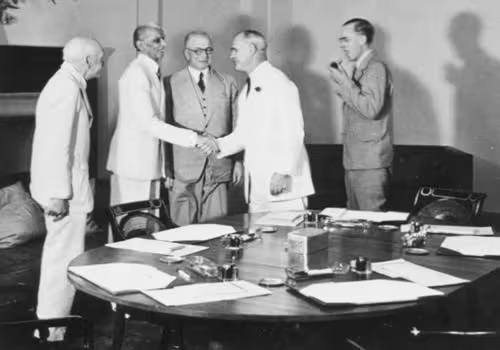
On 24 March 1946, three British Cabinet ministers arrived in New Delhi with a task that had become increasingly urgent: to negotiate the transfer of power from Britain to Indian political leaders without immediately breaking British India into separate states. The delegation was formed at the initiative of Prime Minister Clement Attlee and consisted of Lord Pethick-Lawrence, Secretary of State for India; Sir Stafford Cripps, President of the Board of Trade; and A. V. Alexander, First Lord of the Admiralty. Viceroy Lord Wavell took part in some of their discussions.
The mission's proposal attempted to reconcile two positions that appeared increasingly incompatible. The British government and the Indian National Congress wished, for different reasons, to preserve India's political unity. The Muslim League, led by Muhammad Ali Jinnah, demanded a political arrangement that would protect what it described as Muslim India's status as a nation and provide an effective safeguard against Congress domination. The Cabinet Mission Plan offered a complex federal structure intended to address both concerns.
Its failure was not caused by the absence of a constitutional idea. Rather, the plan's central provisions—especially its provincial groupings and the powers of the future centre—were interpreted differently by Congress and the Muslim League. By the end of July 1946, the League had withdrawn its approval. The subsequent crisis contributed to the formation of a fragile interim government, communal violence, and the eventual replacement of Wavell by Lord Mountbatten.
Background
As British rule approached its end, the government in London faced a contradiction. It had supported the Muslim League as a political counterweight to Congress, yet it also retained a longstanding interest in maintaining a united India. British officials doubted whether Pakistan, as demanded by Jinnah, could function politically and administratively. British pride in having unified the subcontinent also encouraged the preference for a single constitutional framework.
The political balance had shifted during the elections held before the mission's arrival. Congress and the Muslim League performed strongly and emerged as the two principal political forces in the subcontinent. Provincial organisations were weakened in part because of the system of separate electorates. The Muslim League won approximately 90 percent of the seats reserved for Muslims. This strengthened Jinnah's bargaining position with both Britain and Congress.
The results also meant that neither side could easily be ignored. The British had created and maintained separate electorates, and they now had to contend with the political consequences. Congress remained the principal organisation seeking an all-India government, while the League claimed to speak for Muslim political interests and pressed for Pakistan.
The Cabinet Mission's members favoured Indian unity for strategic reasons. Wavell's nickname for them, “the Magi,” reflected the prominence of the three visiting ministers and perhaps the extraordinary difficulty of the task before them. They arrived in a political environment in which both Congress and the League were less willing than before to compromise.
Prelude
The mission held discussions with Indian political leaders, but these conversations did not produce agreement. Congress opposed Jinnah's demand for a Pakistan made up of six complete provinces. The mission therefore developed its own constitutional proposals rather than simply endorsing either side's position.
The plan's solution was a three-tier system. At the top would be a Federal Union. At the bottom would be the individual provinces. Between them would stand groups of provinces with authority to coordinate their affairs. The Federal Union would control only foreign affairs, defence, currency, and communications. The provinces would retain all other powers, while the groups would be able to establish their own arrangements.
Three groups were proposed:
- Group A would include the mostly Hindu provinces of the south and centre: the United Provinces, Central Provinces and Berar, Bombay, Bihar, Orissa, and Madras.
- Group B would include the mainly Muslim north-western provinces: Sind, Punjab, the North-West Frontier Province, and Balochistan.
- Group C would include Bengal and Assam in the east.
The princely states would retain all subjects and powers except those they ceded to the Union. The arrangement was intended to preserve a single India while giving Muslim-majority regions collective political weight.
The design offered Jinnah much of the territorial substance he sought without creating a separate Pakistan immediately. Keeping Punjab and Bengal intact also helped provincial leaders who feared that partition would divide their provinces and reduce their authority. At the same time, the large Hindu minorities in Punjab and Bengal would remain within those provinces, while Muslim minorities in predominantly Hindu provinces would continue to live within a wider Indian framework.
The Event
The Cabinet Mission Plan was an attempt to make unity compatible with political decentralisation. The centre would be deliberately weak, while the provinces and their groups would exercise broad authority. In theory, this could satisfy Congress's preference for a single India and the League's desire for strong Muslim-majority regional blocs.
Key Phases
The first phase was the mission's arrival and negotiations in March 1946. The British ministers sought agreement from Congress and the Muslim League on a constitutional path to independence. Their proposal rejected a straightforward division into two sovereign states and instead created a federation with limited central powers.
The second phase involved the separate reactions of Congress and the League. The Muslim League Council accepted the proposals on 6 June 1946 after securing a guarantee from Wavell that the League would be included in the interim government if Congress rejected the plan.
Jinnah did not view the plan as a final settlement. In a letter to Karachi mayor Hatim Alavi on 10 June, he described acceptance as only a first step. He believed that once Groups B and C had been formed, they might later separate from the centre. His strategy was to use both the provincial and group levels of the constitution and, if possible, eventually “blow up the topmast”—the central structure.
Congress also accepted the proposals, but its interpretation was different. Congress regarded the plan as a rejection of Pakistan and maintained that the future Constituent Assembly would be sovereign. It argued that the provinces in a group should have one vote each. Under this interpretation, Muslim-majority Bengal and Hindu-majority Assam in Group C would possess equal voting weight.
The League understood the plan differently. It interpreted influence in the Group Constituent Assembly as proportional to population. This would give the larger province a greater role and would strengthen Muslim-majority Bengal within Group C. Jinnah also insisted that acceptance made the plan binding.
Turning Points
A decisive disagreement concerned whether provinces were compelled to join their assigned groups. Congress argued that provinces should retain the freedom to decide and that a sovereign Constituent Assembly could revise the arrangement. The League insisted that the grouping scheme was an essential and binding part of the agreement.
Congress leaders also opposed including the Congress-dominated North-West Frontier Province within a Muslim-majority regional arrangement. Nehru and Gandhi wanted it excluded from any Pakistan-like region inside the federation.
On 10 July 1946, Nehru stated that provinces would not be obliged to join a group and that Congress was neither bound nor committed to the plan in the manner claimed by the League. Jinnah interpreted the speech as another act of Congress treachery. On 29 July, the Muslim League rescinded its earlier approval.
Participants
The British Government and Mission
Clement Attlee's government sent Pethick-Lawrence, Cripps, and Alexander to negotiate the transfer of power. Their principal objective was to find a constitutional formula that preserved India's unity while recognising the strength of Muslim political demands. They were not merely mediators between Congress and the League; they were representatives of the government that still held sovereign power in India.
Lord Wavell, the Viceroy, participated in some discussions and became increasingly concerned by the weakening of British authority. He supported the formation of an interim government, but his decisions increasingly reflected the pressure of the deteriorating political situation.
Congress
Congress accepted the Cabinet Mission proposals as a framework for keeping India united, but it did not accept the League's interpretation of compulsory groupings or a permanently weak centre. Nehru's socialist section wanted a government with enough authority to industrialise the country and eliminate poverty. A centre restricted to foreign affairs, defence, currency, and communications did not appear capable of achieving those aims.
Gandhi also opposed the inclusion of Assam in Group C. On 15 December 1946, he told Assam Congress leaders to refuse to join the group with Bengal. He feared that the League could use a confederal arrangement and its influence over the group to encourage large-scale Muslim migration into Assam, changing the province's demographic and political character.
The Muslim League
Jinnah regarded the groupings as the plan's central advantage. He believed that Muslim India constituted a nation and deserved central representation equal to that of Hindu India. Groups B and C could give Muslim-majority regions a powerful position without requiring immediate partition.
The League's acceptance was also tied to participation in the interim government. Once Congress challenged the League's understanding of the plan, Jinnah concluded that the proposed arrangement would not provide the safeguards he sought. His withdrawal of support in July ended the possibility of implementing the plan on the basis of a shared interpretation.
Aftermath
Wavell, concerned about the decline of British power, moved towards an interim government. Despite Jinnah's opposition, he authorised a cabinet headed by Nehru as interim prime minister. On 2 September 1946, Nehru's cabinet was installed.
Jinnah did not initially join the interim government, although he sent Liaquat Ali Khan to participate. Congress did not give Liaquat the Home portfolio and instead assigned him Finance. In that position, he obstructed or limited the functioning of Congress ministries, acting on Jinnah's instructions. The conflict within the interim government appeared to demonstrate how difficult it would be to operate a single administration without agreement between Congress and the League.
The political atmosphere worsened after Jinnah called for “direct action” to demonstrate support for Pakistan. The resulting Direct Action Day was followed by rioting and massacres on religious grounds in some areas. These events increased Wavell's determination to establish an interim government but also showed how far constitutional negotiations had deteriorated.
Britain attempted to revive the Cabinet Mission's scheme in December. Nehru, Jinnah, and Wavell met Attlee, Cripps, and Pethick-Lawrence, but their positions remained inflexible. Nehru returned to India and announced that Congress had stopped looking to London for a solution.
Meanwhile, Wavell began the Constituent Assembly, which the League boycotted. He expected the League to enter it after joining the interim government, but Congress became more assertive and demanded the removal of League ministers. Wavell also failed to obtain a clear declaration from the British government setting out its aims.
Wavell then prepared a plan for a gradual British withdrawal. The Cabinet considered this plan fatalistic. When Wavell insisted on it, he was replaced by Lord Mountbatten, who was sent to seek new solutions.
Historical Significance
The Cabinet Mission Plan was the last major British attempt to preserve a united India through a negotiated constitutional arrangement. It recognised that a strong centralised state was unacceptable to Jinnah while also avoiding the immediate creation of Pakistan. Its three-tier structure was therefore an effort at political compromise rather than a simple continuation of colonial government.
The plan's weakness lay in its ambiguity. Congress accepted unity but wanted a sovereign Constituent Assembly and a centre capable of directing national development. The League accepted the plan because it expected the provincial groups to provide the basis for Muslim political autonomy and perhaps eventual separation. Both parties therefore accepted the same document while imagining different constitutional futures.
The breakdown also showed that formal agreement could not overcome the distrust between the two organisations. Nehru's statement on grouping transformed a disputed interpretation into an open political rupture. The League's withdrawal, the formation of the interim government, and the violence that followed pushed the constitutional question beyond the framework the mission had designed.
Legacy
The Cabinet Mission is remembered as a failed but revealing attempt to avoid the division of British India. Its proposal demonstrates that the path to independence was not limited to a choice between a unitary India and immediate partition. A third possibility—a weak federation of provinces and regional groups—was seriously considered in 1946.
The plan also remains important because it exposed the priorities of the principal actors. Congress sought a united state with an effective centre. The Muslim League sought regional power and safeguards that could secure Muslim political equality. The British government tried to reconcile these goals while protecting the unity it had previously administered. Their incompatible expectations made the plan impossible to sustain.
Historiography
The Cabinet Mission Plan can be interpreted either as a genuine constitutional compromise or as an arrangement whose ambiguities made failure likely. Its supporters could point to the fact that it preserved a common Union and gave Muslim-majority provinces substantial autonomy. From the League's perspective, the groups offered a route towards the political substance of Pakistan without immediately dividing Punjab and Bengal.
Congress's position rested on a different constitutional principle: a sovereign Constituent Assembly should not be permanently bound by an agreement made before it assembled. Its concern that the centre would be too weak also reflected the party's broader social and economic ambitions. Gandhi's opposition to Group C added a regional and demographic dimension to the dispute.
The plan's failure therefore cannot be explained solely by one speech or one party's decision. The disagreements over grouping, voting, provincial freedom, the authority of the Constituent Assembly, and control of the interim government were all connected. By July 1946, the possibility of preserving unity through the Cabinet Mission's framework had largely collapsed.