Overview
In December 1916, joint sessions of the Indian National Congress and the All-India Muslim League in Lucknow produced an agreement that briefly transformed the politics of British India. The two organizations had often been treated as rivals, but the Lucknow Pact brought them together around a common programme of constitutional reform and Indian self-government.
The agreement combined a united political demand with important concessions to Muslim representation. Congress accepted separate electorates for Muslims, one-third representation in the councils, and special protection for measures affecting a particular community. In this sense, the pact attempted to reconcile cooperation between political organizations with safeguards for religious minorities.
Its significance was therefore double-edged. The pact became a symbol of Hindu–Muslim unity and strengthened the demand for Home Rule. At the same time, by formally organizing representation along communal lines, it helped establish a political framework that later contributed to separation between communities.
Background
By 1916, both Congress and the Muslim League were pressing the British government for broader political participation. British authorities had indicated, under pressure from Indian public opinion, that they would consider reforms in which at least half the members of the Executive Council would be elected and the Legislative Council would contain a majority of elected members.
These possibilities encouraged cooperation. Congress and the Muslim League recognized that a common front could make demands for reform more effective. Both organizations wanted a larger elected element in government, and both supported changes that would give Indians greater control over legislation and administration.
The Muslim League's political position had also changed. At its Calcutta session in 1912, it declared that it would work with other organizations toward self-government for India, provided that Muslim interests were protected. This did not mean that the League had adopted Congress's entire ideology, but it brought the two organizations closer on the central objective of self-government.
Several British policies contributed to this shift. The refusal of Britain to support Turkey in conflicts in the Balkans and with Italy caused anger among many Muslims because of the religious and political importance of the Khalifa. The annulment of the Partition of Bengal in 1911 also produced resentment among Muslim groups that had supported the partition. The government's rejection of a proposal to establish an Aligarh university with affiliating powers across India added to dissatisfaction.
During the First World War, suppressive measures further intensified anti-imperialist feeling. Publications associated with Muslim nationalism, including Maulana Azad's Al Hilal and Mohammad Ali's Comrade, faced suppression. Leaders such as the Ali brothers, Maulana Azad, and Hasrat Mohani were interned. These developments helped younger Muslim activists, sometimes described as the “Young Party,” adopt a more assertive nationalist stance.
Prelude
The agreement was made possible by a convergence of interests. Congress wanted the League to join a wider movement for political reform, while the League sought assurances that Muslim political interests would not be overwhelmed by majority rule. Negotiations therefore involved both cooperation and careful protection of separate representation.
Bal Gangadhar Tilak represented Congress in framing the arrangement. Muhammad Ali Jinnah, who had joined the Muslim League in 1913, participated in the event and occupied a position connecting the two political organizations. At this stage, Jinnah was a member of both Congress and the League and was celebrated as an “ambassador of Hindu-Muslim Unity.”
The sessions in Lucknow gave the agreement a public political form. Rather than limiting themselves to general expressions of cooperation, the two parties set out specific demands to present jointly to the British government.
The Event
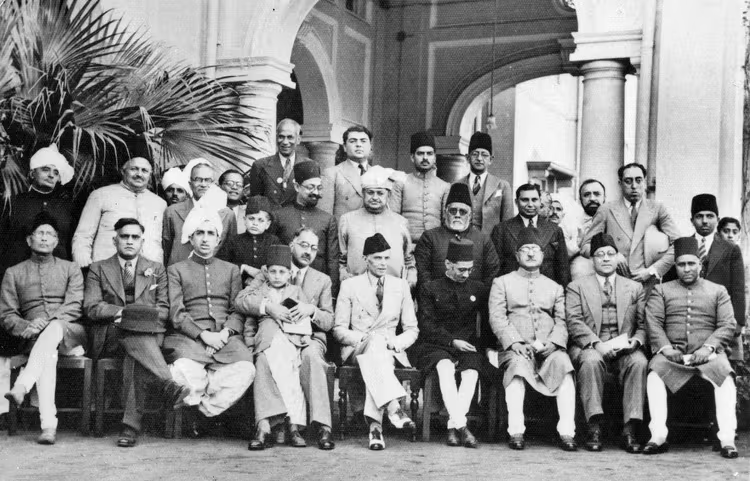
The Lucknow Pact was reached at the joint sessions of Congress and the Muslim League in December 1916. Its central achievement was to turn two competing political organizations into temporary partners in a common constitutional campaign.
The parties demanded an increase in elected seats on legislative councils. They also argued that measures passed by large majorities in the councils should be accepted as binding by the British government. Other common demands included provincial autonomy, protection for minorities, and the separation of the executive from the judiciary.
They further demanded that at least half the members of the Executive Council should be elected and that the Legislative Council should contain a majority of elected members. These proposals aimed to move government away from executive control and toward institutions with a stronger representative character.
Key Terms
The most controversial provisions concerned Muslim representation. Congress accepted separate electorates for Muslims in elections to the Imperial and Provincial Legislative Councils. Under separate electorates, Muslim voters would elect Muslim representatives. Congress had previously opposed this principle, even though it had been introduced for Muslims through the Indian Councils Act of 1909.
Congress also accepted the principle of one-third Muslim representation in the councils, despite the Muslim population being less than one-third of the total population. In addition, the agreement proposed that no act affecting a community should be passed unless three-quarters of the members of that community in the council supported it.
These terms sought to reassure Muslims that constitutional reforms would not simply create an unchecked majority. They also gave the Muslim League a formally recognized role in representing Muslim political interests.
Turning Points
The most important turning point was Congress's acceptance of arrangements it had earlier rejected. This concession made a joint Congress–League platform possible. The second was the League's willingness to join a broader movement demanding Indian autonomy, provided that Muslim interests remained protected.
The pact also coincided with an improvement in relations within Congress. The earlier rivalry between the moderate and extremist factions was reduced to some extent. Tilak's participation represented the role of the nationalist faction, while the wider Congress–League cooperation created an atmosphere in which political differences could be temporarily managed.
Participants
Indian National Congress
Congress entered the agreement as the larger organization seeking a united demand for representative institutions and self-government. Its acceptance of separate electorates and enhanced Muslim representation was a substantial political concession. The arrangement also helped reconcile, at least temporarily, the moderate and extremist traditions within Congress.
Bal Gangadhar Tilak was a key figure in framing the deal. The agreement's wider Congress context also included the political legacy of Gopal Krishna Gokhale, who had led the moderate tendency until his death in 1915, and the continuing importance of the faction associated with the Lal Bal Pal trio.
All-India Muslim League
The Muslim League brought to the pact its demand for political safeguards and recognition of Muslim interests. Its move toward cooperation reflected the changing outlook of younger Muslim nationalists and growing dissatisfaction with British policy.
Jinnah was an important participant. His membership in both Congress and the League made him a prominent intermediary at a time when cooperation between the two organizations seemed possible. His later advocacy of a separate Muslim nation should not be projected backward onto his role in 1916; at the time of the pact, he was associated with Hindu–Muslim unity.
Aftermath
The immediate result was a united presentation of constitutional demands to the British government. Congress and the League were no longer viewed only as rival organizations pursuing separate interests. The pact created a temporary period of cordial relations and strengthened the belief that Home Rule, or self-government, was a realistic political possibility.
The British government faced a stronger nationalist front and needed to respond to demands for reform. The political pressure associated with this period contributed to the later intention to introduce self-governing institutions, influencing the Montagu-Chelmsford reforms and the Government of India Act of 1919.
The spirit of cooperation also helped create conditions for later mass movements. The Non-Cooperation and Khilafat movements drew energy from combined Hindu and Muslim grievances, although the unity represented by the Lucknow Pact itself did not last permanently.
Historical Significance
The pact is often described as the high-water mark of Hindu–Muslim unity. It was the first occasion on which Congress and the Muslim League made a joint demand for political reform from the British. Scholars also cite it as an example of consociational practice: different communities and political organizations shared power through negotiated safeguards and agreed representation.
Yet the pact's unity rested on recognizing communities as distinct political units. Congress's acceptance of separate electorates and Muslim weightage acknowledged that Hindus and Muslims had different political demands and interests. Muslims conceded some representation in areas where they formed a majority but gained substantially more representation in Hindu-majority areas. At the centre, they were allocated one-third of the legislative seats.
These arrangements were initially presented as a way to manage communal disagreement. Over time, however, dissatisfaction developed around the rigid and unequal distribution of seats. The formal recognition of Muslims as a separate political group contributed to communal separation and was later connected to the emergence of the two-nation theory and the demand for a separate Muslim state.
Legacy
The Lucknow Pact remains important because it illustrates both the possibilities and limitations of negotiated unity. It showed that Congress and the Muslim League could cooperate when confronted by a common colonial authority and a shared demand for political reform. It also demonstrated that unity could require constitutional concessions that shaped future political divisions.
Its legacy is therefore not simply one of harmony or division. The pact created a notable but temporary alliance, strengthened the demand for self-government, and influenced later constitutional reforms. At the same time, its communal representation system embedded separate political identities within the constitutional framework of British India.
Historiography
Interpretations of the pact emphasize this tension. One view treats it as a landmark of inter-communal cooperation and a practical effort to protect minorities while building a united nationalist movement. Another stresses that the same safeguards institutionalized communal distinctions.
The agreement can consequently be understood as both a consociational compromise and an early reinforcement of communal politics. Its historical importance lies in this contradiction: the mechanism designed to make cooperation possible also helped define the political separation that later became more powerful.