Meitei Language: An Ancient Literary Tradition in Northeast India
A copper-plate inscription from the reign of King Khongtekcha, dated to approximately 763–773 CE, is among the best-preserved early records of Meitei. It belongs to a written tradition that reaches back much further: the religious song Ougri may have existed before the Common Era, while Numit Kappa, an epic about the division of night from day, is assigned to the first century. Meitei, also known as Manipuri, is spoken principally in Manipur, where it serves as both the official language of the state government and a lingua franca.
The language belongs to the Tibeto-Burman branch of the Sino-Tibetan family. It is the most widely spoken Tibeto-Burman language of India and the third most widely spoken language of northeast India after Assamese and Bengali. Its historical importance also comes from the unusual survival of its literary culture. Meitei is the only non-tribal Indian language in the Sino-Tibetan family, and the only Sino-Tibetan language of India whose literary tradition was well established before the colonial period. It remains a living language of administration, education, media, religion, literature, and everyday communication, while its indigenous writing system, Meitei Mayek, has undergone a major modern revival.
Origins and Classification
Linguistic Family
Meitei belongs to the Tibeto-Burman branch of the Sino-Tibetan languages. Its exact internal classification has been debated. During the nineteenth and twentieth centuries, linguists placed it in several different groupings. George Abraham Grierson classified it within Kuki-Chin; Vegelin and Voegelin placed it in Kuki-Chin-Naga; and Benedict classified it in Kuki-Naga.
Robbins Burling later suggested that Meitei belongs to none of these groups. The current academic consensus, following James Matisoff, places Manipuri in its own subdivision of the Kamarupan group. Kamarupan is described as a geographic rather than a genetic grouping. Even so, some scholars continue to regard Meitei as a member of the Kuki-Chin-Naga branch.
The language has lexical resemblances to Kuki and Tangkhul. Its position within Sino-Tibetan therefore remains a subject of linguistic discussion, although its placement in the Tibeto-Burman branch is established.
Meitei occupies a distinctive position within the languages of India. It is the only non-tribal Indian language in the Sino-Tibetan family. It is also the most widely spoken Tibeto-Burman language in India. Writing traditions in Tibeto-Burman languages are generally described as restricted, and Meitei is one of only four Tibeto-Burman languages with an old written tradition. The other three identified in this context are Tibetan, Burmese, and Newar.
Origins
The Meitei language has existed for at least 2,000 years. Linguist Suniti Kumar Chatterjee dated ancient Meitei literature to between 1,500 and 2,000 years before the present. The earliest literary and religious works associated with the language are connected with Kangleipak, the historical name used in the accounts of the early Meitei kingdom.
The surviving record does not identify a single ancestor language from which Meitei evolved. Instead, it shows a language with a long independent literary development in the region. The early record includes ritual compositions, religious epics, narrative works, poetry, legal and household instruction, royal inscriptions, and a written constitution.
The language was also associated with several political and social groups. The Ningthouja dynasty, the Khuman dynasty, the Moirangs, the Angoms, the Luwangs, the Chengleis or Sarang-Leishangthems, and the Khaba-Nganbas each had distinct speech forms and were politically independent from one another. Later, these groups came under the dominion of the Ningthouja dynasty. Their status changed from independent “ethnicities” to clans within the collective Meitei community. The Ningthouja dialect became predominant and received substantial influence from the speech forms of the other groups.
Name Etymology
The language is known by two principal names: Meitei and Manipuri. Many native speakers prefer Meitei, or its alternate spelling Meithei, over Manipuri. The name is connected with the Meitei word for the language, Meitheirón, formed from Meithei and -lon, meaning “language.” The pronunciation given for Meitheirón is /mə́i.təi.lón/.
The word Meithei may itself be a compound of mí, “man,” and they, “separate.” Western linguistic scholarship commonly uses the term Meithei, while Meitei scholars use Meit(h)ei in English and Meitheirón when writing in Meitei. Chelliah notes that the spelling Meitei has replaced the earlier spelling Meithei.
The alternative name Manipuri is a loconym derived from the name of the state of Manipur. It is the official name used by the Indian government and appears in government institutions and the work of non-Meitei authors. The name can also refer more broadly to the languages of Manipur, to the people of the state, or to anything associated with Manipur. For this reason, Meitei is often preferred when referring specifically to the language.
The Ethnologue lists additional alternative names, including Kathe, Kathi, Meetei, Meeteilon, Meiteilon, Meiteiron, Meithe, Menipuri, Mitei, Mithe, and Ponna. Speakers of Meitei have also been known by different names among neighbouring communities. Burmese people use “Kathe”; people of Cachar in Assam use “Moglie” or “Mekhlee”; Shan people and others living east of the Ningthee or Khyendwen River use “Cassay”; and “Ponna” is a Burmese term for Meiteis living in Burma.
Historical Development
Early Meitei Literature (First Millennium CE)
The earliest known Meitei compositions are closely connected with religion, ritual, and accounts of origins. Ougri, a ritual song, was used in religious and coronation ceremonies of Kangleipak. It may have existed before the Common Era.
Numit Kappa, literally “The Shooting of the Sun,” is a religious epic assigned to the first century. It explains how night was divided from day. Its subject places the language within a literary tradition that used narrative and religious composition to address the structure of the world.
The third-century Poireiton Khunthok, or “The Immigration of Poireiton,” is a narrative work about the establishment of a colony in Kangleipak. The immigrants are led by Poireiton, described as the younger brother of the god of the underworld.
A copper-plate manuscript known as the Yumbanlol was composed in the sixth or seventh century for the royal family of Kangleipak. It is described as a rare work of dharmashastra. Its subjects include sexuality, the relationships between husbands and wives, and instructions for managing a household.
The Khencho, an early Meitei work of poetry, was composed by the beginning of the seventh century. Its language is obscure and unintelligible to present-day Meiteis, but the work continues to be recited during the Lai Haraoba festival. Its survival in ritual performance demonstrates that early Meitei poetry was not preserved only as a written artifact; it also remained part of ceremonial practice.
One of the best-preserved early epigraphic records is a copper-plate inscription from the reign of King Khongtekcha, approximately 763–773 CE. In the same period, Akoijam Tombi composed Panthoibi Khonggul, an account of the romantic adventures of the deified Meitei princess Panthoibi.
These works reveal several dimensions of early Meitei literary culture. Religious songs and epics coexisted with narrative writing, household instruction, royal records, and poetry. The range of genres is especially significant because Meitei is one of the relatively small number of Tibeto-Burman languages with an old written tradition.
Royal and Constitutional Period (Eleventh Century)
The royal use of Meitei continued into the second millennium. In 1100 CE, a written constitution known as Loyumba Shinyen was finalised by King Loiyumba, who ruled approximately from 1074 to 1112 CE. The text codified a proto-constitution drafted by King Naophangba in 429 CE.
The existence of Loyumba Shinyen places Meitei within the administrative and political history of the Manipur Kingdom. Meitei was the court language of the historic kingdom before Manipur merged into the Indian Republic. Royal patronage therefore supported not only literary production but also constitutional and governmental writing.
The language associated with the Ningthouja dynasty became increasingly predominant as political integration brought previously independent groups into a collective Meitei community. The resulting linguistic history includes both the influence of other local speech forms and the wider standardisation of the Ningthouja dialect.
Hindu Influence and Script Replacement (Late Seventeenth to Eighteenth Centuries)
Before 1675 CE, Meitei experienced no significant influence from other languages. Beginning in the late seventeenth century, Hindu influence on Meitei culture increased. The language experienced changes or influences in phonology, morphology, syntax, and semantics.
This period also brought a major change in writing. The Hinduised King Pamheiba ordered that the Meitei script be replaced by the Bengali-Assamese script. The shift changed the visible form in which Meitei was recorded, although the language itself continued to be used in literature, administration, religion, and everyday life.
In 1725 CE, Pamheiba wrote Parikshit, possibly the first piece of Meitei-language Hindu literature. The work is based on the story of the eponymous King Parikshit of the Mahabharata. It represents the relationship between the changing religious environment and the continued production of literature in Meitei.
Modern Period
Meitei continued as the court language of the Manipur Kingdom and later developed as a major public language of northeast India. Imphal dialect, also known as Standard Manipuri, became the standard dialect. It is natively spoken in Imphal, the capital of Manipur, and around the Greater Imphal administrative zone.
Standard Manipuri is used in administration, education, media, and literature. It is also used widely across Manipur and outside the state. Regional variation has persisted, but expanding communication and intermarriage have made many dialect differences relatively insignificant. Speech differences remain particularly notable in Tripura, Bangladesh, and Myanmar.
The twentieth century also saw renewed attention to the indigenous script and the growth of modern literary production. The Khamba Thoibi Sheireng, a poem of 39,000 verses by Hijam Anganghal Singh, was first published in 1940. Based on the ancient romantic adventure tale of Khamba and Thoibi of Moirang, it is regarded as the national epic of the Manipuris and as the greatest of the Meitei epic poems.
Scripts and Writing Systems
Meitei Script
The Meitei script, called Meitei Mayek, is one of the official scripts of the Indian Republic. It is also known as the Kanglei script and the Kok Sam Lai script. The latter names are connected with the script’s early letters: “Kanglei script” is written as kanglei mayek, while “Kok Sam Lai script” is written as kok sam lai mayeke.
The earliest known appearance of Meitei script is on coins dating to the sixth century. The script was used until the eighteenth century, when it was replaced by the Bengali script following the order of the Hinduised King Pamheiba.
Meitei Mayek was revived on a large scale in the twentieth century. In 2021, the government of Manipur officially adopted Meetei Mayek for writing Manipuri alongside the Bengali script. The Bengali script remained co-official for a period of ten years, until 2031.
The script’s history therefore has three broad stages: its early appearance and use in the premodern period; its replacement by the Bengali-Assamese script in the eighteenth century; and its large-scale modern revival. The script remains closely connected with questions of Meitei language, identity, history, and cultural continuity.
Bengali-Assamese Script
The Bengali-Assamese script became the principal replacement script for Meitei from the eighteenth century. It was used for Meitei literature and other written materials after the indigenous script was displaced.
Bengali script remains important in contemporary Meitei. It continues as a co-official script alongside Meitei Mayek, with the arrangement scheduled to continue until 2031. The EM Corpus, created in 2021 for Meitei-English text comparison, uses Bengali script for its Meitei-language material. The corpus was built from sentences collected from The Sangai Express, a daily newspaper of Manipur.
Roman Alphabet
The Roman alphabet has been used for teaching basic Meitei as a second language through the Board of Secondary Education, Manipur. The board later directed that no more Manipuri textbooks using the Latin alphabet should be published.
Roman-script editions of the Bible in Meitei are very commonly used by Christians in Manipur. Thus, although the Roman alphabet has not displaced the principal scripts used for public and literary Meitei, it has a continuing role in certain educational and religious contexts.
Naoriya Phulo Script
The Naoriya Phulo script is a constructed script invented by Laininghan Naoriya Phulo, who lived from 1888 to 1941. It shares many similarities with Devanagari and Bengali script. The script was promoted by Apokpa Marup but was never widely adopted.
Script Evolution
Meitei’s writing history illustrates a sequence of adoption, replacement, coexistence, and revival. Early Meitei script is attested on sixth-century coins and was used through the eighteenth century. The Bengali-Assamese script then became dominant. In the twentieth century, Meitei Mayek was revived, and in 2021 the Manipur government formally adopted it alongside Bengali script.
The coexistence of writing systems is also visible in education, religion, and digital language resources. Bengali script remains present in contemporary corpus development, Roman script remains common in Meitei Bible editions, and Meitei script is used in modern digital tools, including the Meitei-language edition added to Google Translate in 2022.
Geographic Distribution
Historical Spread
Meitei developed in Kangleipak, associated with the historical kingdom and the region now known as Manipur. The language became the court language of the Manipur Kingdom and later the official language and lingua franca of the modern state of Manipur.
Political integration under the Ningthouja dynasty helped establish the Ningthouja dialect as predominant. The language’s history reflects contact among the speech forms associated with the Ningthoujas, Khumans, Moirangs, Angoms, Luwangs, Chengleis or Sarang-Leishangthems, and Khaba-Nganbas.
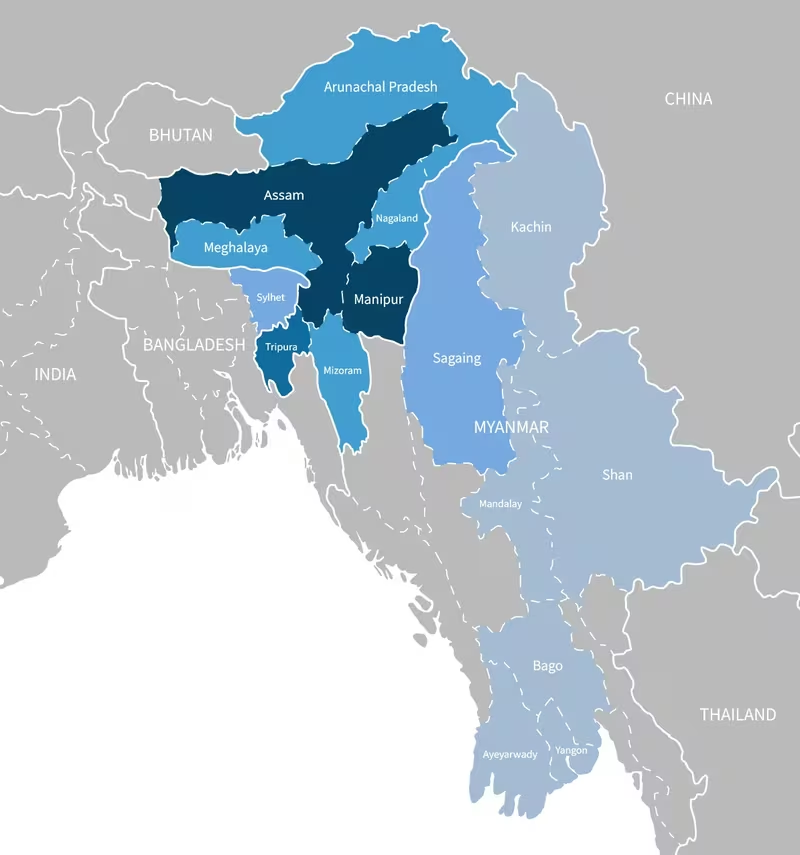
Meitei also spread beyond Manipur. It is spoken by communities in Assam, Tripura, Nagaland, and other parts of India, as well as in neighbouring Myanmar and Bangladesh. In several regions, it is used as a second language by members of other communities.
Centers of Learning
Imphal is the principal centre of Standard Manipuri. The Imphal dialect is natively spoken in the capital and surrounding Greater Imphal administrative zone and is used in administration, education, media, and literature.
Meitei is taught at universities in India, including Jawaharlal Nehru University, Delhi University, Gauhati University, and the University of North Bengal. Indira Gandhi National Open University teaches Meitei to undergraduates. The Department of Manipuri at Assam University offers education through the Ph.D. level.
Modern Distribution
The 2011 census recorded 1.76 million native Meitei speakers in India. Approximately 1.52 million lived in Manipur, where they represented the majority of the population. Smaller communities included approximately 168,000 speakers in Assam, 24,000 in Tripura, 9,500 in Nagaland, and 37,500 elsewhere in India.
In Assam, nearly 170,000 people speak Meitei, mainly in the Barak Valley. It is the third most commonly used language there after Bengali and Hindi. Meitei is also spoken in Dimapur, Kohima, Peren, and Phek in Nagaland and serves as a second language for various Naga and Kuki-Chin ethnic groups.
Bangladesh has approximately 15,000 Meitei speakers, mainly in Sylhet, Moulvibazar, Sunamganj, and Habiganj in the Sylhet Division. Meitei was also spoken in the past in Dhaka, Mymensingh, and Comilla. It is used as a second language by the Bishnupriya Manipuri people.
Myanmar has a significant Meitei-speaking population in Kachin and Shan states and in the regions of Yangon, Sagaing, and Ayeyarwady, among others.
Literary Heritage
Classical Literature
The Meitei literary tradition begins with works whose subjects include ritual, cosmology, migration, royal life, household conduct, romance, and heroic adventure.
Ougri is a ritual song used in religious and coronation ceremonies. Numit Kappa is a religious epic about the separation of night from day. Poireiton Khunthok describes the establishment of a colony by immigrants led by Poireiton.
The Yumbanlol is a sixth- or seventh-century copper-plate manuscript for the royal family of Kangleipak. As a work of dharmashastra, it addresses sexuality, marriage relationships, and household organisation. The Khencho, composed by the beginning of the seventh century, remains part of the Lai Haraoba festival despite being obscure to present-day Meiteis.
The copper-plate inscription from King Khongtekcha’s reign and Panthoibi Khonggul belong to the eighth-century record. Together, these works demonstrate that early Meitei writing was used for both formal inscription and literary narrative.
Religious Texts
Meitei serves as the lingua sacra, or holy and sacred language, of Sanamahism, the indigenous religion of Manipur. Its liturgical register, Amailon, is used in the traditional rites and rituals of Sanamahists.
Religious composition is present from the earliest known period of Meitei literature. Ougri was performed in religious and coronation ceremonies, and Numit Kappa presents a religious account of the division between night and day.
The eighteenth century introduced a further religious literary dimension. In 1725, King Pamheiba wrote Parikshit, possibly the first Meitei-language Hindu literary work, based on the story of King Parikshit in the Mahabharata.
Poetry and Drama
Meitei poetry includes both early ritual verse and modern epic composition. Khencho is an early poem that remains connected with the Lai Haraoba festival. Panthoibi Khonggul recounts the romantic adventures of the deified princess Panthoibi.
The most extensive modern example in the record is Khamba Thoibi Sheireng, a 39,000-verse poem by Hijam Anganghal Singh, first published in 1940. The poem is based on the ancient romantic adventure of Khamba and Thoibi of Moirang. It is regarded as the national epic of the Manipuris and the greatest of Meitei epic poems.
The Meitei classical language movement seeks recognition for Meitei as one of the Classical Languages of India. Meitei is already recognised by Sahitya Akademi, India’s National Academy of Letters, as one of the country’s advanced literary languages.
Scientific and Philosophical Works
The Meitei literary record includes legal, household, and constitutional writing as well as religious and poetic works. The Yumbanlol is a dharmashastra dealing with household conduct and relationships. Loyumba Shinyen is a written constitution finalised in 1100 CE and based on an earlier proto-constitution attributed to King Naophangba.
Modern scholarship has also produced formal descriptions of the language. Works listed in the linguistic literature include Manipuri Grammar, A Grammar of Meitei, studies of Meitei tone, morphology, syntax, early manuscripts, and a glossary of archaic and modern Meitei words.
Grammar and Phonology
Key Features
Meitei sentences generally use subject–object–verb word order. The example Ei chak chai, written in Meitei script as ꯑꯩ ꯆꯥꯛ ꯆꯥꯢ, means “I eat rice.” Its components are ei “I,” chak “rice,” and chai “eat.”
Nouns and pronouns are marked for number. The plural suffix -khoi is used with personal pronouns and human proper nouns, while -sing is used with other nouns. Verbs associated with pluralised nouns are not themselves changed.
When adjectives are used for greater clarity, Meitei uses separate words rather than adding a suffix to the noun. This feature is presented alongside the language’s number marking and compound-verb patterns.
Compound verbs are formed by combining root verbs with aspect markers. The root verbs end with aspectual elements, and compound verbs use one of two main patterns. Aspect markers occur as suffixes that clarify verb tense and come at the end of the compound verb. The general formula is:
[root verb] + [suffix] + [aspect marker]
Compound verbs may also use both compound suffixes. One example is pithokningle, meaning “want to give out.”
Sound System
Meitei is a tonal language. There is disagreement over whether it has two or three tones.
The exact classification of the language within Sino-Tibetan remains unclear, although Meitei has lexical resemblances to Kuki and Tangkhul. Its phonology includes a central vowel transcribed as /ɐ/. Recent linguistic work may write this vowel as <ə>, but phonetically it is not [ə]; it is more usually [ɐ]. The vowel is assimilated to a following approximant. The examples given are /ɐw/ realised as [ow] and /ɐj/ realised as [ej].
Meitei also has several documented phonological processes. Velar deletion occurs in the suffix -lək when it follows a syllable ending in the /k/ phoneme.
Another process resembles Grassmann’s law in Ancient Greek and Sanskrit, although in Meitei it affects the second aspirate. An aspirated consonant is deaspirated when it is preceded by an aspirated consonant in the previous syllable. The preceding consonant may include /h/ or /s/. The deaspirated consonants then become voiced between sonorants.
Influence and Legacy
Languages Influenced
The historical record does not identify specific languages that Meitei influenced. It does, however, describe Meitei as a lingua franca in Manipur and as a second language for various Naga and Kuki-Chin ethnic groups. In Assam, Tripura, Nagaland, Bangladesh, and Myanmar, Meitei has continued to serve communities beyond the core Meitei-speaking population.
Loanwords and Contact
Before 1675 CE, Meitei experienced no significant influence from other languages. From the late seventeenth century onward, Hindu influence on Meitei culture was accompanied by influences on phonology, morphology, syntax, and semantics. The record does not provide a list of specific loanwords or identify the individual languages responsible for these changes.
Cultural Impact
Meitei’s cultural role extends across government, education, public communication, literature, and religion. In Manipur it is both official and widely used as a lingua franca. Its liturgical register, Amailon, serves Sanamahist rites and rituals.
The language also has a strong literary identity. Sahitya Akademi recognised it as an advanced Indian literary language in 1972, two decades before it became an official language of India. Its inclusion in the Eighth Schedule in 1992 gave it constitutional recognition.
Annual events further support its cultural presence. Manipuri Language Day is observed each year on 20 August to commemorate the 1992 recognition of Manipuri as an official language of India. Manipuri Poetry Day promotes Meitei poetry and literary traditions. The Manipuri Language Festival in Bangladesh aims to protect and develop the Meitei language, script, and culture.
Royal and Religious Patronage
The Manipur Kingdom
Meitei was the court language of the historic Manipur Kingdom. Royal patronage is visible in several early works. The Yumbanlol was composed for the royal family of Kangleipak, while the copper-plate inscription of King Khongtekcha records the language in an official medium.
King Loiyumba’s reign is associated with the finalisation of Loyumba Shinyen in 1100 CE. The constitution codified an earlier political text attributed to King Naophangba. King Pamheiba later wrote Parikshit in 1725, connecting royal literary activity with the Hindu-influenced religious environment of the period.
The Ningthouja dynasty also played a central role in the development of the predominant dialect. As other politically independent groups came under Ningthouja authority, their speech forms influenced the language associated with the wider Meitei community.
Religious Institutions and Practice
Sanamahism preserves Meitei as a sacred language through Amailon, its liturgical register. Amailon is used in traditional Sanamahist rites and rituals.
The Lai Haraoba festival also preserves older linguistic material. Khencho, a poem composed by the beginning of the seventh century, remains recited as part of the festival even though its language is obscure and unintelligible to present-day Meiteis.
Religious and ceremonial use therefore connects different layers of Meitei history: early ritual songs, premodern poetry, Sanamahist liturgy, and later Hindu literature. The language’s religious functions have contributed to the continuity of older compositions and performance traditions.
Modern Status
Current Speakers
According to the 2011 census, India had approximately 1.76 million native Meitei speakers. Around 1.52 million were in Manipur, where Meitei speakers formed the majority of the population.
The language is not considered endangered by Ethnologue, which assesses it as safe and assigns it to EGIDS level 2, “provincial language.” UNESCO, however, considers Meitei vulnerable. Meitei and Gujarati jointly hold third place among India’s fastest-growing languages, after Hindi and Kashmiri.
Official Recognition
Meitei is the official language and lingua franca of Manipur. It is also an additional official language in four districts of Assam. Meitei has been an official language of India since 1992 and is included among the constitutionally scheduled official languages of the Indian Republic.
The path to constitutional recognition followed a language movement led by organisations including the Manipuri Sahitya Parishad and the All Manipur Students’ Union. In 1950, the Government of India had not included Meitei among its fourteen official languages. Demands for recognition continued for more than forty years before Meitei was added to the Eighth Schedule in 1992.
Meitei is one of the official languages used in India to administer police, armed services, and civil service recruitment examinations. The Press Information Bureau of the Ministry of Information and Broadcasting publishes in fourteen languages, including Meitei.
Education and Preservation
Meitei is a language of instruction in educational institutions throughout Manipur. It is one of forty instructional languages offered by the Central Board of Secondary Education, which is controlled and managed by the Ministry of Education. It is taught as a subject up to postgraduate level at Jawaharlal Nehru University, Delhi University, Gauhati University, and the University of North Bengal. Indira Gandhi National Open University teaches Meitei to undergraduates.
In Assam, Meitei instruction has been offered in lower-primary schools since 1956. The Board of Secondary Education, Assam offers secondary education in Manipuri, while the Assam Higher Secondary Education Council offers both Meitei-language schooling and Meitei as a second language. Assam University’s Department of Manipuri provides education through the Ph.D. level.
Since 1998, Tripura has offered Meitei as a first-language subject at primary level in twenty-four schools. In 2021, Tripura University proposed diploma courses in Meitei to the Ministry of Education and the University Grants Commission.
The language is also supported through literary and cultural organisations. The Manipuri Sahitya Parishad receives an annual grant from the Assam government, and Assam has invested in a corpus for Meitei language development. The Meitei classical language movement continues to seek recognition for Meitei as one of India’s Classical Languages.
Digital Resources
Meitei has entered contemporary language technology through corpus development, machine translation, and online tools. In 2021, Rudali Huidrom created the EM Corpus, short for “Emalon Manipuri Corpus.” It is described as the first comparable text-to-text corpus for the Meitei and English language pair.
The corpus uses Bengali script for Meitei. Its material was crawled from The Sangai Express, a daily newspaper of Manipur, between August 2020 and 2021. Version 1 contained 1,034,715 Meitei sentences and 846,796 English sentences. Version 2 contained 1,880,035 Meitei sentences and 1,450,053 English sentences.
EM-ALBERT is described as the first ALBERT model available for Meitei, while EM-FT is a FastText word embedding resource. These resources were created by Rudali Huidrom and are available through the European Language Resources Association catalogue under a CC-BY-NC-4.0 licence.
On 11 May 2022, Google Translate added Meitei under the name “Meiteilon (Manipuri)” as part of the addition of twenty-four new languages. The tool uses Meitei script for the Meitei-language interface and translation material.
Learning and Study
Academic Study
Meitei is studied in universities and through specialised linguistic research. Its grammar, tone, morphology, syntax, manuscripts, and vocabulary have all been examined in modern scholarship. The academic literature includes A Grammar of Meitei, Manipuri Grammar, studies of tone in Manipuri, investigations of morphological change and fast-speech phenomena in the Meitei verb, and research on early Meitei manuscripts.
The language’s classification remains an active area of discussion. Linguists have proposed different relationships with Kuki-Chin, Kuki-Chin-Naga, and Kuki-Naga, while the current academic consensus places Manipuri in its own subdivision of the geographically defined Kamarupan group.
Resources
Learners can encounter Meitei in several writing systems and contexts. Meitei Mayek is the indigenous script that underwent a major twentieth-century revival and was officially adopted by the Manipur government in 2021 alongside Bengali script. Bengali-script materials remain important in education, publishing, and language technology. Roman-script Bible editions are widely used by Christians in Manipur.
The language is taught in schools and universities in Manipur, Assam, Tripura, and elsewhere. It is available through undergraduate and postgraduate study, including doctoral education at Assam University. Digital resources include the EM Corpus, EM-ALBERT, EM-FT, and Google Translate’s Meitei-language provision.
Conclusion
Meitei combines a living public language with an unusually deep written history. Its record includes first-century religious literature, a third-century narrative, early poetry, royal manuscripts, an eighth-century inscription, an eleventh-century written constitution, and major modern epic poetry. It has served as the court language of the Manipur Kingdom, the lingua franca of Manipur, and the sacred language of Sanamahism through the liturgical register Amailon.
Today, Meitei remains the official language of Manipur, an additional official language in parts of Assam, and a constitutionally scheduled language of India. Its recognition in 1992, continued educational use, literary institutions, annual language events, digital corpora, and revival of Meitei Mayek all contribute to its modern vitality. Although UNESCO considers it vulnerable, its broad speaker base and institutional presence secure Meitei’s continuing place in the linguistic and cultural life of northeast India.