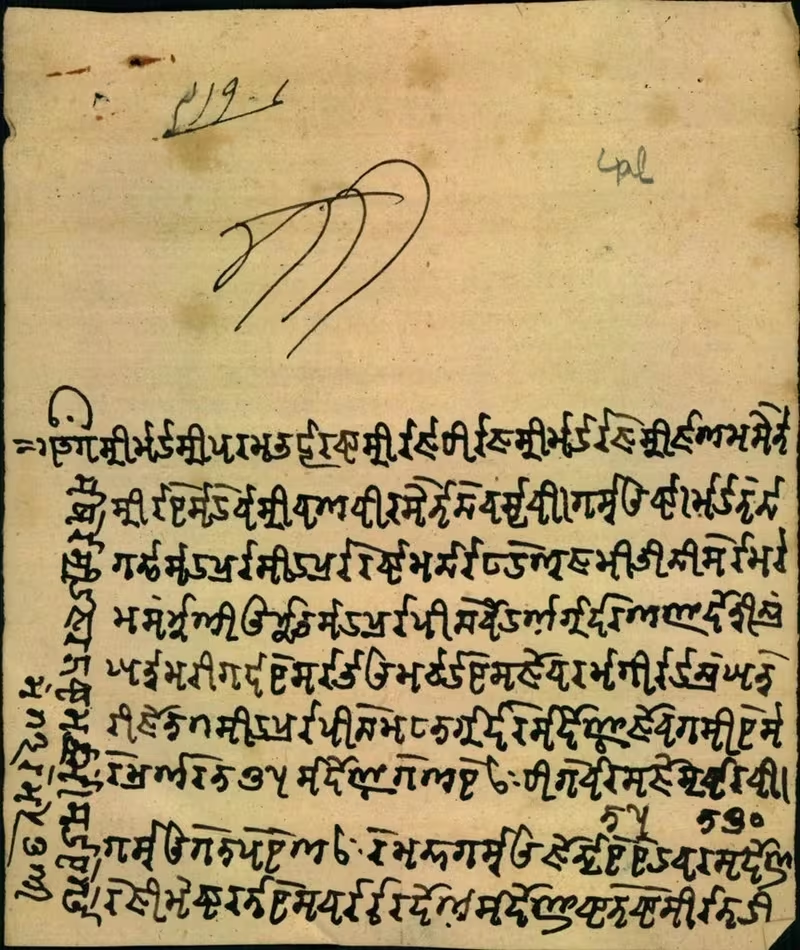
Takri Script: A Historic Writing System of the Western Himalaya
In the Hill States surrounding Chamba, Takri developed from the Devāśeṣa stage of the Sharada script between the 14th and 18th centuries. It became a family of regional Brahmic abugidas rather than a single uniform style: different kingdoms and districts of what is now Himachal Pradesh maintained their own varieties for records. Takri was also used for Western Pahari languages such as Gaddi, Kishtwari, and Chambeali, and was especially important for business records and communication in areas including Kangra and Bilaspur. A related Dogra variety, known as Dogra Takri or Dogra Akkhar, served Jammu and had official status for writing Dogri in the princely state of Jammu and Kashmir until the late 1940s. After Himachal Pradesh was established as an administrative unit in 1948, Devanagari replaced local Takri varieties. The script has nevertheless remained the focus of revival, teaching, digitisation, and Unicode work.
Origins and Classification
Linguistic Family
Takri is an abugida of the Brahmic family of scripts. It is derived from Sharada, the ancient script used for Kashmiri, and is described as the sister script of the Laṇḍā scripts.
Origins
The alphabet developed through the Devāśeṣa stage of Sharada in the Hill States, particularly around Chamba, during the 14th–18th centuries. Its history is closely connected with the regional states and districts of the Western Himalaya.
Name Etymology
The script is called Tākri or Takri. It is sometimes called Tankri. Its Jammu/Dogra form is known as Dogra Takri, Dogra, or Dogra Akkhar. The spelling of regional names varies considerably.
Historical Development
Regional Formation (14th–18th Centuries)
Takri emerged in multiple local forms as it developed from Sharada. The Hill States used their own styles to maintain records, producing considerable regional variation in letter forms and spelling practices.
Administrative and Literary Use (Until the 19th Century)
Local Takri variants became official scripts in some Punjab Hill States. They were used for both administrative and literary purposes. In Himachal Pradesh, Takri was widely used for business records and communication, including in Kangra and Bilaspur.
Replacement by Devanagari (After 1948)
Following the establishment of Himachal Pradesh as an administrative unit, local Takri varieties were replaced by Devanagari. The wider shift toward Devanagari can be traced through the early decades of Indian independence, particularly the 1950s–80s.
Modern Period
Takri later fell into disuse, but sporadic revival efforts have continued. Recent initiatives include workshops, teaching efforts, font development, manuscript cataloguing, digitisation, and the use of Takri in cinema.
Scripts and Writing Systems
Takri and Its Regional Forms
There are numerous varieties of Takri throughout Himachal Pradesh. Forms are associated with Bhattiyali, Chambeali, Dogra, Gaddi, Gahri, Jaunsari, Kangri, Kinnauri, Kishtwari, Kulvi, Mahasu, Mandeali, and Sirmauri. The Takri used in Sirmour and the adjacent Jaunsar-Bawar region has distinctive features.
The Chambeali version was selected as the standard for Unicode. A variety used for Sirmauri and Jaunsari has also been proposed for Unicode encoding.
Dogra Takri
Dogra Takri, also called Dogra Akkhar, was employed in the Jammu region. Until the late 1940s, its adapted form was the official script for Dogri in the princely state of Jammu and Kashmir.
Script Evolution
Takri developed from Sharada and then diversified through use in separate Hill States and districts. The script was added to the Unicode Standard in 2012, in version 6.1.
Geographic Distribution
Historical Spread
Takri was used across Himachal Pradesh, the Jammu region, and parts of the Western Himalaya. It was also used in the adjacent Jaunsar-Bawar region of Uttarakhand.
Regional Languages
The script historically served several Western Pahari languages, including Gaddi or Gaddki, Kishtwari, and Chambeali. Its varieties are also associated with Kangri, Kinnauri, Kulvi, Mandeali, Sirmauri, Jaunsari, and other regional speech communities.
Modern Distribution
The script is no longer the principal administrative script of Himachal Pradesh. Small-scale workshops and teaching initiatives are being conducted in Chamba, Kullu, Kangra, and Shimla.
Literary Heritage
Administrative and Literary Records
Takri was used for administrative and literary purposes in some Punjab Hill States. Kingdoms in the region maintained records in their own local varieties.
Cinema and Manuscripts
The Pahari film Saanjh, directed by Ajay K. Saklani and released in April 2017, used Takri in its title and beginning credits. The Himachal Pradesh government has catalogued 1.26 lakh manuscripts through a Manuscript Resource Centre established under the National Manuscript Mission Yojana; the collection includes manuscripts in Takri.
Influence and Legacy
Cultural Impact
Takri preserves the written history of several Himalayan regions and reflects the administrative traditions of the former Hill States. Its many regional forms also demonstrate the close relationship between writing practices and local Western Pahari languages.
Digital Preservation
An organisation named Sambh, based at Dharamshala, has decided to develop fonts for Takri. Unicode encoding and manuscript digitisation provide additional means of preserving the script.
Modern Status
Preservation Efforts
Revival efforts seek to teach Takri to Himachali Paharis. Workshops are being held on a small scale, while proposed regional cooperation includes a Pahari Corridor from Shimla to Murree under the Aman ki Asha initiative. The proposal aims to connect Western Pahari language-based regions of Himachal Pradesh, Jammu, Azad Kashmir, and the Pothohar Plateau and to revive the script.
Learning and Study
Academic Study
Takri can be studied through its regional varieties, its development from Sharada, and its use in administrative, business, literary, and manuscript traditions. The ISO639-3 codes associated with regional forms assist in identifying the languages and varieties represented.
Resources
Digital resources include Takri entries at Aksharamukha and Omniglot, comparative examples of Takri and related scripts, and online materials concerning ancient Takri and efforts to sustain it.
Conclusion
Takri is a historically important Himalayan writing system whose identity lies in both its Sharada ancestry and its regional diversity. It served the Hill States for administration, literature, business, communication, and the writing of several Western Pahari languages. Dogra Takri gave the Jammu region a related official form, while distinct varieties developed in places such as Sirmour, Chamba, and Jaunsar-Bawar. Although Devanagari replaced the local forms after 1948, Takri has not disappeared from cultural memory. Unicode support, font development, manuscript cataloguing, digitisation, workshops, and contemporary cinematic use all contribute to its preservation and revival.