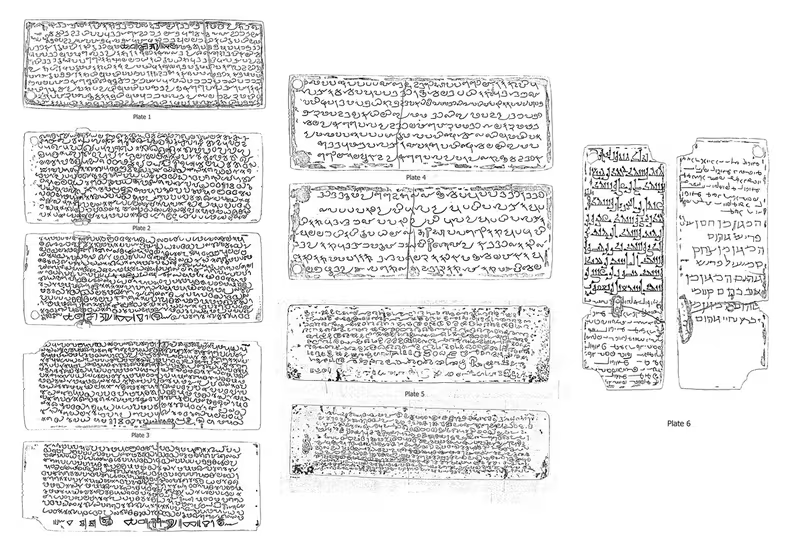
Vatteluttu: A Curving Script of Southern India
The earliest forms of Vatteluttu are traced to memorial stones and rock inscriptions from the fifth and sixth centuries CE, including the Pulankurichi rock inscriptions and hero stones from Chengam Taluk and nearby Dharmapuri District. From its beginnings in late Tamil-Brahmi, Vatteluttu developed into a major writing system of southern India. It was used for Tamil and Malayalam in Tamil Nadu and Kerala and also appears in rock inscriptions in north-eastern Sri Lanka.
Vatteluttu was an alphasyllabic, or syllabic, script belonging to the southern group of Brahmi derivatives associated with the Dravidian languages of South India. Its letters were more cursive than those of the Tamil script and often consisted of a single curvilinear stroke. Writing proceeded from left to right. The script was patronized by Pallava, Pandya, and Chera rulers and remained in use for many centuries, even as Tamil, Pallava-Grantha, and later Malayalam scripts gradually displaced it in different regions.
Origins and Classification
Linguistic Family
Vatteluttu was a writing system rather than a spoken language. It was used to write the Dravidian languages Tamil and Malayalam. As a script, it belonged to the southern group of Brahmi derivatives, generally associated with the Dravidian languages of southern India.
Origins
Vatteluttu began developing from late Tamil-Brahmi around the fourth or fifth century CE. This early stage is sometimes described as a transitional variety of Tamil-Brahmi. By the seventh and eighth centuries, it had become a completely separate script from Tamil-Brahmi and was current throughout the Tamil country.
Name Etymology
The name is commonly explained in three ways. Eḻuttu means “written form” in this context and, when affixed, refers to a writing system or script. The first proposal derives the name from Vatte + eluttu, meaning “rounded script.” Other suggestions connect it with Vata + eluttu, “northern script,” or Vette + eluttu, “chiseled script.”
The script was also known as “Tekken-Malayalam,” literally “Southern Malayalam,” and as “Nana-mona.” The latter name is associated with the way the script was taught through words beginning with forms such as namostu, spelled through sequences represented as “nana, mona, ittanna, tuva.”
Historical Development
Early Vatteluttu (5th–6th Centuries CE)
The earliest securely identified phase is represented by inscriptions on memorial stones, rocks, and hero stones. The Pulankurichi rock inscriptions are among the notable examples. Numerous hero stones from Chengam Taluk and the nearby Dharmapuri District also preserve this early form. Vatteluttu is unambiguously attested in several Tamil Nadu inscriptions from the sixth century CE.
Middle Vatteluttu (7th–8th Centuries CE)
During the seventh and eighth centuries, Vatteluttu was in use across the Tamil country. Some inscriptions connected with Pallava rulers from Simhavarman III to Nandivarman, dating from the mid-sixth to the mid-eighth century, were written exclusively in Vatteluttu. The script was also used by Pandya rulers and by the Chera rulers, especially in Kerala from the middle of the ninth century.
Its geographical range extended across the sea. Rock inscriptions in north-eastern Sri Lanka, including those near Trincomalee, preserve Vatteluttu forms dated between approximately the fifth and eighth centuries CE.
Regional Continuity in Kerala
Vatteluttu continued in Kerala longer than in Tamil Nadu. In Kerala, it incorporated characters from the Pallava-Grantha script to represent Sanskrit or Indo-Aryan loan words in early Malayalam. Most early Malayalam inscriptions of the medieval Chera rulers, dating from the middle of the ninth to the early twelfth century, were engraved in Vatteluttu.
The script continued evolving in Kerala from the twelfth century onward and is attested there in standard form as late as the fourteenth century.
Replacement and Later Forms
In the Pallava court and territory, Vatteluttu was systematically replaced from the seventh century by Pallava-Grantha, which was simplified and supplemented with symbols from Vatteluttu. Vatteluttu nevertheless continued in the Ganga country, Vanakapadi, and North Kongu country.
In northern Tamil Nadu, the Tamil script began replacing Vatteluttu from the middle of the eighth century. Vatteluttu persisted in the southern Pandya country until the end of the tenth century, when the Chola conquest and administrative integration of the region accelerated its displacement. From the eleventh century onward, Tamil became the principal script for writing Tamil.
Scripts and Writing Systems
Vatteluttu
Vatteluttu was written from left to right. It was more cursive than the Tamil script, with letters characterized by curving forms and, in some cases, a single curvilinear stroke. A notable feature was its omission of the virama vowel-muting device.
The shapes of its letters changed over time. In the last quarter of the eighth century, distinctions between letters such as p and v, and between ṅ and l, were clearly marked. Several centuries later, pairs including k and c, ṅ and l, and p and v could become difficult to distinguish. In the seventeenth and eighteenth centuries, p, v, y, and n, and sometimes l, could have similar forms.
Script Evolution
Vatteluttu was closely related to the Tamil script and was described as a sister system of the Pallava-Chola alphabet. In Kerala, the modern Malayalam script, a modified form of Pallava-Grantha, eventually replaced it. The Malayalam script had developed out of Grantha by the end of the fourteenth century.
Geographic Distribution
Historical Spread
Vatteluttu was used in Tamil Nadu, Kerala, and Sri Lanka. It appeared in inscriptions and manuscripts of South India for centuries. Its use in Sri Lanka is particularly visible in north-eastern rock inscriptions dating from approximately the fifth to eighth centuries CE.
Regional Descendants
In Kerala, Vatteluttu gradually developed into Koleluttu, which was used more commonly in northern Kerala. Another derivative, Malayayma or Malayanma, was used more commonly in southern Kerala. Neither script was ancestral to the modern Malayalam script.
Literary and Documentary Heritage
The surviving historical record described here is primarily epigraphic and manuscript-based. It includes rock inscriptions, memorial stones, hero stones, early Malayalam inscriptions, and later administrative records. Some records of Travancore continued to be written in later forms of Vatteluttu as late as the nineteenth century.
Influence and Legacy
Regional Scripts
Vatteluttu’s most visible legacy is found in the Kerala scripts that developed from it, particularly Koleluttu and Malayayma. Its long use for early Malayalam connects the history of writing in Kerala with both Vatteluttu and Pallava-Grantha.
Cultural Impact
The script preserves the changing political and linguistic landscape of southern India. Its inscriptions are associated with Pallava, Pandya, and Chera rule, while its gradual replacement reflects the expansion of Tamil, Pallava-Grantha, and the later Malayalam script in different regions.
Royal Patronage
Pallava, Pandya, and Chera Rulers
Vatteluttu received patronage from Pallava, Pandya, and Chera rulers. Pallava-associated inscriptions from the sixth through eighth centuries provide important evidence for its middle phase. In Kerala, the medieval Chera rulers used it extensively for early Malayalam inscriptions.
Administrative Change
The replacement of Vatteluttu in the Pandya country followed the Chola conquest and the region’s integration into the Chola administrative system. This political change formed part of the broader shift toward the Tamil script from the eleventh century onward.
Modern Status
Later Records
Vatteluttu is no longer used as a principal writing system. Nevertheless, later forms survived in certain Kerala communities, including Muslims and Christians, into the nineteenth century. Travancore records also preserve later forms as late as that period.
Unicode
Vatteluttu has not yet been added to the Unicode standard, although proposals have been made for its inclusion.
Learning and Study
Academic Study
Vatteluttu can be studied through its inscriptions, manuscripts, letter forms, and regional developments. Because the script changed continuously, the approximate date of a record can often be estimated by examining its graphic forms.
Resources
Important evidence includes the Pulankurichi rock inscriptions, hero stones from the Chengam and Dharmapuri region, Pallava-associated inscriptions, early Malayalam inscriptions, north-eastern Sri Lankan rock inscriptions, and later Travancore records.
Conclusion
Vatteluttu developed from late Tamil-Brahmi into a distinctive southern Indian writing system with a strongly curvilinear appearance. From the fifth century onward, it recorded Tamil and Malayalam across Tamil Nadu and Kerala and reached north-eastern Sri Lanka. Its history follows the political and cultural changes of the region: Pallava, Pandya, and Chera patronage supported its use, while the growth of Tamil, Pallava-Grantha, and Malayalam scripts gradually displaced it.
Although Vatteluttu is no longer a principal script, its legacy continued through regional forms such as Koleluttu and Malayayma. Its inscriptions and manuscripts remain important evidence for the history of writing, administration, and language in southern India.