Overview
About 12 kilometres from the twin city of Gadag-Betageri in Karnataka stands Lakkundi, a village surrounded by the remains of a much larger medieval city. Historically called Lokkugundi, it was already an established settlement by 790 CE. By the 10th century, it had developed into a major commercial and economic centre, with mint operations serving South India.
Lakkundi reached its greatest recorded prominence between the 11th and 13th centuries. Under the Kalyana Chalukyas, it became a centre of temple building, Jain and Hindu religious activity, education, public works, and inscriptional culture. Its importance continued under later dynasties, and in 1192 CE a Sanskrit inscription associated with the Hoysala king Ballala II reaffirmed the city's status and its role as a Hoysala capital.
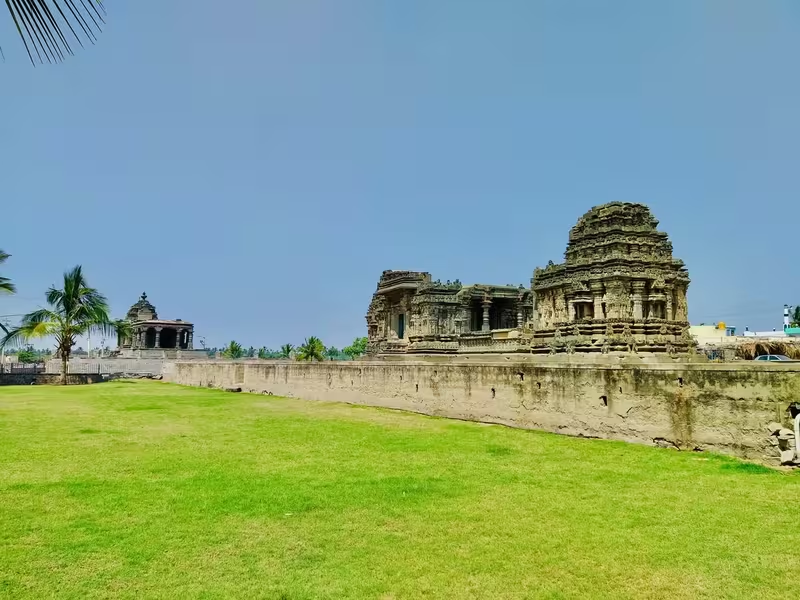
Today, more than 50 temple ruins and temples remain in and around the village. Together with its stepwells and inscriptions, they make Lakkundi a key site for understanding Kalyana Chalukya architecture, often described as the “Lakkundi school” of architects and craftsmen.
Etymology and Names
Lakkundi is the shortened modern form of Lokkugundi, a name preserved in inscriptions from the village and from other parts of southern Karnataka and Maharashtra. The older name appears frequently in medieval records, including inscriptions on stone and copper plates discovered far from Lakkundi itself.
The number of references to Lokkugundi indicates that it was not an obscure settlement. By 1884, approximately 35 Hindu and Jain inscriptions dated between the 9th and 13th centuries had been found mentioning the city. These records preserve information about temple foundations, donations, land grants, religious institutions, public stepwells, donors, and the social groups involved in supporting religious life.
Geography and Location
Lakkundi lies in Gadag District, Karnataka, between the historic regions associated with Hampi and Goa. It is connected by National Highway 67, while Gadag provides the nearest railway station. Its location places it within a landscape rich in medieval temple centres, including Dambal, Kukkanur, Gadag, Annigeri, Mulgund, Harti, Laksmesvara, Kalkeri, Savadi, Hooli, Rona, Sudi, Koppal, and Itagi.
This concentration of monuments reflects the wider political and cultural importance of medieval Karnataka. Kalachuris, Chalukyas, Yadavas-Seunas, Hoysalas, and Vijayanagara rulers all left monuments in the surrounding region.
Ancient and Early History
The earliest surviving inscription associated with Lakkundi dates to 790 CE. British archaeologists found the inscribed stone slab near Kanner Bhanvi, one of the village's stepwells. By then, Lakkundi was already sufficiently established and important to receive a formal inscription.
The record was found in an unexpected condition: local dhobis had been using the slab to wash clothes. Its survival demonstrates how inscriptions could be incorporated into later daily life even after their original context had been forgotten.
The city's growth accelerated after 973 CE. In that year, Taila II, a descendant of the Vatapi Chalukyas and a former chieftain appointed in 965 CE, successfully revolted against Karkka II of the Rashtrakuta dynasty. The dynasty that emerged is known as the Later Chalukyas, Kalyana Chalukyas, or Chalukyas of Kalyana.
Under Satyasraya Irivabedanga, Taila II's son and successor, Lakkundi flourished. Jain and Hindu inscriptions from the early 11th century record this expansion. One of the most important figures connected with this period is Attimabbe, a woman who received royal permission from Satyasraya to construct a Jain temple.
Historical Timeline
Kalyana Chalukya Period
From the 11th to the 13th centuries, Lakkundi became a prosperous city with a mint, flourishing temples, religious institutions, and public infrastructure. Its growth formed part of a wider cultural and economic expansion that also affected Rona, Sudi, Gadag, Hooli, and other towns to the north.
The period saw a close relationship between religious patronage and urban development. Temples were endowed with land and wealth, while monasteries and schools received support. Stepwells served residents, pilgrims, and temple communities. Inscriptions record donations by rulers, officials, merchants, religious figures, and other social groups.
Although Shaivism and Jainism were especially prominent, Lakkundi's religious landscape was not exclusive. Vaishnava temples were also built, and many monuments display a broad range of iconography.
Jain and Hindu Patronage
The Brahma Jinalaya is traditionally identified as Lakkundi's oldest surviving temple. It was built through the patronage of Attimabbe and is associated with records from the reign of Satyasraya Irivabedanga. Its sculptural programme includes Mahavira, Parsvanatha, and other Jain Tirthankaras, but also Hindu images such as the four-headed Brahma, Saraswati, and Lakshmi.
This combination illustrates the complexity of medieval temple culture. Religious identity was clearly expressed through Jain images and ritual associations, while artistic programmes could also incorporate figures familiar across different traditions.
Hoysala Rule
In 1192 CE, a Sanskrit inscription of the Hoysala ruler Ballala II reaffirmed Lakkundi's continuing importance. By this point, many of its most remarkable temples had already been built, yet the city remained valuable enough to serve as a Hoysala capital.
The record of Hoysala authority is part of a longer history of dynastic change. Smaller monuments in Lakkundi can also be associated with the Kalachuris and the brief rule of the Seunas. These successive political transitions did not erase the city's earlier religious and architectural identity.
Fourteenth-Century Disruption
After the 13th century, evidence for new public works, temple foundations, inscriptions, and other signs of economic prosperity ends abruptly. During the 14th century, Islamic Sultanates targeted Lakkundi and other South Indian centres as they sought wealth and political dominance over Hindu kingdoms.
The surviving record does not provide a single explanation for the city's decline, but the end of new construction and the attacks of the period mark a major transformation. Lakkundi continued as a settlement, while its earlier urban prominence gradually faded.
Political and Economic Significance
Lakkundi's importance rested on more than its temples. By the 10th century it was an economic and commercial centre with mint operations for South India. Its repeated appearance in inscriptions suggests that it was integrated into wider political and administrative networks.
Its later role as a Hoysala capital confirms that Lakkundi was also a centre of political authority. Royal inscriptions, temple endowments, and public works connected the city to rulers and institutions across medieval Karnataka.
The city's prosperity supported an active culture of patronage. Donations funded temples, Jain basadis, monasteries, schools, and stepwells. The inscriptions preserve names of donors and details of the social classes from which they came, offering glimpses of the communities that helped shape Lakkundi's public life.
Religious and Cultural Importance
Lakkundi was especially associated with Shaivism and Jainism, but its monuments include Vaishnava imagery and representations of wider Hindu traditions. This diversity is visible in temple sculpture as well as in the inscriptional record.
The city also supported Vidyadana, or charity-supported education. Monasteries such as Hiree Matha are mentioned in the records, although that institution is now lost. Jain inscriptions are particularly important for documenting the history of Jain communities and institutions in medieval Karnataka.
Lakkundi's architectural legacy is known as the Lakkundi school. It represents the work of regional architects and craftsmen associated with the Kalyana Chalukya period and is especially valued for its increasingly sophisticated temple forms, carved details, and integration of religious and civic structures.
Monuments and Architecture
Lakkundi contains about 50 temples and temple ruins dating to before the 14th century. Major monuments include the Brahma Jinalaya, Mallikarjuna, Lakshminarayana, Manikeshwara, Naganatha, Kumbheshvara, Nanneshwara, Someshwara, Narayana, Nilakanteshwara, Virabhadra, Virupaksha, and Kasivisvesvara temples.
Kasivisvesvara is regarded as the most sophisticated and ornate of the surviving monuments. The Brahma Jinalaya is the oldest major temple and an important monument of Jain patronage.
The village is also notable for its stepwells. Lakkundi is associated with 101 stepwells, some of which functioned as water tanks for temples. Their design could include small canopied niches containing lingas, combining utility with religious and artistic purpose. Chateer Bavi, Kanne Bavi, and Musukina Bavi are especially known for their architecture and carvings.
A Muslim dargah dedicated to Zindeshah Wali adds another layer to the site's religious history. The coexistence of Hindu, Jain, and Muslim monuments reflects the changing communities and political conditions that shaped Lakkundi over time.
Inscriptions and Archaeology
More than two dozen Kannada and Sanskrit inscriptions have been found at Lakkundi, while earlier reports recorded more than 30 additional inscriptions. Many are damaged, but some preserve Saka dates and details of their original purpose.
An inscription associated with Satyasraya Irivabedanga records the construction of the Brahma Jinalaya by Attimabbe and the donations connected with it. A 1173 CE inscription of the Kalachuri king Sovideva records a gold donation to a basadi by Gunanidi Keshava. Records from the reign of Somashevara IV in 1185 CE mention a donation for Ashtavidharchana, while another 12th-century inscription records land given to Tribhuvana Tilaka Shantinatha. A further inscription refers to the Jain saint Mulasangha Devanga.
Excavation has continued to add to the site's long chronology. In January 2026, an Archaeological Survey of India-supervised excavation at the Kote Veerabhadraswamy Temple revealed Neolithic-era artefacts, including a broken grey clay pot, cowrie shells, a stone axe, a cross-shaped pedestal, and a stone pedestal carved with a Jina figure. The excavation began on 16 January and involved workers digging to a depth of about five feet.
Rediscovery and Modern Heritage
British archaeologists in the 19th century played a major role in documenting Lakkundi's inscriptions and drawing attention to its importance in Indian art history. James Fergusson reported more than 30 inscriptions from the village, many dating from the 11th and 12th centuries.
Today, the Archaeological Survey of India maintains and restores several of the major temples. Other ruins remain in poorer condition, and some are inhabited by bats. Sculptural remains are displayed in a local gallery and in sheds near the temples, while Lakkundi's monuments feature in museums and studies of Indian architecture.
Restoration also involves the people who live around the monuments. Authorities have been engaging families residing on temple land about relocation so that conservation work can proceed. The families have expressed willingness to move if alternative housing and land are provided.
Modern Lakkundi
Lakkundi is now a village rather than the major medieval city described in its inscriptions. Its temples, stepwells, sculptures, and records attract visitors interested in Chalukya architecture, Jain heritage, and the history of Karnataka. Although it receives fewer visitors than nearby Hampi, it contains some of the finest surviving examples of Kalyana Chalukya architecture.
The site is especially valuable because its heritage is varied. Lakkundi was a mint centre, a commercial town, a political capital, a Jain and Hindu religious centre, and a place of public waterworks. Its surviving remains preserve these overlapping roles rather than presenting only a single monument or dynasty.