Overview
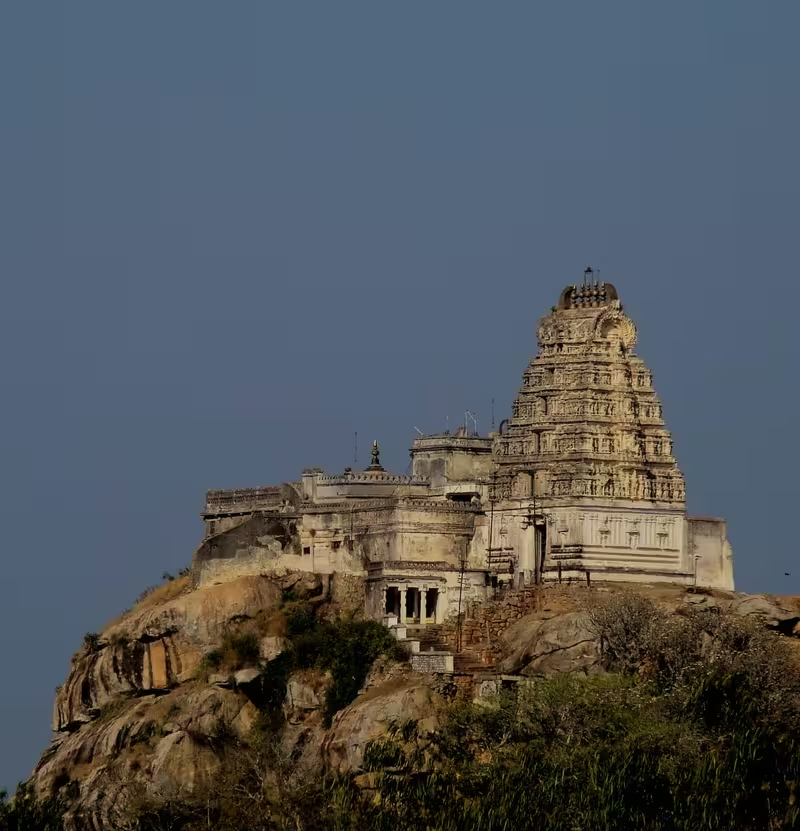
At about 1,094 metres above sea level, Melukote rises from the rocky Yadugiri hills above Karnataka’s Cauvery valley. The hilltop settlement, also called Melkote, is centred on the Cheluvanarayana Swamy Temple and the Yoga-Narasimha Swamy Temple. Its elevation, fortifications, ponds, shrines and long association with Sri Vaishnava teachers give it a distinctive place among the historic temple towns of southern India.
Melukote’s prominence grew especially through its connection with the Sri Vaishnava saint Ramanujacharya. The Tamil Nadu-born philosopher and religious teacher stayed here for approximately twelve to fourteen years in the early twelfth century. His presence made the town an important centre of Sri Vaishnavism and was followed by the settlement of Iyengar Brahmin communities, including the Mandyam Iyengars.
The history of Melukote is also preserved in royal gifts and temple ritual. The Cheluvanarayana temple holds traditions surrounding three important crowns: the Raja-mudi, associated with Raja Wodeyar I; the Krishnaraja-mudi, associated with Krishnaraja Wodeyar III; and the older Vairamudi, whose original donor is unknown. These crowns are kept under state custody and brought to the temple during the annual Vairamudi festival.
Beyond worship, Melukote has been a centre of Sanskrit education, manuscript preservation, literary activity, handloom weaving and ecological conservation. Its temples and ponds remain the most visible features of the settlement, while the Academy of Sanskrit Research and the Melkote Temple Wildlife Sanctuary reflect other dimensions of its heritage.
Etymology and Names
The modern name is commonly written as Melukote or Melkote. The place is associated with the temple of Narayanaswamy, built on a hillock surrounded by a fort. Its hill range is known as Yadugiri, Yaadavagiri or Yadushaila. Traditional accounts give the town several other names, including Narayanadri, Vedadri, Yadavadri, Yathishaila and Tirunarayanapuram.
These names reflect the town’s religious geography. Terms ending in adri or shaila refer to a hill, while Tirunarayanapuram identifies the settlement with Tirunarayana, the principal deity of the Cheluvanarayana temple. The name Cheluvanarayana itself is connected with the temple deity and with the image used in processions and festivals.
The processional image has several names in the temple tradition. It is called Selva Pillai, Sampath Kumaran, Cheluva Raya and Cheluvanarayana Swamy. Its original name is said to have been Ramapriya, meaning “Rama’s Favourite.” The many names attached to the image express the overlapping Tamil, Sanskrit and Kannada traditions that shaped Melukote’s religious culture.
Geography and Location
Melukote is a village and historic settlement in Pandavapura taluk of Mandya district, Karnataka. It lies approximately 36 kilometres north-west of Mandya, 51 kilometres from Mysore and 133 kilometres from Bangalore. The settlement occupies the rocky Yadugiri hill range, which reaches about 3,589 feet above sea level.
The hill setting has shaped both the appearance and the religious life of the town. The temples are approached through a landscape of exposed rock, elevated ground, ponds and stepped water structures. From the hills, the settlement overlooks the Cauvery valley. The location also distinguishes Melukote from lowland settlements in the surrounding district: it is described as the only settlement in Mandya district situated above 1,000 metres.
The high ground offered a natural setting for fortification and for temples that could be seen as dominant landmarks. A fort on the hill is considered likely to belong to the Hoysala and Vijayanagara periods, although the surviving account does not establish a precise date for its construction. The hilltop Yoga-Narasimha temple occupies the highest religious position, while the Cheluvanarayana temple and its Kalyani form the principal focus of the town below.
Ancient and Mythological Associations
Melukote’s earliest history is closely intertwined with sacred tradition. Traditional accounts connect the hill with names such as Narayanadri, Vedadri and Yadavadri. The Yoga-Narasimha image is believed to have been installed by Prahlada, the devotee associated with the Narasimha story. Another tradition identifies Melukote as the place where Prahlada performed penance after the death of his father, Hiranyakashipu.
According to this account, Prahlada’s elders advised him to perform penance so that pitra-dosha would not affect him. He is said to have worshipped Narasimha in the form of a Shaligram at the hill. These accounts belong to the sacred traditions of the temples and should be distinguished from securely dated historical evidence.
The Cheluvanarayana image also has a powerful mythic history. Temple tradition holds that the image, Ramapriya, was once worshipped by Rama and by successive kings of the solar dynasty. It was later given to a ruler of the lunar dynasty and worshipped by Krishna and his successors. In this telling, the deity is uniquely connected with both Rama and Krishna.
Another legend says that the metallic image was lost for centuries and recovered by Ramanujacharya. Epigraphic evidence cited in the historical record, however, indicates that the shrine’s presiding deity was already a well-known object of worship before Ramanujacharya visited it in December 1098 and before he came to the Mysore region. The legend of recovery and the evidence of an earlier established shrine therefore represent two different layers of Melukote’s history.
Historical Timeline
Ramanujacharya and the Rise of Sri Vaishnavism
The decisive medieval transformation of Melukote is associated with Ramanujacharya. In the early twelfth century, he took up residence in the town and remained there for roughly twelve to fourteen years. His stay established Melukote as a prominent centre of Sri Vaishnavism, the tradition with which the town remains most closely identified.
Ramanuja’s presence also had social consequences. Large numbers of Iyengar Brahmins migrated to the region and settled there, contributing to the formation of the Mandyam Iyengar community. The town’s religious institutions, temple customs and educational traditions continued to reflect the Sri Vaishnava world associated with Ramanuja.
The temples follow Tenkalai traditions from the time of Ramanujacharya. Later, Vadakalai markings were introduced when the head of the Parakala Matha became the royal preceptor of the Mysore maharajas. The change met with resistance and eventually became the subject of a court case. The court observed that the markings were newly introduced but also held that removing them would hurt the sentiments of the Vadakalai community. It did not order their removal and directed that, in future conflicts, a single red-line namam should be used.
Hoysala and Vijayanagara Connections
The fort on the hill is considered likely to have been built during the Hoysala and Vijayanagara periods. The temple also received patronage under Vijayanagara rule, and its renovated complex includes a beautiful gopura attributed to the Vijayanagara dynasty.
Inscriptions and other records refer to land grants and gifts made to the shrine. These records show that Melukote was not only a place of local worship but also an institution with land, wealth and recognised custodians. The temple’s later importance was strengthened by its relationship with the Mysore court.
Mysore Royal Patronage
In 1614, Raja Wodeyar I of Mysore, who had acquired Srirangapatna and adopted the Sri Vaishnava faith, granted the temple and the Brahmins of Melukote a large and valuable estate. The estate had earlier been granted to him by the Vijayanagara emperor Venkatapati Raya. In Melukote, the Brahmins served as custodians of the deity.
Raja Wodeyar I is commemorated in a bas-relief on a pillar of the temple’s nava-aranga, a pavilion associated with music and dance performances. The relief shows him standing with folded hands, with his name inscribed at the base. He is described as a devoted worshipper and regular visitor. His gold crown set with precious stones became known as the Raja-mudi.
The temple also preserves gifts associated with Krishnaraja Wodeyar III, who ruled from 1799 to 1831, and his queens. Inscriptions on gold ornaments and on gold and silver vessels identify some of these donations. Krishnaraja Wodeyar III presented another jewelled crown, which became known as the Krishnaraja-mudi. He also presented a gold crown to the Yoga-Narasimha temple on the hilltop.
A Difficult Memory of the Eighteenth Century
Melukote also carries a painful memory associated with the period of Tipu Sultan. The historical account reports that Tipu’s soldiers attacked a temple during Deepavali worship and that approximately 1,500 Mandyam Iyengars were massacred. It further states that, after the attack, people in Melukote stopped celebrating Deepavali from 1790.
This account forms part of the town’s remembered history, but the details should be treated carefully and in the context of the broader historical record. It represents a community memory of violence and loss and remains important to understanding why Deepavali observance in Melukote is described as having changed.
Political Significance
Melukote was not a capital or a large administrative city, but its temples possessed political significance through royal patronage. The relationship between rulers and the Cheluvanarayana temple involved land, wealth, ritual authority and public devotion.
The Vijayanagara association is visible in the temple’s architectural history and in the earlier estate connected with Venkatapati Raya. The Mysore Wodeyars later strengthened the temple’s status through grants and gifts. Raja Wodeyar I’s endowment linked the shrine to the expanding political power of Mysore, while the crowns and vessels donated by the Wodeyars gave the temple a visible royal identity.
The nava-aranga relief of Raja Wodeyar I is particularly important because it represents a ruler not as a conquering figure but as a devotee standing with folded hands. The image expresses the political language of patronage: the ruler’s authority was displayed through service to a major religious institution.
Religious and Cultural Importance
The Cheluvanarayana Swamy Temple is Melukote’s principal shrine. The building is a large, square and relatively plain structure dedicated to Cheluvanarayana or Tirunarayanar. Its processional image, known by several names, is the focus of annual celebrations.
The temple complex includes shrines connected with Ramanuja, images of the Alvars and a shrine associated with Yadugiriammanavaru. The town also contains the Yadugiri Yathiraja Mutt, Ahobila Matha and Parakala Matha, all linked with Sri Vaishnava religious life.
The Yoga-Narasimha Swamy Temple stands at the top of the hill. It is traditionally associated with Prahlada and his penance, and its image is believed to have been installed by him. The temple’s elevated position gives it a powerful presence within the landscape. Krishnaraja Wodeyar III presented a gold crown to this shrine as well.
Melukote’s Kalyani, or Pushkarani, is a large temple pond. Its stepped approach to the water and the mantapas built around it are among the most recognisable features of the town. The architectural setting has also attracted Indian cinema; a song from the Hindi film Damini, featuring Rishi Kapoor and Meenakshi Sheshadri, was filmed at the Melukote temple.
Vairamudi Brahmotsava
The Vairamudi Brahmotsava is Melukote’s most celebrated annual festival. It is named after the Vairamudi, a diamond-set crown whose donor and precise history are unknown. Although the Raja-mudi and Krishnaraja-mudi have clear royal associations, the older Vairamudi receives the special annual commemoration.
All three crowns are kept in the Mandya Treasury under the safe custody of the state government. They are brought to Melukote only for the appropriate festival. The Vairamudi is taken to the temple under extensive security arrangements, and tradition holds that it must not be exposed to daylight. When it is not being used, priests keep it hidden in a sacred casket.
The main procession takes place at night and may continue until dawn. The processional form of Cheluvanarayana is carried on a golden Garuda, accompanied by images of Sridevi and Bhudevi. Before the crown is fitted to the deity, it is placed before the sanctum of Sri Acharya Ramanuja. The head priest covers his eyes with a silk cloth while placing the Vairamudi, since tradition holds that even the chief priest should not look directly at it until it has been fitted onto the Lord.
The festival extends over thirteen days. Its events include Kalyanotsava and Nagavalli Mahotsava at the Kalyani, followed by Maharatotsava. Garudotsava is held a day before the Brahmotsava. In some years the religious programme is accompanied by music and dance performances.
The festival has attracted very large crowds, with past attendance described as reaching 400,000 devotees. The district administration coordinates the movement of the crown from the Mandya Treasury to the temple. The annual chariot festival, held during March and April, also draws more than 100,000 people.
Monuments and Architecture
Melukote’s architectural identity comes from the interaction of hill, fort, temple and water. The Cheluvanarayana temple is large but restrained in appearance, while its gopura reflects Vijayanagara-era renovation. The nava-aranga contains the bas-relief of Raja Wodeyar I and is associated with performances of music and dance.
The Kalyani is an equally important part of the temple complex. Its descending steps and surrounding mantapas create a formal architectural frame for the water. The pond has become an emblematic image of Melukote and a setting for ritual, gathering and visual culture.
The Yoga-Narasimha temple crowns the hill. Its position, the adjoining pond and its connection with Prahlada distinguish it from the lower Cheluvanarayana shrine. Around the town are additional ponds and shrines, including those associated with Ramanuja and the Alvars.
The fort is another important element of the historic landscape. Its exact construction date is not fixed in the surviving account, but it is considered likely to belong to the Hoysala and Vijayanagara periods. Together, the fort and temples show how Melukote developed as both a sacred settlement and a defensible hilltop community.
Learning, Manuscripts and Literature
Melukote has long been a centre of learning. The Sri Veda Vedanta Bodhini Sanskrit College was established in 1854 and is described as one of the oldest institutions of its kind in Karnataka. The town’s educational traditions include instruction in the Veda, the Nalayira Divya Prabandha, Stotras and Granthas, with some teaching continuing within traditional families.
An old library founded in 1935 holds Sanskrit, Kannada, Tamil and Telugu books and manuscripts. The private library of the Yatirajaswamigalu of Melukote contains works on Vishishtadvaita philosophy, as well as texts relating to logic, rhetoric, mathematics, astronomy, astrology, ritual, architecture, Pancharatra, Dharmashastra and Grihya and Dharma Sutras.
The Academy of Sanskrit Research was established by the Government of Karnataka in the late 1970s. The academy occupies a fourteen-acre campus at the southern end of Melukote and combines gurukul-style Sanskrit education with modern methods. It includes libraries, halls, schools and temples dedicated to the study of Sanskrit language and texts. Its holdings are described as including approximately 11,000 manuscripts and 35,000 books.
The academy has published commentaries on Vedic texts in Sanskrit, Kannada and English, including works connected with Sayana’s commentaries on the Vedas and the Purusha Sukta. Its areas of research include Vishishtadvaita, the Upanishads and scientific knowledge found in ancient texts.
Melukote has also produced or been associated with literary figures such as Tirumalarya, Chikkupadhyaya, Alasingachar, Komanduri Deshika Charyulu and P. T. Narasimhachar. These literary and educational traditions complement the town’s role as a centre of worship.
Economic and Craft Traditions
Melukote is known for quality handlooms, especially dhotis and sarees. The town also has an artisans’ training centre, a dairy unit and residential schooling. These activities show that Melukote’s identity is not limited to pilgrimage. Religious institutions, education, craft production and rural services continue to operate within the same historic settlement.
The festivals bring large numbers of visitors and create a strong seasonal rhythm for the town. At the same time, the temple’s historical endowments, manuscript institutions and traditional schools represent longer-term forms of cultural economy and community organisation.
Melkote Temple Wildlife Sanctuary
The Melkote Temple Wildlife Sanctuary was created on 17 June 1974. Its primary purpose was to provide protection for wolves. The sanctuary also supports animals including jungle cats, leopards, bonnet macaques, langurs and pangolins. The surrounding forest has been described as a particularly rich area for birdlife, with around 200 indigenous species.
The sanctuary was also known for its once-abundant Cycas circinalis. The plant has faced over-exploitation by flower decorators and local doctors. Accounts of the sanctuary also refer to blackbuck among the species found in the surrounding forest.
This protected landscape adds an ecological dimension to Melukote’s heritage. The town’s history is therefore not only a story of temples and manuscripts but also one of hill forests and wildlife conservation.
Famous Personalities and Traditions
Ramanujacharya is the central historical personality associated with Melukote. His residence transformed the town into a major Sri Vaishnava centre and shaped its religious institutions and community history.
Raja Wodeyar I is remembered through his endowment, devotion and the Raja-mudi crown. Krishnaraja Wodeyar III and his queens are associated with further gifts of crowns, ornaments and vessels, as well as the gold crown presented to the Yoga-Narasimha temple.
Prahlada belongs to the mythological and devotional history of the hill rather than to securely dated political history. His association with the Yoga-Narasimha shrine remains central to the temple’s sacred narrative.
The town’s literary figures, Sanskrit scholars and teachers have also contributed to Melukote’s identity. Their work connects the temple settlement with wider traditions of philosophy, language, commentary and education.
Decline and Revival
Melukote’s history includes periods of violence, changes in political authority and disputes over ritual symbols. The reported massacre of Mandyam Iyengars and the subsequent suspension of Deepavali celebrations form one of the darkest memories associated with the town.
Yet Melukote also experienced repeated renewal through temple patronage, educational institutions and the preservation of ritual traditions. Vijayanagara and Mysore support strengthened the temple complex. The Sanskrit College founded in 1854, the library established in 1935 and the Academy of Sanskrit Research founded in the late 1970s extended the town’s role beyond pilgrimage.
The creation of the wildlife sanctuary in 1974 added another form of institutional protection. In the present, Melukote continues to combine religious observance, scholarship, handloom production, festivals and conservation.
Modern Melukote
Today, Melukote remains a historic temple town in Mandya district. Its chief attractions are the Cheluvanarayana Swamy Temple, the hilltop Yoga-Narasimha temple, the Kalyani, the fort landscape, the shrines associated with Ramanuja and the annual Vairamudi Brahmotsava.
The town is approximately 51 kilometres from Mysore and 133 kilometres from Bangalore. Nearby Thondanoor, about 20 kilometres away, is another temple town associated with Nambi Narayana, Parthasarathi, Yoga-Narasimha and Ramanuja temples.
For visitors, Melukote offers an unusually layered heritage experience. Its temples preserve living ritual traditions; its crowns and inscriptions recall royal patronage; its ponds and fort express the physical history of the hill; its libraries and academy preserve texts; and its sanctuary protects a forested environment around the sacred settlement.