Overview
At the meeting point of the Betwa and Bes rivers, Vidisha developed into a major centre of trade, religion and political power long before it acquired its present name. The modern city stands in eastern Malwa, about 62.5 kilometres northeast of Bhopal, while the ancient settlement of Besnagar lay roughly three kilometres away on the western side of the river. This closely connected archaeological landscape preserves remains from ancient, Gupta, medieval and modern periods.
Vidisha is especially known for the Heliodorus Pillar, an inscription-bearing stone column associated with Vāsudeva worship and erected by a Greek ambassador in the second century BCE. Nearby Udayagiri preserves Gupta-period rock-cut sculptures, while the city and surrounding district contain Hindu and Jain temples, Buddhist remains, medieval Islamic monuments and a museum rich in sculptures, terracottas and coins.
The history of the place is also a history of changing names. The settlement appears in ancient traditions as Vidishā, Besnagar and Bhaddalpur; in the medieval period it became Bhelsa or Bhilsa; and in 1956 it was officially renamed Vidisha. Today it is the administrative headquarters of Vidisha district, a Jain pilgrimage centre and an agricultural and educational hub.
Etymology and Names
The name Vidisha is connected with the nearby Bais or Bes river, which is mentioned in the Puranas. The place also has a literary and epic presence. Vidisha is referred to in the Ramayana tradition in connection with the rule of Shatrughna, the youngest brother of Rama, and later Shatrughna's younger son Shatrughati. These associations belong to the traditional literary memory of the region rather than to securely dated political records.
In ancient times, the settlement west of the modern city was known as Besnagar. The name is associated with the town that became a commercial centre between the Betwa and Bes rivers. Pali scriptures mention Besnagar, indicating that the settlement had entered the geographical and religious awareness of early Buddhist communities.
During the medieval period, the principal settlement was known as Bhelsa or Bhilsa. The name is linked in the historical account of the town to Bhillasvamin, the Sun god whose temple made the place famous. An inscription of 878 CE, issued by a merchant named Hatiaka of the Paravada community, is among the earliest records cited for the name.
By the twentieth century, the older name Bhelsa had given way to Vidisha. The town was renamed Vidisha in 1956, reviving the ancient geographical identity associated with the area.
Geography and Location
Vidisha lies at approximately 23.53° north latitude and 77.82° east longitude, at an average elevation of about 424 metres. It is situated in the eastern part of the Malwa region and is bordered by the Betwa and Bes rivers. The surrounding landscape includes fertile black soil and low hills.
This setting shaped Vidisha's history in several ways. The river basin supported agriculture, while the meeting of waterways helped the ancient settlement develop commercial importance. The nearby low hills also provided locations for religious monuments and sculptural complexes. Udayagiri, less than ten kilometres from the town, is a hill containing caves and Gupta-period carvings. The eastern slope of a hill at Gyaraspur supports the Maladevi Temple, while the rocky formation known as Lohangi lies within the modern city.
Vidisha is also part of a wider heritage zone that includes Sanchi, approximately nine kilometres away, and Udayagiri. The Heliodorus Pillar stands near the confluence of two rivers, about four kilometres from the city, around eleven kilometres from Sanchi and around four kilometres from Udayagiri. These distances reveal how closely ancient Buddhist, Hindu and Vaishnava sites were clustered in the region.
The modern economy remains closely tied to the land. Agriculture is the principal economic activity, and much of the district lies within the Betwa basin. Wheat, soybean, maize, pulses and oilseeds are among the major crops.
Ancient History
Besnagar as a Trade Centre
Besnagar became an important trade centre in the sixth and fifth centuries BCE. Its position east of the Betwa and near the Bes river gave it access to fertile territory and river-linked movement. The settlement continued to be associated with several ruling traditions, including the Shungas, Nagas, Satavahanas and Guptas.
Archaeological remains demonstrate the scale and complexity of the ancient settlement. When Alexander Cunningham inspected the ruins in 1874–1875, he recorded remains of a large defensive wall on the western side. Ancient Buddhist railings were also found outside the town and may once have adorned a stupa. Numerous coins were recovered, including nine coins of the Western Satraps. Together, these remains point to a settlement connected to political authority, religious activity and long-distance exchange.
Vidisha also appears in the literary world of classical India. Kalidasa's Meghaduta refers to the place, giving it a presence in one of Sanskrit literature's best-known poetic works.
Ashoka and Vidisha Devi
The ancient city is associated with Ashoka before he became emperor. According to the historical account preserved for Vidisha, Ashoka served as governor there during his father's lifetime. Ceylonese chronicles state that his first wife, Devi, was the daughter of a merchant of Vedisagiri, identified with present-day Vidisha, and that Ashoka married her while he was viceroy at Ujjain.
Vidisha Devi is also described as Buddhist. Her association with the city links Vidisha to the movement of people, merchants and religious ideas across central India during the Mauryan age. The evidence does not establish every detail of the traditional account, but the association has remained central to the historical identity of the place.
The Heliodorus Pillar
The most internationally recognised ancient monument of the Vidisha region is the Heliodorus Pillar, locally called Kham Baba. It is a stone column erected by Heliodorus, an ambassador from the court of the Indo-Greek king Antialcidas of Taxila. Heliodorus was sent to the court of Bhagabhadra, identified as a possible Sunga ruler.
The inscription is written in Brahmi script and the language is Prakrit. It records the erection of a Garuda-stambha in honour of Vāsudeva. The pillar stood before a temple dedicated to Vāsudeva and was associated with a Garuda standard. The monument is about 20 feet and 7 inches high.
The pillar is generally dated to around the second century BCE. One account places it about 150 BCE, while another gives approximately 113 BCE. The precise date therefore remains approximate. Its importance lies not only in its Greek connection but also in what it reveals about religious life. Vāsudeva is praised as the “God of Gods” and supreme deity, and the pillar has become important evidence for the early history of Vāsudeva-Krishna devotion and Vaishnavism.
The monument is sometimes described as evidence that Heliodorus converted to Vaishnavism. That interpretation is possible but not certain. Another reading argues that a foreign ambassador could dedicate a monument to a local deity as a diplomatic or political act without necessarily undergoing a personal religious conversion. The inscription securely establishes the dedication; the ambassador's inner religious identity remains a matter of interpretation.
Alexander Cunningham discovered the pillar in 1877. Archaeological excavations in the twentieth century indicated that it formed part of an ancient Vāsudeva temple complex. The pillar's symbolism has also been interpreted in cosmic terms: as a stambha, it may represent the joining of earth, space and heaven, and the cosmic totality of the deity.
Historical Timeline
Ancient and Early Historic Period
By the sixth and fifth centuries BCE, Besnagar had become a major trade centre. Its location near the Betwa and Bes rivers helped connect it with wider economic and cultural networks. Pali texts mention the settlement, and archaeological evidence shows the presence of defensive structures, Buddhist architectural elements and coinage from different political authorities.
During the Mauryan period, Ashoka was associated with Vidisha as a governor. His wife Devi is linked by later chronicles to a merchant family of the area. The region's proximity to Sanchi also places Vidisha within a major Buddhist landscape.
In the second century BCE, Heliodorus erected the pillar dedicated to Vāsudeva. The monument demonstrates the presence of organised worship, temple activity and diplomatic contact between Indo-Greek and Indian courts.
The town continued under the influence of the Shungas, Nagas, Satavahanas and Guptas. The available record does not provide a continuous political narrative for each dynasty, but the survival of coins, structures and religious remains shows that Besnagar and the surrounding region remained active.
Gupta Period
The hills and caves at nearby Udayagiri contain Hindu and Jain sculptures dating broadly to the fourth and fifth centuries CE, the Gupta era. Udayagiri is a small hill where intricate images were cut directly into the rock. Its proximity to Vidisha demonstrates the importance of the wider region as a centre of sacred art.
Udayagiri's Jain association remains significant as well. Jain texts state that Shitalanatha, the tenth Tirthankara, attained nirvana there. The combination of Hindu and Jain sculpture reflects the religious diversity of the landscape.
Medieval Period
By the seventh or eighth century, the settlement known as Bhadravati is said to have been restored from ruins by a Bheel chieftain. He surrounded it with walls and gave it the name Bhilsa. This tradition marks a transition from ancient Besnagar to the medieval identity of Bhelsa.
The town was associated with the temple of Bhillasvamin, dedicated to the Sun god. Bhelsa came under the rule of Later Gupta king Devagupta of Malwa and the Rashtrakuta king Krishna III. The 878 CE inscription of the merchant Hatiaka provides an early written record of the medieval name.
Jain literary tradition also preserved the fame of the area. The twelfth-century Tri-shashthi-shalaka-purusha-charitra refers to an image of Bhillasvamin at Vidisa and mentions a copy of Jivant Swami buried in the sand.
In 1230, Sultan Iltutmish took possession of Bhelsa, which was then the seat of a Rajput prince of the Chohan clan. Minhajuddin's Tabaqat-i-Nusiri states that Iltutmish destroyed the Bhillasvamin temple in 1233–34 CE. The city remained contested, and control was not immediately consolidated. It was only in 1570, under Akbar, that the place was finally wrested from Hindu rulers according to the historical account cited for the city.
The Delhi Sultanate's interest in Bhelsa indicates its strategic and economic importance. In 1293, Alauddin Khalji, then acting as a general under Sultan Jalaluddin, sacked the city. In 1532, Bahadur Shah of the Gujarat Sultanate also sacked Bhilsa. The city subsequently passed under the Malwa Sultans, the Mughals and the Scindias.
Modern Period
Vidisha was renamed in 1956. It became the administrative headquarters of Vidisha district and remains the centre of district and tehsil administration. In 2018, Vidisha district was included among the 112 districts of the Aspirational District Programme launched by NITI Aayog.
The modern city combines its historical identity with agriculture, small-scale industry, education and transport. Its railway station lies on major north-south and east-west railway connections, while highways connect it to Bhopal, Raisen, Gyaraspur, Sagar, Ganj Basoda and other centres.
Political Significance
Vidisha's political importance arose from its location and resources. The ancient settlement occupied a position suitable for commerce and communication, while its fertile surroundings supported settlement and agriculture. Its defensive wall shows that the city also required protection and possessed sufficient importance to justify substantial fortification.
The city was connected with several political formations but was not always the capital of a large empire. Its significance instead came from its role as a regional centre. Ancient trade, proximity to religious sites and control of riverine territory made it valuable to successive rulers.
In the medieval period, Bhelsa became the object of repeated campaigns. Iltutmish's conquest, Alauddin Khalji's sack and Bahadur Shah's attack all demonstrate that the city mattered to expanding states. Its later passage through the Malwa Sultans, Mughals and Scindias reflects the changing political map of central India.
Today, Vidisha's political role is administrative. The district administration is headed by the District Magistrate, while the tehsil administration is headed by a Tehsildar. The city is governed by the Municipal Council Vidisha. It is also represented in the Vidisha Lok Sabha constituency and the Vidisha Assembly constituency.
Religious and Cultural Importance
Vidisha's religious history is unusually varied. The surrounding landscape contains evidence connected with Buddhism, Hinduism, Jainism and Islam. Besnagar's Buddhist railings, the Vāsudeva dedication of the Heliodorus Pillar, Udayagiri's Hindu and Jain sculptures, medieval temples, Jain shrines and Islamic tombs all contribute to this layered heritage.
Vidisha is considered a Puranakshetra Jain tirtha. Bhaddalpur, identified with present-day Vidisha, is believed to be the birthplace of Shitalanatha, the tenth Tirthankara. The district contains fourteen Jain temples. Among the most prominent are Bada Mandir, Bajramath Jain Temple, Maladevi Temple, Gadarmal Temple and Pathari Jain Temple. Many of these structures date from the ninth and tenth centuries CE and are noted for their architecture.
A distinctive local tradition concerns Ravana. For centuries, Kanyakubja Brahmins in Vidisha have worshipped him. During Vijayadashami, thousands of local Brahmins and people from other castes worship Ravana as their reigning deity. This practice illustrates the diversity of local religious customs and the importance of regional traditions alongside wider festival patterns.
Hindi is the most widely spoken language in Vidisha, while Bundeli is the major local dialect. The city's cultural identity has also been shaped by its proximity to Sanskrit literary and archaeological sites.
Economic Role
Agriculture remains the foundation of the Vidisha economy. Most of the district's population depends on farming, supported by the fertile black soil and irrigation opportunities associated with the Betwa basin. Wheat, soybean, maize, pulses and oilseeds are major crops.
The urban economy includes industries linked to agriculture. Oilseed processing, dairy products and flour mills are important examples. Small-scale industries also produce soaps, detergents, chemicals, textiles, steel furniture and agricultural implements.
In antiquity, the economic role of Besnagar was broader. The town's location between rivers and its position near important religious centres encouraged trade. Coins of the Western Satraps and other archaeological finds indicate contact with different political and economic systems. The defensive wall and temple remains further suggest a substantial settlement rather than a small rural community.
Modern transport continues to support Vidisha's regional role. National Highway 146 connects it with Bhopal, Raisen and Gyaraspur, continuing towards Rahatgarh and Sagar. National Highway 346 connects it with Berasia, Ganj Basoda, Kurwai, Mungaoli and Chanderi. State highways provide additional links to Bhopal, Bhind, Datia, Chhindwara, Garhi and Gairatganj.
The railway station lies on the Delhi–Chennai and Delhi–Mumbai main lines of the Central Railway. Vidisha is also close to Sanchi station and connected to the broader Bhopal–Bina and Bina–Katni railway network.
Monuments and Architecture
Bijamandal
Bijamandal, historically identified as Vijay Mandir, stands near the eastern edge of the old town. It preserves the remains of a large temple of the late Paramara period. Construction probably began in the second half of the eleventh century, but the temple was never completed. Unfinished carved niches and architectural pieces remain around the base of the temple platform.
A small mosque stands on top of the plinth. It incorporates pillars, one of which carries an inscription probably dating to the reign of Naravarman, who ruled around 1094–1134 CE. The inscription reveres Carccikā, or Cāmuṇḍā, a goddess of whom Naravarman was a devotee. The mosque's mihrab suggests a construction date in the late fourteenth century.
The same complex contains an Archaeological Survey of India storehouse with sculptures collected from the surrounding area. A seventh-century step-well stands nearby. Beside its entrance are two tall pillars decorated with scenes of Krishna. These are described as the earliest Krishna scenes in the art of central India. The dimensions of the Bijamandal temple platform are considered comparable to those of the Sun Temple at Konark.
Heliodorus Pillar
The Heliodorus Pillar, or Kham Baba, is located north of the Bais river on the Vidisha–Ganj Basoda road. Its Brahmi inscription records Heliodorus's dedication of a Garuda standard to Vāsudeva. Its connection with an Indo-Greek ambassador makes it an exceptional monument of cultural contact and one of the earliest surviving records associated with Vāsudeva devotion.
Lohangi Pir
Lohangi Pir is a rock formation within the modern city, close to the railway station. The name comes from Shaykh Jalal Chishti, locally known as Lohangi Pir. A small domed tomb contains two Persian inscriptions: one dated 1460 CE and another from 1583 CE.
The nearby hill contains a tank and a large bell-capital dating to the first century BCE. Remains of a medieval temple survive as a pillared crypt dedicated to Annapurna. The site therefore brings together Islamic, ancient and medieval Hindu remains within a single urban setting.
Udayagiri
Udayagiri lies less than ten kilometres from Vidisha. It contains at least twenty caves with Hindu and Jain sculptures dating to the Gupta era, broadly between the fourth and fifth centuries CE. The sculptures were cut into the rock of a low hill, creating an important centre of Gupta-period religious art.
Jain texts associate Udayagiri with Shitalanatha's attainment of nirvana. Its sculptures and sacred traditions make it an essential part of the Vidisha heritage circuit.
Monuments of Gyaraspur
Gyaraspur, about forty kilometres from Vidisha along the highway, contains several major monuments. The Maladevi Temple is a grand ninth-century structure built on the eastern slope of a hill. Its platform was cut into the hillside and strengthened with a massive retaining wall. The temple commands a broad view of the valley.
The Hindola Torana is an ornamental sandstone arch, probably dating to the ninth century or the medieval period. Its pillars contain carvings of Vishnu's ten incarnations. Nearby pillars and beams appear to be the remains of a Trimurti temple, showing Shiva, Ganesha, Parvati and attendants.
The Bajramath Temple, facing east, was originally a Hindu temple and was later transformed into a Jain temple. The Dashavatara or Sadhavatara Temple consists of the ruins of small Vaishnava shrines near a local lake. Its large open pillared hall contains pillars dedicated to Vishnu's ten incarnations. Nearby sati pillars date to the ninth or tenth century; one bears four sculpted faces depicting a seated Hara-Gauri group.
Udayeshwara Temple and Sironj
The Udayeshwara Temple stands in Udaipur village of Basoda Tehsil. Inscriptions at the temple indicate that the town was founded by the Paramara king Udayaditya in the eleventh century. Other inscriptions state that Udayaditya dedicated the temple to Shiva.
Sironj contains the Girdhari Temple, known for sculpture and fine carving. The shrines of Jatashankar and Mahamaya stand nearby. Jatashankar is located in a forest area about three kilometres southwest of Sironj, while Mahamaya lies about five kilometres southwest.
Vidisha District Museum
The Vidisha District Museum stands in the centre of the city, approximately 400 metres from Samrat Ashok Technological Institute. Its collections include sculptures, terracottas and coins, especially from the ninth and tenth centuries CE. The museum also holds examples of Harappan art, giving visitors a chronological view that extends beyond the immediate history of Vidisha.
Famous Personalities
The figure most closely linked with ancient Vidisha is Ashoka's wife Devi. According to the Ceylonese chronicles, she was the daughter of a merchant of Vedisagiri, identified with present-day Vidisha, and married Ashoka while he was viceroy at Ujjain.
Heliodorus is remembered through the pillar he dedicated to Vāsudeva. His presence demonstrates the diplomatic connections between the Indo-Greek world and the Indian courts of the period.
The region is also associated with Kalidasa through the reference to Vidisha in the Meghaduta. In modern times, people connected with Vidisha district include social reformer Kailash Satyarthi, academic Pritam Babu Sharma, cricketer Surendra Malviya and writer and lyricist Aalok Shrivastav.
Several major political figures have represented the Vidisha parliamentary constituency, including Atal Bihari Vajpayee, Sushma Swaraj and Pratap Bhanu Sharma. Shivraj Singh Chauhan was elected from the constituency in the 2024 Indian general election.
Decline and Revival
Vidisha did not disappear after the ancient prominence of Besnagar. Instead, its identity shifted from Besnagar to Bhelsa and later to modern Vidisha. The ancient settlement suffered changes and partial ruin, but a medieval town rose again, fortified under a Bheel chieftain and associated with the Bhillasvamin temple.
Repeated military attacks affected the city's political fortunes. Iltutmish took possession of Bhelsa and is reported to have destroyed the Bhillasvamin temple. Alauddin Khalji sacked the city in 1293, and Bahadur Shah of Gujarat attacked it in 1532. These episodes show both the vulnerability and the continuing value of the city.
The modern revival has taken a different form. Vidisha is now a district headquarters, a municipal city, an educational centre and a heritage destination. Archaeological investigation has brought ancient Besnagar, the Heliodorus Pillar and the surrounding monuments into a wider understanding of Indian history. The city has also been included in the Aspirational District Programme, linking heritage with contemporary development.
Modern City
According to the 2011 Census of India, Vidisha had a population of 155,951, compared with 125,453 in 2001, an increase of 24.3 percent. Males made up 53.21 percent of the population and females 46.79 percent. The literacy rate was 86.88 percent, above the national figure cited in the census account. Male literacy was 92.29 percent and female literacy 80.98 percent. Children under six formed 15 percent of the population.
Hinduism was the majority religion, with 88.09 percent of adherents. Islam accounted for 6.47 percent, Jainism 4.73 percent, Sikhism 0.33 percent, Christianity 0.23 percent and Buddhism 0.07 percent.
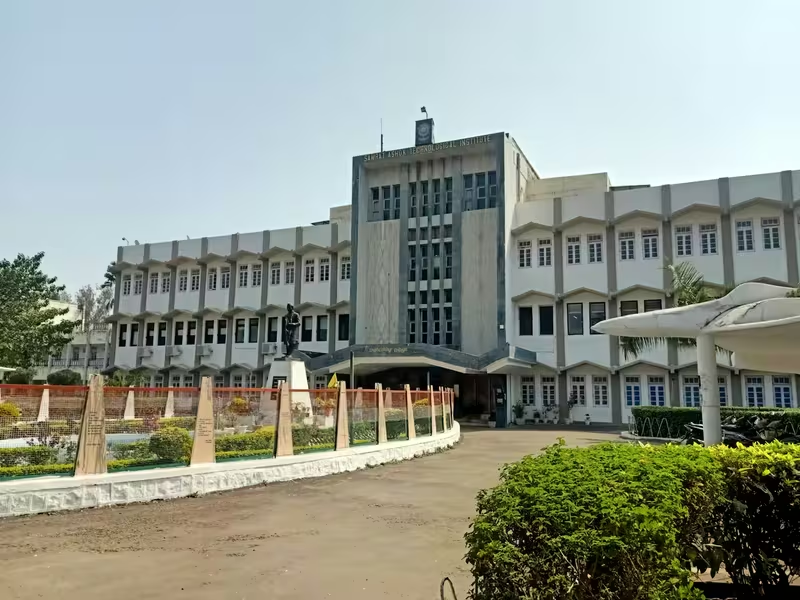
Education is represented by schools affiliated with the Madhya Pradesh Board of Secondary Education and the Central Board of Secondary Education. Samrat Ashok Technological Institute is an autonomous grant-in-aid college. Atal Bihari Vajpayee Government Medical College became functional in 2018, admitting its first students that year through the NEET-UG examination.
For visitors, Vidisha is best understood as part of a connected heritage landscape rather than as a single monument site. The ancient trade centre of Besnagar, the Heliodorus Pillar, Udayagiri, Sanchi, Bijamandal, Lohangi Pir and the monuments of Gyaraspur together reveal the region's long history of religious exchange, political change and artistic production.