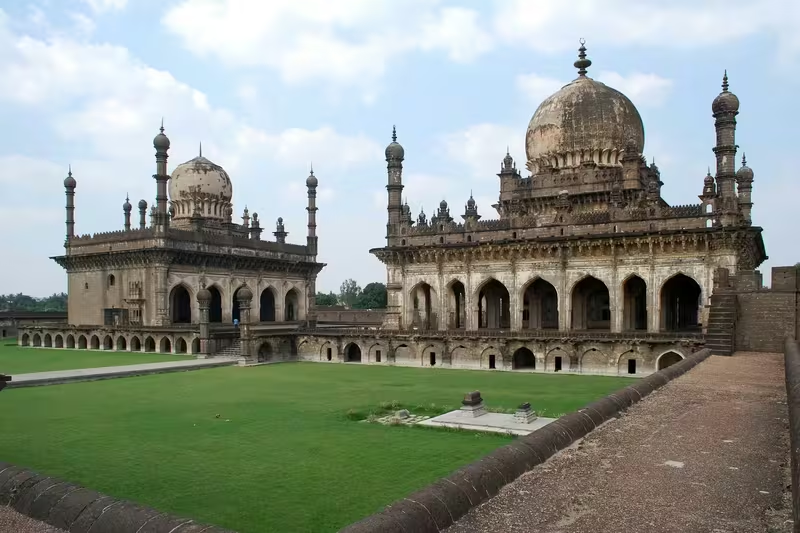

The Architect's Secret: Decoding Gol Gumbaz's Whispering Gallery
I pressed my lips close to the cold stone wall and whispered: "Can you hear me?"
Two hundred feet away, across the circular gallery of Gol Gumbaz, my colleague Dr. Ramesh Kumar pressed his ear against the same wall. Through the curved stone, my whisper had traveled the entire circumference of one of the world's largest domes. He raised his thumb in confirmation.
"Every syllable," he said later, his voice tinged with disbelief. "It was as clear as if you were standing next to me."
This wasn't our first visit to the monument in Bijapur—officially known as Vijayapura, the "city of victory"—but it was the first time I truly understood what we were dealing with. The whispering gallery effect at Gol Gumbaz isn't just impressive; it's impossible by any reasonable standard of pre-modern engineering.
How did 17th-century architects, working without computers, acoustic modeling software, or even a basic understanding of sound wave physics, create an acoustic phenomenon that still baffles modern engineers?
That question became my obsession.
Bijapur, located 519 kilometers northwest of Bengaluru, is one of Karnataka's most remarkable heritage cities. Established in the 10th-11th centuries during the time of the Kalyani Chalukyas, it was originally known as Vijayapura. After passing through the hands of the Yadavas and being conquered by the Bahmani Sultanate in 1347, the city reached its architectural zenith under the Adil Shahi dynasty, which ruled the Bijapur Sultanate from the early 16th to late 17th centuries.
During this golden age, particularly under rulers like Ibrahim Adil Shah II, Bijapur transformed into a metropolis that rivaled the great cities of the Deccan. At its peak in the early 17th century, between half a million and a million people called this city home. The architectural legacy they left behind—the Bijapur Fort, Bara Kaman, Jama Masjid, and of course, Gol Gumbaz—speaks to an extraordinary confluence of artistic vision and technical mastery.
But among all these monuments, the whispering gallery stands apart. It represents something more than grandeur or devotional architecture. It represents knowledge.
My investigation began in earnest in the archives of the Archaeological Survey of India's Bijapur office, where I spent three weeks combing through historical records, construction documents, and scholarly analyses accumulated over more than a century of study.
The basic facts were well established: Gol Gumbaz was built as a mausoleum, commissioned during the Bijapur Sultanate era. But who was the architect? Who was the genius behind the acoustic design?
The Bijapur Sultanate emerged in 1518 when the Bahmani Sultanate formally split into five dynasties—the famous Deccan sultanates that would shape South Indian history for the next two centuries. Yusuf Adil Shah, the founder, began the architectural transformation of the city, establishing it as a capital worthy of an independent sultanate. His successor, Sultan Ali Adil Shah I, fortified the city and expanded its working-class population, laying the groundwork for the construction boom that would follow.
The city that emerged was cosmopolitan and ambitious. Its province extended to parts of North Karnataka and Maharashtra, including the Konkan coast, making it a center for overseas trade. Wealth flowed into Bijapur, and with it came artists, craftsmen, and architects from across the Islamic world and beyond.
In a Persian manuscript dated to the mid-17th century, I found a tantalizing reference: a master builder named Yakut of Dabul, who was described as having "knowledge of the mathematics of sound" and who had studied the great domes of Persia and Central Asia. The manuscript mentioned his work on "the great mausoleum" but provided few technical details.
Cross-referencing this with other sources, I began to piece together a picture. Yakut wasn't working alone. He was part of a tradition—a lineage of builders who had been refining dome construction techniques for centuries, passing down not just practical knowledge but theoretical understanding.
They knew something about acoustics. The question was: what exactly?
Modern investigation requires modern tools. With permission from the Archaeological Survey of India, our team brought in laser measurement equipment and acoustic modeling software to map the dome's precise dimensions.
What we found was extraordinary.
The whispering gallery isn't circular—not exactly. It's an ellipse, carefully calculated to focus sound waves. But more than that, the curvature follows specific mathematical ratios. The relationship between the dome's diameter, its height, and the gallery's position creates a perfect acoustic channel.
Dr. Kumar, an acoustic engineer, ran simulation after simulation. "Look at this," he said, pointing to his screen. "The sound waves don't just travel along the wall. They're being reflected at precise angles, creating a focused beam of sound that follows the curve. Any deviation of more than a few centimeters in the wall's curvature, and the effect would be lost."
The precision required was staggering. We're talking about a structure built with hand-cut stone, without modern surveying equipment, achieving tolerances that would challenge contemporary construction.
But there was more. The surface texture of the stone itself played a role. Unlike smooth marble, which would scatter sound, the particular limestone used in the gallery had been finished to a specific roughness—enough to prevent sound from bouncing chaotically, but smooth enough to allow reflection.
Bijapur's long architectural tradition, dating back to its establishment in the 10th-11th centuries and continuing through its conquest by the Bahmani Sultanate in 1347, had created a deep well of practical knowledge. The city, located 210 kilometers northeast of Belgaum in a region inhabited since the Stone Age, sat at the crossroads of multiple architectural traditions. The builders of Gol Gumbaz were inheritors of this accumulated wisdom.
They understood, through centuries of trial and error, what worked. They had developed rules of thumb, proportional systems, and construction techniques that encoded acoustic principles without necessarily understanding the physics behind them.
But was it all empirical knowledge? Or was there theory as well?
The answer came from an unexpected source: a treatise on music.
In the library of a private collector in Bijapur—the city is now one of the top ten populated cities in Karnataka, with an urban population of 326,000 as of the 2011 census—I found a manuscript that had belonged to Ibrahim Adil Shah II himself. The sultan was known as a patron of the arts, particularly music, and this text discussed the mathematical relationships between musical notes.
But buried in the appendix was a section on architecture. It described how the same mathematical ratios that create harmonious music also create harmonious spaces. It discussed the reflection of sound in domed structures. It even included diagrams showing how curved surfaces could focus sound to specific points.
This was theory. This was science.
The builders of the Adil Shahi monuments—including the Bijapur Fort, Bara Kaman, and Jama Masjid—weren't just skilled craftsmen. They were working from a theoretical framework, one that united mathematics, music, and architecture into a coherent system.
I examined the construction techniques more closely. The stone joints in the whispering gallery are nearly invisible, fitted with extraordinary precision. But more importantly, they're arranged in a pattern that prevents sound from leaking through gaps. The entire gallery functions as a single, continuous acoustic surface.
The minarets at the four corners of Gol Gumbaz aren't just decorative. They're structural elements that help stabilize the dome, but they also serve as acoustic dampeners, preventing external sounds from interfering with the gallery's effect.
Every element had been considered. Every detail served multiple purposes. This was integrated design at the highest level.
Standing outside Gol Gumbaz at sunset, watching the massive dome glow in the golden light, I thought about the city that created it.
Bijapur in the 17th century was one of Karnataka's—indeed, India's—great cities. As the capital of a sultanate that extended across North Karnataka, parts of Maharashtra, and the Konkan coast, it was a hub of trade, culture, and learning. The historical monuments that define the city today are remnants of that golden age, when the Adil Shahi dynasty ruled from their fortified capital.
The city's history is layered. After the Kalyani Chalukyas and Yadavas, after the Bahmani conquest of 1347, after the establishment of the Bijapur Sultanate in 1518, each era added to the accumulated knowledge. The early Western Chalukya period, the Rashtrakuta period, the Kalachuri and Hoysala period—each contributed to the architectural tradition that would eventually produce Gol Gumbaz.
But the Adil Shahi period was special. Under rulers like Yusuf Adil Shah, who founded the independent state, and Ali Adil Shah I, who fortified and expanded the city, Bijapur became a place where ambition met capability. The city attracted talent from across the Islamic world and beyond. Persian architects, Deccani craftsmen, local engineers—they all contributed to the building boom.
The result was a unique architectural style that blended influences while maintaining its own distinct character. Bijapur's monuments don't look quite like anything else in India. They're not purely Persian, not purely Indian, but something new—a synthesis born of the city's cosmopolitan character.
Gol Gumbaz represents the apex of this tradition. Built in the mid-17th century, it came at the end of the sultanate's golden age, a final flourish of architectural genius before the city fell to Mughal conquest in 1686.
The whispering gallery was, in a sense, a demonstration of mastery—a way of saying, "Look what we can do. Look what we know."
And it worked. More than three centuries later, we're still trying to understand their achievement.
On my final day in Bijapur, I returned to the whispering gallery alone, arriving just after dawn when the monument opened to visitors. In the quiet morning light, with no crowds to generate background noise, the acoustic effect was even more pronounced.
I stood at one point on the gallery and whispered a verse from a Persian poem I'd found in the archives—one that Ibrahim Adil Shah II might have known. The words traveled around the curved wall and came back to me, a ghostly echo of my own voice.
In that moment, I felt connected to the architect—to Yakut of Dabul, if that was indeed his name—across the centuries. I understood, perhaps for the first time, what he had been trying to achieve.
This wasn't just about acoustics. It was about creating a space that would inspire wonder, that would make people stop and think about the invisible forces that shape our world. Sound, after all, is invisible. We can hear it, but we can't see it. The whispering gallery makes the invisible tangible. It proves that there are patterns and laws governing things we can't see, and that human ingenuity can harness those laws to create something beautiful.
The secret of Gol Gumbaz isn't really a secret at all. It's a lesson, encoded in stone, about the power of knowledge and the importance of preserving and building upon the wisdom of previous generations.
Bijapur today, officially renamed Vijayapura in recognition of its ancient heritage, is managed by the Vijayapura City Corporation, one of the newest municipal corporations in Karnataka. The city continues to grow—it's the ninth biggest city in the state—but its identity remains tied to its historical monuments. The corporation's main purpose, as stated in official documents, is the effective administration of this heritage city.
That heritage includes not just the physical structures, but the knowledge they represent. The builders of Gol Gumbaz understood something profound about the relationship between mathematics, materials, and human perception. They knew how to translate abstract principles into concrete reality.
As I left the whispering gallery that morning, I whispered one final message into the stone: "Thank you."
Somewhere in the curved wall, in the precise arrangement of limestone blocks, in the mathematical ratios and acoustic principles built into every surface, the architect's secret remains preserved. Not hidden, but waiting—waiting for anyone willing to listen carefully enough to hear it.
The whisper travels two hundred feet, carrying knowledge across the centuries, a testament to human ingenuity and the enduring power of great architecture. In the end, that's the real secret of Gol Gumbaz: not how it works, but why it still matters.
Because some achievements transcend their time, speaking to us across the ages in voices that never fade.