Overview
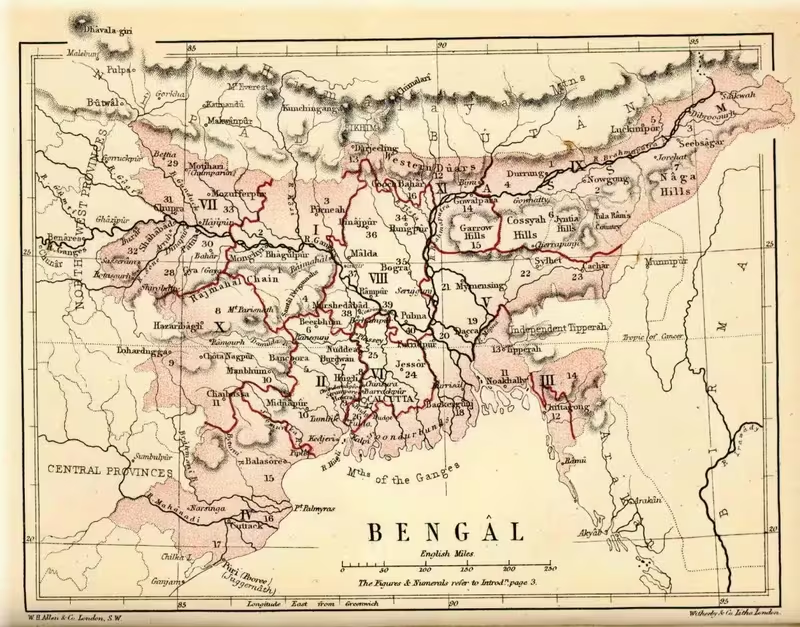
On 1 May 1793, the East India Company permanently fixed the land revenue it expected from Bengal’s zamindars. The measure, introduced under Governor-General Charles, Earl Cornwallis, became known as the Permanent Settlement of Bengal. It was first applied in Bengal and Bihar, and later extended to Varanasi and the northern districts of Madras. A series of regulations dated 1 May 1793 eventually carried the system across much of northern India.
The settlement was designed to solve several problems at once. Company officials wanted a dependable flow of revenue, clearer property rights, and a class of landed interests that would invest in agriculture and support British authority. Zamindars, who had previously acted as revenue intermediaries under the Mughal system, were now treated as proprietors with effective ownership of the land they held. In return, they had to pay a fixed revenue to the Company in perpetuity.
The results differed sharply from the hopes of its architects. The fixed demand could not be adjusted easily when conditions changed, and Company collectors generally refused to make allowances for drought, flood, or other natural disasters. Many zamindars fell into arrears, and their estates were placed on sale. At the same time, cultivators often faced severe pressure from landlords and were frequently denied the land deeds that the new system required zamindars to provide.
The Permanent Settlement therefore became more than a tax arrangement. It reorganised rural power, changed the social background of the landed class, and created political relationships that shaped colonial India for generations.
Background
Before the Company introduced the settlement, zamindars in Bengal, Bihar, and Odisha had served as officials or intermediaries with the right to collect revenue on behalf of the Mughal emperor and his representative, the diwan. The diwan was expected to supervise them and prevent both laxity and excessive demands. This system placed zamindars within a wider administrative structure rather than granting them unrestricted ownership of the land.
The East India Company’s position changed after the Battle of Buxar in 1764, when it received the diwani, or overlordship, of Bengal from the Mughal Empire. The Company gained responsibility for revenue collection but did not possess enough administrators trained in local law, custom, and agrarian practice. Landholders were consequently left with limited supervision, while Company officials were sometimes corrupt or indifferent to the long-term condition of the countryside.
Revenue could be extracted without sufficient concern for future production or local welfare. The devastating famine of 1770 exposed the danger of this short-term approach. Although the famine had several causes, the crisis helped Company officials in Calcutta recognise the importance of supervising the revenue system more closely.
Warren Hastings, then governor-general of Fort William in Bengal, responded with five-yearly inspections and temporary tax farmers. The Company did not wish to take direct control of village administration. It also did not want to alienate people who had traditionally enjoyed prestige and influence in the countryside. Yet the temporary arrangements created their own problems. Some tax farmers attempted to collect as much as possible during the period between inspections and then disappeared with the revenue.
The disastrous consequences attracted the attention of the British Parliament. In 1784, Prime Minister William Pitt the Younger directed the Calcutta administration to change its methods. Charles Cornwallis was sent to India in 1786 to reform Company practice.
Prelude
The Court of Directors of the East India Company first proposed a permanent settlement for Bengal in 1786. The proposal represented a major change from the policy then being followed in Calcutta, where officials were attempting to increase taxation of zamindars. Between 1786 and 1790, Cornwallis and Sir John Shore debated whether the Company should make a permanent agreement with the zamindars.
Shore argued that native zamindars might not believe a promise of permanence immediately. The concern reflected a basic difficulty: a government that had repeatedly altered revenue arrangements could not easily persuade landholders that a new arrangement would remain unchanged. Cornwallis nevertheless believed that a permanent demand would provide the security necessary for landlords to improve their estates.
The intended chain of benefits was straightforward. If the state fixed its revenue demand forever, the landholder could retain any additional income produced by improvements. The zamindar would therefore have an incentive to invest in drainage, irrigation, roads, bridges, and other agricultural infrastructure. The Company, meanwhile, would receive a predictable revenue stream and would no longer be troubled by the uncertainty caused by repeated defaults.
British officials imagined that this process would create a class resembling the prosperous agricultural landowners of Western Europe. These “improving landlords” would use their capital to increase production and would become socially and politically loyal to British rule.
The policy, however, did not clearly identify which people were willing or able to undertake such long-term investment. After extended discussion, the Company made the settlement with the existing rajas and taluqdars of Bengal, who were reclassified as zamindars. A ten-year, or decennial, settlement was issued in 1790. In 1793, it was made permanent.
The Event
The Permanent Settlement fixed the land revenue payable by the zamindars to the East India Company in perpetuity. Zamindars were granted effective ownership of the land they held and were made responsible for collecting revenue from cultivators. The settlement thus converted earlier revenue intermediaries into a landed class with much stronger claims over property.
The arrangement did not make zamindars independent rulers. Their right to maintain armed forces was removed by the Permanent Settlement Act of 1793, and they could no longer hold their own courts. Judicial authority was placed under the supervision of a Company-appointed collector. In this way, zamindars gained property rights while losing several of the political and coercive powers associated with older forms of local authority.
A central part of the arrangement was the fixed relationship between rent and the state demand. The government was to receive 89% of the rent, while the zamindar retained 11%. The state demand could not be increased, but payment had to be made on the due date. The strict deadline became associated with the name “Sunset Law”: failure to pay before sunset could lead to the sale of the zamindari estate.
The policy made land unusually attractive as a commodity. Previously, no comparable market in land had existed in Bengal on this scale. Since the Company's demand was inflexible and often high, many zamindars quickly fell into arrears. When their estates were auctioned, new purchasers entered the landed class.
Some of these buyers were Indian officials serving in the East India Company’s government. Their official positions gave them knowledge of which estates were underassessed and therefore potentially profitable. They also possessed opportunities to accumulate the wealth required for purchase and, according to the historical interpretation presented in the record, could manipulate the system to bring particular lands to sale.
Key Features
The settlement had several connected features:
- Revenue payable by zamindars was fixed permanently.
- Zamindars received effective ownership of their estates.
- Zamindars collected taxes from cultivators on behalf of the state.
- Cultivators were supposed to receive land deeds, or pattas.
- Zamindars lost the right to maintain armed forces.
- Zamindars could no longer exercise judicial authority.
- Estates in arrears could be auctioned to the highest bidder.
- The arrangement was expected to encourage investment in agriculture.
The obligation to issue pattas was important because it was meant to define the cultivators’ rights. In practice, the absence of effective regulatory supervision often allowed zamindars to neglect this duty. Without formal deeds, cultivators could be left vulnerable to changing demands and coercive practices.
Turning Points
The first turning point was the decision to convert the decennial settlement of 1790 into a permanent one in 1793. This transformed a temporary fiscal arrangement into a lasting structure of property and authority.
The second was the creation of a market in zamindari estates through auction. The settlement’s architects expected security of tenure to encourage improvement. Instead, the strict payment rules made land a valuable but risky commodity. Older landholders who could not meet the demand lost estates, while officials, merchants, and bankers could acquire them.
The third was the gap between intended and actual investment. Company officials expected fixed taxation to encourage zamindars to improve drainage, irrigation, transport, and cultivation. Long-term private investment by zamindars, however, failed to materialise on the scale anticipated. Many new landlords were absentee owners who managed their land through agents and had little personal attachment to it.
Participants
The East India Company and Cornwallis
The Company was both the governing authority and the principal beneficiary of the revenue system. Its officials wanted an income that could be predicted for budgeting and administration. Repeated defaults had made Company finances difficult to plan, while temporary tax farming had encouraged short-term extraction.
Cornwallis gave the policy its administrative form. He believed that a permanently fixed demand would allow landholders to increase their profits by improving their estates. The settlement also formed part of the wider Cornwallis Code of 1793, which divided the Company’s service personnel into revenue, judicial, and commercial branches.
The Zamindars
The zamindars were drawn from the existing rajas and taluqdars of Bengal and were reclassified as landowners under the new system. They were required to collect taxes from cultivators and transfer the fixed state demand to the Company.
Their position was contradictory. They gained effective ownership and a possible share in rising rents, but they faced immediate loss of their estates if payments fell into arrears. Some became powerful rural landlords; others were displaced through auction. Over time, the landed class included civil servants and their descendants, merchants, and bankers, as well as older local lineages.
Cultivators
The cultivators produced the agricultural wealth from which both rent and state revenue were drawn. The settlement formally placed an obligation on zamindars to provide them with pattas, but that obligation was often neglected. The absence of effective supervision left cultivators exposed to landlord power.
The record also describes increasing pressure to cultivate cash crops such as cotton, indigo, and jute. Zamindars used such crops to help secure the revenue expected by the Company. This pressure, combined with other agrarian difficulties, contributed to the worsening condition of the Bengali peasantry and to the recurrence of famine.
Aftermath
The immediate effect of the settlement was a rapid restructuring of landholding. Since revenue demands were fixed but had to be paid regardless of local conditions, zamindars could not easily respond to droughts, floods, or other disasters. Company collectors generally refused to reduce the demand. Arrears therefore accumulated, and estates were placed on auction.
The auctions created a new land market and altered the social composition of the ruling class. Historian Bernard S. Cohn and others have described a shift from a system dominated by lineages and local chiefs to one increasingly shaped by civil servants, their descendants, merchants, and bankers. Many new landlords were absentee owners who relied on managers to run their estates.
The Company did achieve a political advantage. It had hoped that zamindars would act as intermediaries, preserve local customs, and protect rural society from the excesses of Company officials. More broadly, the settlement created a wealthy landed group with a strong interest in the continuation of British rule.
The political relationship could also become oppositional. When British policy changed during the nineteenth century and moved toward reform and intervention in custom, zamindars became a conservative interest group and openly resisted aspects of that policy.
Historical Significance
The Permanent Settlement’s significance lies in the way it joined fiscal policy to social engineering. It was not only an attempt to collect taxes. It aimed to create a landed class whose property, prosperity, and political loyalty would be connected to British power.
Economically, the settlement failed to meet several of its stated goals. Fixing revenue permanently meant that Company income declined over the long term as expenses increased. The fixed demand also encouraged the Company to insist on payment even when agricultural conditions were poor. The expected expansion of investment in land and infrastructure did not occur on the scale Cornwallis had envisaged.
Agrarian relations became more unequal. Zamindars possessed stronger claims over land, while cultivators often lacked enforceable documentation. The pressure to produce cash crops could conflict with the needs of food cultivation. The account of the settlement connects these pressures with the increasingly pitiable condition of Bengal’s peasantry and with recurring famine.
The system also changed the meaning of land. By making estates transferable through auction, it encouraged the commercialisation of property. Land became an object of purchase and sale for officials, merchants, and bankers, rather than remaining primarily tied to older local lineages and customary authority.
Administratively, the settlement weakened zamindars in some respects while strengthening them in others. They lost armed forces and judicial authority, but their influence over smallholders increased. The power of the landlord class was not substantially diluted until the first land reforms of the 1950s, which themselves remained incomplete in much of India except West Bengal.
Legacy
The Permanent Settlement became a durable foundation of colonial rural politics. Its landed class was deeply invested in maintaining British rule. Lord Bentinck observed in 1829 that the system had created “a vast body of rich landed proprietors” who had a strong interest in the continuation of British dominion and substantial control over the rural population.
This political stability came at a considerable social cost. Francis Rawdon-Hastings wrote in 1819 that the settlement had subjected almost all the lower classes in the provinces to “most grievous oppression.” These contrasting assessments capture the central tension of the policy: it could be defended as a means of preventing disorder and securing allies for the colonial state, while also being condemned for intensifying landlord power over cultivators.
The basic structure was reproduced beyond its original area and influenced political arrangements elsewhere in the British Empire, including Kenya. In the areas where landlord power remained concentrated, rural politics continued to reflect the influence of zamindar families. The settlement therefore outlasted the specific regulations that created it.
Historiography
Historians have generally examined the Permanent Settlement through the gap between its intentions and its effects. The Company presented fixed revenue and secure property rights as incentives for agricultural improvement. From this perspective, the policy sought to create a productive landed class and replace uncertain revenue farming with a more orderly system.
A contrasting interpretation emphasises the settlement’s fiscal and political consequences. The state’s demand was fixed but inflexible, while the risks of agricultural failure were transferred downward. Zamindars protected their ability to pay by pressing cultivators and, in some cases, encouraging cash-crop cultivation. The result was not the emergence of uniformly “improving landlords,” but a mixed class that included absentee owners and purchasers from the Company’s administrative and commercial networks.
The settlement has also been interpreted as a decisive moment in the commercialisation of land. Bernard S. Cohn and other historians argue that it created a market in property and changed the social background of the ruling class. The shift from local lineages to civil servants, merchants, and bankers shows that the settlement affected not only taxation but also the composition of power in rural society.
The assessments by Francis Rawdon-Hastings and Lord Bentinck reveal another historical debate. One stressed oppression among the lower classes; the other stressed the political stability created by wealthy landlords. Both perspectives point to the same structure: the Permanent Settlement secured colonial authority by empowering intermediaries who exercised considerable control over cultivators.