Kumaoni Language: Inscriptions, Pahari Grammar, and Living Cultural Traditions
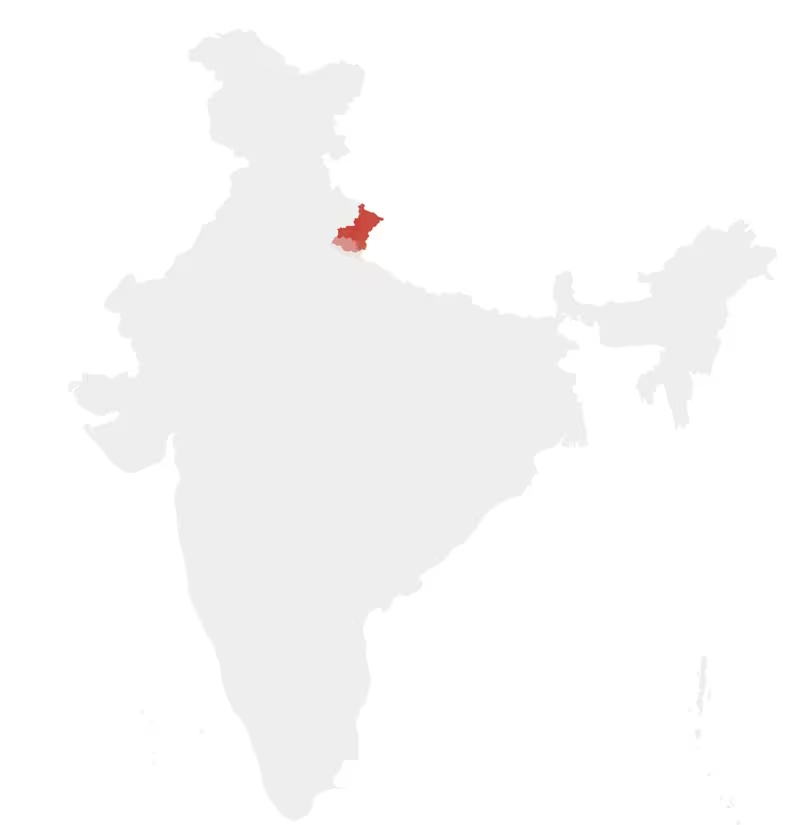
Temple stones and copper plate inscriptions from the Katyuri and Chand eras preserve some of the earliest known written evidence associated with Kumaoni. The language later served as the official language of the Kumaon Kingdom and continues to be spoken across the Kumaon region of Uttarakhand, as well as in the distant northwestern part of Nepal’s Sudurpashchim Province. Written in Devanagari, Kumaoni is an Indo-Aryan language belonging to the Central Pahari group.
The number of Kumaoni speakers in India was recorded as 1,030,254 in a 1961 survey and had risen to 2.0 million by 2011. Although Kumaoni is not classified as endangered, UNESCO’s Atlas of the World’s Languages in Danger places it in the unsafe category. This status indicates that the language requires consistent conservation efforts. Its continued presence is visible not only in everyday speech but also in literature, folk song, theatre, cinema, radio, community broadcasting, and school education.
Kumaoni’s cultural history includes writers such as Lokratna Pant, Gauri Dutt Pant “Gaurda,” Charu Chandra Pandey, Shailesh Matiyani, Mohan Upreti, and Brijen Lal Shah. Its songs and theatrical traditions connect the language with the social life of Kumaon, while its grammatical features preserve links with the wider Indo-Aryan and Central Pahari linguistic landscape.
Origins and Classification
Linguistic Family
Kumaoni belongs to the Indo-Aryan language family and forms part of the Central Pahari group. It shares grammatical features with other Indo-Aryan languages, including Dotyali, Nepali, Hindi, Rajasthani, Kashmiri, and Gujarati. It also shares much of its grammar with Garhwali, another language of the Central Pahari group.
Kumaoni is therefore part of a broad dialect continuum rather than an isolated linguistic system. Its grammatical and phonological characteristics reflect connections across northern India and the Himalayan region.
Origins
The precise date and place of Kumaoni’s emergence are not fixed in the surviving account, but its historical association is closely tied to the Kumaon region. Written Kumaoni material has been found on temple stones and copper plates dating from the Katyuri and Chand eras. The language was also used officially by the Kumaon Kingdom.
The history of Kumaoni grammar includes the influence of the now-extinct language of the Khasas, described as the first inhabitants of the region. Some features of Kumaoni and other Central Pahari languages are attributed to this influence.
Name Etymology
The historical account identifies the language by its connection with Kumaon and does not provide a separate explanation of the name’s etymology. The language is written in Kumaoni Devanagari as कुमाऊँनी and is pronounced [kuːmaːʊ̃ːniː].
Historical Development
Katyuri and Chand Era
Kumaoni texts have been found on temple stones and copper plate inscriptions from the Katyuri and Chand eras. These records provide evidence that the language had a written presence in the historical Kumaon region. The surviving description does not establish a precise date for each inscription, but it places Kumaoni within the documentary history of these eras.
Kumaoni was also the official language of the Kumaon Kingdom. This official role gives the language a political as well as cultural history, linking it to the administration and public life of the kingdom.
Central Pahari Development
Kumaoni’s grammar reflects its position within the Indo-Aryan dialect continuum. Its similarities with Garhwali and other Central Pahari languages are particularly strong. The peculiarities of Kumaoni and related Central Pahari languages are associated with the influence of Khasa.
One important grammatical feature concerns the verb substantive, which is formed from the root ach. The source compares this feature with Rajasthani and Kashmiri. In Kumaoni, as in Pahari and Kashmiri, the relevant form is described as a participial tense and changes according to the gender of the subject. This is presented as a relic of the old Khasa language and as a feature that connects Kumaoni with Kashmiri and northwestern India.
Other features associated with Khasa include a tendency to shorten long vowels, epenthesis—the modification of a vowel by the vowel that follows in the next syllable—and frequent disaspiration. An example contrasts Khas siknu, Kumaoni sikhno, and Hindi sikhna, meaning “to learn.” Another Kumaoni example is yeso, with plural yasa, meaning “of this kind.”
Modern Period
Kumaoni’s modern history has been shaped by literary, musical, theatrical, and educational activity. Writers produced poetry and other works in the language, while performers carried Kumaoni traditions into theatre, cinema, radio, and recorded music.
In December 2019, the government of Uttarakhand introduced official Kumaoni books for students in Classes 1–5 in schools of the Kumaon division. This initiative was described as an effort to promote and protect indigenous languages.
Scripts and Writing Systems
Devanagari
Kumaoni is written using the Devanagari script. The language’s written form is identified as Kumaoni Devanagari, कुमाऊँनी. The inscriptions on temple stones and copper plates demonstrate the historical use of written Kumaoni material, while modern books and other cultural publications continue to use Devanagari.
Script Evolution
The historical record identifies Devanagari as Kumaoni’s script but does not provide a detailed chronology of changes in its written form. The surviving evidence instead shows continuity between historical written records and modern educational and literary use.
Geographic Distribution
Historical Spread
Kumaoni is associated primarily with the Kumaon region of Uttarakhand in northern India. It also has a historical connection with the Kumaon Kingdom, where it served as the official language. Some Kumaoni speakers are reportedly found in western Nepal.
Regional Dialects
There is no single accepted method of dividing Kumaoni dialects. Broadly, Kali or Central Kumaoni is spoken in Almora and northern Nainital. Northeastern Kumaoni is spoken in Pithoragarh, southeastern Kumaoni in southeastern Nainital, and Western Kumaoni west of Almora and Nainital.
These divisions describe broad regional patterns rather than a universally accepted classification. The presence of several dialects illustrates the internal variety of Kumaoni across the Kumaon region.
Modern Distribution
Today, Kumaoni is spoken by over two million people in the Kumaon region of Uttarakhand and in the distant northwestern Sudurpashchim Province of Nepal. The 2011 figure for India was 2.0 million speakers, compared with 1,030,254 recorded in the 1961 survey.
Literary Heritage
Writers and Literature
Kumaoni literature includes many noteworthy writers. Among those identified are Lokratna Pant, also known as Gumani Pant, who lived from 1790 to 1846; Gauri Dutt Pant “Gaurda” (1872–1939); Charu Chandra Pandey (1923–2017); Shailesh Matiyani (1931–2001); Mohan Upreti (1925–1997); and Brijen Lal Shah (1928–1998).
The account does not list individual canonical works by these writers, but their names represent the breadth of Kumaoni literary activity from the nineteenth century into the modern period.
Poetry and Drama
Kumaoni theatre first developed through Ramleela plays and later evolved into a modern theatrical form. Mohan Upreti, Naima Khan Upreti, and Dinesh Pandey were among the figures associated with this development. Theatre groups included Parvatiya Kala Kendra, started by Mohan Upreti, and Parvatiya Lok Kala Manch.
The Lucknow group Ankhar performed a number of Kumaoni plays. These included mee yo gayun, mee yo satkyun, written by Nand Kumar Upreti; Punturi by Charu Chandra Pandey; Motor Road by Govind Ballabh Pant; Labh Ribhadi by Nand Kumar Upreti; and Kagare Aag and Tumhare Liye by Himanshu Joshi. The group also presented Kumaoni translations and other Kumaoni plays.
Films and Television
Megha Aa, directed by Kaka Sharma and produced by S. S. Bisht, was the first Kumaoni film and appeared in 1987. Teri Saun, written, produced, and directed by Anuj Joshi, was released in 2003 and was the first film made in both Kumaoni and Garhwali. Other films listed include Aapun Biraan (Apne Paraye), Madhuli, and the 1985 Doordarshan television show Aapke Liye, which showcased the Kumaoni mela known as “kauteek.”
Grammar and Phonology
Key Features
Kumaoni shares grammar with languages across the Indo-Aryan continuum and particularly with Garhwali. The verb substantive is formed from the root ach. In the Kumaoni system described, the relevant present construction changes according to the gender of the subject. This characteristic is associated with a participial tense and is interpreted as a relic of Khasa.
Kumaoni also displays tendencies toward shortening long vowels, epenthesis, and disaspiration. These features are described as further relics of Khasa and as points of comparison with northwestern Indian languages.
Sound System
Several sounds vary according to dialect. The consonant /ʃ/ may also be heard as [s] in free variation. The vowel /ɛ/ may be heard as [æ], while /ɑ/ may be pronounced either as back [ɑ] or central [ä]. The vowel /ɔ/ may be heard as [ɒ]. These variations form part of Kumaoni’s phonological description.
Influence and Legacy
Languages and Linguistic Connections
The historical account does not identify languages that Kumaoni influenced. It does, however, describe extensive grammatical relationships with Dotyali, Nepali, Hindi, Rajasthani, Kashmiri, Gujarati, and Garhwali. The influence of the extinct Khasa language is especially important in explanations of Kumaoni’s grammatical and phonological peculiarities.
Cultural Impact
Kumaoni has a strong presence in folk music. Folk song genres include ceremonial mandals, martial panwaras, and the melancholy forms khuded, thadya, and jhoda. Instruments used in Kumaon music include the dhol, damoun, turri, ransingha, dholki, daur, thali, bhankora, and masakbhaja. Tabla and harmonium are also used, though to a lesser extent.
Mohan Upreti is described as the most famous personality associated with Kumaoni folk music. He was known for the Nanda Devi Jagar and the Rajula Malu Shahi ballad. He was also associated with Bedu Pako Baro Masa, a song identified for many years with the hills of Uttarakhand. The song was reportedly a favourite of Jawaharlal Nehru, who heard it in a band march.
Other prominent singers include Naima Khan Upreti, Gopal Babu Goswami, and Heera Singh Rana. Gopal Babu Goswami became known for songs about members of the armed forces and their families. Heera Singh Rana wrote and sang about hill life, including the experiences of women, love, beauty, suffering, and political satire.
Royal and Religious Patronage
Kumaon Kingdom
Kumaoni was the official language of the Kumaon Kingdom. Its use in this role marks an important stage in the language’s political history.
Temples and Community Institutions
Kumaoni texts found on temple stones and copper plates show that religious and historical sites preserved written records in the language. In the modern period, theatre groups, radio stations, schools, and community organisations have helped maintain Kumaoni cultural expression.
Modern Status
Current Speakers
Kumaoni had 2.0 million speakers in India in 2011. The 1961 survey recorded 1,030,254 speakers. The language is also spoken in parts of Nepal, including the northwestern Sudurpashchim Province.
Official Recognition
There have been demands to include Kumaoni, along with Garhwali, in the Eighth Schedule of the Constitution of India. Such inclusion would make it one of India’s Scheduled Languages. In 2010, a private member’s bill was introduced for discussion in the Lok Sabha with the aim of including Garhwali and Kumaoni in the Eighth Schedule.
Kumaoni is not listed as an official Scheduled Language in the account presented here. Its historical official status belongs to the Kumaon Kingdom.
Preservation Efforts
UNESCO’s Atlas of the World’s Languages in Danger places Kumaoni in the unsafe category. Although it is not endangered, this classification indicates the need for sustained conservation.
Broadcasting has contributed to preservation and public use. In 1962, the “Utterayana” programme was introduced from Akashwani Lucknow for the Chinese border area and was relayed by Najeebabad Akashwani Kendra. In 2010, TERI launched “Kumaon Vani,” a community radio service from Supi in Uttarakhand. The station broadcast programmes about environment, agriculture, culture, weather, and education in the local language, reaching communities within a radius of 10 kilometres around Mukhteshwar.
An internet radio service for Kumaon, Garhwal, and Jaunsar was launched in 2008 by non-resident Uttarakhandis in New York. Named after Bedu Pako Baro Masa, it gained popularity among inhabitants and migrants after its beta version was launched in 2010.
Learning and Study
Academic Study
Kumaoni has been studied through linguistic descriptions, regional surveys, folklore collections, and works on its formation and linguistic geography. Important further reading includes Ganga Dutt Upreti’s Proverbs & Folklore of Kumaun and Garhwal (1894), Uttarakhandi Lokoktiyan, published in Kumaoni and Garhwali editions, Devidatta Sarma’s The Formation of Kumauni Language (1985), and Linguistic Geography of Kumaun Himalayas (1994).
Educational Resources
The introduction of official Kumaoni books for Classes 1–5 in Kumaon division schools in 2019 created an institutional educational resource for younger learners. Kumaoni literature, recordings, theatre, folk music, radio programming, and community broadcasting provide additional ways of encountering the language and its cultural traditions.
Conclusion
Kumaoni connects historical records, regional speech, and living cultural practice. Its written traces on temple stones and copper plates link it to the Katyuri and Chand eras, while its former role as the official language of the Kumaon Kingdom gives it a distinctive political history. Linguistically, it belongs to the Indo-Aryan family and Central Pahari group, sharing features with Garhwali and other Indo-Aryan languages while preserving grammatical and phonological characteristics associated with Khasa.
With about two million speakers in India, Kumaoni remains a living language. Its literature, theatre, films, folk songs, radio programmes, and schoolbooks demonstrate continuing cultural vitality. At the same time, UNESCO’s unsafe classification underlines the need for sustained conservation so that Kumaoni’s regional varieties, historical memory, and expressive traditions remain part of Uttarakhand’s future.