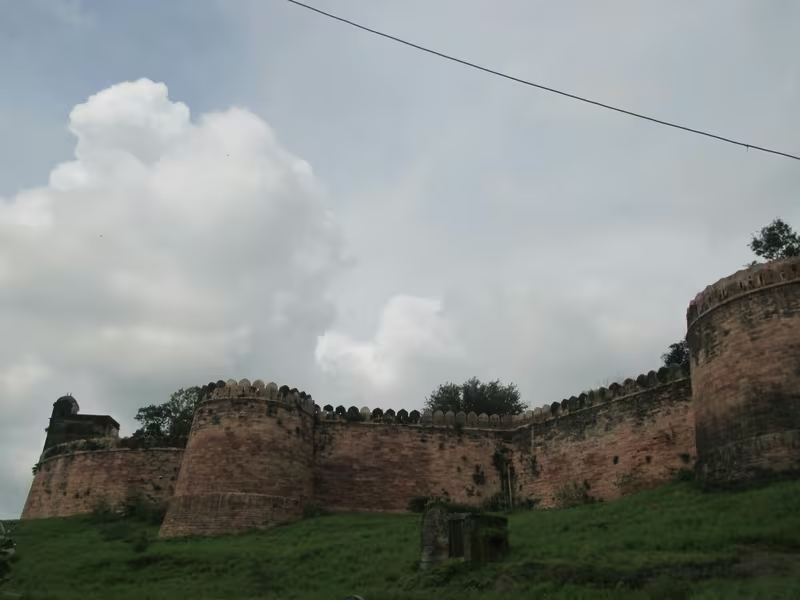
Overview
At an elevation of about 559 metres, Dhar occupies a strategic position in the Malwa region of present-day Madhya Pradesh. Its history is visible not only in royal buildings but also in the shape of the old city: massive earthen ramparts once enclosed a roughly circular settlement, while tanks and moats strengthened its defences. The western and southern stretches of these ramparts remain the best preserved, although parts of the circuit have been dismantled or buried beneath later construction.
Dhar rose to political prominence when the Paramara chief Vairisimha, who ruled approximately between 920 and 945 CE, transferred his headquarters from Ujjain. Under the Paramaras, and especially under King Bhoja around 1000–1055, Dhar became a respected centre of culture and learning. Its later history brought warfare, conquest, administrative change, and new architectural traditions. The city was attacked by the Chalukyas of Kalyana, sacked by the Chalukyas of Gujarat, absorbed into the Delhi Sultanate, connected with the independent Sultanate of Malwa, brought under Mughal authority, and conquered by the Marathas in 1730.
The surviving heritage of Dhar reflects these successive political worlds. The city contains a hill fort, a Sultanate mosque, Islamic tombs, an iron pillar with inscriptions, reused temple architecture, Pawar palaces and cenotaphs, a colonial administrative building, and a twentieth-century renovation of a nineteenth-century palace. Together, these remains show how Dhar was repeatedly adapted rather than simply abandoned when power changed hands.
Etymology and Names
Dhar is associated with the older name Dhārā Nagara, commonly interpreted as “city of sword blades.” The earliest reference to the city appears in an inscription at Jaunpur dating from the sixth century during the Maukhari dynasty. This reference establishes the antiquity of the name, although it does not by itself describe the size or political importance of the settlement at that time.
The name became especially prominent during the Paramara period. When Vairisimha made Dhar the main seat of the Paramara chiefs of Malwa, the city replaced Ujjain as the principal headquarters of the dynasty. Later records and traditions connected Dhar with King Bhoja and with a learned court whose influence extended into poetics, grammar, aesthetics, drama, and religious literature.
Geography and Location
Dhar lies in Malwa, between approximately 21°57′ and 23°15′ north and 74°37′ and 75°37′ east. The city is about 55 kilometres west of Mhow. Its district is bordered by Ratlam to the north, parts of Indore to the east, Barwani to the south, and Jhabua and Alirajpur to the west.
The location placed Dhar within the political and military geography of Malwa. The city was close enough to Ujjain to inherit and compete with its earlier political importance, while its position also connected it with Mandu, Indore, and the routes leading toward Gujarat and Maharashtra. The former Dhar State, established under the Pawar rulers, covered 1,775 square miles, or approximately 4,600 square kilometres, and included Rajput and Bhil feudatories.
The old city’s fortifications reveal how the terrain was organised for defence. Dhar’s ramparts formed a circular plan, an unusual feature in northern India. A series of tanks and moats surrounded the city, creating a defensive landscape comparable in the description to Warangal in the Deccan. On the north-eastern side, these features have disappeared under houses and other modern buildings. The city also contains numerous stepwells from different periods. Forty-six stepwells had been listed within Dhar, and plans to revive them were continuing in 2024. Many, however, had dried up or become filled with sewage and rubbish.
Ancient and Paramara History
Dhar’s first known reference belongs to the sixth century, but its decisive political rise began several centuries later. Vairisimha, the Paramara chief who ruled approximately from 920 to 945 CE, appears to have moved the dynasty’s headquarters from Ujjain to Dhar. This change made Dhar the principal seat of Paramara power in Malwa and established the city as an enduring political centre.
The Paramaras ruled in a period when Malwa was contested by several regional powers. Dhar’s wealth and growing reputation attracted the attention of neighbouring dynasties. The Chalukyas of Kalyana, under Somesvara I, who ruled approximately from 1042 to 1068, captured and burnt the city. They also occupied Mandu, known in earlier times as Mandava. Dhar was later sacked by the Chalukyas of Gujarat under Siddharaja. These attacks damaged the city and contributed to political fragmentation in the region.
Dhar’s cultural reputation is closely connected with King Bhoja, who ruled approximately from 1000 to 1055. Bhoja is remembered as an author associated with poetics, grammar, and aesthetics, particularly the Śṛṅgāra Prakāśa. The intellectual associations of his reign continued to shape later understandings of Dhar. In 1903, Sanskrit and Prakrit inscriptions found in a building near the tomb of Kamal Maula helped strengthen this connection. One inscription preserves parts of a drama called Vijayaśrīnāṭikā, composed by Madana, the king’s preceptor, who bore the title Bālasarasvatī. Other inscriptions include two versions of the Kūrmaśataka, a group of verses praising Ādī Kūrma, the primordial tortoise in Hindu tradition. A colophon attributes the verses to King Bhoja.
These discoveries led K. K. Lele, Superintendent of Education in the princely state of Dhar, to call the building Bhoj Shala, or “Hall of Bhoja.” The name reflects the connection made between the inscriptions and Bhoja’s intellectual world. C. E. Luard, writing in 1908, did not use the term Bhoj Shala, though he recorded traditions that described the building as “Raja Bhoja’s school.”
Historical Timeline
Delhi Sultanate and Malwa
The wars among the regional powers weakened Malwa’s political resistance. As a result, when Ala al-Din Khalji, Sultan of Delhi, sent an army into Malwa in the early fourteenth century, the region was annexed to Delhi with no significant opposition described in the historical record. Dhar became the capital of the province under Ayn al-Mulk Multani, who served as governor until 1313.
The history of the following seventy years is less clear. In 1390–1391, Dilawar Khan was appointed muqti of Dhar and governor of Malwa by Sultan Muhammad Shah. He later took the title Amir Shah Daud and ordered the khutba to be read in his name in 1401–1402. This act marked his establishment as an independent sultan. After his death in 1406, his son Hoshang Shah became ruler, with his capital at Mandu.
Dhar remained an important city within this wider political landscape. In 1405, Dilawar Khan built the Lat Mosque, or Pillar Mosque, as the Jami Mosque. Its name comes from the iron pillar standing in its immediate precinct.
Mughal Rule
During Akbar’s reign, Dhar came under Mughal control. The city remained within the Mughal dominion until 1730, when it was conquered by the Marathas. The iron pillar records a specific moment in this Mughal phase: one of its inscriptions commemorates Akbar’s visit to Dhar in 1598 while he was conducting a military campaign in the Deccan.
Another Mughal-period addition survives at Dhar Fort. One of the fort’s gateways dates to 1684–1685, during the reign of Alamgir. This later gateway stands alongside older defensive features and buildings associated with the fort’s changing use.
Maratha Expansion and the Dhar State
In late 1723, Bajirao led a large Maratha army through Malwa, accompanied by Malharrao Holkar, Ranoji Shinde, and Udaji Rao Pawar. The Marathas had obtained the right to collect Chauth taxes in Malwa and Gujarat from the Mughal emperor. Chauth, a levy of one-quarter of produce, and Sardeshmukhi, a ten-percent surcharge, were important sources of Maratha revenue. The system supported the Maratha administration and its military expenditure at a time when the state’s finances were under pressure.
The Maratha armies defeated the Mughal governor and attacked Ujjain. Their military outposts extended northward to Bundelkhand. Dhar was eventually conquered by the Marathas in 1730. In the late eighteenth and early nineteenth centuries, the Dhar Maratha state suffered repeated depredations by Scindia of Gwalior and Holkar of Indore. The state was preserved from destruction by the strong rule of the adoptive mother of the fifth raja.
After the Third Anglo-Maratha War in 1818, Dhar came under British authority. It became a princely state within the Bhopawar Agency of the Central India Agency. The British confiscated the state after the Revolt of 1857, but restored it in 1860 to Raja Anand Rao III Pawar, who was then a minor. The detached district of Bairusia was granted to the Begum of Bhopal. Anand Rao later received the personal title Maharaja and the KCSI in 1877. He died in 1898 and was succeeded by Udaji Rao II Pawar.
Political Significance
Dhar’s importance rested on its repeated role as a seat of administration. The Paramaras made it their principal headquarters; the Delhi Sultanate used it as the capital of the province of Malwa; and the Pawars ruled a princely state from the city during the colonial period.
The Dhar State also included a system of subordinate estates. In 1921, a separate department called the Department of Thakurans, Bhumians and Thikanejat was established to supervise the Thakurs and Bhumias. There were twenty-two such estates at the time. The jagir lands of Dhar’s nobles were divided between the two groups, and all paid tribute to the Darbar.
The Thakurs were generally Rajput landholders whose estates lay in the north of the state. They were locally called Talukdars, and their holdings were known as kothari. The group included eight Rathore Rajputs, one Pawar, and one Kayasth. The Bhumias were Bhilalas, who claimed mixed Bhil and Rajput, specifically Chauhan, descent. Their grants were connected with an obligation to keep peace among Bhils and other hill communities. In return for tribute and service, they received cash allowances known as Bhet-Ghugri.
Religious and Cultural Importance
Dhar’s religious landscape contains Hindu, Islamic, and Jain associations. The city has mosques, Sufi tombs, reused temple fragments, Jain sculpture, and stepwells from several periods. Its majority population follows Hinduism, with significant Muslim and Jain communities.
The Kamal Maula campus is a spacious enclosure containing several tombs. Its principal tomb is associated with Shaykh Kamal Malvi, or Kamal al-Din, who lived approximately from 1238 to 1331. He was a follower of Farid al-Din Ganj-i Shakar and the Chishti saint Nizamuddin Auliya. Kamal al-Din migrated to Malwa with his brother in the late thirteenth century. His descendants have remained custodians of the tomb in an unbroken line for approximately seven hundred years.
Another tomb, located on the old circular ramparts above the former moat, is associated with Shaykh Abdullah Shah Changal, described as a warrior saint. The earliest evidence for this tomb is an inscription dated 1455, although the building itself was completely rebuilt during the second half of the twentieth century. In the fields west of the old city stands the tomb said to belong to Shaykh Zahir al-Din Qadiri, a contemporary of Kamal al-Din.
On the eastern side of the old town is the tomb of Taj al-Din Ata'ullah, popularly known as Bugde Pir. The small domed structure dates from the seventeenth century. Ata'ullah was born in 1578–1579 and enjoyed the patronage of Nur Jahan.
Monuments and Architecture
Dhar Fort
The historic parts of Dhar are dominated by a sandstone fortress on a small hill. The fort is thought to have been built by Muhammad bin Tughluq, Sultan of Delhi, possibly on the site of the ancient Dhārāgiri mentioned in early records. Its buildings combine defensive, royal, and museum functions.
Inside the fort is a deep rock-cut cistern of great age. A later palace of the Maharaja of Dhar contains an elegant pillared porch from the Mughal period, possibly dating to the middle of the seventeenth century. The palace area also contains an outdoor museum with temple fragments and medieval images.
The fort’s collections are housed partly in utilitarian buildings constructed in the late nineteenth century. These buildings contain sculptures and antiquities from Dhar and its surrounding area. Some objects were later moved to Mandu, where the Department of Archaeology, Museums and Archives created a museum in Barnes Koti. This Sultanate-period building had been used by Captain Ernest Barnes, the political agent of the Bhopawar Agency.
Circular Ramparts and Stepwells
The earthen ramparts are among Dhar’s most distinctive remains. Their circular form is described as unique in north India and as an important legacy of the Paramaras. The western and southern sections are the most visible. The walls are threatened by gradual dismantling, particularly where brick-makers and others take material for construction. On the north-east side, modern houses and other buildings have covered the ramparts and moats.
Dhar’s forty-six listed stepwells represent another layer of urban infrastructure. Their condition varies, and many are dry or polluted. Their proposed revival points to the importance of conserving not only monumental buildings but also the water systems that supported historic urban life.
Iron Pillar and Lat Mosque
The Dhar iron pillar is displayed in fragments outside the Lat Mosque on a platform conserved by the Archaeological Survey of India. Three surviving portions are visible, along with the pillar’s original stone footing. The most recent assessment placed the pillar’s original height at nearly 13.2 metres.
Several inscriptions appear on the pillar. The most important for the city’s later political history records Emperor Akbar’s visit in 1598 during his Deccan campaign. The pillar’s presence also gave the Lat Mosque its popular name. Built by Dilawar Khan in 1405 as the Jami Mosque, the Lat Masjid stands to the south of the town.
Bhoj Shala
The hypostyle hall beside the tomb of Kamal Maula is built largely from reused temple columns and architectural components. The mihrab and minbar were purpose-built for the monument, while much of the remaining structure consists of earlier material. The building resembles the Lat Mosque but predates it. An inscription from 1392 records repairs made by Dilawar Khan.
The Sanskrit and Prakrit inscriptions found in its walls in 1903 are central to the building’s modern historical identification. Their contents connect Dhar with literary and religious learning in the Paramara period, while the architectural reuse reflects the changes that accompanied the city’s incorporation into later Islamic polities.
Pawar Palace and Cenotaphs
The old city palace belonged to the Pawar clan, a Maratha family that claimed descent from the Paramar Rajputs of Malwa. Built around 1875, the plain, medium-sized palace is now used as a school. A marble statue of the Jain goddess Ambika discovered at the palace site in 1875 is now held by the British Museum.
Near the large tank called Munj Talab is a group of domed cenotaphs belonging to the Pawar rulers. The tank’s name was probably derived from Vakpati Munja, a tenth-century Paramara king who entered Malwa and made Ujjain his principal administrative seat.
Colonial and Modern Buildings
The Agency House stands outside the old town on the road to Indore. Built by the Public Works Department during British rule, it served as the administrative centre of Dhar State and the Central India Agency. The building has been abandoned and is now in ruins.
At Hazira Bagh, beside the road to Mandu, the Powars built a palace in the 1860s. Known as Jheera Bagh Palace, it was renovated by Maharaja Anand Rao Pawar IV in the 1940s. The complex now operates as a heritage hotel. Its restrained art deco design is regarded as an elegant and forward-looking example of early modern architecture in North India.
Famous Personalities
King Bhoja is the figure most closely associated with Dhar’s reputation as a centre of learning. His approximate reign, from 1000 to 1055, coincided with the city’s Paramara cultural prominence. He is associated with works on poetics, grammar, and aesthetics, including the Śṛṅgāra Prakāśa.
Vairisimha established Dhar as the Paramara headquarters by transferring the centre of power from Ujjain. Dilawar Khan shaped Dhar’s Sultanate-era history by becoming an independent ruler in 1401–1402 and building the Lat Mosque in 1405.
Dhar is also identified as the birthplace of Baji Rao II, the last of the Peshwas. In the modern political sphere, Neena Vikram Verma has represented the Dhar Vidhan Sabha constituency in the Madhya Pradesh Legislative Assembly, while Savitri Thakur was elected in 2024 as a Member of Parliament representing the Dhar constituency. Maharaja Shrimant Hemendra Singh Rao Pawar is the present titular head of the Maratha Pawar dynasty of Dhar.
Decline, Preservation, and Revival
Dhar’s political centrality shifted as power moved between Ujjain, Mandu, Delhi, Mughal centres, and Maratha states. Yet the city did not lose its importance entirely. It continued as the capital of the Dhar princely state and later became the administrative headquarters of Dhar district.
The condition of its monuments presents a mixed picture. The fort, Lat Mosque, iron pillar, tombs, and palace complexes preserve major elements of the city’s past. At the same time, the circular ramparts are being dismantled, the north-eastern defences have disappeared beneath modern construction, the Agency House lies in ruins, and many stepwells are polluted or neglected. Conservation efforts by the Archaeological Survey of India have protected the displayed fragments of the iron pillar, while plans to revive the stepwells indicate a broader interest in restoring Dhar’s historic infrastructure.
Modern City
According to the 2011 Indian Census, Dhar had 93,917 residents: 48,413 males and 45,504 females. Children aged between zero and six numbered 11,947. The city had 18,531 households and 68,928 literate people. The overall literacy rate was 73.4 percent, with male literacy at 78.1 percent and female literacy at 68.4 percent. Among the population aged seven and above, literacy stood at 84.1 percent. Scheduled Castes numbered 7,549 and Scheduled Tribes 16,636.
Dhar’s role today is administrative as well as historical. It is the headquarters of Dhar district and remains connected by road with Indore, Maharashtra, and Gujarat. The nearest airport is Devi Ahilyabai Holkar Airport in Indore, approximately 60 kilometres away. Indore is also the nearest major railway station at about the same distance, while Ratlam lies approximately 93 kilometres away by road. Dhar is described as an upcoming railway junction, with construction work underway.
The city also preserves evidence of more recent state formation. In 1897, Dhar issued primitive postage stamps bearing entirely native text. A later definitive issue used the name “Dhar State” in Latin script and consisted of eight stamps. From 1901, Indian stamps were used in Dhar.
Beyond its built heritage, the wider Dhar region is known for fossils from the Lameta Formation. Discoveries include dinosaur fossils and nests, shark teeth, tree fossils, and marine molluscs. Fossils of Titanosaurus, Isisaurus, Indosaurus, Indosuchus, Laevisuchus, and Rajasaurus have been found in the region. Volcanic lava associated with Deccan volcanism helped preserve them. The discovery of unusual eggs, including an egg-within-an-egg or ovum-in-ovo formation, has also been used to illuminate dinosaur reproduction.