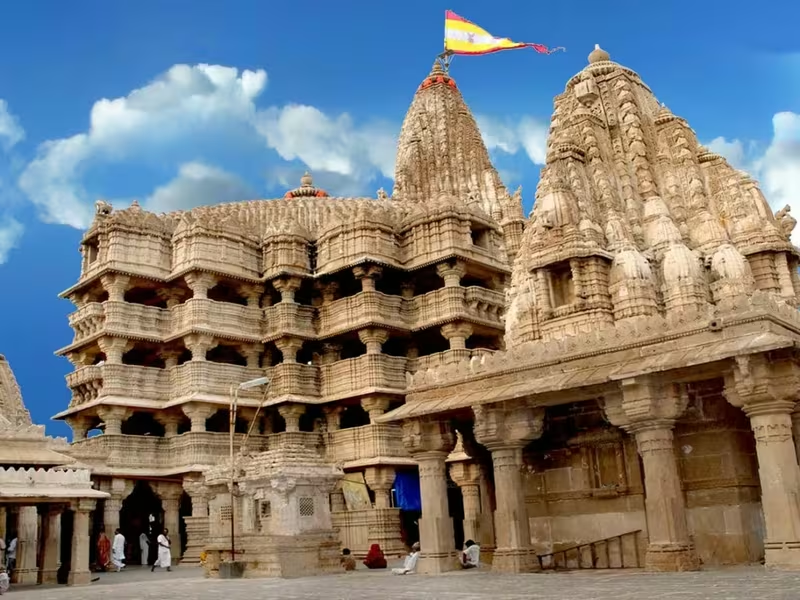
Overview
At the mouth of the Gulf of Kutch, where the Gomti River meets the Arabian Sea, stands Dwarka: a coastal town whose history is inseparable from pilgrimage, legend, maritime activity, and repeated rebuilding. Located on the western shore of the Okhamandal Peninsula in Gujarat, it faces the Arabian Sea and occupies a landscape where the boundary between land and water has always shaped human settlement.
For Hindu traditions, Dwarka is the city of Krishna. Ancient epic and Puranic accounts describe it as the fortified coastal capital to which Krishna moved after defeating Kamsa at Mathura. The city is also counted among the Char Dham, the four major pilgrimage sites associated with Adi Shankaracharya, and among the Sapta Puri, the seven ancient sacred cities of India. Today, the Dwarkadhish Temple, the Gomti ghats, Rukmini Devi Temple, Bet Dwarka, and nearby Shaiva shrines draw pilgrims throughout the year.
Dwarka's importance is not limited to religious tradition. Archaeological investigations on land and beneath the Arabian Sea have identified settlements, fortification-like structures, a large stone-built jetty, and triangular stone anchors. These finds point to a coastal settlement and port tradition, although they do not by themselves establish every detail of the city described in epic literature. Dwarka is therefore best understood as a place where literary memory, living worship, and material evidence have accumulated over many centuries.
The modern town had a population of 38,873 in the 2011 Census of India. Tourism and pilgrimage supply much of its revenue, while agriculture, salt, cement production, and energy generation also contribute to the local economy. Its temples remain active institutions rather than isolated archaeological monuments.
Etymology and Names
The modern name Dwarka developed from the Sanskrit Dvārakā. The root word dvāra means “door,” “gate,” or “entrance,” while the suffix -ka denotes a place. The name is therefore commonly interpreted as “the city of gates” or “gateway city.” This meaning suits the city's literary description as a fortified coastal settlement with multiple entrances.
Dvārakā appears in ancient Indian texts including the Mahabharata and the Harivamsa. In these accounts, the city is associated with Krishna and is portrayed as a defended settlement on the coast. The name later developed into regional forms such as Dwarka in Gujarati and Hindi.
The city has also been known as Dwarkavati, Dwarkamati, and Mokshapuri. The first two names preserve the Sanskrit form of the place-name, while Mokshapuri conveys its religious association as a city connected with liberation. Dwarka is also traditionally regarded as the first capital of Gujarat, though this claim belongs to the historical and religious memory attached to the city rather than to a securely documented political chronology.
Geography and Location
Dwarka lies at the western end of the Saurashtra, or Kathiawar, Peninsula. It stands on the right bank of the Gomti River, near the river's mouth at the Gulf of Kutch. The Gomti rises near Bhavda village at a place called Mul-Gomti, about 10 kilometres east of Dwarka. Until the nineteenth century, the river functioned as a harbour, reinforcing the town's relationship with coastal movement and maritime trade.
The town's position gave it several geographical advantages. It faced the Arabian Sea, stood near the entrance to the Gulf of Kutch, and had access to a river channel that reached the coast. At the same time, the site was vulnerable to coastal erosion and the movement of water. Archaeological interpretations identify coastal erosion as a likely cause of the destruction of an ancient port settlement.
Dwarka has a hot semi-arid climate that borders on a hot arid climate. Its rainfall is concentrated in a short monsoon season lasting about 16 days between June and September. Average annual rainfall is approximately 490 millimetres, but the variation from year to year is unusually high. Recorded annual rainfall has ranged from 15 millimetres in 1987 to 1,288.1 millimetres in 2010. On 2 July 1998, as much as 355.8 millimetres fell in a single day.
The average maximum temperature is about 30 degrees Celsius, while the recorded high is 42.7 degrees Celsius. The average minimum temperature is 23.6 degrees Celsius, with a recorded low of 6.1 degrees Celsius. These conditions, together with the exposed coast, have influenced settlement, agriculture, water use, and the preservation of archaeological remains.
Ancient History
Krishna and the Legendary City
Dwarka's earliest and most influential history comes from epic and Puranic tradition. According to the narrative, Krishna moved from Mathura to the western coast after defeating and killing his uncle Kamsa. He established a new settlement at Dwarka, which became his capital and a fortified refuge for his people.
One tradition says that Krishna reclaimed 12 yojanas of land—given in the historical account as approximately 96 square kilometres—from the sea to create the city. This story connects the city's foundation directly to the coastal landscape. It also offers a religious explanation for a place whose archaeological remains have been affected by submergence and erosion.
These narratives should be distinguished from archaeological dating. The literary tradition describes a city connected with Krishna and the Mahabharata, while archaeological work identifies several layers of settlement from different periods. The two bodies of evidence illuminate Dwarka in different ways: texts reveal the city's enduring cultural meaning, while excavations reveal patterns of occupation, construction, and maritime activity.
Archaeological Evidence
The first investigations on land were carried out in 1963 and produced a range of artefacts. Later excavations at two sites on the seaward side brought to light submerged settlements, a large stone-built jetty, triangular stone anchors with three holes, exterior and interior walls, and fort bastions.
The anchors and harbour structures are especially important because they suggest that Dwarka functioned as a port. Their typological classification has been used to associate the port with the period of the Middle kingdoms of India. The submerged remains also demonstrate the vulnerability of the settlement to changing coastal conditions. Archaeological interpretation identifies coastal erosion as a probable factor in the destruction of the ancient port.
Excavation near the Dwarkadhish Temple produced evidence of a shrine dedicated to Vishnu dating to the ninth century CE. Other work yielded a settlement dated to the first century BCE. A further excavation produced a settlement considered possibly contemporary with the Mahabharata and dated to around the second millennium BCE. The different dates indicate that the area was occupied and transformed repeatedly rather than representing a single, unchanged city.
Bet Dwarka, the island off the coast, adds another important archaeological layer. It is a religious pilgrimage site and an archaeological location associated with the Late Harappan period. One thermoluminescence date from the island has been given as 1570 BCE. This evidence places human activity in the wider Dwarka region within a much older coastal history than the later temple town alone would suggest.
Historical Timeline
Early References and the Maitraka Period
Dwarka appears in early geographical and epigraphic discussions beyond the Sanskrit epics. The Greek author of the Periplus of the Erythraean Sea referred to a place called Baraca, which has been interpreted by some scholars as present-day Dwarka. Ptolemy's Geography mentions Barake as an island in the Gulf of Kanthils, also interpreted as a possible reference to Dwarka. These identifications remain matters of historical interpretation, but they place the city within wider discussions of western India's coastal geography.
A copper inscription dated to 574 CE provides a firmer historical reference. It is associated with Garulaka Simhaditya, the son of Varahdas, identified as the king of Dwarka. The inscription was found at Palitana and connects Dwarka with the political world of the Maitraka dynasty and the regional rulers of western India.
Archaeological interpretation places an early form of the Dwarkadhish Temple no later than 200 BCE. The surviving temple, however, is not that early structure. Like many long-lived sacred sites, the shrine has been rebuilt, enlarged, and altered repeatedly.
The Western Peeth
Adi Shankaracharya is associated with the establishment of four monastic centres at the four corners of India. The western centre was established at Dwarka and became known as the Dwarka peeth, Sharada Matha, or western peeth. The chronology traditionally given for Adi Shankaracharya is 686–717 CE.
The peeth forms part of the Dwarka temple complex. Its presence gave the city significance beyond its local shrine and connected Dwarka to a wider religious network spanning the subcontinent. The city thus became both a destination for Krishna devotees and a centre of monastic learning and authority.
Conflict and Reconstruction in the Fifteenth and Sixteenth Centuries
In 1473, the Gujarat Sultan Mahmud Begada sacked Dwarka and destroyed its temple. The event became one of the major ruptures in the history of the shrine. The temple was subsequently rebuilt, and the present structure is generally associated with reconstruction and enlargement in the fifteenth and sixteenth centuries.
During the period of invasion and instability, the image of Dwarkadhish was moved for protection. Vallabha Acharya is said to have retrieved the idol revered by Rukmini and hidden it in a stepwell known as Savitri vav. It was later moved to Ladva village. In 1551, when Turk Aziz invaded Dwarka, the idol was shifted to Bet Dwarka.
These episodes show how the religious life of the region was sustained through the movement of images, custodians, and communities. The sacred geography of Dwarka extended beyond the central town to stepwells, villages, and the island of Bet Dwarka.
The 1857–59 Conflict
Dwarka and the wider Okhamandal region were under the rule of the Gaekwad of Baroda State during the Indian rebellion of 1857. In 1858, fighting broke out in Okhamandal between local Vaghers and the British. The Vaghers won an initial battle and continued to rule until September 1859.
A joint offensive by British forces, the Gaekwads, and troops from other princely states eventually removed the Vaghers. The operations were led by Colonel Donovan. During the conflict, the temples at Dwarka and Bet Dwarka were damaged and looted.
Local people from Jamnagar, Porbander, and Kutch complained of atrocities committed during the operations. Their complaints led to the restoration of the temples. In 1861, Maharaja Khanderao and the British renovated the Dwarkadhish Temple and refurbished its shikara. Later, in 1958, the Maharaja Gaekwad of Baroda added a golden pinnacle during a refurbishment carried out by the Shankaracharya of Dwarka.
Since 1960, the temple has been maintained by the Government of India.
Political Significance
Dwarka's political significance has taken several forms. In traditional accounts, it was the capital established by Krishna after his movement from Mathura. In regional historical memory, it is regarded as the first capital of Gujarat. Its position on the coast also made it a place of strategic and commercial interest.
The ancient city described in literary traditions was fortified and equipped with multiple gates. Archaeological remains of walls and bastions offer material evidence for defensive construction at the coastal sites, although the surviving evidence does not establish that these structures belonged to the exact city described in the Mahabharata.
In the nineteenth century, Dwarka's importance was demonstrated through the struggle for control of Okhamandal. The conflict involving the Vaghers, the British, and the Gaekwad state was not simply a local disturbance: it brought the town's temples and religious institutions into the consequences of regional military operations. The subsequent restorations also show how the temple functioned as a political and social institution whose condition affected communities across western Gujarat.
Religious and Cultural Importance
Dwarkadhish Temple
The Dwarkadhish Temple, also called Jagat Mandir, is the centre of Dwarka's religious life. It is a Vaishnava temple dedicated to Krishna, whose principal image is known as Dwarkadeesh. The deity is represented in the four-armed Trivikrama form of Vishnu.
The temple faces west and stands about 12.19 metres above mean sea level. Its present form is associated with the sixteenth century, although the site is traditionally believed to be 2,500 years old and to mark the location where Krishna built his city and temple. The five-storeyed structure is built over 72 pillars. Its spire rises approximately 78 metres, and a large flag bearing symbols of the sun and moon is hoisted above it.
The temple's plan includes the garbhagriha, or sanctum, also called Nijamandira or Harigraha, and an antarala, or antechamber. The complex also incorporates the Dvaraka Pitha, or western peeth, associated with Adi Shankaracharya.
Gomti Ghat
Gomti Ghat consists of steps leading down to the Gomti River. Pilgrims traditionally bathe at the ghat before visiting the Dwarkadhish Temple. Small shrines in the area are dedicated to Samudra, the god of the sea, Saraswati, and Lakshmi.
The ghat also contains the Samudra Narayana, or Sangam Narayana, Temple at the confluence of the Gomti and the sea. The Chakra Narayana Temple preserves a stone with an imprint of a chakra, understood as a manifestation of Vishnu. The Gomati Temple contains an image of the river goddess Gomati, which tradition says was brought to earth by the sage Vasishta.
Rukmini Devi Temple
The Rukmini Devi Temple stands approximately two kilometres from Dwarka and is dedicated to Rukmini, Krishna's chief queen. Tradition assigns the shrine an antiquity of 2,500 years, while its present form is estimated to belong to the twelfth century.
The temple is richly carved. Sculptures of gods and goddesses decorate the exterior, while the sanctum houses the principal image of Rukmini. Panels at the base of the tower contain carved human figures, known as naratharas, and elephants, known as gajatharas.
Janmashtami
Janmashtami, celebrated during Bhadrapada in August or September, is Dwarka's principal festival. Celebrations continue through the night with bhajans, sermons, Garba, and Raas dances. At midnight, performances mark Krishna's birth and childhood.
A local form of the Dahi Handi or Utlotsavam tradition involves boys forming a human pyramid. A young boy dressed as Krishna climbs the pyramid to break a pot of butter, recalling Krishna's mischievous acts among the gopis. The festival makes the city's mythological identity visible through music, dance, ritual, and public participation.
The Gugli Brahmins serve as hereditary pilgrimage priests of Dwarka. Their role reflects the town's continuing institutional connection with pilgrimage.
Economic Role
Tourism and pilgrimage provide most of Dwarka's revenue. The town is part of the Krishna pilgrimage circuit, which includes Vrindavan, Mathura, Barsana, Gokul, Govardhan, Kurukshetra, Veraval, and Puri. It is also one of twelve heritage cities selected under the Government of India's Heritage City Development and Augmentation Yojana, or HRIDAY, intended to improve civic infrastructure.
Dwarka's older economy was connected to its port and coastal position. Agricultural products such as millets, ghee, oilseeds, and salt are transported from the port. The Gomti served as a harbour until the nineteenth century, while submerged structures and anchors indicate an earlier maritime role.
Modern industrial activity centres mainly on cement production. A wind farm near Dwarka generates 39.2 megawatts of power. It was operated by AES Saurashtra Windfarms and is now run by Tata Power Renewable Energy. Education also contributes to the town's institutions: Sharda Peeth Vidya Sabha, sponsored by the Sharda Peeth, runs an arts college in Dwarka.
Monuments and Architecture
Dwarka's built heritage combines temple architecture, pilgrimage infrastructure, riverfront spaces, and maritime landmarks. The Dwarkadhish Temple dominates the town's sacred landscape with its tall spire, flag, sculptural programme, sanctum, and pillared structure.
The Gomti ghats express the relationship between the town and the river. Their steps allow ritual bathing and provide access to shrines associated with the sea, Vishnu, Saraswati, Lakshmi, and the river goddess Gomati.
The Rukmini Devi Temple represents a distinct temple complex with a richly carved exterior and sculptural panels. Nearby, the Nageshvara Jyotirlinga is an ancient Shiva temple counted among the twelve Jyotirlingas. The shrine's image is located in a subterranean cell.
Dwarka also has a lighthouse at the end of the peninsula. The fixed light stands 70 feet above sea level and can be seen from a distance of about 10 miles. The tower itself is 40 feet high and stands 117 yards from the high-water level. Its radio beacon is powered by a solar photovoltaic module. From Dwarka Point, the lighthouse provides a panoramic view of the town and coast.
Gopi Talab, a lake or tank in the western part of Dwarka, is another place associated with the city's sacred geography. A similar lake on Bet Dwarka is connected with Gopi Chandan, or “sandal paste from Gopi.” The fragrant mud from its bed is applied by Hindu devotees to the forehead as a mark of sanctity.
Bet Dwarka
Bet Dwarka is an island in the Arabian Sea off the coast of Dwarka. Religious tradition considers it the original residence of Krishna and the old port associated with his time, before the development of Okha port in Dwarka. The main temple on the island is credited to Vallabha Acharya of the Pushtimarg Sampradaya.
Rice is traditionally offered to the deity because Sudama is believed to have presented rice to his childhood friend Krishna. Smaller shrines on the island are dedicated to Shiva, Vishnu, Hanuman, Devi, Rukmini, Trivikrama, Devaki, Radha, Lakshmi, Satyabhama, Jambavati, Lakshmi Narayan, and other deities.
One legend says that Vishnu killed the demon Shankhasura on the island. Other temples represent Vishnu in the Matsya, or fish, incarnation. The island's archaeological importance is equally notable: it is associated with the Late Harappan period and has produced a thermoluminescence date of 1570 BCE.
Hanuman Dandi Temple lies on Bet Dwarka, about six kilometres from the Dwarkadhish Temple. It contains several images of Hanuman and his son Makardhwaja. According to the legend, Hanuman's sweat was consumed by a crocodile, which then gave birth to Makardhwaja. The Jethwa Rajput clan of Kshatriyas claims descent from him.
Access to Bet Dwarka has been improved by Sudarshan Setu, a bridge connecting the island with the mainland.
Decline, Restoration, and Revival
Dwarka's history is not a simple sequence of rise and decline. It is a story of repeated transformation. Coastal erosion probably destroyed parts of the ancient port, while later communities rebuilt religious structures on or near earlier sacred ground. The Dwarkadhish Temple itself has an early history associated with a shrine dated no later than 200 BCE, evidence of a ninth-century Vishnu shrine near the temple, and a present structure associated with fifteenth- and sixteenth-century rebuilding.
The sack of 1473 and the invasions of the sixteenth century disrupted the temple's ritual life and led to the movement of its sacred image. The nineteenth-century conflict in Okhamandal again damaged the temples. Yet each disruption was followed by restoration, allowing Dwarka to remain a major pilgrimage centre.
Modern infrastructure has continued this process of renewal. Sudama Setu, a bridge over the Gomti River connecting mainland Dwarka with Panchkui island, opened in 2016. In December 2023, the Government of Gujarat announced an underwater tourism project in collaboration with Mazagon Dock Shipbuilders. The proposed submarines would descend to 100 metres and carry 24 tourists along with pilots and crew, allowing visitors to view the marine environment around Dwarka. The facility was announced for operation by October 2024.
Modern City
Dwarka is now part of Devbhoomi Dwarka district in Gujarat. According to the 2011 Census, it had 38,873 residents: 20,306 males and 18,567 females. The literacy rate was 75.94 percent, with male literacy at 83 percent and female literacy at 68.27 percent. About 11.98 percent of the population was under six years of age.
The town is connected by road and rail with cities across Gujarat and other parts of India. Dwarka railway station is a busy Western Railway junction served by regional and long-distance trains. Weekly services connect the town with Guwahati, Rameswaram, Puri, Tuticorin, Dehradun, and Kolkata. Daily trains connect it with Ahmedabad, Bhavnagar, Jamnagar, Junagadh, Rajkot, Surat, Vadodara, and Veraval.
The nearest airport is Jamnagar Airport, approximately 131 kilometres away. Dwarka is about 217 kilometres from Rajkot, 235 kilometres from Somnath, and 378 kilometres from Ahmedabad.
The town's attractions include the Dwarkadhish Temple, Gomti Ghat, Rukmini Devi Temple, Nageshvara Jyotirlinga, Bet Dwarka, the lighthouse, and Shivrajpur Beach. Shivrajpur Beach lies about 14.5 kilometres from Dwarka Railway Station and is among the Indian beaches to receive Blue Flag certification.
Dwarka's present identity therefore rests on several connected roles: sacred city, temple town, archaeological landscape, former port, coastal settlement, and modern tourism centre. Its importance lies not in a single uncontested date or monument, but in the way successive communities have continued to interpret and inhabit the same coastal space.
Timeline
Early regional settlement
Archaeological evidence from the wider Dwarka region includes a Late Harappan context at Bet Dwarka, with one thermoluminescence date of 1570 BCE.
Early Dwarkadhish shrine
Archaeological interpretation dates an early form of the Dwarkadhish Temple to no later than 200 BCE.
Coastal settlement
Excavation near the temple produced evidence of a settlement dated to the first century BCE.
Copper inscription
A copper inscription associated with Simhaditya, son of Varahdas, identifies a king of Dwarka.
Western monastic centre
Dwarka became associated with the western peeth traditionally connected with Adi Shankaracharya.
Vishnu shrine
Excavation near the Dwarkadhish Temple yielded a shrine dedicated to Vishnu dating to the ninth century CE.
Sack of Dwarka
Mahmud Begada sacked the town and destroyed the temple.
Image moved to Bet Dwarka
During the invasion of Turk Aziz, the image of Dwarkadhish was shifted to Bet Dwarka.
Conflict in Okhamandal
Vaghers fought the British in the region during the wider crisis of 1857–59.
Temple restoration
Maharaja Khanderao and the British renovated the Dwarkadhish Temple and refurbished its shikara.
Golden pinnacle added
The Maharaja Gaekwad of Baroda added a golden pinnacle during a refurbishment.
Government maintenance
The Government of India assumed maintenance of the principal temple.
Sudama Setu opens
A bridge over the Gomti connected mainland Dwarka with Panchkui island.
Underwater tourism announced
The Government of Gujarat announced a submarine-based underwater tourism project for the marine area around Dwarka.