Overview
On the right bank of the Ganga, in present-day Meerut district, stands Hastinapur—the city remembered in the Mahabharata as the capital of the Kuru kingdom. Its name is usually translated from the Sanskrit Hastinapura as “City of Elephants,” combining hastina, elephant, with pura, city. Tradition also connects the name with King Hasti.
Hastinapur occupies an unusual position between epic memory, religious practice and archaeology. In the Mahabharata, it is the courtly centre of the Kauravas and the setting for many episodes involving the Kuru royal family. The Puranas present it as the capital of the kingdom of Emperor Bharata, while ancient Jain texts also mention the city. Modern religious geography continues this layered inheritance: Hastinapur is regarded as holy by both Hindus and Jains and contains temples, pilgrimage complexes and sites associated with figures from the epic tradition.
Archaeological work has added a different kind of history. Excavations begun in the early 1950s revealed pottery, walls, floors, drains, coins, seals, figurines, tools and evidence of food production. B. B. Lal, who directed that work, was especially interested in establishing the position of Painted Grey Ware in relation to other early ceramic industries. The material found at Hastinapur also led him to compare the archaeological record with episodes in the Mahabharata, particularly the tradition of a destructive flood and the movement of the Kuru capital to Kaushambi.
The chronology remains a subject of interpretation. Lal’s excavations suggested repeated abandonment and reoccupation, including a substantial gap after the third century CE. Excavations reported for 2021–22 instead describe a more continuous occupation from antiquity into the late medieval period. These differing interpretations make Hastinapur valuable not only as a place of pilgrimage but also as a case study in how archaeology and literary tradition are brought into conversation.
Etymology and Names
The Sanskrit form Hastinapura is generally explained as “City of Elephants.” The first element, hastina, refers to an elephant, while pura means city or settlement. The city is also said to have been named after King Hasti.
The name appears in several bodies of Indian literature. In the Mahabharata, Hastinapur is the capital of the Kuru kingdom and the royal centre of the Kauravas. The Puranas give it an even broader dynastic setting by describing it as the capital of Emperor Bharata’s kingdom. Hastinapur is also mentioned in ancient Jain texts, a literary association that corresponds with the city’s continuing importance as a Jain pilgrimage centre.
The Ramayana contains a reference to the city in a passage describing messengers who crossed the Ganga at Hastinapura. They then travelled westwards through Kuru Jangala towards the Panchala kingdom, passing lakes and clear-water rivers. This reference places Hastinapur within a wider landscape of routes and territorial names associated with northern India.
Geography and Location
Modern Hastinapur lies in the Doab region of Uttar Pradesh, approximately 37 kilometres from Meerut and nearly 96 kilometres north-east of Delhi. It is located at about 29.17° north and 78.02° east, with an average elevation of 218 metres. National Highway 34 connects the town with the surrounding region.
The settlement stands beside an old ravine of the Ganga. The river’s proximity has shaped both the religious identity and the archaeological interpretation of Hastinapur. The Ganga is central to the city’s sacred landscape, while possible changes in the river’s course or flooding may have affected the location and continuity of settlement.
Hastinapur experiences hot summers, a monsoon season and cool winters. Summer extends broadly from March to May, when temperatures may range from 32 to 40°C. The monsoon generally falls between July and September. Winter lasts from December to February; December is usually the coldest month, and temperatures may fall to around 5°C without commonly rising above 14°C.
The wider landscape also includes the Hastinapur Sanctuary, established in 1986. The sanctuary extends across parts of Meerut, Ghaziabad, Gautam Budh Nagar, Bijnor, Hapur and Jyotiba Phule Nagar districts, covering nearly 2,073 square kilometres. It is a forested regional landscape rather than a monument within the ancient settlement itself.
Ancient History
Excavation and the earliest layers
The first major excavations at Hastinapur took place in the early 1950s under B. B. Lal, then Director General of the Archaeological Survey of India. Lal’s immediate archaeological objective was to determine the stratigraphic position of Painted Grey Ware in relation to other ceramic industries of the early historical period. The excavation nevertheless became important for the study of the Mahabharata because Lal identified apparent parallels between literary traditions and the material remains.
The earliest phase in Lal’s report was placed before approximately 1200 BCE. Settlement during this phase appears to have been sporadic, and no structures were identified. Scattered fragments of Ochre Coloured Pottery were the principal finds. Lal’s excavation suggested a break between this early phase and the next, implying that the site may have been abandoned for a time before being occupied again.
The excavation report from the 2020s offers a different picture. It describes a bottom layer dating approximately from 1500 to 1000 BCE, in which Painted Grey Ware predominated. Mud and mud-brick walls were also reported. This interpretation therefore suggests occupation in the earlier period rather than a simple initial phase followed by a long interruption.
Painted Grey Ware and early settlement
In Lal’s chronology, the second period extended approximately from 1100 to 800 BCE and was marked by Painted Grey Ware, a ceramic tradition frequently associated with the Vedic period. Complete houses have not been found from this phase, but traces of walls were preserved. These were built of mud, mud brick or reeds, including Saccharum spontaneum, arranged horizontally and vertically and covered with mud plaster.
The plaster was reinforced with rice husks, a technique that has continued in parts of the subcontinent into modern times. Charred rice grains were also recovered. Their presence indicates that rice was cultivated at Hastinapur during this period and represents one of the earliest archaeological attestations of rice cultivation in the Indian subcontinent.
Copper appears to have been the principal metal in this phase. No finished iron objects were found, although lumps of iron ore and iron slag occurred in the uppermost portion of the layer, closer to the end of the period. The settlement’s economy also included substantial cattle-rearing. Large numbers of bones belonging to zebu cattle and water buffalo were recovered. Cut marks on cattle, sheep and pig bones indicate slaughter for food. The remains therefore provide evidence for a diet that included beef and pork in this period.
The more recent excavation report divides the chronology differently. It describes continuous occupation through a phase from approximately 1000 to 500 BCE, characterised by Northern Black Polished Ware alongside other pottery types. The difference between the two chronologies is significant: it affects how the settlement’s continuity, pottery sequence and relationship with early northern Indian history are understood.
The Mahabharata and Hastinapur
The Mahabharata presents Hastinapur as the capital of the Kuru kingdom and the seat of the Kaurava royal family. Many of the epic’s political conflicts unfold in or around the city. It is associated with King Dhritarashtra, Queen Gandhari and their sons, the hundred Kauravas. The city also forms part of the story of the Pandavas, whose rivalry with the Kauravas culminates in the great war described by the epic.
Local places near Hastinapur preserve this memory in their names. Draupadi Ghat and Karna Ghat are situated along the Budhi Ganga and refer to prominent Mahabharata figures. The Karna Temple and Pandeshwar Temple also draw their present significance from epic associations, although the historical dates of the structures and the traditions attached to them should not be treated as identical.
The Mahabharata tradition also includes a story of environmental disaster. During the reign of the Kuru king Nichakshu, a great flood is said to have occurred in the Ganga, carrying away a considerable part of Hastinapura. The capital was then moved to Kaushambi. Lal compared this literary account with an erosional scar identified in the mound and proposed that a major flood may have damaged the settlement around 800 BCE.
This interpretation remains cautious. The 2020s excavation report did not confirm or reject a flood. Nor does the archaeological evidence by itself establish that the literary account records a single identifiable historical event. The comparison is nevertheless important because it shows how a physical feature in the mound was used to investigate the possible historical background of an epic tradition.
Historical Timeline
Early historic development
According to Lal’s excavation report, the settlement was reoccupied after approximately 800 BCE, and a later phase began around the early sixth century BCE. Houses in this period used mud bricks and baked bricks. Northern Black Polished Ware replaced Painted Grey Ware as the characteristic pottery, and the excavated layers also contained burnt-brick drains designed to carry wastewater away.
Iron objects first appear clearly in this phase, along with copper and silver coins. The phase may have ended in the early third century BCE after a fire destroyed much of the settlement. Burnt walls and floors, together with charcoal remains from reed matting used as roofing, were cited as evidence.
The more recent excavation report gives a different sequence. It places its third phase in approximately the third and second centuries BCE, broadly corresponding to the Mauryan period. An inscription on a terracotta sling ball from this layer was dated palaeographically to roughly the fourth or third century BCE. The report did not discuss a destructive fire.
Shunga and Kushan-period occupation
Lal’s report proposed another gap before reoccupation in the early second century BCE. In his chronology, the site remained inhabited until the late third century CE. Baked bricks dominated construction, forming both walls and floors. The settlement appears to have been laid out with a fairly regular grid.
Evidence from this period indicates a community with varied religious, technological and commercial connections. A terracotta figurine of Maitreya, the future Buddha, was found in the upper part of the layer. It depicts Maitreya seated in the abhayamudra, with a kamandalu in the left hand. Its style has similarities with sculptures from Mathura and Ahichchhatra, suggesting interaction with artistic traditions associated with those centres.
A rotary quern was also recovered. It represented a more efficient grinding technology than the saddle querns that had predominated at earlier protohistoric sites in the Indian subcontinent. Other objects include two inscribed pots belonging to individuals named Sadhujata and Jayasama, a terracotta seal and coins associated with several political authorities.
The coins included issues from rulers of Mathura dating to the second century BCE, Yaudheya coins from around the transition between the BCE and CE eras, and pieces imitating coins of the Kushan ruler Vasudeva I in approximately the mid-third century CE. The 2020s excavation report places a comparable phase from roughly the second century BCE to the second century CE and records terracotta seals, including examples dated palaeographically to the first or second century BCE and to the Kushan period. Coins of the Indo-Greek king Menander I were also found.
Gupta and later occupation
The original excavations suggested that Hastinapur was abandoned after approximately the third century CE and reoccupied only in the late eleventh century. Later investigations challenge this conclusion. A terracotta seal of the Gupta ruler Vishnugupta, together with various Gupta coins, demonstrates occupation during the Gupta period.
The 2020s report identifies a fifth phase corresponding broadly to the Gupta and Later Gupta periods, extending from approximately the third to the seventh centuries CE. Ceramic roof tiles and textile-making tools reach particularly high levels during the period from the Shunga to Gupta dynasties, roughly the second century BCE to the sixth century CE. Coins and seals point to an administrative and commercial centre connected with wider routes. The Uttarapatha, a major route across northern India, may have passed through or near the network to which Hastinapur belonged, although this connection is presented as a possibility rather than a fixed conclusion.
Medieval period
The recent excavation report records another phase from roughly the eighth to the eleventh centuries. Its structures resembled those of the Gupta period. Iron rings, nails, sickles and sword fragments were found, and the wider collection includes objects dated from the sixth century BCE to the sixteenth century CE. Crucibles and slag indicate that inhabitants carried out melting activities.
A final phase, dated approximately from the eleventh or twelfth centuries to the sixteenth century, reused bricks from earlier structures. The settlement may have been abandoned after this period, or the inhabited area may simply have shifted beyond the excavated zone. Flooding or a change in the course of the Ganga may have contributed to this transition.
Lal’s medieval Period V contained pottery that differed substantially from the preceding phase. Its structures reused bricks from earlier buildings as spolia. A coin from the reign of Sultan Balban, who ruled from 1266 to 1287, helps establish the date of the layer. A sandstone image of Rishabhadeva, the first Jain Tirthankara, probably dating to the fourteenth century, is especially important. It confirms the earlier presence of Jain religious activity at a city that remains a major Jain pilgrimage centre today.
Political Significance
Hastinapur’s principal political identity comes from the Kuru kingdom. The Mahabharata places the Kuru court here and presents the city as the seat of dynastic authority during the conflict between the Kauravas and Pandavas. The Puranic tradition likewise gives the city a royal role as the capital of Bharata’s kingdom.
Archaeology suggests that Hastinapur was not merely a ceremonial or legendary centre. Coins, seals, planned brick construction, craft tools and evidence of long-distance artistic and commercial links indicate a settlement with administrative and economic functions. The precise political authorities who controlled the city in each archaeological phase cannot always be identified, but the material record reveals sustained urban activity.
In the Mughal period, Hastinapur was listed in the Ain-i-Akbari as a pargana under Delhi sarkar. It produced a recorded revenue of 4,466,904 dams for the imperial treasury and supplied 300 infantry and 10 cavalry. Abu’l-Fazl described it as “an ancient Hindu settlement” lying on the Ganges. This administrative description shows that the city retained a recognised place in the imperial revenue and military system even though its political role was no longer that of a royal capital.
Religious and Cultural Importance
Hindu traditions connect Hastinapur with the Kuru dynasty, the Kauravas, the Pandavas and several major episodes of the Mahabharata. Pandeshwar Temple is dedicated to Shiva and is traditionally associated with the education of the Kauravas and Pandavas in the Vedas and Puranas. A local tradition holds that Yudhishthira established the Shiva lingam there before the war and prayed for victory.
The nearby Karna Temple contains a Shiva lingam believed to have been established by Karna. These traditions are part of the living sacred landscape of the town. They express the continuing importance of epic memory, even where the dates of the existing temples are not established by the archaeological information available here.
Hastinapur is equally important in Jain religious geography. It is believed to be the birthplace of three Jain Tirthankaras and contains major Digambara and Shvetambara institutions. The sandstone Rishabhadeva sculpture from the medieval archaeological layer provides material evidence for the city’s earlier Jain importance.
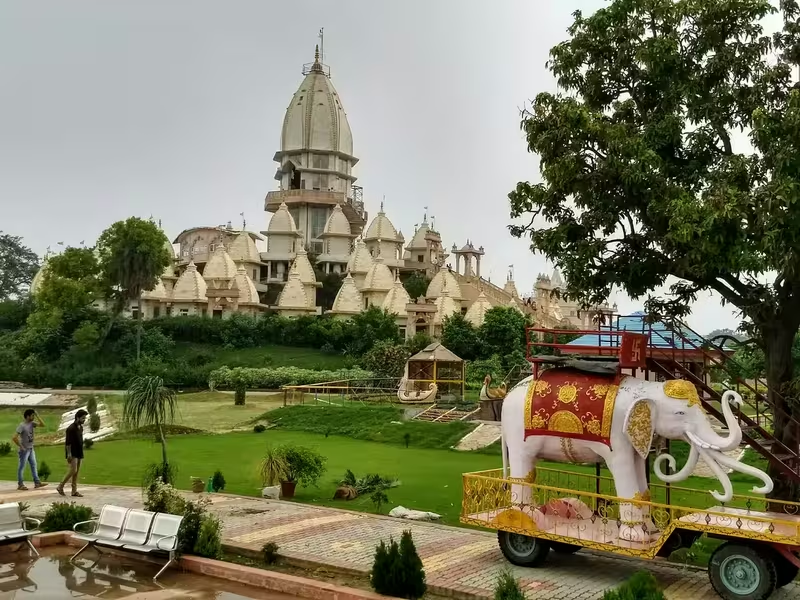
Jambudweep Jain Tirth, designed under the supervision of Shri Gyanmati Mataji in 1985, presents a model of Jain cosmology. Other major Jain institutions include the Digamber Jain Bada Mandir, Shri Shwetambar Jain Ashtapad Teerth and Kailash Parvat. The town’s festivals include Akshaya Tritiya, Das Lakshana, Kartik Mela, Holi Mela and Durga Puja. These events are organised with participation from non-government organisations and the State Tourism Department.
Economic Role
Hastinapur’s archaeological record points to more than subsistence settlement. Rice cultivation, cattle-rearing, textile production, pottery manufacture, metalworking and coin circulation all appear at different stages. The presence of textile-making tools reaches a notable level during the Shunga-to-Gupta centuries, while crucibles and slag demonstrate later metalworking activity.
The city’s coins and seals are especially valuable for reconstructing its connections. Issues associated with Mathura, the Yaudheyas, the Kushans, the Indo-Greek king Menander I and the Gupta period indicate that Hastinapur participated in networks larger than its immediate surroundings. These finds support the description of the settlement as an administrative and commercial centre.
Its position near the Ganga and within the Upper Ganges basin likely helped connect it with regional movement, although the exact routes used at different times cannot always be established. The possible relationship with the Uttarapatha, the great northern route, remains an informed archaeological possibility rather than a securely documented fact for every period.
Monuments and Architecture
The Digamber Jain Bada Mandir is regarded as one of the oldest Jain temples in Hastinapur. The main temple is believed to have been built in 1801 under the patronage of Raja Harsukh Rai, imperial treasurer of Shah Alam II. The complex includes a Jain Gurukul, an Udaseen Ashram and other facilities. Nearby attractions include Jal Mandir, a Jain library, the Acharya Vidyanand Museum, 24 Tonks and ancient Nishiyajis.
The Shri Shwetambar Jain Ashtapad Teerth is a 46-metre-high structure dedicated to Rishabhnath, the first Tirthankara. Kailash Parvat Rachna, standing about 40 metres high, is another major Jain complex. It includes temples, a pilgrims’ residence, a dining hall, an auditorium and a helipad.
At Jambudweep Jain Tirth, the built landscape represents Jain cosmology. Its construction under the supervision of Shri Gyanmati Mataji in 1985 makes it a modern addition to Hastinapur’s long religious history.
The Pandeshwar Temple stands at a location identified with the ancient city. A Kali temple and Hindu ashramas are also found on the nearby hillock among the ruins. The Karna Temple lies near Pandeshwar beside an old ravine of the Ganga.
Vidur ka Tila is an archaeological mound associated with Vidura, a prominent figure in the Mahabharata tradition. A pillar marks the site, which overlooks the Ganges Canal and is visited by pilgrims.
Famous Personalities and Associations
Hastinapur is associated in epic tradition with Dhritarashtra, Gandhari, the Kauravas, the Pandavas, Draupadi, Karna, Vidura and Yudhishthira. These figures belong to the narrative world of the Mahabharata, and the city’s modern ghats, temples and mounds preserve their names.
The archaeologist B. B. Lal is central to the modern history of the site because his excavations in the 1950s established the first detailed archaeological sequence discussed here. His interpretation of the apparent flood layer influenced later debates about the possible historical background of the Mahabharata’s account of Hastinapur.
In the modern colonial period, Raja Nain Singh Nagar ruled Hastinapur and is associated with the construction of many Hindu temples in and around the town.
Decline and Revival
Hastinapur’s history includes several proposed episodes of interruption. Lal’s excavations suggested an early break between settlement phases, a major flood around 800 BCE, a possible fire in the early third century BCE and another long gap after the third century CE. The flood was connected with the Mahabharata tradition that the Kuru capital moved to Kaushambi after the Ganga damaged Hastinapur.
The 2020s excavations revise several elements of this picture. They suggest continuing occupation from antiquity through the late medieval period and do not make a definitive statement about the proposed flood or fire. The later settlement reused older bricks and may have shifted because of flooding or a change in the Ganga’s course.
The modern town was re-established by Jawaharlal Nehru on 6 February 1949. Its revival has been religious as much as civic. Jain temples, cosmological models and pilgrimage facilities now stand alongside Hindu temples and archaeological mounds, allowing several historical traditions to coexist in the landscape.
Modern City
Hastinapur Nagar Panchayat had a population of 26,452 according to the 2011 Census of India: 14,010 males and 12,442 females. The literacy rate was recorded as 74.5 percent, slightly above the national average given in the demographic account. Approximately 14 percent of the population was below six years of age.
The town’s present identity combines a small urban settlement, a pilgrimage destination and a heritage landscape. Visitors encounter active temples, Jain institutions, religious fairs, archaeological mounds, the old Ganga ravine and the wider environment of the Hastinapur Sanctuary. Its location near Meerut and Delhi, along National Highway 34, supports access from the surrounding region.
Hastinapur’s historical importance is therefore not confined to a single period. The epic capital, the Painted Grey Ware settlement, the early historic town, the Gupta-period centre, the medieval Jain site and the modern pilgrimage town are distinct layers of memory and evidence. Together, they explain why Hastinapur remains one of the most evocative historical places in the Upper Ganges basin.
Timeline
Early archaeological occupation
The 2020s excavation report describes a bottom layer dating approximately from 1500 to 1000 BCE, with Painted Grey Ware and mud or mud-brick structures.
Early settlement phase
Lal’s excavation report placed an initial, sporadic phase before approximately 1200 BCE and identified Ochre Coloured Pottery.
Painted Grey Ware phase
A phase associated by Lal with the Vedic period included mud, mud-brick and reed construction, rice cultivation and substantial cattle-rearing.
Possible flood and change of capital
An erosional scar led B. B. Lal to suggest a major flood around this time and compare it with the Mahabharata tradition of the Kuru capital moving to Kaushambi.
Early historic settlement
Mud-brick and baked-brick houses, Northern Black Polished Ware, drains, iron objects and coins appear in Lal’s third phase.
Possible fire and Mauryan-period phase
Lal’s report associated the end of one phase with a destructive fire, while the 2020s report identified a Mauryan-period phase and a terracotta sling-ball inscription.
Shunga and Kushan-period growth
Baked-brick construction, grid-like planning, seals, coins, textile tools and a Maitreya figurine indicate a prosperous later ancient settlement.
Gupta-period occupation
A seal of Vishnugupta and Gupta coins provide evidence that Hastinapur remained occupied during the Gupta period.
Medieval Jain evidence
A sandstone sculpture of Rishabhadeva, perhaps dating to the fourteenth century, records Hastinapur’s continuing Jain importance.
Digamber Jain Bada Mandir
The main temple is believed to have been built under the aegis of Raja Harsukh Rai.
Modern re-establishment
The modern township was re-established by Jawaharlal Nehru on 6 February 1949.
Jambudweep Jain Tirth
A modern model of Jain cosmology was designed at Hastinapur under the supervision of Shri Gyanmati Mataji.
Hastinapur Sanctuary
The large regional wildlife sanctuary was established across parts of western Uttar Pradesh.