Overview
In 746 CE, the Chavda ruler Vanaraja established a settlement called Anahilapataka in northern Gujarat. That city grew into Patan, a regional capital whose history connects dynastic power, Jain religious life, water architecture, commerce, and textile production.
Patan became the capital of the Chaulukya, or Solanki, dynasty between the tenth and thirteenth centuries. It later served briefly as the capital of the Gujarat Sultanate from 1407 to 1411. Across these political changes, the city remained a trading centre and a place where Hindu, Jain, and Muslim religious traditions left visible architectural traces.
The modern city stands beside the now-extinct Saraswati River. Its best-known monuments include Rani ki Vav and the Sahastralinga Tank, while its living heritage is represented by Patola, an exceptionally precise hand-woven textile. Patan also retains an important Jain community, historic markets, temples, mosques, dargahs, and rauzas.
Etymology and Names
Patan was established as Anahilapataka by Vanaraja Chavda in the ninth century. The city is also associated with the names Anahilavada and Patan. The surviving historical account identifies Vanaraja as the founder of the territory in 746 CE.
Vanaraja is also credited with building the Panchasara Parshvanath temple. Its principal image of Parshvanatha was brought from Panchasar village, linking the new political centre to an important Jain foundation from the beginning of its recorded history.
Geography and Location
Patan is located in Gujarat's northern region and is the headquarters of Patan district. Its historical settlement developed on the bank of the Saraswati River, which is now extinct. The river was seasonal even during its most favourable period, yet its presence shaped the city's monuments and memory.
Rani ki Vav was constructed beside the Saraswati, and the riverbank setting helps explain the importance of water architecture in Patan. The city also contains the Sahastralinga Tank, an artificial water tank built during the Chaulukya period. Together, these sites show how water management became part of the architectural and political landscape of medieval Gujarat.
Ancient and Early Medieval History
The history presented for Patan begins with the Chavda dynasty. Vanaraja Chavda, whose reign is dated approximately to 746–780 CE, established the city in 746 CE. The new settlement was named Anahilapataka and became the foundation for Patan's later political importance.
The Panchasara Parshvanath temple was associated with Vanaraja's foundation. Jain traditions remained central to the city's identity in later centuries, particularly under the Chaulukyas. Patan's early development therefore combined royal establishment with religious patronage and the growth of an urban centre in northern Gujarat.
Historical Timeline
Chavda Foundation
Vanaraja Chavda established Anahilapataka in 746 CE. He also built the Panchasara Parshvanath temple, whose principal idol was brought from Panchasar village. This foundation marked the beginning of Patan's long career as a capital and pilgrimage centre.
Chaulukya Period
From the tenth through the thirteenth centuries, Patan served as the capital of the Chaulukya dynasty, also known as the Solanki dynasty. During this period, it flourished as a major regional centre. Jain pilgrimage expanded, and the region came to contain more than 100 temples.
The Chaulukya period also saw the construction of the Sahastralinga Tank. Rani ki Vav belongs to the same broader tradition of monumental water architecture associated with medieval Gujarat. Patan's political role and religious significance reinforced each other: royal power supported major public works, while temples and pilgrimage drew communities and visitors to the capital.
Vaghela and Sultanate Connections
The city's old market is believed to have remained in continuous operation since at least the rule of the Vaghelas. This tradition reflects Patan's enduring commercial importance after the main Chaulukya period.
During the Gujarat Sultanate, Patan was the capital from 1407 to 1411. The city contains mosques, dargahs, and rauzas alongside its Hindu and Jain temples, demonstrating the layered religious and political history of the urban settlement.
Political Significance
Patan's principal historical importance came from its role as a capital. Under the Chavdas it was newly established as Anahilapataka; under the Chaulukyas it became the centre of a powerful dynasty in Gujarat; and under the Gujarat Sultanate it briefly continued as a capital.
Its position as a regional capital encouraged the construction of temples, tanks, markets, and other public spaces. It also made Patan a meeting point for different religious communities and commercial networks. The city's surviving monuments are therefore not isolated structures but reminders of its wider administrative and economic role.
Religious and Cultural Importance
Patan is particularly associated with Jainism. During the Chaulukya period it became a major Jain pilgrimage centre, and more than 100 temples are recorded in the region. A large Śvetāmbara Murtipujaka Jain community continues to have deep roots in the city.
The Panchasara Parshvanath Temple remains an important Jain site. The temple was rebuilt in the sixteenth and seventeenth centuries after destruction attributed to Muslim invaders. This later history illustrates the repeated rebuilding and preservation through which religious monuments survived periods of political change.
Patan's religious landscape is broader than its Jain heritage. The city contains Hindu temples as well as mosques, dargahs, and rauzas. Its annual cultural life includes Garba, celebrated across Gujarat, and Rathyatra. The Rathyatra of Patan is described as the third biggest and oldest in the world after those of Puri and Ahmedabad.
Economic Role and Patola Weaving
Patan prospered as a trading city and retained an old market of considerable size. The market is believed to have been operating continuously since at least the Vaghela period, making it an important expression of the city's long commercial life.
Patan is also renowned for Patola, a highly delicate hand-woven sari made with exceptional precision. Depending on the complexity of the pattern and whether the sari is five or six metres long, production can take four to six months. Vegetable colours are used, and prices range from approximately ₹20,000 to ₹20,00,000 depending on the difficulty of the work and the use of gold thread.
The craft is traditionally transmitted within a very limited number of families. The source account identifies two families making Patola saris and notes that the art is taught to sons within those families. Salvivad is associated with Patola weaving and the production of traditional clay toys. A Patola Heritage Museum, managed by the Salvi family, presents the weaving tradition as an ancestral craft preserved for more than thirty-five generations. Shri Vinayak Kantilal Salvi received the Ship Guru Award in 2002 for his dedication to the heritage craft.
Monuments and Architecture
Rani ki Vav
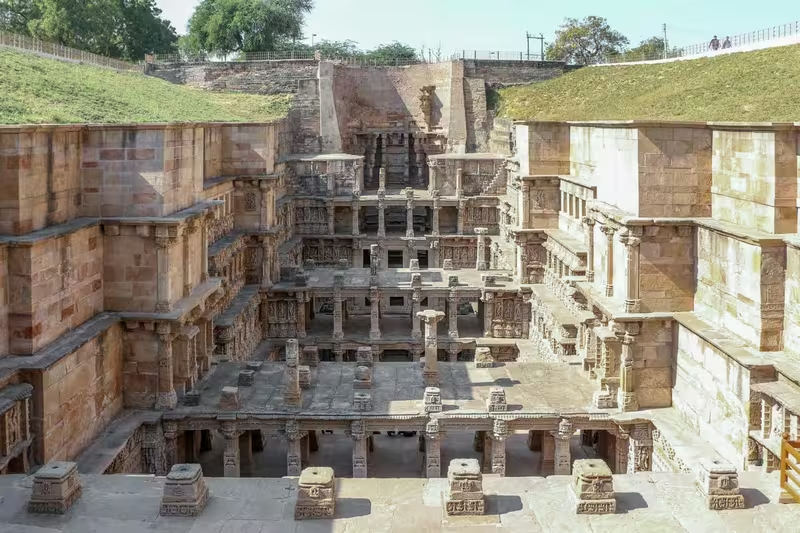
Rani ki Vav is an intricately constructed stepwell on the bank of the dried-up Saraswati River. It is described as the oldest and deepest among Gujarat's 120 stepwells. Its sculptures include Vishnu's avatars, Hindu goddesses, Jain idols, and their ancestors.
The monument was added to the UNESCO World Heritage list on 22 June 2014. Its combination of elaborate sculpture and water architecture makes it one of Patan's defining landmarks.
Sahastralinga Tank
Sahastralinga Tank is an artificial water tank constructed during the Chaulukya, or Solanki, period. It is designated a Monument of National Importance and is protected by the Archaeological Survey of India.
Panchasara Parshvanath Temple
The Panchasara Parshvanath Temple is one of Patan's important Jain temples. Its foundation is associated with Vanaraja Chavda, who brought the principal image of Parshvanatha from Panchasar village. The temple was rebuilt during the sixteenth and seventeenth centuries.
Famous Personalities
Vanaraja Chavda is the ruler most closely associated with Patan's foundation. The city is also linked to Acharya Hemachandra, the polymath after whom Hemchandracharya North Gujarat University is named.
In modern times, people associated with Patan include Gujarati singers Kinjal Dave and Maniraj Barot; former Gujarat chief minister Anandiben Patel; businessman Karsanbhai Patel; and Gujarati film personalities Naresh Kanodia, Hitu Kanodia, and Mahesh Kanodia.
Decline and Revival
Patan's political prominence changed as dynasties succeeded one another. It was the Chaulukya capital from the tenth to the thirteenth centuries and the Gujarat Sultanate capital only from 1407 to 1411. These shifts reduced or redirected its role as a seat of power, but they did not erase its importance as a trading and religious centre.
The city has continued to develop through the preservation of its monuments, its Jain institutions, its market traditions, and Patola weaving. Modern museums, educational institutions, and heritage tourism now stand alongside the older religious and commercial landscape.
Modern City
Patan is an educational and medical centre for northern Gujarat. Institutions include Hemchandracharya North Gujarat University, Government Engineering College, K.D. Polytechnic, Sheth M.N. Science College, Sheth M.N. Law College, and GMERS Medical College and Hospital at Dharpur-Patan.
The city had a population of 112,038 in the 2001 census. Its recorded literacy rate was 72 percent, with male literacy at 78 percent and female literacy at 65 percent. In addition to its hospitals and clinics, Patan has a Regional Science Centre with interactive exhibits, demonstrations, a Dinosaur Park, and displays on subjects including optics, hydroponics, solar energy, rainwater harvesting, and virtual reality.
Patan is connected by road and rail to Mehsana, Ahmedabad, and other parts of Gujarat. National Highway 68 links it with northern Gujarat and Rajasthan, while nearby airports include Mehsana Airport and Deesa Airport.
Timeline
Foundation of Anahilapataka
Vanaraja Chavda establishes the territory of Patan and founds the city as Anahilapataka.
Panchasara Parshvanath Temple
Vanaraja builds the Jain temple and brings its principal image of Parshvanatha from Panchasar village.
Chaulukya Capital
Patan serves as the capital of the Chaulukya, or Solanki, dynasty.
Jain Pilgrimage Centre
During the Chaulukya period, Patan and its surrounding region become major centres of Jain pilgrimage.
Gujarat Sultanate Capital
Patan becomes the capital of the Gujarat Sultanate.
End of Sultanate Capital Status
Patan ceases to be the capital of the Gujarat Sultanate.
UNESCO Recognition
Rani ki Vav is included in the UNESCO World Heritage list on 22 June.