Overview
In 973, Tailapa II used the political confusion surrounding the Rashtrakuta capital of Manyakheta to overthrow his overlords and establish a new Chalukya power in the western Deccan. The dynasty that emerged from this revolt ruled large parts of South India for more than two centuries. Its principal capitals were Manyakheta, Kalyani, and, during the later crisis, Annigeri.
This dynasty is commonly called the Western Chalukya Empire because it ruled in the western Deccan while the separate Eastern Chalukyas controlled Vengi. It is also known as the Kalyani Chalukya dynasty, after Kalyani—modern Basavakalyan in Karnataka's Bidar district—and as the Later Chalukya dynasty because of its claimed or presumed relationship with the earlier Chalukyas of Badami. That relationship remains debated. Some inscriptions, names, and royal titles suggest continuity with the sixth-century Chalukyas, while other inscriptional evidence indicates that the Western Chalukyas were a separate line.
The dynasty's political history was shaped by two connected struggles. The first was the effort to control the western Deccan after the decline of Rashtrakuta authority. The second was the prolonged contest with the Chola dynasty for Vengi, a fertile and strategically important region between the Krishna and Godavari rivers. The Eastern Chalukyas of Vengi, related to the Western Chalukyas but increasingly connected to the Cholas through marriage, made this conflict especially complex.
At its height under Vikramaditya VI, the empire reached from the Narmada River in the north to the Kaveri River in the south. Its subordinate houses included the Hoysalas, Seunas, Kakatiyas, Kadambas, and Kalachuris. These powers later became the principal challengers to Chalukya authority.
The Western Chalukya period was also a formative era in the cultural history of Karnataka and the Deccan. Kannada became the principal language of royal inscriptions and developed a substantial literary tradition. Sanskrit continued to flourish at court, in legal writing, historical biography, philosophy, poetry, and encyclopedic works. Temple architecture at Lakkundi, Itagi, Balligavi, Bagali, Kuruvatti, and other centres created a transitional style between the earlier Chalukyas and the later Hoysalas.
Rise to Power
The Rashtrakuta background
Before the Western Chalukyas emerged, the Rashtrakuta Empire controlled much of the Deccan Plateau and parts of central India for more than two centuries. By the late tenth century, however, Rashtrakuta political authority had weakened. The decisive opportunity came when the Paramara ruler of Malwa successfully invaded Manyakheta, the Rashtrakuta capital.
Tailapa II was a Rashtrakuta feudatory ruling from the Bijapur region. He acted during the confusion created by the invasion and defeated the Rashtrakuta ruler Karka II in 973. His success transformed him from a subordinate regional chief into the founder of a new imperial power. Tailapa II took Manyakheta as his capital and began consolidating the western Deccan.
The circumstances of Tailapa's rise were part of a wider pattern in Deccan politics. Imperial authority did not disappear all at once; instead, local rulers, feudatory families, and provincial commanders used the weakening of the Rashtrakuta centre to expand their own power. The Western Chalukya state inherited much of the political space formerly held by the Rashtrakutas while also having to confront the Paramaras and other rivals.
There may have been an earlier attempt to restore local Chalukya authority. Records refer to a possible rebellion by Chattigadeva, a Chalukya ruler of Banavasi province, around 967. He may have acted with local Kadamba chiefs, but the rebellion failed. Even so, it may have helped prepare the political conditions for Tailapa II's later success.
Tailapa II and the new empire
After defeating the Rashtrakutas, Tailapa II worked to consolidate his authority over the western Deccan. He subdued the Paramaras and other aggressive rivals and extended Chalukya control across the territory between the Narmada and Tungabhadra rivers. Some records also suggest that Balagamve in the Mysore region remained an important centre until the reign of Someshvara I, indicating that the location of political power could be distributed across more than one centre.
Tailapa's achievement was not simply the replacement of one royal family by another. The new dynasty had to build an administrative structure from the territories and subordinate relationships inherited from the Rashtrakuta age. Regional chiefs retained considerable authority, but they now acknowledged the Chalukya emperor, supplied tribute, and served in military and administrative capacities.
The dynasty's early records are especially important for reconstructing this period. The earliest known record dates from 957, when the Western Chalukyas were still Rashtrakuta feudatories and Tailapa II governed Tardavadi in present-day Bijapur district. Later inscriptions record the dynasty's claims, grants, military successes, religious patronage, and relations with local authorities.
The Contest for Vengi
Why Vengi mattered
The central international conflict of the Western Chalukya period was the struggle with the Cholas for Vengi. The region lay in the fertile river valleys of the Krishna and Godavari rivers, in modern coastal Andhra Pradesh. Its agricultural wealth and strategic location made it valuable to both empires.
The Cholas of Thanjavur sought to extend their influence northward from the Tamil country. The Western Chalukyas sought to prevent Chola power from reaching deep into the eastern Deccan. The Eastern Chalukyas of Vengi complicated the rivalry. They were distant relatives of the Western Chalukyas, but marriage ties increasingly brought them into the Chola political sphere.
Consequently, the contest for Vengi involved more than direct battles between two imperial armies. The Cholas and Western Chalukyas attempted to influence succession, support rival claimants, secure alliances with local rulers, and use marriage diplomacy. The throne of Vengi became a focus of wider competition across southern India.
Satyashraya and the Chola invasion
Satyashraya succeeded Tailapa II and faced pressure from the Cholas in both the south and the eastern Deccan. He retained control over the northern territories of Konkan and Gujarat, although Chalukya influence in Vengi remained uncertain.
In 1007, the Chola crown prince Rajendra Chola I invaded the Western Chalukya Empire. A battle took place at Donur in the Bijapur region, where the invading force met the army of Satyashraya. A record of Satyashraya describes the Chola army in highly elaborate terms, claiming that it numbered 900,000 soldiers and carried fire and sword through the region. Such figures belong to the language of royal inscriptional praise and should not automatically be read as a literal census of military strength.
The Chola army advanced toward Manyakheta. Chola inscriptions at Thanjavur and the Hottur inscriptions describe the destruction of the Western Chalukya capital. The campaign also resulted in Chola conquest of Gangapadi and Nolambapadi, territories associated with the Western Ganga and Nolamba regions.
The invasion demonstrated the military reach of the Cholas but did not permanently eliminate Western Chalukya authority. The Chalukya state survived and continued to contest the northern and eastern Deccan. The struggle would be repeated under later rulers.
Jayasimha II and the northern frontier
Jayasimha II fought a series of battles with the Cholas around 1020–1021 while both powers attempted to determine the succession in Vengi. The conflict was not confined to the eastern frontier. Around 1024, Jayasimha II also subdued the Paramara ruler of central India and the rebellious Yadava ruler Bhillama.
These campaigns show the range of responsibilities faced by a Deccan emperor. The Western Chalukyas had to manage the Chola frontier in the south and east while maintaining authority over northern and central Indian borderlands. Their political reach depended on military campaigns, alliances, and the continued loyalty of feudatory houses.
Someshvara I and the Move to Kalyani
Jayasimha II's son, Someshvara I, ruled during what historian Sen described as a brilliant period in Western Chalukya history. Around 1042, he moved the capital from Manyakheta to Kalyani. The new capital gave the dynasty its most familiar modern name: the Kalyani Chalukyas.
Kalyani, identified with modern Basavakalyan in Bidar district, became a major royal and cultural centre. The movement of the capital was also politically meaningful. Manyakheta was closely associated with the Rashtrakuta past, while Kalyani represented the Western Chalukya state at the height of its own power.
Hostilities with the Cholas continued throughout Someshvara I's reign. Both sides won battles, but neither was able to secure a permanent and decisive settlement. The main object remained the installation of a favourable ruler in Vengi. At the same time, Someshvara I retained Chalukya control over important northern areas, including Konkan, Gujarat, Malwa, and Kalinga.
The rivalry reached a crisis in 1066 when Vikramaditya VI, then a prince, invaded the Chola Empire. His army advanced as far as Gangaikonda Cholapuram, the Chola capital, and threatened the city before being forced back.
In 1068, Someshvara I and Vikramaditya VI suffered defeat against the Chola emperor Virarajendra Chola in the Battle of Vijayawada. The Cholas recovered Vengi. Soon afterward, Someshvara I, who was suffering from an incurable illness, drowned himself in the Tungabhadra River in an act described as Paramayoga.
The Civil War and the Rise of Vikramaditya VI
Someshvara II and Vikramaditya VI
Someshvara I was succeeded by his eldest son, Someshvara II. His younger brother Vikramaditya VI was an ambitious and experienced military commander who had governed Gangavadi in the southern Deccan. A dispute between the brothers developed into a civil war over control of the empire.
Vikramaditya sought support from Virarajendra Chola. The Chola ruler recognised him as the Western Chalukya king and strengthened the alliance by marrying his daughter to Vikramaditya. This agreement temporarily halted the long conflict between the Cholas and Western Chalukyas.
Vikramaditya also won the loyalty of several Chalukya feudatories, including the Hoysalas, Seunas, and Kadambas of Hangal. In 1075, he overthrew Someshvara II and became emperor. The civil war demonstrated the importance of feudatory support in determining succession. The Western Chalukya monarchy was hereditary, but the practical transfer of power depended on military alliances and the cooperation of provincial rulers.
The Nangili campaign
The Chola-Western Chalukya conflict resumed during the reign of Kulottunga I. In 1075–1076, Vikramaditya's forces entered Chola territory. The armies met in the Kolar region in an episode remembered as the Nangili campaign.
The Chola counter-attack routed the Chalukyan army. Chola forces pursued Vikramaditya's army from the rocky roads of Nangili through Manalur toward the Tungabhadra. The episode illustrates the limits of Chalukya power even during Vikramaditya's long reign. His eventual success did not mean that every campaign ended in victory; rather, the empire's strength lay in its ability to recover, maintain alliances, and continue contesting the frontier.
The Chalukya Vikrama era
Vikramaditya VI ruled for approximately fifty years, from 1075 to 1126. Historians refer to his reign as the “Chalukya Vikrama era.” It was the most successful period of the later Chalukya dynasty.
He managed powerful feudatories in both the north and south. Among them were Kadamba Jayakesi II of Goa, Silhara Bhoja, and the Yadava ruler. In the south, he dealt with Hoysala power while continuing the struggle against the Cholas. He defeated the Cholas in the Battle of Vengi in 1093 and again in 1118. The second victory reduced Chola influence in the eastern Deccan and enabled Vikramaditya to hold Vengi for several years.
At the height of his authority, Vikramaditya's territories extended broadly between the Kaveri River and the Narmada River. He used the titles Permadideva and Tribhuvanamalla, meaning lord of the three worlds. These titles expressed imperial ambition and royal prestige, although actual control over distant regions depended on local rulers and changing military circumstances.
Vikramaditya was celebrated both as a warrior and as a patron of culture. Inscriptions record grants to scholars and religious centres. The Kashmiri poet Bilhana came to his court and composed Vikramankadeva Charita, a Sanskrit poetic account of the king's life and achievements. Vikramaditya's reign therefore combined military expansion, political alliance-building, religious patronage, and literary production.
Administration and Governance
Hereditary kingship and feudatory power
The Western Chalukya monarchy was hereditary. When a king had no male heir, succession could pass to his brother. Although the emperor stood at the apex of the political system, the empire was highly decentralised.
Feudatory clans such as the Alupas, Hoysalas, Kakatiyas, Seunas, southern Kalachuris, and others governed autonomous provinces. In return, they paid annual tribute and acknowledged Chalukya sovereignty. Their rulers could maintain local administrations and military forces, but their position depended on their relationship with the imperial court.
The weakening of Chalukya authority in the twelfth century was therefore especially dangerous. Once powerful feudatories began acting independently, the empire could lose territory without the immediate collapse of its central administration. The same political system that enabled the Chalukyas to govern a large Deccan territory also provided a path for regional dynasties to become independent.
Provinces and local divisions
The kingdom was divided into large provinces known as Mandalas. Some were identified by names that included a numerical designation, such as Banavasi-12000, Nolambavadi-32000, and Gangavadi-96000. The number is associated with the administrative unit's villages rather than necessarily representing a modern population count.
Mandalas were divided into Nadus, which were further organised into Kampanas and villages, sometimes called Badas. A Mandala could be governed by a royal family member, a trusted feudatory, or a senior official. Provincial chiefs could be transferred as political circumstances changed. For example, Bammanayya administered Banavasi-12000 under Someshvara III and was later moved to Halasige-12000.
The system combined royal oversight with local authority. Military commanders and provincial governors could be moved, rewarded, or replaced, allowing the court to respond to changing alliances. At the village level, officials participated in taxation, land transactions, irrigation, and local councils.
Officials and military administration
The administrative vocabulary of inscriptions includes the titles Mahapradhana, or chief minister; Sandhivigrahika, associated with diplomacy and political agreements; and Dharmadhikari, or chief justice. The title Tadeyadandanayaka referred to a commander of the reserve army.
Many ministerial positions also included the term Dandanayaka, meaning commander. This suggests that members of the governing elite were expected to possess military as well as administrative skills. The state was governed by a political class in which civil authority and military command were closely connected.
Large provincial chiefs were called Mahamandaleshwaras. Officials heading a Nadu were known as Nadugouvndas. The Gavundas, or Goudas, were particularly important in rural society. They occupied two broad levels: the Praja Gavunda, associated with the people, and the Prabhu Gavunda, or lord of the Gavundas.
Gavundas represented local communities before the rulers while also acting as state appointees. They collected taxes, helped raise militias, supervised village affairs, participated in land transactions, and maintained irrigation works. Their presence in inscriptions shows that the empire depended on local intermediaries to make its authority effective.
Land, taxation, and justice
Land revenue was the principal source of state income. Tax assessments considered the quality of the land and the type of produce. Records distinguish black-soil and red-soil areas as well as wetland, dry land, and wasteland. This classification allowed taxation to be adjusted according to agricultural potential.
The state also taxed mining and forest products. It collected tolls from transport routes, customs on commodities, professional licence fees, and judicial fines. Taxes could be levied on horses, salt, gold, textiles, perfumes, black pepper, paddy, spices, betel leaves, palm leaves, coconuts, and sugar.
There are no recorded revolts by landless cultivators against wealthy landlords in the material described here. The available account suggests that when peasants were dissatisfied with a ruler, a common response was migration. Moving out of a ruler's jurisdiction deprived the state and landlords of agricultural labour and revenue.
Military Campaigns and Imperial Rivalries
Campaigns against the Paramaras and Rashtrakutas
Tailapa II's defeat of the Rashtrakutas in 973 was the foundational military event of the dynasty. His timing was crucial: the Paramara invasion had thrown the Rashtrakuta capital into confusion, giving Tailapa an opportunity to defeat his former overlords.
Afterward, Tailapa subdued the Paramaras and other rivals while extending Western Chalukya authority across the western Deccan. The early empire was therefore built through a combination of rebellion, succession crisis, and territorial consolidation.
Jayasimha II continued the northern struggle by subduing the Paramara ruler of central India and the rebellious Yadava ruler Bhillama around 1024. These campaigns helped protect the empire from encirclement while the Cholas remained the principal threat in the south and east.
Campaigns against the Cholas
The wars with the Cholas were not a single uninterrupted conflict but a series of campaigns, alliances, reversals, and succession disputes. The 1007 invasion under Rajendra Chola I reached Donur and Manyakheta and resulted in Chola gains in Gangapadi and Nolambapadi.
In the 1020s, Jayasimha II fought the Cholas over the selection of a ruler for Vengi. Under Someshvara I, Vikramaditya VI reached Gangaikonda Cholapuram in 1066 but was repulsed. Two years later, Someshvara I and Vikramaditya were defeated at Vijayawada, and the Cholas regained Vengi.
Vikramaditya's alliance with Virarajendra Chola temporarily changed the political relationship. The alliance was strengthened through marriage and helped Vikramaditya defeat his brother Someshvara II. However, after Kulottunga I came to power, conflict resumed. The Nangili campaign of 1075–1076 ended in a major Chola victory.
The later victories of Vikramaditya VI at Vengi in 1093 and 1118 represented the high point of Western Chalukya military influence. Yet the underlying contest remained unstable. Vengi could be won and lost, and the Chalukyas had to devote substantial military resources to maintaining their position.
Feudatories and the later military crisis
The empire's military power was inseparable from its feudatories. During Vikramaditya VI's reign, he successfully managed several subordinate dynasties. After his death, however, these same powers expanded their autonomy.
The Kakatiyas, Hoysalas, Seunas, Kalachuris, and other regional rulers contested Chalukya territory and one another. The result was a multipolar military landscape in which the imperial court could no longer reliably direct the Deccan.
Tailapa III was defeated by the Kakatiya ruler Prola in 1149 and was taken captive before being released. The event damaged the prestige of the Western Chalukya monarchy. Hoysala Narasimha I later defeated and killed Tailapa III, although he could not overcome the Kalachuris.
Cultural Contributions
Religion and religious change
The Western Chalukya period was religiously diverse. The decline of Rashtrakuta authority and the defeat of the Western Ganga dynasty by the Cholas coincided with a reduction in the prominence of Jainism in some regions. At the same time, Virashaivism expanded in Chalukya territory, while Vaishnavism grew in the Hoysala region.
This transition appears to have been gradual rather than marked by widespread religious conflict. Jain, Hindu, and Buddhist institutions continued to receive patronage at different places and times. Shravanabelagola and Kambadahalli remained important Jain centres in Hoysala territory. Buddhist worship survived at Dambal and Balligavi during the Western Chalukya period.
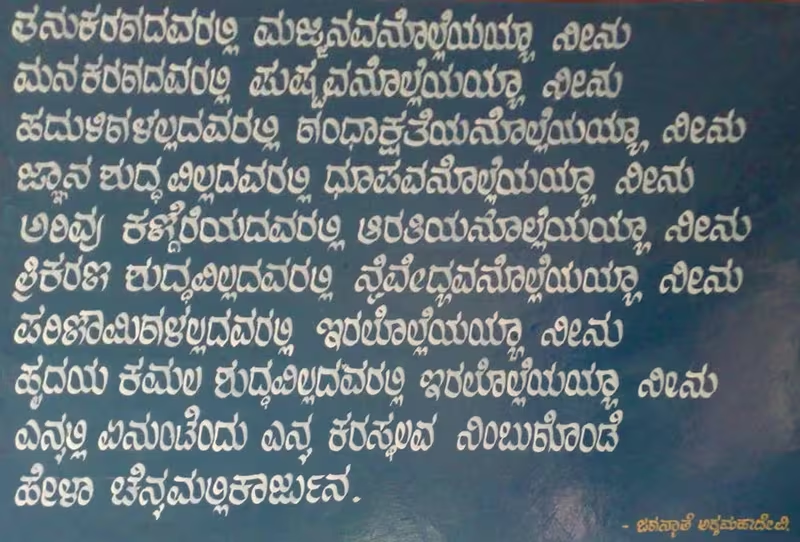
The movement associated with Basavanna in the twelfth century became a major force in religious and social thought. Virashaiva teachers preached devotion to Shiva and challenged aspects of the established caste order. Basavanna's Vachanas, written in accessible Kannada, presented work as a form of worship and addressed a broad social audience.
The movement questioned ritual authority and the theory of rebirth. It supported widow remarriage and the marriage of older unmarried women, thereby creating forms of social freedom for women, although women were not admitted into the priesthood. Akka Mahadevi, Allama Prabhu, Siddharama, Channabasavanna, and other saints became associated with this tradition.
Vaishnava thought also developed during this era. Ramanujacharya, head of the Vaishnava monastery at Srirangam, travelled through the Hoysala territories and taught the path of devotion, or bhakti marga. He later composed Sribhashya, a commentary on the Brahmasutra and a critique of Advaita philosophy. His stay at Melkote was associated with the conversion of Hoysala ruler Vishnuvardhana to Vaishnavism.
Women and society
The social position of women varied according to economic status, family background, and education. Women in royal and wealthy urban families appear to have had greater access to education and the arts. Chalukya queen Chandala Devi and Sovala Devi, a Kalachuri queen, are remembered for their abilities in dance and music.
Some royal women also participated in administration and military affairs. Princess Akkadevi, the sister of Jayasimha II, fought rebellious feudatories and defeated them. Such examples show that elite women could exercise political and military authority, although they should not be assumed to represent the experience of women across society.
Inscriptions indicate that widowhood was publicly accepted. Sati existed but was described as voluntary. Other ritual deaths occurred among different religious communities. Jains could undertake sallekhana, fasting to death, while other people might seek ritual death by jumping on spikes or entering fire during an eclipse.
Education and public institutions
Schools and hospitals are mentioned in the records, often in connection with temples. Monasteries and religious institutions supported advanced study, libraries, and ethical instruction. Hindu mathas, Jain pallis, and Buddhist viharas maintained educational functions.
Schools attached to monasteries trained young men in singing devotional hymns. Libraries were known as Saraswati Bhandaras. Instruction was conducted in Kannada and Sanskrit. Higher centres of learning were called Brahmapuris, Ghatikas, or Agraharas.
Sanskrit education was largely controlled by Brahmins, who received royal grants. Subjects taught to royal students included economics, political science, the Vedas, and philosophy. Brahmins also served as local arbiters, or Panchayat members, and were valued as providers of knowledge and local justice.
Marketplaces functioned as open-air meeting spaces where residents discussed local matters. Festivals, fairs, wrestling matches, animal contests, gambling, horse racing, music, dance, drama, and performances by travelling entertainers formed part of public and private life.
Literature and Language
Kannada as an administrative and literary language
Kannada was the principal language of Western Chalukya inscriptions. Scholars have noted that approximately ninety percent of the dynasty's royal inscriptions are in Kannada, with the remainder in Sanskrit. This extensive inscriptional use of Kannada helped establish it as a language of administration, land grants, public rights, and royal communication.
Bilingual inscriptions often divided their functions by language. Sanskrit was used for royal titles, genealogies, origin stories, praise, and blessings. Kannada recorded the practical terms of grants: the location and boundaries of land, the rights and obligations of recipients, taxes, dues, local authorities, and witnesses.
This arrangement made the legal and administrative content accessible to local communities. It also demonstrates that Kannada was not restricted to informal or local use; it served as a language of public authority and written law.
The devotional movement associated with Virashaivism further expanded Kannada's literary range. The Vachanas used short, direct poems to express devotion and ethical reflection. Their accessible style allowed religious ideas to circulate beyond elite Sanskritic settings.
Major Kannada writers
Ranna was one of the leading Kannada writers of the period. Patronised by Tailapa II and Satyashraya, he was given the title “Emperor among Poets.” His Saahasabheema Vijayam, also called Gada Yuddha, was composed in 982 in the Champu style. It praises Satyashraya by comparing his courage and achievements with those of Bhima and narrates the mace duel between Bhima and Duryodhana on the eighteenth day of the Mahabharata war.
Ranna also wrote Ajita Purana in 993, describing the life of Ajitanatha, the second Jain Tirthankara.
Nagavarma II, poet laureate of Jagadhekamalla II, wrote across several fields. His Kavyavalokana discusses poetics, Karnataka-Bhashabhushana treats grammar, and Vastukosa is a lexicon giving Kannada equivalents for Sanskrit words. These works became important authorities in the study of Kannada language and literature.
Other Kannada works covered romance, medicine, astrology, erotics, lexicography, prosody, and encyclopedic knowledge. Examples include Chandombudhi, Karnataka Kadambari, Ranna's Rannakanda, Karnataka-Kalyanakaraka by Jagaddala Somanatha, Jatakatilaka by Sridharacharya, Madanakatilaka by Chandraraja, and Lokopakara by Chavundaraya II.
Sanskrit scholarship
Sanskrit continued to be central to royal literary culture. Bilhana, a poet from Kashmir, composed Vikramankadeva Charita in praise of Vikramaditya VI. The poem consists of eighteen cantos and presents the king's life and accession in epic form.
Someshvara III composed Manasollasa, also known as Abhilashitartha Chintamani. Written in Sanskrit, this work functioned as an extensive encyclopedic text. Its subjects included medicine, magic, veterinary science, precious stones and pearls, fortifications, painting, music, games, amusements, and other fields of knowledge.
Someshvara III also wrote Vikraman-Kabhyudaya, a biography of his father Vikramaditya VI. It is a historical prose narrative that includes descriptions of the geography and people of Karnataka.
Vijnaneshwara, a Sanskrit scholar in Vikramaditya VI's court, composed the Mitakshara, a legal treatise and commentary on the Yajnavalkya Smriti. It drew upon earlier writings and later became influential in many parts of India. The section dealing with inheritance was translated into English by Colebrooke and subsequently used in British Indian courts.
The period also produced important writings on music and musical instruments, including Sangita Chudamani, Sangita Samayasara, and Sangita Ratnakara. The mathematician Bhaskara II, whose native place was Bijjada Bida, or modern Bijapur, flourished during this era. His Siddhanta Shiromani, composed around 1150, included works on arithmetic, algebra, the celestial globe, and planets.
Architecture
A transitional Deccan style
Western Chalukya architecture occupies an important position between the temple style of the early Chalukyas of Badami and the later architecture of the Hoysalas. It is sometimes called the Gadag style because many ornate temples were built in the region around the Tungabhadra–Krishna doab, especially in present-day Gadag district.
The dynasty's temple-building activity reached maturity in the twelfth century. More than one hundred temples were built across the Deccan, with more than half located in central Karnataka. Temples were not the only major architectural achievement. Stepped wells, known as Pushkarnis, served as ritual bathing places. Some of these structures survive at Lakkundi, and their designs influenced later Hoysala and Vijayanagara architecture.
Western Chalukya architects developed lathe-turned or finely shaped pillars and made extensive use of soapstone, also called chloritic schist. This material could be cut into intricate decorative forms and became especially important in later Hoysala temples.
The temple tower, or vimana, represented a compromise between the relatively plain stepped forms of the early Chalukyas and the more elaborate decorative style associated with the Hoysalas. Sculptors also popularised Kirtimukhas, or decorative demon faces, as part of the temple vocabulary.
Major monuments
The Kasivisvesvara Temple at Lakkundi is among the best-known examples of mature Western Chalukya architecture. Lakkundi was also an important centre for stepped wells and temple construction.
The Mallikarjuna Temple at Kuruvatti, the Kalleshvara Temple at Bagali, and the Mahadeva Temple at Itagi display the dynasty's emphasis on sculptural detail and carefully worked architectural surfaces. The Mahadeva Temple, built by Mahadeva, a commander under Vikramaditya VI, was praised in an inscription as the “Emperor of Temples.”
The Kedaresvara Temple at Balligavi, dated to 1060, is an important example of a transitional Chalukya-Hoysala style. Balligavi was also one of the places where Buddhist worship continued during the period.
Other notable monuments include the Dodda Basappa Temple at Dambal, the Siddhesvara Temple at Haveri, the Amrtesvara Temple at Annigeri, the Kaitabheshvara Temple at Kubatur, and temples at Badami and Aihole. The latter include the Mallikarjuna Temple, the Yellamma Temple, and the Bhutanatha group, reflecting the dynasty's early temple-building activity in areas associated with the older Chalukyas.
The influence of Western Chalukya architecture continued beyond the dynasty itself. Hoysala architects included individuals from places such as Balligavi who worked within the Chalukyan architectural tradition. The Western Chalukya style is also described as Karnata Dravida, one of the important regional traditions of Indian architecture.
Economy and Trade
Agriculture and taxation
Agriculture was the principal foundation of the empire's economy. Most people lived in villages and cultivated rice, pulses, and cotton. Sugarcane grew in areas with sufficient rainfall, while areca and betel were important cash crops.
Land taxation was based on surveys and assessments of soil quality, water availability, and the type of agricultural production. Wetland, dry land, wasteland, black soil, and red soil were distinguished in tax records. The system shows an effort to connect revenue demands with agricultural potential.
In addition to land revenue, the state collected income from mining, forests, transport tolls, customs, professional licences, and judicial fines. Horses and salt were taxed, as were commodities such as gold, textiles, perfumes, black pepper, paddy, spices, betel leaves, palm leaves, coconuts, and sugar.
Guilds and corporate enterprise
By the eleventh century, many crafts and occupations were organised into guilds. Work was often carried out collectively, and records generally preserve the names of guilds or corporate bodies rather than individual artists and craftsmen. This contrasts with some later Hoysala records, where individual sculptors signed their work.
Merchant guilds could operate across political boundaries. Their commercial activities were therefore less vulnerable to changes of ruler, although caravans and ships faced the threat of brigands and theft. Important South Indian guilds included the Manigramam, Nagarattar, and Anjuvannam.
The Ainnurruvar, also known as the Five Hundred Svamis of Ayyavolepura, was among the wealthiest and most influential merchant organisations. Ayyavolepura is identified with Aihole. The guild included Brahmins and Mahajanas and conducted extensive land and maritime trade.
The Ainnurruvar used the bull as an emblem and recorded its achievements in Prasasti inscriptions. These inscriptions referred to its commercial obligations through the expression Vira Bananjudharma, or the law of noble merchants. Approximately five hundred such inscriptions have been excavated.
Long-distance trade
The Western Chalukya Empire controlled much of South India's western coast and developed extensive trade ties by the tenth century. Commercial connections extended to the Tang Empire of China, Southeast Asian kingdoms, and the Abbasid Caliphate in Baghdad. By the twelfth century, Chinese fleets were frequently visiting Indian ports.
Exports to Song China included textiles, spices, medicinal plants, jewels, ivory, rhinoceros horn, ebony, and camphor. Similar goods moved westward to ports such as Dhofar and Aden, from where they reached Persia, Arabia, and Egypt.
Siraf, a major port on the eastern coast of the Persian Gulf, served merchants from the Chalukya Empire. Local merchants reportedly hosted visiting Indian traders, and dining plates were reserved for them, an indication of their recognised commercial importance.
Trade goods included diamonds, lapis lazuli, onyx, topaz, carbuncles, emeralds, cardamom, saffron, cloves, sandalwood products, bdellium, musk, civet, rose products, and camphor. Arabian horses were among the most expensive imports. Their trade was monopolised by Arab and local Brahmin merchants.
Coinage
The Western Chalukyas minted gold pagodas that were thin, large, and punch-marked. Their legends appeared in Kannada and Nagari. Coins used several symbols, including a stylised lion, the Kannada form of Sri, a spearhead, lotus motifs, and royal titles.
The coin legends varied by ruler. Jayasimha II used Sri Jaya. Someshvara I issued coins bearing Sri Tre lo ka malla, while Someshvara II used Bhuvaneka malla. Lakshmideva's coins carried Sri Lasha, and Jagadhekamalla II used Sri Jagade.
Feudatories also issued coins. The Alupas minted pieces with the Kannada and Nagari legend Sri Pandya Dhanamjaya. Lakkundi in Gadag district and Sudi in Dharwad district were major mints.
The heaviest gold coin was the Gadyanaka, weighing 96 grains. Other denominations included the Dramma at 65 grains, Kalanju at 48 grains, Kasu at 15 grains, Manjadi at 2.5 grains, Akkam at 1.25 grains, and Pana at 9.6 grains.
Decline and Fall
After Vikramaditya VI
Vikramaditya VI died in 1126. His death removed the ruler who had most effectively managed the empire's competing feudatories and external enemies. During the following decades, the Western Chalukya state steadily contracted.
The prolonged wars with the Cholas had consumed resources, while subordinate dynasties expanded their autonomy. Between 1150 and 1200, the Chalukyas and their feudatories fought repeatedly, often while the feudatories also fought among themselves. Imperial authority became increasingly regional and uncertain.
Under Jagadhekamalla II, the Chalukyas lost control of Vengi. His successor, Tailapa III, was defeated by the Kakatiya ruler Prola in 1149. Tailapa was captured and later released, but the episode weakened the prestige of the dynasty.
The Kalachuri occupation of Kalyani
The Kalachuris of Kalyani had originally entered the southern Deccan from central India. Their rulers had served as Chalukya commanders, or Mahamandaleshwaras, governing the Karhad-4000 and Tardavadi-1000 provinces. These areas overlapped parts of modern Karnataka and Maharashtra.
By the reign of Bijjala II, the Kalachuris had become powerful enough to challenge their former overlords. In 1157, Bijjala captured Kalyani and occupied it for approximately two decades. The Chalukyas were forced to move their capital to Annigeri in present-day Dharwad district.
The capture of Kalyani symbolised the breakdown of the old imperial order. A former subordinate now controlled the Chalukya capital, while the Hoysalas, Seunas, Kakatiyas, and other dynasties pressed into the remaining imperial territories.
The final restoration attempt
The successors of Bijjala II could not permanently retain Kalyani. In 1183, the last Chalukya scion, Someshvara IV, made a final attempt to restore imperial rule. He recaptured Kalyani, and the Chalukya general Narasimha killed the Kalachuri king Sankama during the conflict.
Someshvara's recovery was temporary. Hoysala Veera Ballala II was expanding his power and fought the Chalukyas and other claimants. He defeated Someshvara IV and Seuna ruler Bhillama V in separate struggles, bringing large parts of the Krishna River valley under Hoysala control, though he did not defeat the Kalachuris.
The Seunas, under Bhillama V, were also pursuing imperial expansion. Their forces were temporarily defeated by the Chalukya general Barma in 1183, but the Seunas later recovered. In 1189, they drove Someshvara IV into exile at Banavasi.
This ended the Western Chalukya dynasty as an imperial power. The Seunas and Hoysalas continued to fight over the Krishna River region, while the Kakatiyas and other successor powers consolidated their own territories. The fall of the Western Chalukyas coincided with the decline of the Chola Empire, leaving a changing political landscape in which former feudatories became the leading powers of the Deccan and southern India.
Legacy
The Western Chalukyas left a durable mark on the political, linguistic, literary, commercial, and architectural history of the Deccan.
Politically, the dynasty provided a bridge between the Rashtrakuta age and the later Hoysala, Seuna, Kakatiya, and Kalachuri states. Its decentralised imperial system allowed a large territory to be governed through provincial chiefs and feudatories, but it also enabled those same subordinate powers to become independent when the central monarchy weakened.
The dynasty's rivalry with the Cholas shaped the history of Vengi and the eastern Deccan. Their wars were fought over territory, succession, resources, and political influence. The conflict also connected the Deccan to the larger political world of the Tamil country and the Eastern Chalukya realm.
In language and literature, the Western Chalukya period strengthened Kannada as an administrative and literary language. Inscriptions recorded land rights, taxation, local boundaries, and obligations in Kannada, while poets such as Ranna and Nagavarma II expanded the language's literary possibilities. The Vachana tradition of Basavanna, Akka Mahadevi, Allama Prabhu, and other saints brought devotional poetry into direct contact with broad social audiences.
Sanskrit scholarship also flourished. Bilhana's Vikramankadeva Charita, Someshvara III's Manasollasa, Vijnaneshwara's Mitakshara, and the mathematical works associated with Bhaskara II illustrate the intellectual diversity of the period.
The dynasty's temples are among its most visible achievements. Lakkundi, Itagi, Balligavi, Bagali, Kuruvatti, Haveri, Annigeri, Dambal, and other centres preserve the development of a Deccan style between the early Chalukyas and the Hoysalas. The use of soapstone, turned pillars, ornate wall carving, stepped temple towers, and elaborate decorative motifs became important elements of later South Indian architecture.
The Western Chalukyas also participated in long-distance commercial networks that connected the Deccan with China, Southeast Asia, the Persian Gulf, Arabia, and Egypt. Merchant guilds such as the Ainnurruvar show how commercial organisations could operate across political borders and contribute to the wealth of the imperial treasury.
Although the empire ended in 1189, its political institutions, literary traditions, religious movements, commercial associations, and architectural forms continued to influence the states that followed.