Ashokan Edicts in Delhi: Imperial Messages Carved in Stone
On a small, inclined rock face near Bahapur in South Delhi, a message issued in the name of Ashoka survives in early Brahmi script. Nearby, and elsewhere in the city, two polished sandstone pillars carry related imperial declarations. These monuments form the Ashokan Edicts in Delhi: a group of rock and pillar inscriptions connected with the Mauryan emperor’s effort to communicate moral conduct, religious commitment, and social responsibility across his empire.
The Delhi group brings together two different forms of Ashokan inscription. The Bahapur text is an in-situ minor rock edict discovered in 1966 near Srinivaspuri, about one kilometre north of the Kalkaji temple. The two pillars were created from Chunar sandstone and originally stood at Meerut and Topra before being transported to Delhi in the fourteenth century by Firuz Shah Tughlaq. One now stands on the northern Delhi ridge, while the other rises above the palace buildings at Feroz Shah Kotla.
Together, these inscriptions preserve the ambitions of Ashokan public writing. They were intended to teach the population the morals and ideals of civilized living and to encourage peace and harmony in a large and diverse empire. Their messages also record Ashoka’s turn away from conquest by warfare and toward what the inscriptions describe as spiritual and moral action.
Discovery and Provenance
Discovery
The earliest known discovery in Delhi was the Bahapur rock edict, found in 1966. It is engraved on a small patch of exposed rock at Srinivaspuri in South Delhi, close to Bahapur village and roughly one kilometre north of the Kalkaji temple. A building contractor working on the construction of a residential colony exposed the inscription on an inclined rock face. Archaeologists examined it immediately on 26 March 1966.
The inscription was identified as the fourteenth known epigraphic version of Ashoka’s Minor Rock Edict I. Its wording and form were compared with inscriptions from thirteen other locations in different parts of India, including Barat in the Jaipur division. The Delhi text was especially close to the Barat version and to the inscriptions on the two pillars preserved in Delhi.
The Bahapur inscription occupies an area approximately 75 centimetres long and 77 centimetres high. It contains ten lines of writing of varying lengths. The letters are in early Brahmi, and the language is Prakrit. The rock surface is irregular, and several lines and characters are not clearly decipherable.
The two pillar inscriptions have a different history. They were not discovered in Delhi in their original setting. Both had been erected elsewhere during the Mauryan period and were transported to the city in the fourteenth century. Their relocation was ordered by Firuz Shah Tughlaq, the Delhi Sultan who ruled from 1351 to 1388.
Journey Through History
The pillars had stood at Topra near Ambala and near Meerut until Firuz Shah encountered them during his campaigns. He was interested in history, architecture, hunting, and public works, and was impressed by the two undeciphered monoliths. He decided to move them to his new palatial city of Feruzabad, the fifth medieval city of Delhi.
The pillar from Topra was installed above the palace building now associated with Feroz Shah Kotla. The pillar from Meerut was erected on the northern ridge of Delhi, near Firuz Shah’s hunting palace and close to Pir-Ghaib. The first pillar was placed beside the Friday mosque in the new city of Feruzabad during the 1350s.
The relocation of the Meerut pillar involved elaborate logistical planning. It was carried to the bank of the Yamuna on a 42-wheeled cart and then transported along the river on barges. The movement of the pillar now associated with Feroz Shah Kotla was similarly demanding. Silk cotton from the simal tree was gathered in large quantities to cushion the pillar as it was lowered horizontally. Once the protective covering was removed, reeds and rawhide were used to protect the stone during transport.
A purpose-built palatial structure of stone and lime mortar was constructed to house the pillar brought from the Yamuna’s upstream reaches. The pillar came from Khizrabad, approximately 90 kilometres from Delhi. A square base stone was placed beneath it before the installation was completed. The building is now ruined, but the pillar remains standing.
The Delhi-Meerut Pillar suffered damage during an explosion in the reign of Farrukshiar, who ruled from 1713 to 1719. The pillar broke into five pieces. These fragments were first moved to the Asiatic Society of Bengal in Calcutta. They were returned to Delhi in 1866 and re-erected in 1887.
Current Home
The Ashokan Edicts in Delhi remain distributed across several locations rather than being held together in a museum collection. The Bahapur inscription remains on its original rock exposure in Srinivaspuri. The Delhi-Meerut Pillar stands on the northern Delhi ridge opposite the entrance of Bara Hindu Rao Hospital and close to the Delhi University campus. It is located between Chauburji-Masjid and Hindu Rao Hospital.
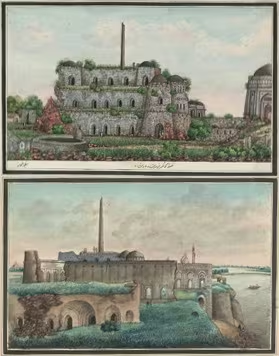
The Delhi-Topra Pillar stands in the grounds of Feroz Shah Kotla. It rises above the three-storey rubble-masonry structure built to house it. The structure has small domed rooms on its first and second floors, with arched entrances and connections to the roof. The pillar is installed on the terrace.
The pillar sites have acquired later associations. Near the building that houses the Ashokan pillar at Feroz Shah Kotla, visitors gather on Thursday afternoons in connection with beliefs about djinns or genies. These beliefs are described as pre-Islamic in origin, and some visitors come to revere or mollify the beings believed to inhabit the site.
Physical Description
Materials and Construction
The Ashokan pillars were made from Chunar sandstone quarried in the Mirzapur District of Uttar Pradesh. Massive blocks measuring approximately 1.22 metres square and 15.2 metres long were extracted from the quarry. Craftsmen shaped these blocks into monolithic columns measuring between 12.2 and 15.2 metres in length, with an average diameter of 0.785 metres.
The stone surfaces were cut, dressed, and finely polished before the edicts were carved. This combination of monumental scale, circular form, and smooth polish is characteristic of the pillar tradition associated with Ashoka. The pillars were prepared before being transported to their distant destinations.
The Bahapur edict differs physically from the pillars. It is not a freestanding monument but an inscription cut directly into an exposed rock surface. Its lines follow the irregularity of the stone, and the letter sizes are not uniform. The physical setting is therefore part of the character of the inscription: rather than being placed on a prepared column, the message occupies a naturally exposed patch of rock.
Dimensions and Form
The Bahapur rock inscription covers approximately 75 centimetres in length and 77 centimetres in height. Its ten lines vary in length and are arranged across the uneven surface.
The Delhi-Meerut Pillar is approximately 10 metres high in its present form. It was damaged by the explosion during Farrukshiar’s reign, and its five fragments were subsequently brought back together and re-erected. An early seventeenth-century account by William Finch described a globe and half moon at the top, together with inscriptions on the pillar.
The Delhi-Topra Pillar is approximately 13 metres high, including about one metre below the platform on which it stands. It is made of sandstone and is described as more finely finished than the second Delhi pillar located on the ridge.
Condition
The Bahapur inscription is incomplete in readability. Its rock surface has irregular lines, and a number of letters and lines cannot be clearly deciphered. Nevertheless, the text can be identified through comparison with related Minor Rock Edict I inscriptions.
The Delhi-Meerut Pillar survives after serious historical damage. The explosion during the reign of Farrukshiar broke it into five pieces. Its fragments were removed, returned to Delhi in 1866, and re-erected in 1887.
The Delhi-Topra Pillar remains standing above its ruined architectural setting. Its polished surface is visible today, although the original upper arrangement is no longer present in the form described for the monument’s earlier history.
Artistic Details
The pillars were independent monumental structures rather than parts of earlier buildings. The creation of carved, polished monolithic columns was described as unique to Ashokan times and independent of other structures.
The Delhi-Topra Pillar may originally have had a lion capital similar to the Ashoka Emblem, although this is presented as a conjecture. Firuz Shah is said to have decorated its top with black-and-white stone frescoes and a gilded copper cupola. What is visible now is the smooth polished surface and an elephant carving added at a later period.
The pillar also carries an additional inscription in Sanskrit, written in Nagari script, below and around the Ashokan edict. This later text records the conquests of Visala Deva Vigraharaja IV of the Chauhan dynasty and his victories over a Mlechha, described as presumably referring to Ghaznavid or Ghurid forces. The inscription suggests that the pillar was reused to record later military triumphs.
Historical Context
The Era
The edicts were created during the reign of Ashoka, who ruled the Mauryan Empire during the third century BCE. The Mauryan political lineage began with Chandragupta Maurya, who ruled from 322 to 298 BCE and founded the Mauryan Empire. Chandragupta was Ashoka’s grandfather. Ashoka’s father, Bindusara, ruled from 297 to 272 BCE.
After succeeding his father, Ashoka expanded and consolidated the territories inherited from his grandfather. His empire extended across large parts of the Indian subcontinent, with its capital at Pataliputra, the present-day Patna in Bihar. Ashoka ruled for three decades.
A decisive turning point came with the Kalinga War of 261 BCE. The conflict caused immense loss of life. One of Ashoka’s inscriptions states that 150,000 people were forcibly abducted from their homes, 100,000 were killed in battle, and many more died afterward. Ashoka’s Thirteenth Edict describes this loss as a grievous consequence even if only a hundredth or a thousandth part of those killed, slain, or abducted were counted.
The war profoundly affected Ashoka. He expressed repentance, renounced further warfare, and converted to Buddhism. The teachings of Buddhism appealed to him, and he declared that his future actions would follow spiritual lines and support the spread of right conduct.
Two years after the Kalinga War, Ashoka undertook a nationwide pilgrimage to Buddhist holy places. He spent 265 days on this journey and returned to Pataliputra in 258 BCE. After a public celebration, he began a missionary campaign throughout his empire, extending it into South India and Sri Lanka. His son Mahindra participated in this mission.
Purpose and Function
The edicts were public statements intended to reach the people of Ashoka’s empire. They were written in Prakrit, a colloquial language used in everyday speech. In most parts of India, the inscriptions used the Brahmi script. In the north-western regions of the empire, some edicts used Kharoshti. Bilingual and bi-scriptural examples from Kandahar and Afghanistan were written in Greek and Aramaic.
The messages addressed moral and religious conduct. They were intended to teach people the ideals of civilized living and to encourage peace and harmony. Ashoka’s Dhamma included kindness, forbearance, and concern for the welfare of his people. Other messages emphasized obedience and respect toward parents, elders, and teachers.
The rock and pillar edicts also served different stages of Ashoka’s public communication. The minor rock edicts were earlier than the major rock edicts, while the pillar edicts came later. The minor edicts express Ashoka’s religious commitment and encourage people to follow the Buddhist path. Minor Rock Edict II emphasizes obedience and respect for parents, elders, and teachers.
The six basic pillar edicts deal principally with the spread of moral values. The Delhi-Topra Pillar includes a long additional message that abridges and reaffirms the content of other pillars and, to some extent, the Major Rock Edicts. It also refers to taxation, distinguishing it from the general moral emphasis of the other pillars.
Commissioning and Creation
In 257 BCE, Ashoka had the first four of his fourteen major rock edicts inscribed in different parts of his empire. One rock edict was later found in Delhi, although it was not complete. The Bahapur inscription belongs instead to the minor rock edict tradition and was identified as Minor Rock Edict I.
Ashoka’s inscriptions were carved on rocks and pillars to make his messages more permanent than earlier writings on palm leaves or bark. Their durability was significant in a period when writing on perishable materials could disappear. The pillars were quarried, shaped, polished, inscribed, and transported over long distances.
The names of the individual craftsmen who carved the Delhi inscriptions are not recorded. The construction and finishing of the pillars, however, reveal a highly organized process involving quarrying, stone dressing, polishing, inscription, and transportation.
Significance and Symbolism
Historical Importance
The Delhi edicts are evidence of the reach of Mauryan imperial communication. Their texts were designed to cross regional boundaries and address people throughout a large empire. The use of Prakrit made the messages accessible in everyday language, while the deployment of different scripts and languages in different regions reflected the geographical extent of Ashoka’s rule.
The monuments also connect three historical periods. The rock inscription belongs to Ashoka’s Mauryan age. The pillars preserve the original imperial texts but were relocated by Firuz Shah Tughlaq in the fourteenth century. The Delhi-Topra Pillar additionally carries a later Sanskrit inscription associated with the Chauhan ruler Visala Deva Vigraharaja IV.
The pillars therefore embody both continuity and reuse. They were first created as Ashokan proclamations, later moved as monumental objects by a Delhi Sultan, and subsequently interpreted through additional inscriptions and local traditions.
Artistic Significance
The Ashokan pillars demonstrate the technical achievement of producing tall, circular, polished monoliths from Chunar sandstone. Their scale required large quarry blocks, skilled shaping, careful polishing, and complex transportation. Their erection as independent columns distinguished them from other architectural structures.
The Bahapur rock edict offers a contrasting form of inscriptional practice. Its text follows the irregular rock face, with uneven lines and varying letter sizes. Together, the rock and pillar inscriptions show how imperial messages could be integrated into both natural stone exposures and purpose-made monumental columns.
Religious and Cultural Meaning
The Bahapur edict is a first-person message attributed to Ashoka. It states that more than two and a half years had passed since he became a lay devotee and that, after an initial period without great exertion, he had drawn closer to the Buddhist order and exerted himself zealously. He also encouraged others to join in this effort.
The edict insists that spiritual exertion was not restricted to great people. A humble person who exerted himself could reach heaven. The message was intended for both humble and great people and was to be communicated beyond the borders of the empire.
The wider philosophy of the edicts emphasizes moral conduct, social harmony, kindness, forbearance, and concern for the welfare of others. These themes reflect Ashoka’s commitment to spreading the doctrine of right conduct after the violence of the Kalinga War.
Inscriptions and Text
The Delhi inscriptions are written primarily in Prakrit. The Bahapur rock edict uses early Brahmi script. The pillar inscriptions also use Brahmi. The later inscription on the Delhi-Topra Pillar is in Sanskrit and Nagari script.
The Bahapur text begins with the formula “Beloved of the Gods said thus.” Ashoka describes his conversion to lay Buddhist devotion and his increasing effort during the previous year. He states that the goal of exertion is open to people of every social standing. The edict calls on people to persevere and declares that the effort should spread among the population.
The concluding message explains the purpose of the proclamation: to encourage both humble and great people to exert themselves and to inform people living beyond the empire’s borders. The text declares that exertion in this cause should endure forever and increase among the people.
The pillar edicts are relatively uniform in their language and text. They focus on the spread of moral values and communicate Ashoka’s Dhamma. The Delhi-Topra Pillar has a longer supplementary message that reaffirms other pillar edicts and some of the Major Rock Edicts. It also includes reference to taxation.
The later Sanskrit inscription on the Delhi-Topra Pillar is separate from the Ashokan text. It records the victories of Visala Deva Vigraharaja IV and shows that the pillar was reused to commemorate a later ruler’s military achievements.
Scholarly Study
Key Research
The Bahapur inscription was identified by archaeologists on 26 March 1966. Its classification as Minor Rock Edict I depended on comparison with inscriptions from other locations, including Barat and the Delhi pillars.
The Brahmi script used by the Ashokan edicts was not deciphered until 1837. James Prinsep, an Indian antiquarian and scholar, played a central role in deciphering it. This made it possible to read the inscriptions and understand their moral, religious, and administrative messages.
The transportation of the pillars to Delhi is described in the account of the contemporary historian Shams-i-Siraj. His record preserves details of the logistical methods used under Firuz Shah Tughlaq, including the use of silk cotton, reeds, rawhide, a 42-wheeled cart, boats, and large numbers of laborers.
Debates and Interpretations
Two interpretations have been proposed for the location of the Bahapur rock edict. One view connects it with a trans-regional trade route in northern India, linking the Gangetic Delta with the north-western part of the subcontinent. In this interpretation, the inscription marked an ancient route through which people and messages moved.
A second view associates the rock with a temple site. The edict was found at the base of a rock exposure near the present-day Kalkaji temple. This interpretation proposes that the area may have contained an older temple associated with the Pandavas of the Mahabharata tradition.
The original capital of the Delhi-Topra Pillar is also uncertain. It has been conjectured that the pillar originally carried a lion capital similar to the Ashoka Emblem. The upper section visible today includes an elephant carving added at a later time, while earlier descriptions refer to decorative features associated with Firuz Shah’s treatment of the monument.
Legacy and Influence
Impact on Art History
The Ashokan pillars established a distinctive form of monumental inscription. Their freestanding, polished, monolithic construction was described as unique to Ashokan times and independent of other structures. The combination of imperial text and carefully finished stone created a durable form of public communication.
The Delhi examples are especially valuable because they preserve both the original Mauryan purpose and the later history of reuse. The pillars were not simply ancient objects left in place; they were actively transported, installed, damaged, repaired, and reinterpreted over centuries.
The inscriptions also preserve evidence for the history of writing in the Indian subcontinent. The use of Prakrit and Brahmi demonstrates how political and religious messages were expressed in a language associated with everyday speech and in a script that later became central to the study of early Indian inscriptions.
Modern Recognition
The Bahapur discovery established Delhi’s ancient historical connection with the Ashokan period. The inscription’s identification in 1966 added Delhi to the distribution of sites preserving Ashoka’s Minor Rock Edict I.
The Delhi pillars remain prominent historical landmarks. The Delhi-Topra Pillar stands above the ruins of the Feroz Shah Kotla palace complex, while the Delhi-Meerut Pillar remains on the northern ridge. Their continued presence in Delhi reflects the city’s layered history, in which Mauryan monuments were incorporated into a medieval capital and remain visible in the modern city.
Viewing Today
The Ashokan Edicts in Delhi are viewed at their original or historic Delhi settings. The Bahapur rock edict remains at Srinivaspuri in South Delhi, near Bahapur village and close to the Kalkaji temple.
The Delhi-Meerut Pillar is located on the Delhi ridge opposite the entrance of Bara Hindu Rao Hospital, near the Delhi University campus. Its current form reflects the damage caused by the eighteenth-century explosion, the removal of its fragments, and its re-erection in 1887.
The Delhi-Topra Pillar can be seen at Feroz Shah Kotla. It stands approximately 13 metres high above the three-storey rubble-masonry building constructed to house it. The building’s small domed rooms and arched entrances form part of the monument’s later Delhi setting.
Conclusion
The Ashokan Edicts in Delhi preserve a remarkable combination of imperial proclamation, religious teaching, technical achievement, and layered urban history. The Bahapur rock inscription records Ashoka’s commitment to Buddhist devotion and the idea that moral exertion was open to both humble and great people. The two polished sandstone pillars communicate Dhamma through teachings on kindness, forbearance, social responsibility, and public welfare.
Their histories extend beyond the Mauryan period. Firuz Shah Tughlaq transported the pillars from Meerut and Topra to Delhi, where they became features of a medieval capital. Later damage, repair, additional inscriptions, and local traditions added further chapters to their lives. Together, the rock and pillars show how messages carved in stone could survive changes in empire, religion, language, and cityscape while continuing to connect Delhi with Ashoka’s third-century BCE vision of moral rule.