Overview
Around 831 CE, Nannuka ruled a small kingdom centred on Khajuraho. This was the beginning of the Chandela dynasty in Jejakabhukti, the historical region broadly associated with Bundelkhand. For much of their early history, the Chandelas were feudatories of the Gurjara-Pratiharas of Kanyakubja, or Kannauj. During the tenth century, however, their position changed. Yashovarman became practically independent, and under his successor Dhanga the dynasty emerged as a sovereign regional power.
The Chandelas ruled through a period of shifting alliances and repeated warfare. Their principal rivals included the Paramaras of Malwa and the Kalachuris of Tripuri. From the eleventh century, they also faced raids from northern Muslim powers, particularly the Ghaznavids and later the Ghurids. Their effective political dominance ended around the beginning of the thirteenth century, although branches of the family continued to rule at places such as Kalanjara and Mahoba.
The dynasty's best-known legacy is architectural. At Khajuraho, Chandela rulers commissioned Hindu and Jain temples whose developed Nagara style is among the most celebrated achievements of medieval Indian architecture. Their wider building programme also included forts, palaces, reservoirs, and temples at Ajaigarh, Kalinjar, Mahoba, and other sites.
Rise to Power
The early history of the Chandelas is partly obscured by dynastic legends. Their inscriptions and several contemporary or near-contemporary texts associated them with the Lunar dynasty, or Chandravansha. A Khajuraho inscription dated to 954 CE traced the first king, Nannuka, to Chandratreya, who was described as a son of the sage Atri. Another inscription, dated to 1002 CE, presented Chandratreya as the son of Indu, the Moon, and grandson of Atri. Later inscriptions at Baghari and Ajaygadh preserve similar traditions.
A different origin story appears in the Mahoba-Khanda. It tells of Hemavati, the daughter of a priest at the court of the Gaharwar ruler of Benares. According to the legend, the Moon god Chandra saw Hemavati bathing, and their son Chandravarma became the progenitor of the dynasty. Chandra supposedly gave him a philosopher's stone and instructed him in politics. The Chandela inscriptions do not mention Hemavati, her father Hemaraja, or the figure of Indrajit associated with versions of this tradition. The Mahoba-Khanda and the Prithviraj Raso also contain historical inaccuracies, so these accounts are generally treated as later bardic traditions rather than firm records of dynastic origins.
Some historians, including V. A. Smith and R. C. Majumdar, proposed that the Chandelas may have had Bhar or Gond origins. Arguments for this view include the dynasty's worship of the goddess Maniya and its association with regions connected with Bhars and Gonds. Other historians have not found this evidence conclusive. R. K. Dikshit argued that Maniya need not have been a tribal deity and that residence or office in a region associated with a particular community does not prove common descent. The later marriage of Rani Durgavati, a woman whose family claimed Chandela descent, to a Gond ruler likewise does not establish the origin of the medieval dynasty.
The historical line begins with Nannuka, who ruled a small state around Khajuraho. His successor Vakpati is credited in Chandela inscriptions with defeating several enemies. Vakpati's sons Jayashakti and Vijayashakti appear to have consolidated the family's authority. A Mahoba inscription associates the name Jejakabhukti with Jayashakti, or Jeja. Vijayashakti's successor Rahila is praised for military victories, though the eulogistic character of such records makes it difficult to measure the precise extent of these campaigns.
Rahila's son Harsha played an important role in restoring the authority of the Gurjara-Pratihara ruler Mahipala. The circumstances may have involved a Rashtrakuta invasion or Mahipala's conflict with his stepbrother Bhoja II. Whatever the immediate cause, Harsha's support demonstrates that the early Chandelas remained active within the political world of the Pratihara empire.
Golden Age
Yashovarman, who ruled approximately from 925 to 950 CE, marked a decisive stage in Chandela expansion. He continued to acknowledge Pratihara suzerainty, but his actual position was close to that of an independent ruler. He conquered the fortress of Kalanjara, a possession that became central to Chandela power.
A Khajuraho inscription of 953–954 CE attributes victories to Yashovarman over a wide range of peoples and regions. These included the Gaudas, Khasas, Chedis, Kosalas, Mithila, Malavas, Kurus, and Kashmiris. Some identifications are uncertain, and the scale of the claims resembles the expansive victory lists found in the records of other contemporary rulers, including the Kalachuris and Rashtrakutas. They should therefore be read as royal eulogy rather than as a precise itinerary of conquest. Still, the inscription indicates that Yashovarman's court presented him as a ruler with ambitions extending well beyond the immediate Khajuraho region.
Yashovarman also commissioned the Lakshmana Temple at Khajuraho, generally dated to approximately 930–950 CE. Its construction marks the beginning of the celebrated Chandela phase of temple building.
Under Dhanga, who ruled approximately from 950 to 999 CE, the dynasty appears to have formally broken with its earlier subordinate status. Unlike earlier Chandela records, Dhanga's inscriptions do not acknowledge a Pratihara overlord. This omission is an important indication that the Chandelas had become sovereign.
The Khajuraho inscription of Dhanga makes grand claims about rulers from Kosala, Kratha, Kuntala, and Simhala listening to his officers. It further states that the wives of kings from Andhra, Anga, Kanchi, and Radha were held in his prisons after his military successes. These statements are likely exaggerated court poetry, but they suggest that Dhanga undertook significant campaigns and possessed a powerful military establishment. He also sponsored the Vishvanatha Temple at Khajuraho.
Dhanga was succeeded by Ganda, who seems to have retained the inherited territory. Ganda's son Vidyadhara became one of the most prominent Chandela rulers. He is associated with the killing of the king of Kannauj, probably Rajyapala, who had fled rather than confront the Ghaznavid invader Mahmud of Ghazni. Mahmud later invaded Vidyadhara's kingdom. Muslim accounts describe the conflict as ending with Vidyadhara paying tribute, although the political circumstances and exact outcome remain tied to the presentation of those accounts.
Vidyadhara commissioned the Kandariya Mahadeva Temple, usually dated to around 1030 CE. Together with the Lakshmana and Vishvanatha temples, it represents the mature form of Khajuraho's Nagara architecture. These monuments were not isolated artistic projects: they expressed the authority, religious patronage, and resources of a dynasty that had established itself as a major power in central India.
Administration and Governance
The available evidence offers a clearer picture of Chandela political relationships than of everyday administration. The dynasty began as a feudatory of the Gurjara-Pratiharas and gradually established sovereignty. This transition can be traced through royal inscriptions: Yashovarman still acknowledged Pratihara supremacy in principle, whereas Dhanga's records no longer mention an overlord.
Chandela rule centred on a chain of strategic strongholds and regional capitals. Khajuraho was the original political centre. Kalanjara, identified with modern Kalinjar, was a major fortress conquered by Yashovarman and remained a crucial military possession. Mahoba, or Mahotsava-Nagara, became another important centre, particularly in the later history of the dynasty. Ajaigarh, or Jayapura-Durga, was also among the principal Chandela strongholds.
Inscriptions were issued to commemorate rulers, victories, genealogy, and religious patronage. Their language is highly eulogistic, which makes them valuable evidence for royal ideology but less reliable as straightforward military reports. The records show a hereditary monarchy, military competition among neighbouring dynasties, and the importance of officers and subordinate rulers. They do not provide enough information to reconstruct taxation, village administration, commercial regulation, or the exact structure of the Chandela bureaucracy.
The dynasty's building programme indicates access to substantial labour and resources. Temples, water bodies, palaces, and forts were commissioned across the kingdom. These works served religious purposes while also reinforcing royal presence in important settlements and defensive sites.
Military Campaigns
Chandela military history was shaped by both expansion and survival. Early rulers consolidated the territory around Khajuraho while operating within the Pratihara political sphere. Yashovarman's conquest of Kalanjara strengthened the dynasty's strategic position and helped establish its independent power.
Under Dhanga, the dynasty projected authority over a broad area, though the detailed claims in his inscriptions cannot all be accepted literally. Vidyadhara's confrontation with Mahmud of Ghazni brought the Chandelas into direct conflict with one of the most powerful northern invaders of the period. The Ghaznavid attacks weakened the Chandela kingdom by the end of Vidyadhara's reign.
The Kalachuris of Tripuri took advantage of this pressure. Their ruler Gangeya-deva conquered eastern portions of Chandela territory. Chandela inscriptions claim that Vijayapala defeated Gangeya, but the kingdom nevertheless began to decline during Vijayapala's reign. The Kachchhapaghatas of Gwalior probably ended their allegiance to the Chandelas during this period, further reducing Chandela influence.
Vijayapala's elder son Devavavarman was subordinated by Gangeya's son Lakshmi-Karna. The dynasty recovered under Devavarman's younger brother Kirttivarman, who defeated Lakshmi-Karna. Kirttivarman's son Sallakshanavarman is credited with successes against both the Paramaras and Kalachuris. A record from Mau also associates him with successful operations in the Antarvedi region of the Ganga-Yamuna doab.
The reign of Madanavarman brought a temporary revival. The Kalachuri and Paramara kingdoms had been weakened by external attacks, allowing Madanavarman to defeat the Kalachuri ruler Gaya-Karna and perhaps annex northern Baghelkhand. The Chandelas soon lost this territory to Gaya-Karna's successor, Narasimha. Madanavarman also captured territory near Bhilsa, or Vidisha, on the western edge of the Paramara kingdom. This acquisition too was temporary.
Madanavarman became involved in conflict with Jayasimha Siddharaja, the Chaulukya ruler of Gujarat, after Jayasimha invaded Paramara territory lying between the Chaulukya and Chandela realms. The outcome is disputed. A Kalanjara inscription claims a Chandela victory, while Gujarati chronicles state that Jayasimha defeated Madanavarman or extracted tribute from him. The competing claims do not establish a certain result. Madanavarman did, however, maintain friendly relations with the Gahadavalas to the north.
The final major confrontation came during the reign of Paramardi-deva, who ascended the throne while still young. Around 1182–1183 CE, the Chahamana ruler Prithviraj Chauhan invaded the Chandela kingdom and raided Mahoba. Medieval ballads describe heroic resistance led by Alha, Udal, and other commanders, but these accounts combine historical material with legend and contain inaccuracies. The raid itself is supported by Prithviraj's Madanpur stone inscriptions.
The traditional account says that Paramardi fled to Kalanjara, lost courage, and either died by suicide or retired to Gaya. This is contradicted by the later historical record. Paramardi restored Chandela power after the Chauhan raid and continued to rule as a sovereign until the Ghurid invasion around 1202–1203 CE.
Cultural Contributions
The cultural achievements of the Chandelas are most visible at Khajuraho. The Lakshmana Temple, built during Yashovarman's reign, the Vishvanatha Temple, associated with Dhanga, and the Kandariya Mahadeva Temple, commissioned under Vidyadhara, represent successive stages in the development of the mature Nagara style.
The dynasty also supported Jain temples at Khajuraho, alongside its Hindu foundations. This surviving complex demonstrates the range of religious patronage associated with Chandela rule. The monuments combine elaborate plans, vertical temple forms, sculptural decoration, and carefully organised sacred spaces. Their importance lies not only in individual sculpture but in the larger architectural system created across the site.
Chandela patronage extended beyond Khajuraho. The rulers commissioned temples, reservoirs, palaces, and fortifications at their principal strongholds and at smaller centres such as Chandpur, Deogarh, Dudahi, Kakadeo, Madanpur, and Aharji. Kalinjar, Ajaigarh, and Mahoba were especially important as political and military centres.
The surviving inscriptions also reveal a strong concern with dynastic genealogy and royal memory. By linking their line to the Lunar dynasty, the Chandelas placed themselves within established Sanskritic traditions of kingship. At the same time, later legends created more dramatic accounts of their beginnings, illustrating how historical memory around the dynasty developed over time.
Economy and Trade
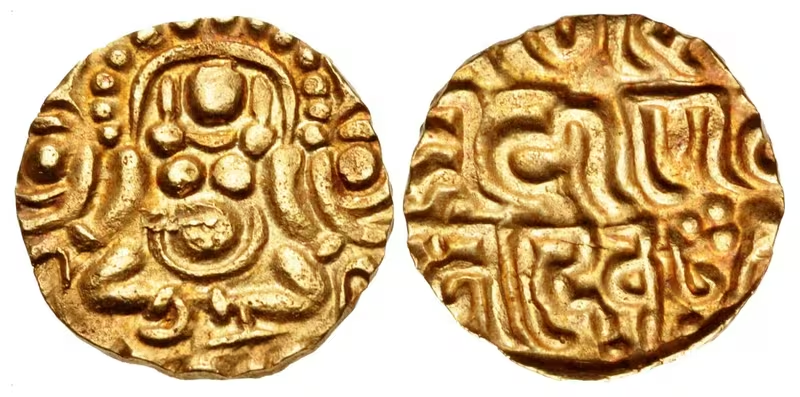
The surviving historical account provides limited information about Chandela economic organisation and trade. It does not describe a coinage system, tax schedule, market network, or commercial policy. It is therefore not possible to reconstruct the dynasty's economy in detail from the available evidence.
The construction of large temples, forts, palaces, and water bodies nevertheless indicates the mobilisation of significant resources. Water infrastructure formed part of the Chandela building programme, while fortified sites such as Kalanjara and Ajaigarh required sustained labour and material support. The location of the kingdom in central India also gave its rulers an important strategic position between neighbouring political regions, although the surviving account does not document specific trade routes.
Decline and Fall
The Chandela decline was gradual rather than the result of a single defeat. Ghaznavid invasions weakened the kingdom during and after Vidyadhara's reign. The Kalachuris then captured eastern territory, while the Kachchhapaghatas of Gwalior probably withdrew their allegiance. Later rulers recovered some strength, but gains against the Kalachuris and Paramaras were not permanently retained.
The raid by Prithviraj Chauhan exposed the vulnerability of the kingdom, but it did not immediately end Chandela rule. Paramardi continued to govern after the loss of Mahoba and restored his authority. Around 1202–1203 CE, however, Qutb al-Din Aibak, the Ghurid governor of Delhi, invaded the Chandela kingdom. According to the Taj-ul-Maasir, Paramardi surrendered and promised tribute, but died before fulfilling the agreement. His dewan resisted the invading forces, though that resistance was ultimately overcome. The sixteenth-century historian Firishta gives a different account, stating that Paramardi was killed by his own minister because the minister opposed surrender.
After Paramardi, Trailokyavarman, Viravarman, Bhojavarman, and Hammiravarman ruled a much-reduced kingdom. Hammiravarman, who ruled approximately from 1288 to 1311, no longer used the imperial title Maharajadhiraja. This change indicates the lower political status of the later Chandela rulers. The rise of the Bundelas, Baghelas, and Khangars, together with expanding Muslim influence, further diminished Chandela authority.
The dynasty did not disappear entirely. A minor branch continued to rule Kalanjara, where its ruler was killed by the army of Sher Shah Suri in 1545. Another branch ruled at Mahoba. Durgavati, a princess of this line, married into the Gond royal family of Mandla. Other ruling families also claimed Chandela descent.
Legacy
The Chandelas left a political legacy in the history of Bundelkhand and a cultural legacy visible across central India. Their transformation from Pratihara feudatories into sovereign rulers illustrates the fragmentation and regionalisation of power in medieval northern India.
Their greatest surviving legacy is the temple complex at Khajuraho. The Lakshmana, Vishvanatha, and Kandariya Mahadeva temples preserve the artistic ambitions of the dynasty at the height of its power. The forts of Kalinjar and Ajaigarh, together with Mahoba's association with later Chandela history, show that the dynasty's achievements extended beyond temple construction.
The contrast between inscriptions and later ballads is also part of the Chandela legacy. Stories of Paramardi, Alha, and Udal continued to shape popular memory, but the historical record shows that these narratives cannot always be read literally. Inscriptions and contemporary chronicles provide a more complex picture of defeat, recovery, negotiation, and political decline.