Overview
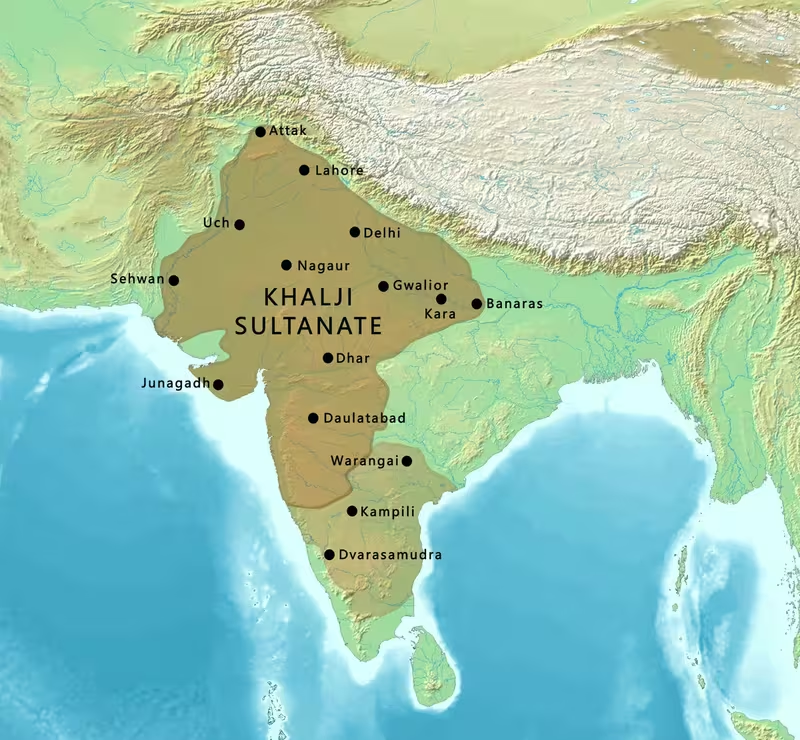
In 1290, power in Delhi passed from the Mamluk ruling house to Jalal-ud-din Firuz Khalji, beginning a dynasty that would govern the Delhi Sultanate until 1320. The Khaljis ruled for nearly three decades, but their political and military impact extended far beyond the length of their reign. Under Alauddin Khalji, the Sultanate reached its greatest territorial extent, resisted repeated Mongol attacks, conquered important regions of northern India, and projected power into the Deccan and south India.
The dynasty was the second ruling house of the Delhi Sultanate. Its rise is often described as the Khalji Revolution: a transfer of political authority from an established Turkish ruling elite to a Khalji faction regarded by contemporary Turkic nobles as non-Turkish. The identity and origins of the Khaljis, however, are complex. Historians and historical writers have variously connected them with Turkic, Central Asian, Afghan, and mixed frontier traditions.
The dynasty's political history falls into two sharply contrasting phases. Jalal-ud-din Khalji established the new ruling house and was remembered as mild, humble, and kind to the general population. Alauddin Khalji, his nephew and son-in-law, seized power through assassination and created a far more centralized and militarized state. His reign brought conquest, administrative control, market regulation, harsh taxation, and severe repression. After his death in 1316, rapid succession struggles destroyed the dynasty's stability. In 1320, Ghazi Malik, later known as Ghiyath al-Din Tughluq, overthrew Khusrau Khan and founded the Tughlaq dynasty.
Rise to Power
The Khaljis' earlier history is difficult to establish with certainty. Their ancestors, known as the Khalaj, are described in different ways in historical writing. One account associates them with Turkic groups that moved from Central Asia with the Hunas and Hephthalites into areas of present-day Afghanistan as early as the seventh century. There, they are said to have ruled Kabul as the Buddhist Turk Shahis. Over time, the Khalaj are described as having adopted Afghan customs and habits.
This frontier background helps explain why their identity was disputed within the Delhi Sultanate. Some historians describe the Khaljis as being of Turko-Afghan origin. The New Cambridge History of Islam presents them as a people distinct from the Turks, making the Khalji Revolution a change from a Turkish ruling elite to a non-Turkish one. André Wink describes them as a Turkicized group that also incorporated remnants of earlier Indo-European nomadic peoples, including Kushans, Hephthalites, and Sakas, before merging with Afghans. Doerfer has suggested that the Khalaj may have been Sogdians who became Turkicized.
Other evidence also reflects this uncertainty. Mahmud al-Kashgari, writing in the eleventh century, did not include the Khalaj among the original Oghuz Turkic tribes, although he placed them among Oghuz-Turkman groups. Muhammad ibn Najib Bakran's Jahan-nama explicitly calls them a tribe of Turks but notes that their language had developed into a distinct dialect and that their appearance had changed in comparison with other Turks. Later assimilation of Khalaj groups into Pashtun society has been connected by C. E. Bosworth with the formation of the Ghilzai or Ghilji Pashtuns. The early history of the tribe remains obscure, and even the identity of the name Khalaj has not been considered fully proven.
By the late thirteenth century, Khaljis had become part of the Muslim nobility of the Delhi Sultanate. They served the Mamluk sultan Ghiyas ud din Balban, although they occupied a relatively minor position within the political elite. Balban's efforts to control powerful Turkish officers weakened the political group known as the Forty. This damaged the cohesion of the Turkish nobility and left it vulnerable to the Khalji faction.
The transfer of power occurred through a violent series of assassinations. The last major Turkish Mamluk ruler, Balban, was followed by the young Muiz ud din Qaiqabad. Qaiqabad, only seventeen, was killed at the Kailu-gheri Palace during the coup. Jalal-ud-din Firuz Khalji then took power and ascended the throne of Delhi in January 1290.
The new sultan did not receive universal acceptance. Balban's nephew revolted against him, while commanders and nobles associated with the Mamluk regime resented the displacement of their faction. Jalal-ud-din suppressed the revolt and executed some commanders. He also led an unsuccessful expedition against Ranthambhor. During his reign, Kilokhri, an Afghan settlement on the outskirts of Delhi, served as his de facto capital.
Jalal-ud-din's reign lasted from 1290 to 1296. He was remembered as a mild and humane monarch, particularly in contrast with the severity associated with his successor. He also faced Mongol attacks. With the assistance of his nephew Juna Khan, he destroyed a Mongol force on the banks of the Sind River in central India. His reign ended when he was assassinated in a plot involving his nephew. Muhammad Salim of Samana carried out the killing, clearing the way for Alauddin Khalji's seizure of power.
Golden Age
Alauddin Khalji was Jalal-ud-din's nephew and son-in-law. Before becoming sultan, he raided the Deccan peninsula and attacked Deogiri, then the capital of the state of Maharashtra. The expedition brought him considerable treasure. On his return to Delhi in 1296, he murdered Jalal-ud-din and assumed the throne.
Alauddin strengthened his position by appointing trusted allies to important offices. Zafar Khan became minister of war, Nusrat Khan became wazir of Delhi, and Ayn al-Mulk Multani, Malik Kafur, Malik Tughlaq, and Malik Nayk also received prominent responsibilities. These appointments supported the sultan's military expansion and helped him counter the political dangers posed by older aristocratic factions.
His reign lasted twenty years and marked the high point of Khalji power. The Sultanate conquered or raided territories across northern and central India and sent armies deep into the peninsula. Alauddin's commanders gathered substantial booty from defeated kingdoms, including treasure from royal capitals and temples. One-fifth of the war booty, known as khums, was paid into the sultan's treasury. This flow of wealth helped finance the court, the army, and further campaigns.
Alauddin's power was also linked to his resistance against Mongol invasions. At the Battle of Jaran-Manjur in 1298, he defeated a major Mongol invasion. The victory consolidated his authority and increased his prestige at a time when his rule was still being established. He later withstood two further Mongol raids. The danger from Mongol forces was not simply an external military issue; it also influenced the expansion and financing of the Sultanate's standing army.
The extent of Alauddin's conquests made the Khalji period the territorial high point of the Delhi Sultanate. In Rajputana, his forces attacked and seized Jaisalmer in 1299, Ranthambhor in 1301, and Chittorgarh in 1303. Malwa was conquered in 1305. Gujarat was also brought under Khalji control, and Deogiri was again plundered during the southern raids.
The court's claims of power were accompanied by violence. Historical accounts describe massacres after campaigns and severe action against individuals suspected of threatening the sultan. In 1298, between 15,000 and 30,000 recent converts to Islam near Delhi were killed in a single day because of fears that they were planning an uprising. In 1299–1300, Alauddin ordered the blinding and beheading of family members and nephews whom he suspected of rebellion. These episodes illustrate the coercive nature of the regime as well as the insecurity surrounding the ruler's authority.
Administration and Governance
Alauddin Khalji's administration was designed to strengthen the central treasury and maintain a large army. He raised agricultural taxation from 20 percent to 50 percent. The tax could be paid in grain, agricultural produce, or cash. Payments and commissions traditionally received by local chiefs in connection with tax collection were eliminated. The policy increased the direct reach of the central government into rural society.
The sultan also sought to prevent nobles from forming independent networks of opposition. He banned social gatherings among officials and prohibited intermarriage between noble families. Salaries paid to officials, poets, and scholars were reduced. Landed property was confiscated from courtiers and officers, and revenue assignments held by Muslim jagirdars were cancelled. Revenue was instead collected by the central administration.
Alauddin's revenue officers worked with local intermediaries, including khuts, mukaddims, chaudharis, and zamindars. The administration demanded half of the produce generated by farmers as a tax on the standing crop. Officers were instructed to enforce payment, sometimes using beatings against the middlemen responsible for rural collection. The stated political effect was to leave people occupied with earning a living and unable to accumulate the surplus that could finance rebellion.
The scope of these measures made the Khalji state highly centralized, but they also placed intense pressure on cultivators and local elites. Increased taxation contributed to reduced agricultural output and aggravated inflation. The administration therefore introduced extensive market controls to ensure that the army and the capital could be supplied at regulated prices.
The government established markets known as shahana-i-mandi. Prices were fixed for agricultural produce, manufactured goods, livestock, and slaves. Muslim merchants received exclusive permits and monopolies to buy and resell goods in these markets. Farmers could not freely sell to anyone they chose, and people other than the authorized merchants were forbidden to purchase from cultivators or sell in the cities.
Alauddin appointed munhiyans, or spies and secret police, to supervise the markets. They monitored transactions and could seize people who bought or sold goods above or below the official prices. Violations were punished severely, including punishments involving mutilation. The system also controlled where goods could be sold and who could participate in trade.
The state collected taxes in the form of grain and other agricultural produce and stored them in granaries. As shortages multiplied, Alauddin introduced rationing. Private storage of food was prohibited. The rationing system was intended to preserve supplies in Delhi, particularly during famines, and to make sure the army and court remained supplied. The nobility and the army were exempt from the per-family food quota applied to other groups.
The price system had mixed consequences. It lowered prices, but the reduction of official salaries and wages meant that ordinary people did not necessarily benefit from cheap goods. Over time, some farmers abandoned production for income and shifted toward subsistence farming. Food supplies in northern India worsened, shortages increased, and the Sultanate experienced increasingly severe and prolonged famines. The system collapsed soon after Alauddin's death. Within a few years, prices for agricultural products and wages had doubled or quadrupled.
The Khalji military establishment was large by the standards of the period. Historians have estimated that the standing army included between 300,000 and 400,000 cavalry and between 2,500 and 3,000 war elephants. This was smaller than the army later associated with the Tughlaq state, which was reported to possess 500,000 cavalry. The taxes and market regulations of Alauddin's reign were closely connected to the maintenance of this military force.
Military Campaigns
The first major test of Alauddin's reign came from the Mongol invasion defeated at Jaran-Manjur in 1298. The victory helped secure the throne and demonstrated that the new sultan could defend the Sultanate. Alauddin later resisted two further Mongol raids. His responses to the Mongol threat strengthened the case for a large standing army and helped justify the harsh fiscal policies imposed on the population.
The campaign in Malwa was connected to the Sultanate's wider commercial and strategic interests. Ayn al-Mulk Multani was sent against the Paramara kingdom of Malwa to secure a route to Gujarat's trading ports. The Rai of Malwa defended his kingdom with a large Rajput army, but Multani defeated him and became governor of the province.
In 1299, Nusrat Khan was sent to conquer Gujarat. He defeated its Solanki ruler and plundered the principal cities. The campaign also involved the sacking of temples, including Somnath, which had been rebuilt in the twelfth century. Malik Kafur was captured during the Gujarat campaign. He had been born into a Hindu family and converted to Islam before rising to become one of the Delhi Sultanate's leading commanders and Alauddin's favored lieutenant.
Alauddin's armies also advanced through Rajputana. Jaisalmer was seized in 1299, Ranthambhor in 1301, and Chittorgarh in 1303. Malwa followed in 1305. These victories expanded the territory directly controlled or dominated by Delhi and placed important regional powers under Khalji pressure.
The most dramatic campaigns were conducted in the Deccan and south India. In 1308, Malik Kafur captured Warangal. He overthrew the Hoysala Empire south of the Krishna River and raided Madurai in Tamil Nadu. These campaigns did not merely extend the Sultanate's military reach; they also brought vast quantities of treasure to Delhi. Malik Kafur looted royal treasuries and temples in the southern capitals and returned in 1311 with war booty from the Deccan peninsula.
The Warangal booty was said to include the Koh-i-Noor, described in the historical account as one of the largest known diamonds in human history. Malik Kafur submitted the captured wealth to Alauddin Khalji. The scale of the booty helped make him a powerful figure at court and contributed to his status as the sultan's favorite.
The southern expeditions demonstrate the character of Khalji expansion. The dynasty could project military power over great distances, but its commanders also sought tribute, treasure, and war booty. The wealth brought north helped support the Sultanate's army and administration. At the same time, the campaigns subjected defeated kingdoms and their populations to plunder and coercion.
Cultural Contributions
The Khalji period contributed to the development of early Indo-Mohammedan architecture, a style and building program that continued to flourish under the Tughlaq dynasty. Its most celebrated surviving monument is the Alai Darwaza, the southern gateway of the Qutb complex enclosure.
Completed in 1311, the Alai Darwaza was incorporated into the Qutb Minar and its Monuments complex. The complex was included in the UNESCO World Heritage List in 1993. The gateway therefore provides a direct architectural connection between the Khalji court and one of the most important monumental ensembles associated with the Delhi Sultanate.
Other buildings attributed to the Khalji period include the Idgah at Rapri and the Jamat Khana Masjid in Delhi. Persian-Arabic inscriptions have also been traced to monuments from the dynasty's era. Together, these buildings and inscriptions reflect the growth of a distinct architectural and epigraphic tradition within the Sultanate.
Literary evidence is important but must be used cautiously. Yamin al-Din Abul Hasan, better known as Amir Khusrau, composed semi-fictional poetry in the mathnawi form. His work contains extensive praise of his employer, the reigning sultan. Because the poetry is strongly laudatory, historians debate how far it can be treated as an independent account of political events. It remains valuable for understanding the courtly culture and political language surrounding the Khalji rulers, but its praise of the sovereign requires careful interpretation.
The dynasty's cultural world was part of a wider Persianate society. Court language, official records, inscriptions, architecture, military administration, and the circulation of historical narratives all linked the Khalji state to the broader political culture of the Delhi Sultanate. At the same time, its rule operated across societies with different languages, religions, and regional political traditions.
Economy and Trade
Khalji economic policy was shaped by the needs of conquest and military defense. The sultan had to maintain a large cavalry force, war elephants, commanders, garrisons, and a central administration. Alauddin's taxation system aimed to transfer a substantial share of rural surplus into the treasury. The state demanded half of agricultural production, collected taxes through central officers, and stored grain in government granaries.
The conquest of Gujarat was partly intended to secure access to its trading ports. Wealth captured in Gujarat, Malwa, Deogiri, Warangal, the Hoysala territories, and Madurai was used to reinforce the authority of the court. The payment of one-fifth of war booty into the treasury formalized the connection between military victory and state finance.
Alauddin also imposed four taxes on non-Muslims: jizya, a poll tax; kharaj, a land tax; kari, a house tax; and chari, a pasture tax. These were administered alongside the broader extraction of agricultural surplus. The combined burden affected rural production, local intermediaries, and the capacity of households to retain wealth.
Trade within the Sultanate was tightly supervised. The shahana-i-mandi system combined official prices, authorized merchants, surveillance, and punishment. State controls extended to food, livestock, goods, and slaves. During shortages, the granaries and wholesale markets were intended to protect the supply of Delhi and the military establishment.
The results were contradictory. Regulated prices could keep food and supplies available to the army, court officials, and urban residents of Delhi even during scarcity. Yet low official prices were accompanied by reduced wages, while heavy taxation and coercive collection damaged agricultural incentives. The movement of farmers toward subsistence production worsened the food supply. Once the system collapsed after Alauddin's death, prices and wages rose sharply.
Slavery was another important feature of the Khalji economy and society. In Delhi, at least half of the population during Alauddin's reign was described as enslaved people working as servants, concubines, and guards for Muslim nobles, amirs, court officials, and military commanders. Enslaved men were referred to by terms including banda, qaid, ghulam, and burdah; enslaved women were called bandi, kaniz, or laundi. People entered slavery through military capture or after defaulting on taxes. The institution of slavery and bonded labor became widespread during the Khalji period and continued under later Islamic dynasties.
Decline and Fall
Alauddin Khalji died in January 1316. His death removed the ruler who had held together the dynasty's military, fiscal, and political system. The Sultanate immediately entered a period of coups, assassinations, and unstable succession.
Malik Kafur briefly became sultan, but he lacked the support of the amirs. He was killed within a few months. After his death, the nobles installed the six-year-old Shihab-ud-din Omar as sultan and made his teenage brother, Qutbuddin Mubarak Shah, regent.
Qutbuddin eventually killed his younger brother and took the throne for himself. He attempted to secure the loyalty of the nobles and the Malik faction by distributing offices. Ghazi Malik, who commanded the army in Punjab, was appointed to a leading military position. Other members of the elite were offered official posts or faced death.
Mubarak Shah ruled in his own name for less than four years. In 1320, one of his generals, Khusrau Khan, murdered him and took power. Khusrau Khan's position was also insecure. The amirs persuaded Ghazi Malik to lead a coup. From Punjab, Ghazi Malik marched on Delhi, captured Khusrau Khan, and beheaded him.
Ghazi Malik then renamed himself Ghiyath al-Din Tughluq and founded the Tughlaq dynasty. His accession marked the end of the Khalji dynasty in 1320. The transition was not caused by a single military defeat comparable to the Mongol attacks. Instead, it resulted from the breakdown of succession, the concentration of authority around the sultan, factional rivalry among commanders and nobles, and the rapid violence that followed Alauddin's death.
Legacy
The Khalji dynasty's short reign altered the trajectory of the Delhi Sultanate. Its most visible achievement was territorial. Under Alauddin, Delhi's authority expanded across Rajputana, Gujarat, Malwa, and the Deccan, while military expeditions reached Warangal, Hoysala territory south of the Krishna River, and Madurai. The dynasty demonstrated that the northern Sultanate could mobilize armies and extract wealth from regions far beyond Delhi.
Its administrative legacy was equally important. Alauddin's land-revenue system made the kharaj or land tax the principal form through which the ruling class appropriated peasant surplus. The taxation system introduced during his reign exerted a long-term influence on Indian taxation and state administration, surviving in important respects into the nineteenth or even twentieth century.
The Khalji experience also showed the strengths and limits of centralization. Direct revenue collection, confiscation of assignments, surveillance of officials, restrictions on aristocratic alliances, and market controls gave the sultan considerable power. These policies helped maintain the army and keep Delhi supplied. But they also produced heavy rural pressure, reduced agricultural output, and depended heavily on the authority of a single ruler. After Alauddin's death, the system rapidly lost coherence.
The dynasty's architectural legacy survives in monuments such as the Alai Darwaza and the Jamat Khana Masjid. Its inscriptions and building programs form part of the history of early Indo-Mohammedan architecture, which developed further under the Tughlaqs.
The Khaljis are also important for the history of political identity in medieval India. Their rise exposed tensions between Turkish nobles and groups shaped by the frontier societies of Afghanistan and Central Asia. Historical descriptions of the Khalaj vary between Turkic, non-Turkish, Turkicized, Afghanized, and mixed identities. This disagreement is not incidental: it reflects the shifting social categories of the Delhi Sultanate and the difficulty of applying modern ethnic labels to medieval populations.
Finally, the Khalji period must be reconstructed with caution. A genuine continuous set of primary records for 1260–1349 has not been found. The account by Wassaf, duplicated in the Jami al-Tawarikh, provides a short discussion of the Delhi Sultanate around 1302–1303 and covers the end of Balban's rule, the beginning of Jalal-ud-din's reign, and Alauddin's succession. Amir Khusrau's poetry supplies courtly testimony but is shaped by praise for his employer.
The more independent accounts of Abdul Malik Isami, Ziauddin Barani, and Sirhindi were written decades after the dynasty ended—respectively in 1349, 1357, and 1434—and may have depended on lost texts or memories of people connected with the Khalji court. Barani's work is the most frequently cited among them, but the chronological distance remains significant. The surviving evidence therefore preserves the broad outline of Khalji expansion and political change while leaving some details open to debate.