Overview
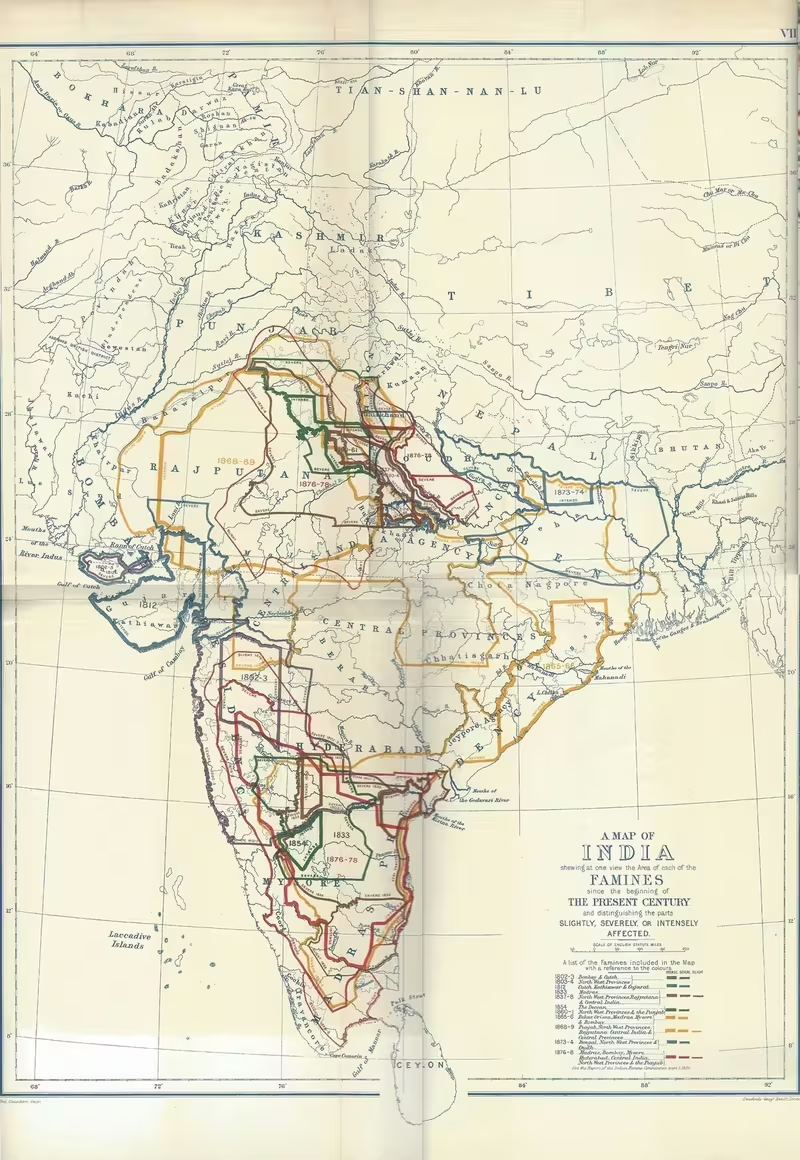
The Great Famine of 1876–1878 began with an intense drought and crop failure in the Deccan Plateau. It soon became a vast humanitarian crisis affecting the Madras, Bombay, and Punjab presidencies, as well as the princely states of Mysore and Hyderabad. In 1877, famine conditions spread northward into parts of the Central Provinces and the North-Western Provinces.
The affected area eventually covered about 670,000 square kilometres, with a population of approximately 58.5 million exposed to distress. Estimates of excess mortality range from 5.6 million to 9.6 million deaths; a careful modern demographic estimate places the figure at 8.2 million. The crisis is also known as the Southern India famine of 1876–1878 and the Madras famine of 1877.
Drought was the immediate environmental cause, but food scarcity alone does not explain the scale of the disaster. Grain continued to be exported, cash-crop cultivation had expanded, and the colonial government was attempting to limit welfare expenditure. Relief policy therefore became a central part of the famine’s history—and of the controversy surrounding it.
Background
The famine formed part of a wider period of drought and crop failure that affected India, China, South America, and parts of Africa. These conditions were associated with the interaction of the 1877–1878 El Niño and an active Indian Ocean Dipole. Across the affected regions, the combined crisis was linked to between 19 million and 50 million deaths.
In India, the drought caused crops to fail across the Deccan Plateau. Yet the region continued to produce foodstuffs in quantities that, according to the historical account, could have helped avoid famine. The regular export of grain by the colonial government did not stop. Under Viceroy Lord Lytton, wheat exports to England reached a record 6.4 million hundredweight, or approximately 320,000 tons.
The structure of agriculture also mattered. The cultivation of alternate cash crops and the increasing commodification of grain played an important role in the crisis. Food was increasingly treated as a market commodity, while poor agricultural labourers and other vulnerable groups struggled to purchase enough of it.
The government’s attitude had been shaped by the Bihar famine of 1873–1874. During that earlier crisis, severe mortality had been avoided by importing rice from Burma, but the Government of Bengal and Lieutenant-Governor Sir Richard Temple were criticised for spending too much on relief. By 1876, Temple had become Famine Commissioner for the Government of India and was determined to avoid accusations of excessive expenditure.
Prelude
Temple advocated a laissez-faire approach to grain trade and stricter standards for receiving public relief. The government established two broad forms of assistance. Able-bodied men, women, and working children could receive support through “relief works,” while small children, elderly people, and those unable to work were eligible for gratuitous, or charitable, relief.
The qualification tests were rigorous. In the Bombay Presidency, people working for relief protested and went on strike. Their distress reflected the gap between official ideas about assistance and the physical demands placed on famine victims.
In January 1877, Temple reduced the ration associated with a day of hard labour in the relief camps of Madras and Bombay. The so-called “Temple wage” provided a man with 450 grams, or one pound, of grain and one anna. Women and working children received slightly less. The workday was described as long and physically demanding, without shade or rest.
The policy was based on the belief that generous assistance could create “dependency,” described at the time as “demoralisation.” Viceroy Lytton supported Temple’s position, insisting that financial considerations had to govern relief spending. Other officials disagreed. William Digby criticised the policy, while W. R. Cornish, the Sanitary Commissioner for the Madras Presidency, argued that labourers needed at least 680 grams of grain, along with vegetables and protein.
The Event
The famine deepened during 1877 as drought, failed harvests, restricted relief, and continuing economic pressure combined. The affected regions included the Madras, Bombay, and Punjab presidencies, Mysore and Hyderabad, and later areas farther north.
Relief Policy
In March 1877, the provincial government of Madras increased the ration partway toward Cornish’s recommendation. The revised allowance consisted of 570 grams of grain and 43 grams of protein in the form of daal, or pulses. By then, however, many people had already died.
Relief policy varied across India. In the United Provinces, assistance was meagre, and mortality was high. The system was also divided between labour-based relief and charitable support, leaving the elderly, children, the sick, and those unable to perform strenuous work dependent on the second category.
The Government of India eventually spent Rs. 30 million on relief in British India, covering 700 million units of assistance, with one unit representing relief for one person for one day. A further Rs. 7.2 million supported 72 million units in the princely states of Mysore and Hyderabad. Tax payments worth Rs. 6 million were either not enforced or postponed, while charitable donations from Britain and the colonies amounted to Rs. 8.4 million.
These figures did not correspond to generous per-capita assistance. In the Bombay Presidency, expenditure was less than one-fifth of the amount spent during the Bihar famine of 1873–1874, even though the Great Famine affected a larger area and lasted longer.
Famine in Mysore
Mysore experienced serious agricultural disruption before the wider famine reached its height. Two years earlier, heavy rain had destroyed ragi crops around Kolar and Bangalore. Ragi, a type of millet, was an important food crop. Scant rainfall in the following year dried up lakes and reduced available food stocks.
The Mysore government opened relief kitchens, and many people travelled to Bangalore in search of assistance. Those who received food or grain often had to work on the Bangalore–Mysore railway line. The state imported large quantities of grain from the neighbouring British-ruled Madras Presidency.
Authorities temporarily allowed grazing in forests, constructed new tanks, and repaired older ones. Sir Richard Temple was sent by the Government of British India as Special Famine Commissioner to supervise relief works in Mysore.
The famine caused Mysore’s population to decline by 874,000 compared with the 1871 census. In a Dasara speech, the state’s Dewan, C. V. Rungacharlu, estimated the cost of the crisis at 160 lakhs, with the state taking on a debt of 80 lakhs.
Turning Points
By 1877, Temple declared that he had brought the famine “under control.” William Digby challenged this assessment, arguing that a famine could not be considered adequately controlled if one-fourth of the people had died.
The crisis did not end with the improvement of official conditions. In the second half of 1878, an epidemic of malaria killed many people already weakened by malnutrition. The famine therefore involved not only hunger and crop failure but also the heightened vulnerability to disease created by prolonged deprivation.
Participants
Colonial Government
Lord Lytton, the Viceroy of India, supported the financial priorities behind Temple’s relief policy. Sir Richard Temple served as Famine Commissioner and promoted strict qualification standards, limited rations, and reliance on market principles in grain trade.
The colonial government also continued grain exports during the crisis. Its policies became central to later criticism because food moved out of affected regions while millions faced hunger.
Critics and Provincial Officials
William Digby criticised the official claim that the famine had been brought under control. W. R. Cornish opposed the reduced relief ration and argued that workers performing hard physical labour required more grain, along with vegetables and protein.
In Mysore, Dewan C. V. Rungacharlu described the financial burden placed on the state. The government of Mysore organised kitchens, imported grain, and undertook public works, but the state still suffered a major population decline.
Aftermath
The famine’s immediate human cost was enormous. Its excess mortality has been estimated within a range of 5.6 million to 9.6 million deaths, while a modern demographic estimate gives 8.2 million. The deaths disrupted the natural population growth of the Bombay and Madras presidencies during the decade between the 1871 and 1881 censuses.
The famine also produced major population movements. Many agricultural labourers and handloom weavers from South India emigrated to British tropical colonies, where they worked as indentured labourers on plantations.
Questions about relief and government protection led directly to the formation of the Famine Commission of 1880. The crisis eventually contributed to the adoption of the Indian Famine Codes, which sought to establish more systematic approaches to famine administration.
Historical Significance
The Great Famine altered the debate over colonial responsibility. It demonstrated how environmental disaster could become far more deadly when combined with market pressures, continued exports, limited welfare spending, and relief systems that demanded hard labour from starving people.
The controversy also had political consequences. British administrators such as William Wedderburn and A. O. Hume were unsettled by the official response and by the suppression of debate about the best form of famine relief. Less than a decade later, they would help found the Indian National Congress.
For Indian nationalists including Dadabhai Naoroji and Romesh Chunder Dutt, the famine became a central example in the economic critique of British rule. It was used to question whether colonial policies protected India’s population or extracted wealth while leaving people vulnerable to disaster.
Legacy
The famine remained present in Tamil and other literary traditions. Numerous Kummi folk songs describing the crisis have been documented, preserving memories of hunger and suffering outside official administrative records.
Its legacy also survived in institutional form through the Famine Commission and the Indian Famine Codes. In Mysore, the crisis was remembered through the financial and infrastructural measures undertaken during the emergency, including relief kitchens, railway labour, tank repairs, and grain imports.
The event is therefore remembered in two connected ways: as a catastrophe of extraordinary mortality and as a turning point in the history of colonial governance, famine relief, and Indian nationalism.
Historiography
Interpretations of the famine have focused on the relationship between drought and policy. The drought and associated crop failures created the initial emergency, but the continuation of grain exports, the growth of cash-crop cultivation, and restricted relief influenced how widely and severely the crisis affected people.
Officials disagreed sharply about the adequacy of relief. Temple and Lytton prioritised limited expenditure and feared that larger payments would encourage dependency. Cornish and Digby regarded the rations and labour requirements as inadequate. Digby’s criticism directly challenged the claim that the famine had been brought under control.
Later nationalist thinkers treated the famine as evidence of the economic costs of British rule. Modern demographic estimates have also refined understanding of the death toll, placing it at approximately 8.2 million while recognising that historical estimates range considerably.
Timeline
Drought and Crop Failure
An intense drought causes crop failure in the Deccan Plateau, while famine conditions emerge across southern India.
Famine Spreads
The crisis affects the Madras, Bombay, and Punjab presidencies, Mysore, Hyderabad, and later parts of central and northern India.
Relief Rations Reduced
The Temple wage is introduced in January; Madras increases the ration in March after criticism from officials including W. R. Cornish.
Mysore Relief Efforts
Mysore operates relief kitchens, imports grain, permits forest grazing, and undertakes railway and tank works.
Disease After Famine
Malaria kills many people weakened by malnutrition during the second half of the year.
Famine Commission
Renewed questions about relief and protection lead to the formation of the Famine Commission.