Overview
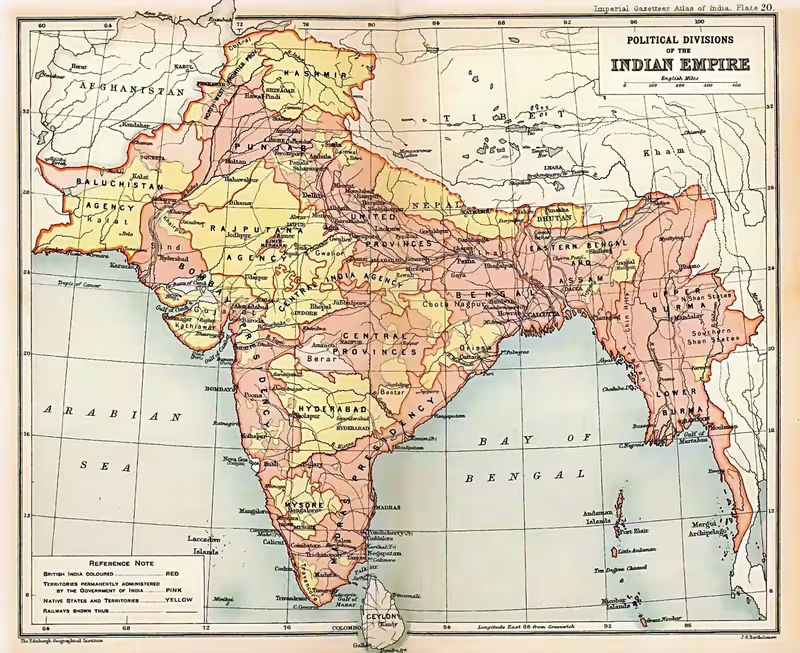
On 15 August 1947, independence did not produce a single, uniformly governed India. The subcontinent contained territories that had been ruled directly by Britain, hundreds of princely states governed by hereditary rulers under British paramountcy, and colonial enclaves controlled by France and Portugal. The political map inherited by the new dominions was therefore complicated, fragmented and constitutionally uncertain.
The princely states varied enormously. Some were large territories with millions of inhabitants, substantial administrations and considerable political influence. Others were small states, estates or talukas with limited resources and little effective autonomy. In total, 562 princely states existed within the British Indian system. Their rulers retained different degrees of authority over internal affairs, while the British Crown controlled or supervised their external relations through treaties, subsidiary alliances and the wider principle of paramountcy.
The integration of these territories into the Indian Union unfolded through several connected processes. First, rulers were persuaded to sign Instruments of Accession. These commonly transferred authority over defence, external affairs and communications while preserving internal autonomy. Second, smaller states were merged into neighbouring provinces or combined into unions. Third, the Government of India extended responsible government and central constitutional authority over the former princely territories. Finally, the States Reorganisation Act of 1956 removed the remaining formal distinction between the old provinces and the former princely states.
The process was largely diplomatic, but it was not entirely peaceful. Junagadh, Hyderabad and Jammu and Kashmir became the most difficult cases. Junagadh acceded to Pakistan despite having no land border with it. Hyderabad attempted to remain independent and was incorporated into India after Operation Polo. Jammu and Kashmir acceded to India during a war with forces entering from Pakistan, but its territory remained divided. These disputes created consequences that lasted far beyond the first years of independence.
The integration of the princely states was therefore not a single event or a single act of annexation. It was a sequence of negotiations, legal arrangements, mergers, administrative reforms, military interventions and constitutional changes that continued from 1947 into the 1950s.
Background
British India and the princely states
Before independence, India—also called the Indian Empire—was divided into two broad categories of territory. The first consisted of provinces under direct British rule, commonly described as British India. The second consisted of princely states under the suzerainty of the British Crown.
The relationship between Britain and each princely state was not identical. It was governed by individual treaties and developed through different historical circumstances. Some rulers exercised extensive internal authority. Others were subject to substantial British supervision. In certain cases, a ruler was effectively little more than the proprietor of a landed estate and possessed only limited political autonomy.
British policy toward the states had changed over time. During the early nineteenth century, annexation was an important instrument of expansion. The British sought in some cases to absorb Indian states into provinces ruled directly by the colonial government. The Indian Rebellion of 1857 altered this approach. The rebellion demonstrated the difficulty of governing annexed territories and also showed the usefulness of the princely rulers as possible allies. In 1858, the British formally renounced the policy of annexation.
After 1858, relations were increasingly organised around subsidiary alliances and paramountcy. The British Crown became the ultimate suzerain over the princely states. Britain controlled their external relations and claimed a superior political position, but it also recognised and protected the states as allies. Internal autonomy varied from one state to another.
This arrangement produced a political system that was neither a collection of fully sovereign states nor a completely centralised empire. The princes ruled within limits set by British authority. The British, in turn, relied on treaties, political agents and the broader doctrine of paramountcy rather than incorporating every state directly into British India.
Attempts at closer integration
During the twentieth century, the British made several attempts to connect the princely states more closely with the directly ruled provinces. In 1921, they created the Chamber of Princes as a consultative and advisory body. It offered rulers a forum through which they could discuss matters affecting the states, but it did not create a common democratic government.
In 1936, responsibility for supervising smaller states was transferred from the provinces to the centre. The Government of India also established direct relations with the larger princely states, replacing some of the earlier arrangements involving provincial political agents.
A more ambitious project appeared in the Government of India Act 1935. It proposed a federation that would unite British India and the princely states under a federal government. The plan came close to success but was abandoned in 1939 after the outbreak of the Second World War. As a result, the relationship between the Crown and the princely states remained based on paramountcy and the separate treaties with each state.
The federal proposal was important because it raised a question that would return during the transfer of power: could the subcontinent function as a political and economic unit while retaining numerous autonomous states? The proposed federation suggested one answer. The later integration process produced another.
The Congress and the question of responsible government
The Indian National Congress did not initially treat the princely states in exactly the same way as British India. Congress had limited resources for organising inside the states and concentrated much of its energy on ending direct British rule. Some Congress leaders were also sympathetic to rulers who appeared to support reform or demonstrate that Indians could govern themselves.
This position gradually changed. In 1920, under Mahatma Gandhi's leadership, Congress declared swaraj, or self-rule, to be its goal. It called upon the princes to establish responsible government in their own states. The demand was not initially a call for immediate annexation by a central Indian government. Instead, it emphasised that people living in the princely states should have political rights and responsible institutions.
At the Calcutta Congress in 1928, Congress again expressed sympathy for the people of the Indian states and supported their peaceful struggle for full responsible government. This was an important development because it placed the political claims of the subjects of princely rulers within the larger national movement.
Jawaharlal Nehru pushed Congress toward a more direct confrontation with the political structure of the states. In his presidential address at the Lahore session in 1929, he argued that the princely states could not remain separate from the rest of India. He rejected the idea that rulers possessed an inherent or divine right to determine the future of their territories. In his view, that decision belonged to the people of the states.
The Congress position became more active after its electoral victory in most parts of British India in the provincial elections of 1937. Congress ministries supported protests, satyagrahas and popular movements in several princely states. These movements sometimes became violent, while others were organised as campaigns for responsible government.
Gandhi became involved in the dispute in Rajkot State, where he fasted in support of the demand for full responsible government. He described the people as the real rulers of Rajkot and presented the struggle as opposition to the disciplined power of the British imperial system. In 1937, Gandhi also played a role in proposing a federation that would unite British India and the princely states under an Indian central government.
The rise of socialist Congress leaders and the broader political activity of the 1930s led Congress to engage more actively with popular and labour movements in the states. By 1939, Nehru described the princely states as anachronistic and argued that they did not deserve to continue in their existing form.
Congress's formal position by 1939 was that the states should enter independent India on the same terms as the provinces of British India, while their inhabitants should be granted responsible government. This position combined two ideas: territorial integration and popular political rights.
The constitutional crisis of 1947
The end of paramountcy
The transfer of power created a fundamental problem. The British government concluded that paramountcy and the treaties between the British Crown and the princely states could not simply be transferred to India or Pakistan. These relationships had been established directly between the Crown and the individual rulers. They would therefore end when Britain withdrew.
The decision also reflected Britain's unwillingness to continue obligations associated with the old system, including the responsibility to maintain forces for the defence of the princely states. With paramountcy ending, rights that had flowed from the relationship with the Crown would return to the rulers. In theory, each state would be free to negotiate with India or Pakistan on a basis of complete freedom.
Some British plans for the transfer of power recognised the possibility that a princely state might remain outside both dominions. Congress rejected this possibility. Its leaders believed that a collection of independent states would amount to the Balkanisation of India. In their view, the historical, economic and social connections linking the subcontinent made the creation of multiple independent political units dangerous and impractical.
Nehru declared in 1946 that no princely state could resist militarily against the army of independent India. In January 1947, he stated that independent India would not accept the divine right of kings. In May, he warned that a state refusing to join the Constituent Assembly would be treated as an enemy state.
These statements expressed the harder edge of Congress policy. They made clear that the new Indian government did not accept the idea that a ruler could use the lapse of paramountcy to create a permanently independent state inside the geographical and economic space of India.
Economic and strategic connections
The argument for integration was not only ideological. Trade, commerce and communications had connected the states to British India through a complex network. Railways, customs arrangements, irrigation systems, roads, ports and other services often crossed political boundaries. Ending these agreements threatened the economic life of the subcontinent.
Lord Mountbatten, the last British viceroy, was concerned that breaking these links would create instability. He was also persuaded by Indian officials such as V. P. Menon that integrating the states into India might reduce some of the damage caused by Partition.
Strategic geography added another consideration. Some states lay across essential routes between different parts of India. Hyderabad, for example, occupied a large landlocked area in the southeast and lay across important communications between northern and southern India. An independent Hyderabad could, in the Indian government's view, be used by foreign interests or become a threat to national security.
The question was therefore not simply whether individual rulers had a legal right to choose their future. It was also whether the subcontinent could maintain functioning communications, economic exchange, defence and public order if the states remained outside the Union.
The principal negotiators
Vallabhbhai Patel
Vallabhbhai Patel was the political head of the States Department, the government office responsible for relations with the princely states. His approach combined a firm commitment to Indian unity with a willingness to reassure the rulers.
Patel's official statement of 5 July 1947 did not threaten the princes. Instead, it stressed the common interests of the states and the future Indian Union. He invited the rulers to join India so that they could make laws together as friends rather than conduct relations as foreign powers.
Patel also reassured the princes that the States Department would not function as a new instrument of paramountcy. It would serve as a means for conducting business between India and the states as equals. This distinction was important. The government sought accession, but it presented accession as a negotiated settlement rather than an immediate act of conquest.
V. P. Menon
V. P. Menon was the administrative head of the States Department and the principal official responsible for turning political objectives into workable legal arrangements. He helped prepare the Instruments of Accession, Standstill Agreements, Merger Agreements and later arrangements for princely unions.
Menon's role was especially important because the states differed so widely. A single constitutional formula could not easily be applied to a major state with an established administration and to a small estate with very limited resources. The legal instruments therefore offered different levels of authority depending on the character of each state.
Menon also negotiated the later mergers that dissolved many individual states. His discussions with rulers often took place under intense time pressure, especially in late 1947 and 1948, when the government was attempting to prevent administrative collapse and unrest.
Lord Mountbatten
Mountbatten was trusted by many rulers because of his relationship to King George VI and his personal connections with several princes. The rulers also believed that he might help ensure that independent India respected the terms of accession. Nehru and Patel asked him to become the first Governor-General of the Dominion of India, strengthening his influence during the transition.
Mountbatten argued that Britain would not grant dominion status to individual princely states or accept them into the British Commonwealth. The Crown would sever its links with the states unless they joined India or Pakistan. He also emphasised that the states would suffer economically if the connections binding them to the larger subcontinent were broken.
He presented himself as the trustee of the commitments made to the princes. In one example, he persuaded the Nawab of Bhopal to sign an Instrument of Accession and agreed to keep it in his safe until 15 August, giving the ruler an opportunity to change his mind. The Nawab ultimately did not withdraw.
Mountbatten's policy angered some princes, who believed that Britain had abandoned them. Sir Conrad Corfield resigned as head of the Political Department in protest. Winston Churchill and other critics also attacked the language used by the Indian government. Nevertheless, historians have generally regarded Mountbatten as a major influence in persuading the princes to accept accession.
Instruments of Accession and Standstill Agreements
The most important legal device was the Instrument of Accession. Through it, a ruler agreed that the state would accede to independent India and that the Government of India would control specified subjects.
For states that had retained substantial internal autonomy under British rule, the Instrument of Accession usually transferred three subjects:
- Defence
- External affairs
- Communications
These subjects were defined with reference to the relevant schedule of the Government of India Act 1935. The arrangement initially left the rulers with authority over internal matters.
States with an intermediate political status signed a different form that preserved the degree of power they had exercised under British rule. Rulers of states that functioned more like estates or talukas signed an arrangement that transferred residuary powers and jurisdiction to the Government of India.
The instruments included safeguards. One clause stated that the rulers would not be bound by the future Indian Constitution unless they agreed to it. Another protected their autonomy in matters not transferred to India. Other assurances covered extra-territorial rights, immunity from prosecution in Indian courts, exemption from customs duty, eligibility for British honours and the possibility of gradual democratisation.
The princes were also promised that the major states would not be forced immediately to merge and that their personal privileges and dignities would be protected. The government later provided annual payments, known as privy purses, as compensation for the surrender of governing authority.
The Standstill Agreement served a different purpose. It continued existing agreements and administrative practices during the transition. It could cover services and arrangements that might otherwise have ended with the departure of the British.
The States Department used the two documents together. It was unwilling to sign a Standstill Agreement with a state that refused to sign an Instrument of Accession. This linked the continuation of practical services to acceptance of the basic political relationship with India.
The limited scope of the initial Instruments of Accession made accession more acceptable to many rulers. They could preserve internal authority while transferring the subjects that made a separate foreign policy and defence system impractical. The arrangement offered what Mountbatten described as the practical independence the princes required, even though it did not preserve complete sovereignty.
The first wave of accession
Between May 1947 and the transfer of power on 15 August, most states signed Instruments of Accession. The rulers faced several pressures. Popular opinion in many states favoured integration with India. Smaller states doubted whether larger states would protect their interests. Many princes believed that integration was inevitable and sought to negotiate the most favourable settlement available.
The princes were also unable to form a united front. Some wanted independence, others preferred India, and others considered Pakistan. Smaller states did not necessarily trust the large ones. Hindu rulers often distrusted Muslim princes who supported independence, especially Hamidullah Khan of Bhopal, who was viewed by some as acting in Pakistan's interests.
The Muslim League's decision to remain outside the Constituent Assembly weakened the princes' attempt to build a political alliance against Congress. Attempts to boycott the Assembly failed on 28 April 1947 when Baroda, Bikaner, Cochin, Gwalior, Jaipur, Jodhpur, Patiala and Rewa took their seats.
The rulers of Bikaner and Jawhar were motivated in part by patriotic or ideological support for India. Others joined because of internal political pressures or because they saw accession as the only practical option. The ruler of Jamkhandi was the first to integrate with independent India.
Not every ruler was willing to accept the terms immediately. Bhopal, Travancore and Hyderabad announced that they did not intend to join either dominion. Travancore pointed to its thorium reserves and asked for recognition by foreign powers. Hyderabad attempted to establish international commercial contacts and considered negotiating with Portugal for access to the sea. Some princes proposed a confederation of states separate from both India and Pakistan.
These plans lacked the unity and popular support required to succeed. The initial resistance gradually collapsed as the rulers confronted the political, economic and military realities of independence.
The border states
Jodhpur and Jaisalmer
The ruler of Jodhpur, Hanwant Singh, was hostile to Congress and uncertain about the future of the political and social order he represented. Along with the ruler of Jaisalmer, he entered negotiations with Muhammad Ali Jinnah.
Jinnah sought to attract large border states to Pakistan. He offered Jodhpur and Jaisalmer the freedom to specify their own terms of accession, reportedly presenting blank sheets of paper for the rulers to fill in. He hoped that their accession would encourage other Rajput states to choose Pakistan and compensate for the loss of territory in Bengal and Punjab.
Jaisalmer eventually rejected the proposal. Its ruler believed that siding with a Muslim-majority Pakistan could create serious difficulties in a state where communal tensions might place Hindus and Muslims on opposing sides.
Hanwant Singh came close to agreeing with Pakistan. Mountbatten warned him that the accession of a predominantly Hindu state to Pakistan would contradict the two-nation theory used to justify Pakistan's creation. He also warned of possible communal violence. The political climate in Jodhpur was generally hostile to accession to Pakistan, and Hanwant Singh eventually agreed, though reluctantly, to join India.
Manipur and Tripura
The northeastern states of Manipur and Tripura acceded to India on 11 August and 13 August 1947 respectively. Their accession formed part of the wider process by which states in sensitive border regions were brought into the Indian Union.
Junagadh
Junagadh was located in the southwestern part of Gujarat. It had no common land border with Pakistan, although its ruler argued that the state could be connected to Pakistan by sea. The Nawab of Junagadh chose to accede to Pakistan despite Mountbatten's argument that geographical considerations strongly favoured accession to India.
The decision created an immediate dispute. Junagadh was predominantly Hindu, and the Government of India argued that the accession would worsen communal tensions in Gujarat. Two states under Junagadh's suzerainty, Mangrol and Babariawad, declared their independence from Junagadh and acceded to India. The Nawab responded by militarily occupying them.
Neighbouring states sent troops to the Junagadh frontier and appealed to the Government of India. A group of Junagadhi people led by Samaldas Gandhi formed the Aarzi Hukumat, or provisional government, in opposition to the Nawab.
India applied political and economic pressure. It cut supplies of fuel and coal, severed air and postal connections, and moved troops to the frontier. Indian forces reoccupied Mangrol and Babariawad after their rulers had acceded to India.
Pakistan agreed to discuss a plebiscite but demanded that Indian troops first withdraw. India rejected that condition. On 26 October, after clashes with Indian troops, the Nawab and his family fled to Pakistan.
The Junagadh court faced collapse and on 7 November invited the Government of India to take over the administration. India agreed. A plebiscite was held in February 1948 and produced an almost unanimous vote in favour of accession to India.
Pakistan continued to claim sovereignty over Junagadh. The dispute demonstrated the tension between the legal claim of a ruler to determine accession and the Indian government's insistence that geography, the wishes of the population and the practical unity of the subcontinent had to be considered.
Jammu and Kashmir
Jammu and Kashmir was ruled by Maharaja Hari Singh, a Hindu ruler presiding over a Muslim-majority state. Hari Singh hesitated between India and Pakistan. Accession to either dominion risked provoking opposition in parts of his kingdom, and he initially sought to remain independent.
He signed a Standstill Agreement with Pakistan and proposed a similar agreement with India. Pakistan accepted the arrangement, while Kashmir's relationship with India remained unsettled. Hari Singh's rule was opposed by Sheikh Abdullah, the popular leader of the National Conference, who demanded the Maharaja's abdication.
The state's geographical connections also complicated the issue. Pakistan controlled important supply and transport routes, while Kashmir's connections with India were more tenuous and vulnerable to disruption during the rainy season. Pakistan cut supplies and transport links. Rumours of atrocities against the Muslim population of Poonch by the Maharaja's forces spread in Pakistan.
Pathan tribesmen from Pakistan's North-West Frontier Province crossed into Kashmir and advanced rapidly toward Srinagar. Facing the military emergency, Hari Singh appealed to India for assistance.
India required two political conditions. The Maharaja had to sign an Instrument of Accession, and an interim government headed by Sheikh Abdullah had to be established. Hari Singh agreed. Indian troops then secured Jammu, Srinagar and the Kashmir Valley.
Nehru stated that the accession would have to be confirmed by a plebiscite, although the legal form of accession did not require such confirmation. The fighting continued, but the onset of winter made much of the state difficult to cross. Nehru sought United Nations arbitration, arguing that India would otherwise have to invade Pakistan because Pakistan had not stopped the tribal incursion.
On 13 August 1948, the United Nations adopted a three-part resolution calling for a ceasefire. India agreed to a ceasefire on 1 January 1949. The plebiscite was never held.
The Constitution of India came into force in Jammu and Kashmir on 26 January 1950 with special provisions for the state. India did not, however, control the whole of the former princely state. Northern and western portions came under Pakistani control during the fighting and associated rebellions of 1947 and became known as Pakistan-administered Kashmir.
Kashmir differed from the other princely states because its constitutional relationship with India continued to rest on the original Instrument of Accession and special constitutional provisions. This distinctive settlement later became central to disputes over political autonomy and integration.
Hyderabad
Hyderabad was the largest and most difficult challenge to the Indian government's policy. It was a landlocked state in southeastern India covering more than 82,000 square miles, or over 212,000 square kilometres. Its population was approximately 17 million, around 87 percent of whom were Hindu. The ruler, Nizam Osman Ali Khan, was Muslim, while the political elite was dominated by Muslims.
The Nizam sought independence. In June 1947, he issued a firman declaring that Hyderabad would become independent when British rule ended. The Government of India rejected this claim as legally doubtful. It argued that Hyderabad's location across communications between northern and southern India made the question a matter of national security. It also pointed to the state's population, history and geographical situation as evidence of its close connection with India.
Hyderabad proposed a limited treaty with India that would provide safeguards beyond those in the standard Instrument of Accession. Among the proposals was a guarantee of neutrality in a conflict between India and Pakistan. India rejected the proposal, fearing that granting such terms to Hyderabad would encourage other states to demand special treatment.
A temporary Standstill Agreement was signed. It was intended to preserve existing arrangements while negotiations continued. India later accused Hyderabad of repeatedly violating it, while the Nizam accused India of imposing a blockade. India denied the charge.
Hyderabad faced internal disorder as well. The Telangana Rebellion, which began in 1946, was a peasant revolt against feudal structures and continued to challenge the Nizam's government. The Nizam was unable to suppress it fully.
The Ittehad-ul-Muslimeen, a powerful pro-Nizam Muslim organisation, supported the ruling structure. Its militia, the Razakars, intensified its activities under the influence of Qasim Razvi. The Razakars presented themselves as defenders of the Muslim ruling class and were accused of intimidating Hindu villages and opposing popular mobilisation.
The Hyderabad State Congress, affiliated with the Indian National Congress, launched a political agitation. Communist groups, which had initially supported the Congress movement, later changed sides and attacked Congress groups. The combined pressures of peasant revolt, communal tension, political agitation and armed militia activity made a negotiated settlement increasingly difficult.
In August 1948, the Nizam attempted to approach the United Nations Security Council and the International Court of Justice. Patel argued that an independent Hyderabad would damage the authority of the Indian government and leave both Hindus and Muslims insecure.
On 7 September, Nehru issued an ultimatum demanding that the Razakars be banned and that Indian troops return to Secunderabad. Negotiations led by Mountbatten had failed.
On 13 September 1948, two days after Jinnah's death, the Indian Army entered Hyderabad in Operation Polo. The stated justification was that the law-and-order situation threatened peace in southern India. Indian forces encountered little resistance from the Razakars and established complete control between 13 and 18 September.
The operation was followed by serious communal violence. Estimates of those killed vary widely, from an official figure of approximately 27,000–40,000 to scholarly estimates of 200,000 or more. The difference between these estimates reflects continuing disagreement over the scale and character of the violence.
The Nizam was retained as head of state in a position comparable to that of other rulers who had acceded to India. He withdrew the complaints submitted to the United Nations. Pakistan protested, and other countries criticised the action, but the United Nations Security Council did not pursue the matter further. Hyderabad was absorbed into India.
Fast-track integration of smaller states
The Instruments of Accession created a relationship between India and the states, but they did not by themselves create a uniform administrative system. Many small states lacked the resources to operate viable governments. Their economies were weak, their territories were sometimes fragmented, and their tax arrangements impeded free trade with neighbouring provinces.
Patel and Menon argued that without further integration, some states might face economic collapse or administrative disorder. Yet merging the states breached guarantees that Mountbatten and Indian leaders had recently given the rulers. Patel and Nehru initially considered waiting until Mountbatten's term as Governor-General ended.
Events forced the government to move more quickly. An adivasi uprising in Orissa in late 1947 led to an all-night meeting in December between Menon and rulers from the Eastern India Agency and Chhattisgarh Agency. The rulers agreed to sign Merger Agreements. Their states were integrated into Orissa, the Central Provinces and Bihar from 1 January 1948.
Later in 1948, sixty-six states in Gujarat and the Deccan were merged into Bombay. These included the substantial states of Kolhapur and Baroda. Other small states were incorporated into Madras, East Punjab, West Bengal, the United Provinces and Assam.
Some states were not merged into neighbouring provinces. Thirty states of the former Punjab Hill States Agency lay close to the international frontier. Although they signed Merger Agreements, they were incorporated into Himachal Pradesh, which was administered directly by the centre as a Chief Commissioner's Province for security reasons.
A separate form of merger was used for sensitive areas. Kutch in western India and Tripura and Manipur in the northeast were retained as Chief Commissioners' Provinces under central control. Bhopal also became a Chief Commissioner's Province. Its ruler believed that his administration was efficient and feared that a merger with neighbouring Maratha states would destroy its identity. Bilaspur was treated similarly, partly because much of its territory was likely to be flooded by the completion of the Bhakra dam.
Terms of the Merger Agreements
The Merger Agreements required rulers to transfer full and exclusive jurisdiction over the governance of their states to the Dominion of India. In return, the rulers received several guarantees.
The Indian government agreed to provide annual payments known as privy purses. These compensated rulers for surrendering their political authority and dissolving their states. Their private property was protected, as were personal privileges, titles, dignities and customary succession.
The provincial administrations were also required to take over the staff of the former states and provide guarantees concerning equal pay and treatment. These provisions helped make the merger acceptable to rulers and officials who might otherwise have resisted the dissolution of their administrations.
The formation of princely unions
Larger states and groups of neighbouring smaller states were integrated through a four-step process. Rulers signed Covenants of Merger that created new princely unions. In these unions, most rulers surrendered their governing authority. One ruler became the Rajpramukh, while other rulers participated in a council of rulers or a presidium.
The Rajpramukh and the Uprajpramukh were selected through the structures established by the covenants. The new unions were also expected to create constituent assemblies that would frame their internal constitutions.
The rulers received privy purses and guarantees similar to those offered in the Merger Agreements. The political purpose was to transform multiple small states into larger and more viable units without immediately abolishing every ceremonial connection with the ruling families.
Saurashtra
In January 1948, Patel secured the unification of 222 states in the Kathiawar peninsula of Gujarat into the princely union of Saurashtra. Six more states joined the union the following year.
The creation of Saurashtra illustrated the practical problem of fragmentation. A peninsula containing hundreds of political units could not easily operate as a modern administrative region if each state retained separate customs, taxation and governing structures.
Madhya Bharat
Madhya Bharat was formed on 28 May 1948 through the union of Gwalior, Indore and eighteen smaller states. The new union brought together territories with distinct ruling houses and political histories.
Patiala and East Punjab States Union
The Patiala and East Punjab States Union was created on 15 July 1948. It brought together Patiala, Kapurthala, Jind, Nabha, Faridkot, Malerkotla, Nalagarh and Kalsia.
The union was particularly important because it was located in a politically sensitive region affected by Partition and close to the international border.
Rajasthan
The United State of Rajasthan emerged through a series of mergers. The final stage was completed on 15 May 1949. The process brought a number of Rajput states into a single political unit.
Travancore-Cochin
Travancore and Cochin were merged in the middle of 1949 to form the princely union of Travancore-Cochin. Their integration demonstrated that even states that had initially considered independent political futures could eventually be brought into a broader Indian framework.
Kashmir, Mysore and Hyderabad were the only princely states that signed neither Covenants of Merger nor Merger Agreements during this phase. Each retained a distinct constitutional history, although Hyderabad was brought under Indian control after Operation Polo.
Democratisation of the former states
Integration required more than changing borders or transferring authority from rulers to the central government. The former states had very different political systems.
Mysore had a legislative system based on a broad franchise and was not radically different from the institutions of British India. Other states were governed by small aristocratic circles. Political decision-making could be paternalistic, highly restricted or shaped by court politics.
The Government of India therefore sought to establish responsible government in the merged states. In December 1947, Menon suggested that rulers should take practical steps toward popular government. The States Department adopted this idea through a special covenant signed by the Rajpramukhs of the princely unions.
The Rajpramukhs agreed to act as constitutional monarchs. Their powers became, in practice, similar to those of governors in the former British provinces. This meant that the people of the princely unions were to receive the same measure of responsible government as citizens of the old provinces.
The process was not always successful. In the former Central India Agency, states had initially been combined into Vindhya Pradesh. Rivalries between two groups of states became so serious that the Government of India persuaded the rulers to sign a Merger Agreement cancelling the earlier Covenants of Merger. The central government then took direct control as a Chief Commissioner's State.
The experience showed that political union did not automatically create administrative harmony. Rivalries between ruling families, differences in political institutions and competition between regional interests continued to influence the new units.
Constitutional integration
Extending central authority
The initial Instruments of Accession transferred only limited subjects to India in many states. Congress leaders believed this arrangement would obstruct national policies relating to social justice, economic development and administrative uniformity.
In May 1948, V. P. Menon organised a meeting in Delhi between the Rajpramukhs of the princely unions and the States Department. At the end of the meeting, the Rajpramukhs signed new Instruments of Accession. These gave the Government of India authority to legislate on all matters included in the seventh schedule of the Government of India Act 1935.
The princely unions, Mysore and Hyderabad subsequently agreed to adopt the Constitution of India as the constitution of their own states. This placed them in the same legal position in relation to the central government as the former British provinces.
Kashmir remained the major exception. Its relationship with India continued to be governed by its original Instrument of Accession and special constitutional provisions. This difference became a continuing source of political debate.
The Constitution of 1950
When the Constitution of India came into force in 1950, it classified India's constituent units into Part A, Part B and Part C states.
Part A states consisted mainly of the former British provinces, along with princely states that had been merged into them. Part B states consisted of the princely unions as well as Mysore and Hyderabad. Part C states included former Chief Commissioners' Provinces and other centrally administered territories.
The constitutional heads of Part B states were Rajpramukhs appointed under the Covenants of Merger. Governors in Part A states were appointed by the central government. Apart from this distinction, the forms of government were broadly similar.
The Constitution also gave the central government significant authority over the former princely states. Their governance was placed under the general control of the Union, and the President could issue particular directions. This represented a more extensive form of central authority than the limited arrangements established in 1947.
The process had therefore moved from negotiated accession to constitutional incorporation. The government had initially promised internal autonomy in order to secure accession, but later sought to create a common national framework through agreements that the rulers formally accepted.
Reorganisation in 1956
The distinction between Part A and Part B states was intended to be temporary. The States Reorganisation Act of 1956 reorganised the former provinces and princely states primarily on linguistic lines.
At the same time, the Seventh Amendment to the Constitution removed the distinction between Part A and Part B states. Both were now simply treated as states, while Part C states became union territories.
The Rajpramukhs lost their constitutional authority and were replaced by governors appointed by the central government. Former princely territories were now fully integrated in both legal and practical terms. They no longer occupied a separate constitutional category from regions that had once been part of British India.
The political integration of the princely states was thus completed through a combination of territorial merger, democratic reform, constitutional change and administrative reorganisation. The process that began with accession in 1947 ended with the disappearance of the separate princely order from India's constitutional structure.
The rulers' personal privileges did not disappear immediately. Privy purses, exemptions from customs duty and customary dignities continued for a time. These privileges were abolished in 1971.
Colonial enclaves
The integration of the princely states raised a related issue: the future of the territories still controlled by European powers.
French possessions
At independence, France retained Pondicherry, Karaikal, Yanam, Mahe and Chandernagore. An agreement between France and India in 1948 provided for a vote in the French possessions to determine their political future.
A plebiscite in Chandernagore on 19 June 1949 produced a vote of 7,463 to 114 in favour of integration with India. Chandernagore was transferred to India de facto on 14 August 1949 and de jure on 2 May 1950.
In the other French enclaves, the pro-French camp under Edouard Goubert used the administrative machinery to suppress groups that favoured merger with India. Popular discontent increased. Demonstrations in Yanam and Mahe in 1954 allowed pro-merger groups to take power.
A referendum in Pondicherry and Karaikal in October 1954 favoured merger. On 1 November 1954, de facto control over the four remaining French enclaves was transferred to India. A treaty of cession was signed in May 1956, and after ratification by the French National Assembly in May 1962, de jure control also passed to India.
Portuguese possessions
Portugal retained Goa, Daman and Diu, Dadra and Nagar Haveli. Unlike France, Portugal rejected diplomatic solutions and treated its possessions as a matter of national pride. In 1951, it amended its constitution to classify them as Portuguese provinces.
In July 1954, an uprising in Dadra and Nagar Haveli ended Portuguese rule there. Portugal attempted to send troops from Daman to recover the enclaves, but Indian forces prevented the move.
Portugal brought proceedings before the International Court of Justice, seeking access for its troops. The Court rejected the complaint in 1960 and held that India was entitled to deny Portugal military access. In 1961, the Indian Constitution was amended to incorporate Dadra and Nagar Haveli as a Union Territory.
Goa, Daman and Diu remained under Portuguese control. On 15 August 1955, approximately 5,000 non-violent demonstrators marched at the border. Portuguese forces opened fire, killing 22 people.
In December 1960, the United Nations General Assembly rejected Portugal's argument that its Indian possessions were provinces and listed them as non-self-governing territories. Nehru continued to prefer negotiations, but Portugal's suppression of a revolt in Angola and pressure from African leaders increased support for military action.
On 18 December 1961, after an American attempt to find a negotiated solution failed, the Indian Army entered Portuguese India and defeated the Portuguese garrisons. Portugal surrendered on 19 December.
Goa was incorporated into India as a centrally administered union territory and became a state in 1987. The action ended the last European colonial presence in the Indian subcontinent.
Sikkim and the wider Himalayan context
Nepal, Bhutan and Sikkim occupied a different position from the princely states within British India.
Nepal had been recognised by Britain as de jure independent under the Nepal–Britain Treaty of 1923. Bhutan was treated during the British period as a protectorate outside India's international frontier. In 1949, India entered into a treaty with Bhutan that continued the arrangement and provided that Bhutan would follow India's advice in the conduct of its external affairs.
Sikkim had historically been a British dependency with a status resembling that of a princely state. At independence, however, its Chogyal resisted full integration with India.
India first signed a Standstill Agreement with Sikkim and then a treaty in 1950. The treaty made Sikkim an Indian protectorate rather than part of India. India assumed responsibility for defence, external affairs and communications, as well as ultimate responsibility for law and order, while Sikkim retained internal autonomy.
In the late 1960s and early 1970s, Chogyal Palden Thondup Namgyal, supported by sections of the Bhutia and Lepcha upper classes, sought greater powers, especially in external affairs. These efforts were opposed by Kazi Lhendup Dorji and the Sikkim State Congress, which represented the Nepali middle classes and favoured a closer relationship with India.
Anti-Chogyal agitation broke out in April 1973. Protesters demanded popular elections, and Sikkim's police could not control the demonstrations. Dorji asked India to exercise its responsibility for law and order.
India facilitated negotiations between the Chogyal and Dorji. The resulting agreement reduced the Chogyal to the role of a constitutional monarch and provided for elections based on an ethnic power-sharing formula. The Chogyal's opponents won overwhelmingly. A new constitution proposed association with India.
On 10 April 1975, the Sikkim Assembly passed a resolution seeking full integration with India. A referendum on 14 April endorsed the resolution with 97 percent of the vote. Parliament then amended the Constitution, and Sikkim became India's twenty-second state.
Sikkim's integration occurred after the principal period of princely-state accession, but it demonstrated that the question of political status in the Himalayan borderlands remained distinct from the settlement reached in 1947–1950.
Aftermath for the princes
The rulers did not respond uniformly to the end of their political authority. Many had expected the Instruments of Accession to be permanent and were unhappy when later arrangements dissolved their states or transferred additional powers to India.
Some rulers believed that their families had built efficient administrations and resented the disappearance of those political structures. Others were uneasy about becoming private citizens after generations of hereditary rule. Many, however, accepted retirement and lived on the privy purses guaranteed by the government.
Several former rulers entered public service. The Maharaja of Bhavnagar, Colonel Krishna Kumarasingh Bhavasingh Gohil, became Governor of Madras State. Other former rulers received diplomatic appointments overseas.
The settlement therefore did not simply remove the princes from public life. It changed their position. They ceased to be governing sovereigns but could retain wealth, social standing, ceremonial titles and, in some cases, public office.
The later abolition of the privy purses and privileges in 1971 completed the formal end of the political order associated with the princely states.
Post-integration issues
Kashmir and separatism
The integration process did not eliminate all regional political disputes. The most prominent continuing issue concerned Jammu and Kashmir.
Unlike most other states, Kashmir was not required to sign a Merger Agreement or a revised Instrument of Accession transferring authority over a broader range of subjects. India's law-making power in relation to Kashmir was shaped by Article 5 of the Constitution of Jammu and Kashmir and was more restricted than its authority over other states. Article 370 of the Constitution of India provided the wider constitutional framework for this special relationship.
Scholars have linked the later insurgency in Kashmir to the distinctive manner in which the state was integrated. Widmalm argues that during the 1980s many young Kashmiris believed that the Indian government was interfering increasingly in the state's politics. The elections of 1987 weakened confidence in constitutional politics and were followed by the violent insurgency that began in 1989.
Sumit Ganguly similarly argues that Indian policies prevented Kashmir from developing the stable political institutions associated with a modern, multi-ethnic democracy. Dissatisfaction among politically aware young people was expressed outside the electoral system, while Pakistan transformed that dissatisfaction into an active insurgency.
These interpretations do not eliminate the importance of other factors, including the international dispute and Pakistan's role. They do show that the special constitutional settlement created by the accession of 1947 remained politically consequential.
The northeastern states
Separatist movements also emerged in Tripura and Manipur. The insurgency in Tripura was later crushed, while that in Manipur continued. Scholars generally place these movements within the wider history of insurgency in Northeast India rather than treating them solely as consequences of princely-state integration.
The movements reflected tensions involving tribal identity, migration from other parts of India and the failure of the central government to address regional aspirations adequately. Their history suggests that formal incorporation into India did not automatically resolve questions of local identity or political representation.
Telangana
The integration of Hyderabad also created later regional tensions. Telangana, comprising the Telugu-speaking districts of the former Hyderabad State, differed in important ways from the Telugu-speaking areas of British India with which it was merged.
The States Reorganisation Commission initially recommended that Telangana remain a separate state rather than joining a broader Telugu-speaking unit. The Government of India rejected the recommendation and merged Telangana into Andhra Pradesh.
A movement for separate Telangana emerged in the 1960s. The demand was eventually accepted, and Telangana became India's twenty-ninth state in June 2014.
A similar but weaker movement developed in Vidarbha, which included the former Nagpur state and the Berar region of the former Hyderabad State. These movements demonstrated that linguistic reorganisation could solve some problems while creating new debates about historical identity, administrative difference and regional resources.
Historical significance
Preventing territorial fragmentation
The political integration of the princely states prevented the new Indian Union from becoming a collection of disconnected political entities. Congress leaders feared that independent states would create a Balkanised subcontinent, vulnerable to foreign influence, internal conflict and economic disruption.
The success of accession and merger gave India a continuous territorial framework. Railways, communications, trade routes and administrative services could be reorganised within a common political system. Defence planning also became more coherent because the central government gained authority over territories that might otherwise have pursued separate external relationships.
Converting imperial relationships into republican citizenship
Under British paramountcy, inhabitants of the princely states were subjects of hereditary rulers who possessed varying degrees of authority. The process of integration gradually converted these populations into citizens of a constitutional republic.
This conversion was uneven and sometimes coercive. It involved pressure on rulers, military action in Hyderabad, conflict in Kashmir and the dissolution of states whose existence had recently been guaranteed. Yet the long-term objective was to replace a hierarchy of treaties and hereditary privileges with a common constitutional order.
Balancing negotiation and compulsion
The integration process combined accommodation with pressure. Patel and Menon offered legal safeguards, privy purses and protection for personal property. Mountbatten used personal influence and warned rulers of the consequences of remaining outside India. Nehru and other Congress leaders made clear that independence for individual states would not be accepted indefinitely.
Where diplomacy succeeded, it reduced the need for force. Where rulers resisted despite geographical, political and popular pressures, the government used economic measures, administrative intervention or military action.
This mixture makes the history difficult to describe either as a wholly peaceful union or as a simple campaign of annexation. It was a negotiated process conducted under highly unequal conditions. The rulers signed documents that preserved some authority, but they did so while facing the end of British protection, popular movements and the power of the new Indian state.
Administrative transformation
The process also changed the scale of governance. Hundreds of small states were combined into provinces and unions that could operate larger administrations. Former state officials were absorbed into new bureaucracies. Customs barriers and separate fiscal arrangements were reduced or removed.
The creation of Saurashtra, Madhya Bharat, Rajasthan, the Patiala and East Punjab States Union and Travancore-Cochin showed how the government used intermediate structures before imposing a uniform state system.
The Constitution of 1950 preserved some transitional distinctions, but the States Reorganisation Act of 1956 completed the move toward a common system. Former princely territories were no longer constitutionally separate from former British provinces.
The limits of integration
Integration did not erase regional differences. The later histories of Kashmir, the Northeast and Telangana revealed the limits of a settlement based primarily on territorial unity and administrative centralisation.
In Kashmir, the special terms of accession generated continuing arguments over autonomy and sovereignty. In the Northeast, political movements reflected ethnic, tribal and demographic tensions. In Telangana, the merger of historically distinct regions produced a movement for separate statehood.
The creation of the Indian Union therefore solved the immediate problem of political fragmentation without ending all debates about federalism, identity or regional self-government.
Historiography
Historians have offered different interpretations of the integration process.
One interpretation treats the incorporation of the princely states as a remarkable achievement by the Government of India and Lord Mountbatten. E. W. R. Lumby and R. J. Moore, for example, are associated with the view that the states could not have survived as independent entities after the transfer of power. From this perspective, their rapid integration was a triumph of political judgement and administrative skill. The rulers achieved in a few months what the British Empire had failed to accomplish over more than a century: the unification of the subcontinent under one political authority.
A more critical interpretation emphasises the gap between the terms initially offered to the princes and the later outcome. Ian Copland argues that Congress leaders did not regard the Instruments of Accession as a permanent settlement. Although the instruments promised internal autonomy, the later mergers and transfers of authority between 1948 and 1950 created a much more centralised Union.
From this perspective, the promises made at accession were provisional or strategically framed. The Government of India used them to secure agreement and then pursued deeper integration once the immediate danger had passed.
Copland also criticises Mountbatten's role. Although Mountbatten may have acted within the strict legal framework, he had a moral obligation to assist the princes when it became clear that India would alter the terms of accession. In this interpretation, Mountbatten supported a bargain that could not fully protect the rulers after independence.
V. P. Menon's own account presents the later changes differently. He argued that the rulers freely consented to the new arrangements and that the mergers were not imposed through coercion. Critics of this view note that foreign diplomats believed the princes had little realistic choice and that several rulers expressed dissatisfaction with the settlement.
Barbara Ramusack and other historians emphasise the princes' abandonment by Britain. Once paramountcy ended, the rulers lost the external support that had sustained their position. Even if formal independence was legally imaginable, they faced economic dependence, popular opposition and the overwhelming power of India. Their decision to accede can therefore be interpreted as the result of constrained choice rather than unrestricted negotiation.
The history of Hyderabad has also received critical treatment because of the violence that followed Operation Polo. The official estimate of deaths differed sharply from scholarly estimates reaching 200,000 or more. These disagreements concern not only numbers but also the character of the military operation, the role of communal violence and the treatment of the state's Hindu and Muslim populations.
Junagadh and Kashmir generated a separate historiographical dispute. Pakistan criticised India for rejecting the accession of Junagadh to Pakistan while accepting Kashmir's accession to India. Indian leaders argued that Junagadh's lack of a land border with Pakistan, its Hindu majority and the subsequent plebiscite made the two cases different. Pakistan responded that the legal rights of rulers should have been applied consistently.
Some historians have proposed that Patel might have accepted Kashmir joining Pakistan if Pakistan had allowed India to retain Hyderabad and Junagadh. Rajmohan Gandhi has associated this possibility with a potential understanding between Patel and Jinnah, although such an arrangement was not India's official policy and was not accepted by Nehru.
The differing interpretations reveal the central tension in the history of integration. Was the process an inevitable and necessary construction of a functioning nation-state, or did it involve the gradual abandonment of assurances made to rulers who had been promised autonomy? Both perspectives draw attention to real features of the settlement.
Legacy
The political map of the Republic of India was shaped by the decisions made between 1947 and 1956. The accession of the states, their merger into larger units, the creation of responsible governments and the reorganisation of territories established the federal structure within which later democratic politics developed.
The legacy of the process is visible in several ways:
- A unified territorial framework: Former British provinces and princely states became parts of the same Union.
- The end of hereditary government: Rulers ceased to exercise sovereign or administrative authority over their states.
- A common constitutional system: The Constitution replaced the earlier mixture of treaties, alliances and political agencies.
- The growth of federal reorganisation: The linguistic reorganisation of 1956 demonstrated that political unity could coexist with the creation of states based on regional language and identity.
- Continuing regional debates: Kashmir, the Northeast and Telangana showed that integration did not eliminate demands for autonomy or separate political recognition.
- The gradual ending of princely privilege: Privy purses, customs exemptions and personal dignities survived the initial settlement but were abolished in 1971.
The achievement was therefore both territorial and institutional. India was not merely enlarged by the accession of individual states. Its administrative systems, political identities and constitutional relationships were remade.